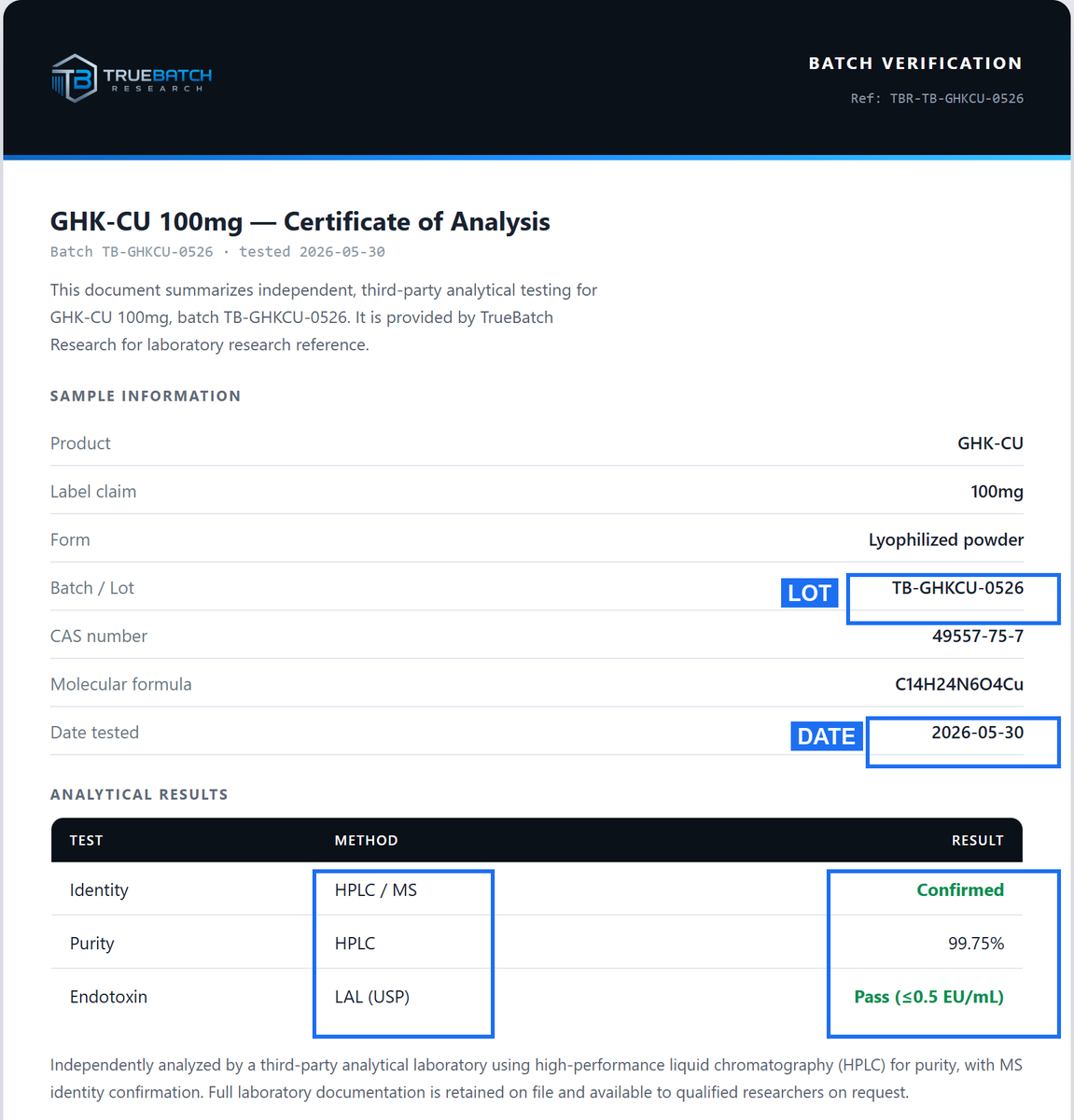
Cover the purity line. Can you still read the rest?
This is one of our lot reports: GHK-Cu, lot TB-GHKCU-0526, HPLC and MS, tested 2026-05-30, endotoxin pass.
Lot, method, date first. The number last: 99.75%.
Research use only. Not for human or animal use.
Pretty vial. Now read the label.
Brand mark, mass, the research-use line. The render stops there.
A real label adds compound name, lot code, and CAS number, so sheet and vial match.
Lot or CAS: which do you check first?
Research use only. Not for human or animal use.
Endotoxin: the sheet line nobody photographs.
TB-500 on sand. Lot TB-TB500-0726, 43 residues: 99.43% purity, dated 2026-07-24, endotoxin at or under 0.05 EU/mL, beside purity.
Purity or endotoxin: which do you read second?
Research use only. Not for human or animal use.
A batch number you have to ask for is not public.
A lot code ties one vial to one sheet, one lab, one date.
Kept in a vendor inbox, nobody can check it against a label.
Printed on both label and sheet, anyone can match the two.
Which do you match first, label or sheet?
The label says 99%. The sheet says 99.43%.
A label rounds down. A COA carries the decimal and the lot.
TB-500 lot TB-TB500-0726, 99.43%, 2026-07-24, endotoxin 0.05 EU/mL or under.
Which do you read first, label or sheet?
Research use only. Not for human or animal use.
Common mistake: 50mg on a vial is not 50mg of peptide.
Epithalon on sand, lot TB-EPI-0626. 50mg is gross fill; counterion and water count too. A COA states net peptide content on its own line.
Does yours, or only purity?
Research use only. Not for human or animal use.
Skip the big peak on a chromatogram. Look beside it.
Purity is area percent: main peak over everything integrated.
The small shoulders next to it decide that number.
Left uncounted, the headline number is soft.
What do you read first, the peaks or the baseline?
Epithalon is a tetrapeptide: Ala-Glu-Asp-Gly, four residues.
Short still gets both checks, HPLC and mass.
Lot TB-EPI-0626, the 50mg vial on screen: 99.49%, tested 2026-06-05.
Four residues: skip the mass check, or run it?
Research use only. Not for human or animal use.
A sunset changes nothing about what is in the vial.
The label reads oxytocin acetate, 10 mg, lyophilized powder. The record behind it still has to name lab, lot and method.
Which do you read first, label or record?
Research use only. Not for human or animal use.
A reference standard answers identity, not purity.
Area percent on the HPLC trace says how clean the peak is.
Matching it to a known standard says it is the right peptide.
The wrong peptide can still show one clean peak.
Does the COA show identity, or only a number?
Four fields make a label. This one carries two.
PT-141, 10mg. No lot, no CAS.
A cyclic heptapeptide's sheet adds both: CAS 1607799-13-2, lot TB-PT141-0826, 2026-08-21, 99.74% by HPLC.
Lot or CAS: which do you match first?
Research use only. Not for human or animal use.
Sand, sunset, a vial with a familiar name.
None of it is data. Semax lot TB-SEMAX-0526 tested 99.75% purity. That covers the vial, not the study: question, model, controls, limits.
COA or design, which do you read first?
Research use only. Not for human or animal use.
Vetting a peptide supplier takes one email, not a review site.
Ask which lab ran the COA and the report number. Then ask that lab if the number is real.
Few COAs get checked at the source. Fakes fail there fast.
Lab confirmation or lot match: which do you run first?
A COA has a date. Read it before the percent.
It describes one lot on one day, not the vial forever.
Selank on this beach: lot TB-SELANK-0626, 99.33%, tested 2026-06-05.
How old can a report be before you ask for a retest?
Research use only. Not for human or animal use.
Endotoxin is a limit test, not a purity number.
LAL reads EU/mL against a ceiling. Under it: pass.
The sheet: Tesamorelin lot TB-TESA-0426, 99.81%, endotoxin pass.
Pass alone or the EU/mL figure: which goes on the sheet?
Research use only. Not for human or animal use.
Bacteriostatic is not sterile. Different claim, different test.
Bacteriostatic water is sterile water plus 0.9% benzyl alcohol.
Sterile: nothing living in it at sealing.
Bacteriostatic: the alcohol stops bacteria multiplying after the seal breaks. Stops, does not kill.
Cover the 99% with your thumb. What is left?
Name, 10 mg, the research-use line. No lot code.
A lot code ties vial to sheet: BPC-157 lot TB-BPC-0426, tested 2026-04-20.
Purity last. Lot or date: which do you check first?
Research use only. Not for human or animal use.
NAD+ is not a peptide. Same two tests apply.
1000mg vial on screen. Lot TB-NAD-0626: 99.98% by HPLC, 2026-06-05.
Percent is one peak. Identity is that peak matching a reference standard.
Percent or identity: which first?
Research use only. Not for human or animal use.
Lyophilized means freeze-dried. Here is why.
In water, peptide bonds hydrolyze and residues oxidize. Freeze-drying sublimates the water under vacuum and leaves a dry cake with little left to react.
A collapsed or shrunken cake is a storage flag, not cosmetics.
Common mistake: NAD+ is not a peptide.
Dinucleotide coenzyme. Vial on the sand still gets a lot sheet.
TB-NAD-0626, 1000mg, HPLC 99.98%, endotoxin pass, 2026-06-05.
Non-peptide: purity line or endotoxin line first?
Research use only. Not for human or animal use.
Tesamorelin on the sand. A percent cannot see its cap.
44-residue GHRH analogue, N-terminal trans-3-hexenoyl. LC-MS sees the cap.
Lot TB-TESA-0426, CAS 901758-09-6, 99.81%, 2026-04-27.
Does your COA list observed mass?
Research use only. Not for human or animal use.