The grave of Polish-Belarusian volunteer fighter Przemysław Rasiewicz-Kuczyński, call sign “Kordian”, who was killed defending Ukraine against Russia.
Przemysław Rasiewicz-Kuczyński was born in the Polish city of Gdynia. He was actively involved in volunteer and social work.
Having Belarusian roots, he considered Belarus his second homeland, spoke fluent Belarusian, and had a deep interest in Belarusian history and culture.
For some time, he volunteered in the Belarusian city of Hrodna, but left the country after the start of political repressions.
Following Russia’s full-scale invasion of Ukraine, he immediately decided to take up arms and joined the Belarusian volunteer unit, the Kastuś Kalinoŭski Regiment.
During his service, he took part in some of the fiercest battles of the war, including Bakhmut, Orikhiv, Kharkiv, and Chasiv Yar.
He was killed during a combat mission on August 6, 2024.
According to his wish, he was buried in Lviv.
Today, the flags of Belarus, Poland, and Ukraine are flying over his grave.
Eternal memory.
Heroes never die.
⚪️🔴⚪️ 🇵🇱🇺🇦
👅Очередной языковой скандал. В киевском кафе девушка устроила истерику из-за того, что за соседним столиком парни говорили между собой на русском языке.
По ее словам, в Украине «все плохо», потому что парни говорят на русском.
«Если бы вы не говорили по-русски – было бы все нормально», – набросилась девушка на парней.
W rocznicę uchwalenia Zaręczenia Wzajemnego Obojga Narodów prezydenci Polski @NawrockiKn i Litwy @GitanasNauseda spotkali się przy oryginalnym zbiorze uchwał i konstytucji Sejmu Czteroletniego, zawierającym Konstytucję 3 Maja i Zaręczenie Wzajemne Obojga Narodów.
Slavs and the "Illyrian" identity 🇷🇸🇭🇷🇸🇮
Not many people know this: the word "Illyrian" has been repeatedly claimed and revived by Slavic scholars and movements throughout history, often used as a straight synonym for "Slav," by foreign historians.
It starts early. From the 1500s-1700s, Dalmatian humanists wrote grammars and dictionaries of the local South Slavic vernacular and simply referred to the language "Illyrian."
In 1700, Croatian historian Pavao Ritter Vitezović published "Croatia Rediviva," advancing the idea of South Slavic-Illyrian continuity, a work later cited as a direct inspiration for the 19th-century revival.
Croatian scholar Josip Kušević went further, theorizing South Slavs were the indigenous descendants of the ancient Illyrians and naming their shared tongue "idioma Croatico-Slavico-Illyricum", the Croatian-Slavic-Illyrian language.
The name kept getting institutionalized too: Napoleon's "Illyrian Provinces" (1809–1813) and the Habsburgs' "Kingdom of Illyria" (to 1849) both covered Slavic Adriatic lands, Croatia, Dalmatia, Istria, Carniola - reinforcing "Illyrian" as a label for Slavs.
All of this fed into the big one: the Illyrian movement of the 1830s-40s, led by Ljudevit Gaj and Janko Drašković. They revived "Illyrian" as a unifying name for all South Slavs, Croats, Serbs, Slovenes, Bosnians under Habsburg rule.
Gaj's 1833 song "Još Hrvatska ni propala" is still remembered today as the anthem of the Illyrian movement, a snapshot of how central the "Illyrian" identity was to the project.
It didn't last, though. In January 1843, Emperor Ferdinand banned official use of the name amid political unrest, and by 1848 the movement had collapsed, its unifying idea surviving only by being rebranded as Yugoslavism.
So, from 16th-century Dalmatian grammarians to Vitezović, Kušević, Napoleon's administrators, and finally Gaj's 1830s movement, Slavs kept picking "Illyrian" back up as a name for themselves, generation after generation, until the 1830s revival made it a real political project.
So why didn't it come back a third time? By the mid-to-late 1800s, Slavic linguistics had shown the "Illyrian" theory to be shallow. Illyrism fed directly into Yugoslavism, but not straight into pan-Slavism. After the original movement collapsed in 1848–49, a wave of "neo-Illyrism" in the 1890s-1900s, involving Croats, Serbs, and Slovenes, revived its core idea of South Slavic unity, and that current fed directly into the Yugoslav movement, culminating in the 1918 Kingdom of Serbs, Croats and Slovenes.
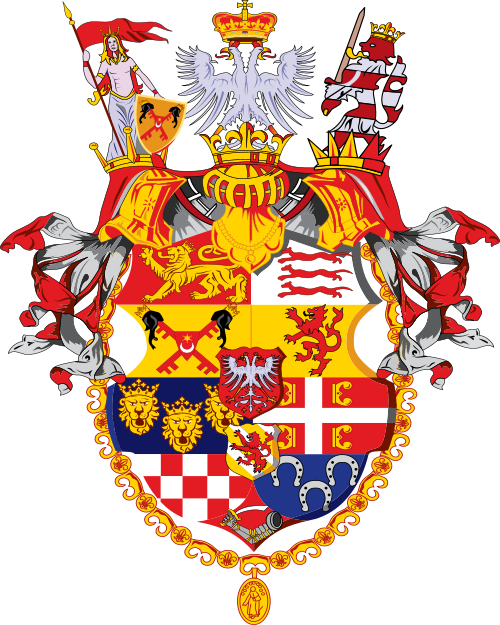
Important to mention, even the visual symbols of "Illyrian" identity are Slavic. The so-called "Illyrian Armorials", coats of arms endlessly reprinted as badges of the movement, were compiled by South Slavic figures like Petar Ohmučević of Ragusa, and catalog Serbian, Bosnian, and Dalmatian noble houses (one edition is even dedicated to Serbian King Stefan Dušan).
Slavs were the ones that throughout history had attempted to revive the Illyrian identity, before they ultimately abandoned it. Today the "Illyrian" name is used and paraded by the Albanians. No verified lineage from the ancient Illyrians to modern Albanians has been established, and most scholars treat the nationalist versions of that claim as unpersuasive.
@IlyaShvydkov23@Gengarovsky@narodowo13772@incelpisowski W projekcie budżetu Federacji Rosyjskiej na 2027 rok nakłady na obronę narodową zostaną zwiększone o około 27%, a ich redukcje i cięcia finansowe to 😏:
– Gospodarka narodowa spadek o 7,4%.
– Polityka społeczna spadek o 7%.
– Ochrona zdrowia spadek o 6,8%.
– Edukacja spadek o 6%.
A m angry gay guy loses his cool and starts cursing the migrants who have vandalized and looted Milan.
He screams that they must all be deported and that he wants his city back, a city which he says was built by his grandfather & great-grandfather
People applaud him
Rumunia jest drugim po Polsce największym eksporterem okien i drzwi z PVC w UE oraz trzecim na świecie pod względem wolumenu.
Polska jest globalnym liderem
Eksport w 2025 r.:
🇵🇱 391,4 tyś. ton - 2,23 mld 💲
🇨🇳 321,9 tyś. ton - 626 mln 💲
🇷🇴 75,3 tyś. ton - 378 mln 💲