Been bidding into $CARDS (Collector Crypt) and something stood out that I barely see anyone mentioning...It’s not just another tokenized card play or Gacha hype. The Gacha system is actually built with positive expected value for the user. On average you pull more value than you spend. Plus they offer an 85% instant buyback guarantee on whatever you get.
2/ Most crypto packs/games are designed to be -EV (the house wins). Here it’s the opposite because they buy real graded cards wholesale (cheap through dealer networks) and structure the packs so the math works in your favor on average.
3/ This changes everything. It pulls in actual collectors and traders who see real economic sense in participating, not just degens hoping for a quick flip. The thrill of opening packs + the chance to come out ahead = way stickier usage than pure speculation plays.
4/ And because 100% of net CARDS token sale proceeds go straight into buying more physical cards for the treasury, token demand directly fuels more inventory and more Gacha volume. Real flywheel, not just vibes @Collector_Crypt
We are pleased to introduce the Nearly Builders Program. Teams with a live product on @NEARProtocol can now apply to work directly with the https://t.co/SOCLbomlzl team on their token launch.
Apply: https://t.co/0LKwCvR4KH
NATION Swarm V2 launches tomorrow.
Every user gets free usage to start.
One prompt can spin up an AI team of specialist agents that research, build, code, market and work together inside the same workspace.
We’re also launching at up to 90% cheaper than our competitors, with infrastructure built to support 1,000+ Swarm agents.
Want early access before launch?
Comment “NATION” below.
This is absolute insanity. onchain TCGs are heating up again, and like never before, as it’s also the marketplaces that are picking up traction in a big way.
First @Collector_Crypt broke the onchain record with a $600k Charizard sale.
Then they immediately topped it, with a $64k Lugia sale and yet another record Charizard sale at $825k.
and now let this sink in:
Just a few hours later, @Beezie didn't just break the onchain record, but the world record.
$1M for a 1st edition Charizard from 1999.
Everything fully transparent onchain, ridiculously low fees, and settled instantly without needing to trust a middleman.
Congrats to the chad seller @dcfgod.
I want you to realize that this has always been the bull case for these platforms. the gachas were just the gamified way to attract collectors, and now they're realizing how vastly superior these marketplaces are to eBay, Goldin and co.
Soon there will be billions settled on these marketplaces.
How to launch on c8ntinuum Arena: the Social Launch, explained.
Not every token deserves a market. On c8ntinuum Arena, you can prove demand first, then earn a share of the $20,000,000 pool.
1. Launch
Push the launch button. It's free; supply is fixed at 888,888,888, and you set up your project.
2. Build Demand
Supporters join, complete quests, and earn tokens as demand builds.
3. Unlock Trading
Open trading once you have demand. Social verdict first.
4. Enter the Arena
The c8ntinuum Foundation backs the projects that prove demand from the pool, paid in $CTM.
Launch or join a crew: https://t.co/n2bG8zEBfg
The Network Score is live.
Claim your Legacy p8ints. Start the Presence streak. Clear the Social quests.
Every contribution earns p8ints and pushes you up the leaderboard.
Earn rewards: https://t.co/mFUDJE5MKe
The 2026 crypto market doesn’t look much like the one people were still talking about two years ago.
We’ve moved past the pure speculation cycles that defined the early 2020s. What’s taking shape now is more structural. Crypto is turning into actual infrastructure that large institutions and even governments are starting to treat as permanent. Capital is rotating in ways that feel bigger and more deliberate than the usual cycles. If you’re still looking at everything through a 2024 lens, a lot of what’s happening right now is easy to miss.
Here’s how it breaks down.
1. The institutional side has settled into a new phase:
The regulatory arguments from a couple years ago are mostly finished. The frameworks are in place. The question isn’t “can institutions even touch this?” anymore. It’s “how much are they actually putting on-chain?” We’ve gone past Bitcoin ETFs. Tokenization is moving into sovereign debt and real estate. The SEC’s Phase 3 digital asset plans made the direction pretty clear: traditional finance isn’t really competing with crypto at this point. Parts of it are being rebuilt on top of it. The projects that matter most in this phase are the ones quietly providing the plumbing for that shift.
2. The AI side is changing how markets actually function:
A lot of the edge that used to live in group chats or manual research is now coming from autonomous agents that can execute on-chain. Tools like Grok have become more capable as predictive systems that work directly with the chain. The old information gap has gotten a lot smaller. People are less the main participants and more the ones designing the systems the agents run on. If a strategy doesn’t account for agent-to-agent activity or DePIN in some way, it’s up against systems that don’t get tired or emotional. The practical advantage right now is using these tools to notice liquidity shifts before they fully show up in the order books.
3. What this means going forward:
The market feels higher-signal and more focused on infrastructure and real execution. The easy retail meme phase has largely given way to something more serious. The interesting part sits where the advances in AI meet the large institutional capital that’s now moving on-chain. Understanding both sides is what makes the current environment navigable.
The broader cycle is still early. The structural pieces are continuing to fall into place.
That’s roughly where things stand in 2026.
Tokenized asset growth is exploding.
Total holder count of onchain tokenized equities has now surged to a record 759,000.
This metric is up +92% over the last 30 days and +522% year-to-date.
The growth continues to be fueled by demand to trade tokenized equities outside of regular market hours.
Amid this trend, the world's largest onchain platform, Jupiter, has reported +360% YTD growth in off-market monthly trading volume.
Chip and memory stocks have become the most popular tokenized assets in the onchain market.
We expect 1+ million tokenized equity holders by year-end.
Another week, another trusted component failed.
A signer set, an oracle, a verifier contract. It doesn't matter which. When trust is the security model, one bad input is enough.
The industry's fix is swapping one middleman for another. Ours is building with none in the trust path.
Don't trust, verify.
One of the things we've learned from our Robinhood Chain mainnet launch is that ecosystems can grow incredibly quickly when there is exceptional engineering behind them
Huge credit to the Robinhood engineering team, and congrats to our friends and partners @arbitrum.
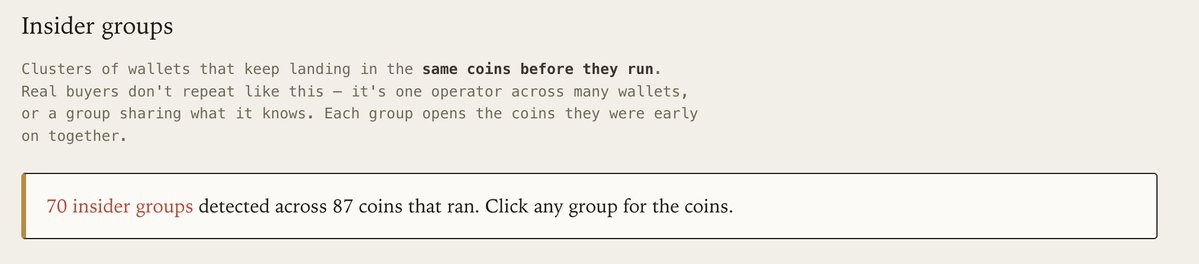
More than 8000 Robinhood runners have been analyzed
I pulled their entire transaction history to find patterns in wallets that can be classified as Cabal, insiders.
So far we have identified 70 insider groups.
Average entry ranging from 5k - 20k for coins that ran to multi millions.
Same wallets, same entry patterns, different coins.
The entire build will be live on https://t.co/RvwoR7rtUY in couple of hours!
Retail investor sentiment is very bullish:
44.9% of individual investors expressed bullish sentiment over the next 6 months in the AAII survey for the week ending June 25th, the 2nd-highest reading since mid-January.
This percentage has surged +14.5 points over the last 2 weeks, the largest 2-week increase since May 2025.
This is also the 3rd-biggest increase since November 2023.
Meanwhile, just 36.1% of retail investors were bearish in the week ending June 25th, the lowest reading since mid-May.
As a result, the bull-bear spread is up to +8.8 percentage points, turning positive for the first time in 6 weeks.
Retail investors are turning aggressively bullish again.
They are sourcing 2M a DAY to continue on replenishing the DEMAND.
Though $CARDS does not necessarily portray any EQUITY to the holder of the coin (or maybe one day? who knows! IDK) it is an "investment" on betting on the team's foundation to continue to grow in their sector.
Leading #1 on-chain TCG surpassing Courtyard and Phygitals, continuing to meet restock demands, buying back at 85% (90~93% for the $2500 GACHA, my personal fave atm)
Revenue =/ buying back power/demands for only token enjoyorrs. They've set their foundation almost a year ago, and it has continued to only grow at an insane rate.
Let @Collector_Crypt cook.
Why this could be a solid long-term hold
1/ Quick long-term take on $CARDS The traditional trading card market (Pokémon, sports, TCGs) is huge but super broken: high fees (eBay takes 13%+), slow settlements, shipping risks, fakes, and it’s hard to trade globally without hassle.
2/ Collector Crypt fixes the core problems. Send in your graded card → it gets vaulted, insured, authenticated → you get a redeemable pNFT on Solana. Trade it 24/7 instantly for basically nothing in fees. Want the physical back? Burn the NFT and they ship it.
3/ Low 2% fees on their marketplace vs traditional platforms. Global access. No counterfeits or chargebacks. Plus you can even use the pNFTs as collateral for loans later (DeFi for your collection without selling your grails).
4/ The Gacha keeps bringing fresh users and volume ($89M+ already). More people using it = more cards get tokenized = better liquidity = stronger ecosystem. Classic network effect.
5/ Token has real utility powering the Gacha, buybacks, and platform ops. Current market cap is still tiny relative to even a small slice of the overall collectibles space. If this becomes the go-to on-chain hub for trading cards, the upside compounds.
6/ They’ve actually shipped product and have real usage, not just promises. In a maturing RWA + Solana narrative, this feels like one of the cleaner bridges between real-world hobbies and crypto.
7/ Long term I see it as potentially becoming the “liquid on-chain version” of the trading card market. NFA, DYOR, always do your own research. But the product-market fit here feels different.
Been bidding into $CARDS (Collector Crypt) and something stood out that I barely see anyone mentioning...It’s not just another tokenized card play or Gacha hype. The Gacha system is actually built with positive expected value for the user. On average you pull more value than you spend. Plus they offer an 85% instant buyback guarantee on whatever you get.
2/ Most crypto packs/games are designed to be -EV (the house wins). Here it’s the opposite because they buy real graded cards wholesale (cheap through dealer networks) and structure the packs so the math works in your favor on average.
3/ This changes everything. It pulls in actual collectors and traders who see real economic sense in participating, not just degens hoping for a quick flip. The thrill of opening packs + the chance to come out ahead = way stickier usage than pure speculation plays.
4/ And because 100% of net CARDS token sale proceeds go straight into buying more physical cards for the treasury, token demand directly fuels more inventory and more Gacha volume. Real flywheel, not just vibes @Collector_Crypt