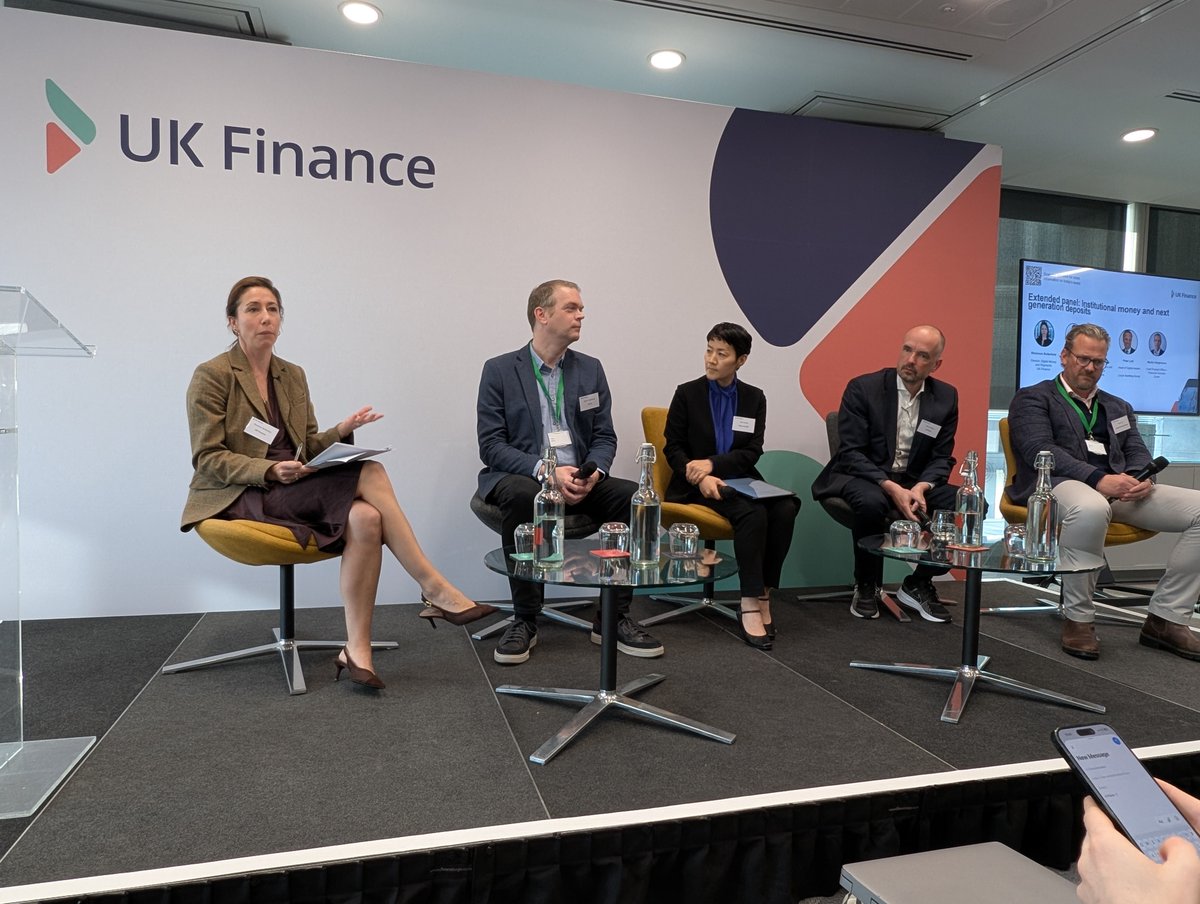
Yesterday at @UKFtweets's Tokenised Markets and Money Conference 2026, our Chief Product Officer, Martin Hargreaves, joined a panel exploring how #tokeniseddeposit initiatives from the UK, Japan, the US and Germany can connect across borders.
“Connecting tokenised deposit networks across borders comes down to standards, rulebooks and overlapping participation to create commercial corridors. It’s a more complex journey than #stablecoins, but tokenised deposits bring advantages stablecoins don’t, so it’s worth the work,” said Martin.
Thanks to @UKFtweets for hosting. Look out for our key takeaways article next week.
#DigitalAssets #ProgrammableMoney
Tokenised assets are ready to move. If the cash leg doesn’t move with them, the risk stays.
Our recent paper with Murex shows how #programmablesettlement synchronises cash and asset across ledgers, while teams keep working in MX.3.
Read the paper here: https://t.co/We0Jbjm8mC
#Tokenisation
Tokenised deposits have moved from pilots to production planning, and regions are racing to get there first.
At @Sibos Miami 2026, our Founder and CEO, @gverdian, moderated a panel with @LloydsBank, @UKFtweets, @TCHtweets, @TDBank_US and @smbc_group.
The discussion covered where #tokeniseddeposits go first, what makes the commercial case, and why #interoperability will shape the next five years.
Read the full article here: https://t.co/MdsPGCnje6
#ProgrammableMoney #Sibos2026
Every network keeps its own books. Moving value between them safely takes a common language.
SATP is that standard, being written at the IETF, with Quant's Martin Hargreaves as first author.
I read the drafts and animated how it works 🧵👇
$QNT
$QNT more evidence! Look who sponsors this event in Japan…. Programmable yen is incoming!! Along with its Japanese partner Dentsu soken !
https://t.co/gg4SC7jBQM
Thanks for sharing @philipp_1981
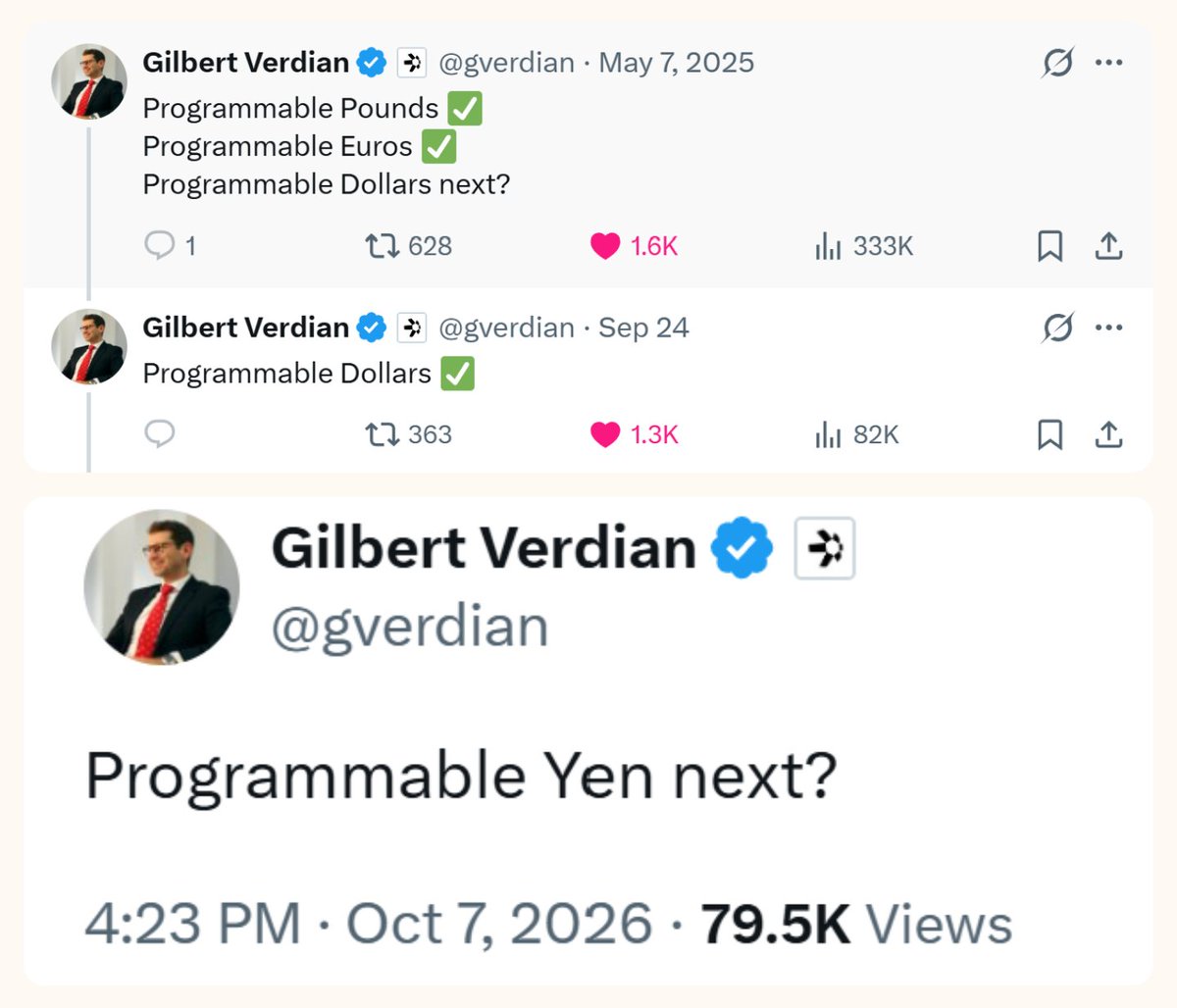
If @gverdian drops “Programmable Yen next?”, best believe the work is already deep in progress.
Quant already has Japan ties via Dentsu Soken on tokenised deposits and programmable settlement, linked to The Bank of Japan!
$QNT 💎
I’ve been trying to tell everyone that everyone for over a year now that Quant is going to provide the program ability and interoperability for all of the money(all the CBDC’s) because the Regulated Liability Network use to be called the Regulated Internet of Value so the unified ledger and RLN are just replacement words for the Internet of Value(the XRP Ledger). The XRP Ledger is where over 95% of the CBDC’s are being built and Quant provides the interoperability, programability and custom API for them. 👇$QNT
Programmable Yen next suddenly makes a lot more sense. 🇯🇵 $qnt
Project Agorá already has a Japan ledger connected to BOJ-NET, with tokenized JPY deposits/reserves and real-value testing involving Mizuho, MUFG and SMBC.
Add that with Quant recently partnering with Dentsu Soken to build programmable settlement + tokenized deposit infrastructure in Japan. +Dentsu already runs BOJ-NET settlement tech.
And SMBC just sat with Gilbert talking interoperable tokenized deposits.
Agora in the bagora?
After establishing a strong presence across the US, UK, and European markets, Quant CEO G. Verdian now appears to be hinting that Japan could be next.
For those new to Quant: I’ve followed Verdian for years, and I have yet to see him hint at a partnership that wasn’t eventually made official.
“Programmable Yen next?” isn’t a rhetorical question.
This isn’t some spontaneous pivot towards opportunity in Japan.
$QNT has spent years laying this groundwork.
And Gilbert has a habit of leaving breadcrumbs that lead somewhere real.
Rewind to 2017.
Japan was already in the room at the beginning of ISO/TC 307, the global blockchain standards work Gilbert helped create.
The group’s second plenary was held in Tokyo, with major Japanese technology companies including NTT and NTT DATA participating in Japan’s domestic standards committee.
Gilbert was chronicling it in real time:
https://t.co/WCrbXEQ8cc
https://t.co/xoXBibKCu2
Quant then filed for two patents in Japan, the first in 2018 and the second in 2021.
Both have since been granted:
➡️“Blockchain Communication and Ordering” Submitted: December 1, 2017 Granted in Japan: May 12, 2023
https://t.co/kGQKVVuMTy
➡️ “Secure Multi-Distributed Ledger System” Submitted: November 20, 2020 Granted in Japan: January 14, 2026 https://t.co/S8kGIv3Hdp
All along, Quant was building an entirely separate track record with central banks.
In 2023, Quant joined the vendor team for Project Rosalind, led by the Bank for International Settlements.
Quant provided the underlying blockchain infrastructure, secure smart contracts, and interoperability between central bank ledgers.
Then in 2024, the BIS launched Project Agorá.
And this time, the Bank of Japan was directly involved.
By 2026, it had moved beyond theory: Agorá conducted real-value testing involving JPY (with the Bank of Japan participating) all using a shared programmable platform.
Considering Quant has already worked directly with the BIS on this exact class of problem, the overlap is impossible to ignore:
• Central bank money
• Tokenized deposits
• Programmability
• Interoperability
• Legacy financial systems
As the community likes to say, #AgoraInTheBagora.
On January 14, 2026, $QNT announced their strategic partnership with Dentsu Soken, specifically to bring tokenized deposits and programmable money to major Japanese financial institutions.
(Fun fact, this was the same day one of Quant’s Japanese patents was awarded.)
Dentsu Soken is not some small player — they’ve spent decades building mission-critical systems for a variety of Japanese banks.
Their StreamR settlement platform is also compatible with BOJ-NET, the Bank of Japan’s real-time gross settlement system, and Dentsu explicitly said it would use that infrastructure to help implement programmable payments with Quant.
A month after the partnership announcement, Gilbert was in Tokyo, “meeting clients and regulators” and speaking about tokenized deposits.
Quant and Dentsu held a joint session at GFTN Forum Japan titled: “The Frontline of Programmable Payments (Tokenized Deposits).”
Then today, we get the tweet.
Keep in mind Gilbert had tweeted “Programmable Dollars next?” in May 2025, only to see it come to fruition 16 months via The Clearing House.
The fact is $QNT has been in Japan’s standards orbit since the earliest days of the company.
They’ve accumulated Japanese interoperability patents.
They’ve partnered with institutions embedded in Japanese banking and connected to BOJ-NET.
They’ve worked directly with the Bank for International Settlements on programmable money.
They spent a week in Tokyo this year meeting regulators around tokenized deposits.
So when you know the history, the seemingly harmless question about programmable yen lands completely differently.
This story did not start with a tweet.
But it will likely end with $QNT at the center of Japanese finance.
Looks like $QNT have Japan in the bag
Last time @gverdian teased Programmable Dollars through $QNT infrastructure..
They announced they're working directly with The Clearing House in the US
When Gilbert talks about specific institutions, countries or banks.. its nearly always because there is substance
So.. don't be surprised if an announcement follows with BOJ-NET or Zengin 🇯🇵
$QNT
While all eyes are on the US and UK financial rails, $QNT is quietly wiring the orchestration layer for Japan’s massive banking system.
Through Dentsu Soken, tokenised deposits and programmable settlement link directly to BOJ-NET.
The silent third giant. 🇯🇵
$QNT BB tightening substantially here. This is a very nice bull pennant ready for breakout. Can obviously go either way, but momentum has indicated upward trend to date. PT $1K in the next 9-12 months. Near term goal is a break of ATH. I like $480-500, but closest breakout zone to the $380 region imo. A lot of news and a lot of institutional buy in for QNT. I suspect something is brewing in coordination with $AMZN, but obviously will see. This is one of my favorite cryptos for a reason.
NFA as always.