Q4 Inventory Was Ready. Then One Oversized Carton Turned 4,800 Units Into a Margin Problem.
An artificial Christmas tree weighed only 8.6 kg.
So why was the carrier billing the seller for 31.6 kg? 📦
A Shopify holiday decor brand had prepared 4,800 artificial Christmas trees for Q4.
The product cost, selling price, and sales forecast all looked healthy. But when the shipping estimate arrived, the projected margin quickly started to disappear.
The product wasn't too heavy.
The packaging was too large.
The factory had used nearly identical cartons for the 5 ft, 6 ft, and 7 ft models. Branch sections weren't folded efficiently, and the metal stands and support poles weren't placed inside the unused spaces.
The 122 x 37 x 35 cm carton created approximately 31.6 kg of volumetric weight for a product that actually weighed around 8.6 kg.
In other words, the seller was paying to ship empty space with every order. 💸
Before the Q4 rush, TrustedFulfill worked with the supplier to measure each SKU and optimize the carton size, branch arrangement, accessory placement, and outer packaging.
After optimization:
📉 Package volume decreased by approximately 41%
📉 Volumetric weight dropped from 31.6 kg to 18.8 kg
📉 Estimated last-mile shipping cost decreased by 23% per order
This is where TrustedFulfill goes beyond basic warehousing.
A traditional fulfillment process often begins after inventory reaches the warehouse.
TrustedFulfill helps move cost and risk control upstream to the supplier and pre-shipment stages.
🔍 Identify product and packaging issues before bulk inventory ships
📦 Optimize packaging based on SKU size and volumetric weight
🚚 Match shipping channels to destination, cost, and delivery speed
🔄 Automatically sync Shopify orders and inventory
📊 Provide real-time inventory visibility
⚡ Process orders for fulfillment within 24 hours
🌍 Support global delivery to more than 200 countries and regions
From supplier coordination and quality inspection to packaging, warehousing, fulfillment, and global shipping, brands can manage the process through one fulfillment partner.
The real Q4 profit gap isn't created by product cost alone.
It is also determined by how well you control dimensional weight, repacking, inventory errors, and dispatch speed before peak season begins.
Don't wait until orders start piling up to discover that your packaging is consuming your margin.
👉 Register with TrustedFulfill and prepare your Q4 packaging and global fulfillment plan: https://t.co/Ylvq1J2ruw
#Q4Fulfillment #DimensionalWeight #ShopifyFulfillment #TrustedFulfill
📦 **You paid to win the subscriber. Can you afford to keep the next delivery on schedule?**
For a Shopify subscription brand, the next renewal is where the acquisition plan starts being tested.
The customer expects another box.
Your warehouse needs available stock.
Your supplier needs payment.
But the cash you’re counting on from that renewal hasn’t arrived yet.
Now imagine new orders are consuming inventory reserved for subscribers. Replenishment is late. An existing customer runs out and buys a replacement elsewhere.
You may have lost more than one shipment. You may have lost the future orders that were supposed to recover the cost of acquiring that customer.
🚚 This is why fulfillment belongs in the growth conversation.
If customers are concentrated in one country, local fulfillment may improve delivery consistency. Backup stock in China may help during a local stockout—but only with workable transit times, costs, and clear updates to customers.
Delivery problems can reach your bank balance, too. Late parcels, missing tracking, and unclear charges can generate disputes and chargebacks, potentially delaying access to payouts.
And reliable shipping won’t rescue a product people don’t want to keep using.
Use your own product through several normal subscription cycles. Does it still deliver what the ad promised? Would you willingly pay for the next box?
💸 Then look at what has to be paid before the next renewal lands.
A lower factory price may still leave too much cash tied up upfront. With trusted suppliers, discuss staged payments, agreed factory-held stock, and split deliveries.
If first-order losses stretch your cash too far, revisit costs and pricing to narrow that gap.
**The question before your next ad-budget increase: how much acquisition spend have actual renewals recovered—and what is preventing the rest from coming back?**
A cancellation, a skipped order, a failed payment, and a stockout need different responses.
👉 Read the full guide: https://t.co/k8JQJLWnYz
for a worked payback example, the records to check when renewals fall short, and a practical checklist to review before increasing ad spend.
#Shopify #SubscriptionBusiness
@GoodsCommand@GoodsCommand That’s a useful way to pressure-test a Black Friday offer. Factoring in expected returns and the gift cost upfront gives sellers a clearer view of the margin they can actually work with before committing to the promotion.
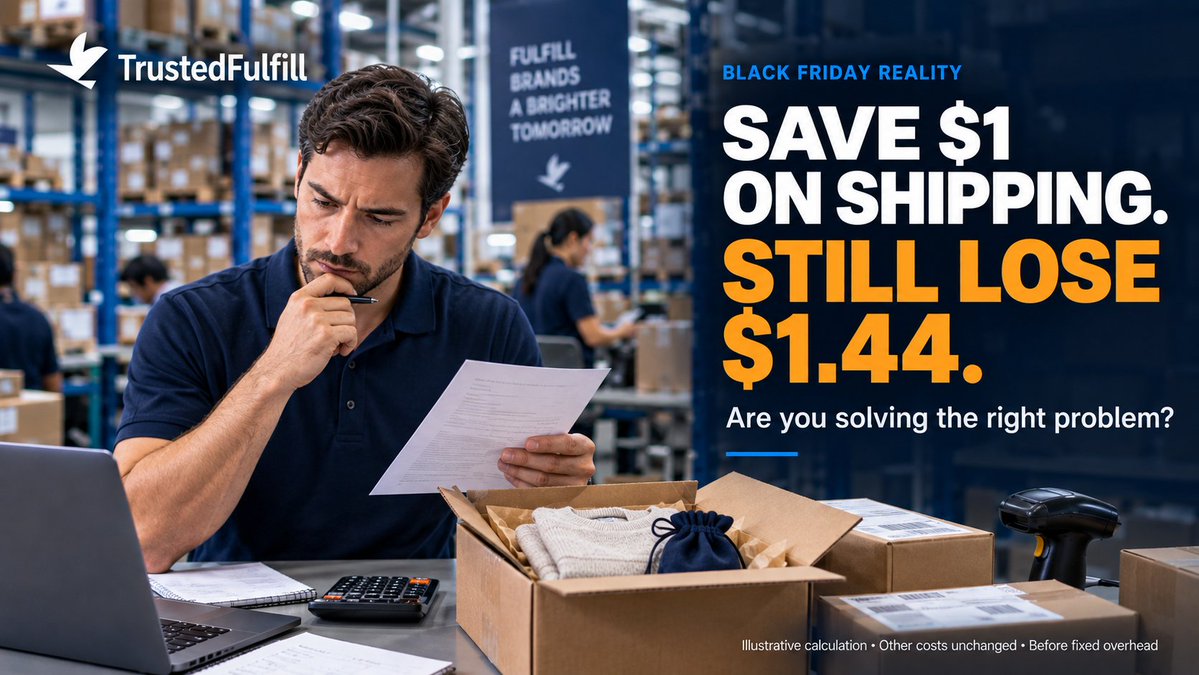
📉 You negotiated cheaper shipping. Your Black Friday order still loses money.
We ran the numbers on this Shopify offer:
• 20% off a $60 product
• Free shipping
• A gift that costs $4
Revenue: $48.
After product, fulfillment, payment, marketing, and expected post-purchase costs: −$2.44.
Fixed overhead hasn’t been covered yet.
Save $1 on shipping?
You’re still losing $1.44.
🔍 A better shipping rate can help. It may not be enough to make the offer work.
In this breakdown, adding the gift increases total order costs by $7.60 compared with the same promotion without it.
Budget only for the gift’s $4 purchase price, and you miss several costs that change with the parcel.
Would a smaller discount leave enough?
How much could you afford to spend on shipping and still hit your target?
We compared three carts and calculated the results of different adjustments.
👉 Before increasing ad spend, see whether you need to change the shipping—or the offer:
https://t.co/vXzmXwJBqx
#Shopify #BlackFriday #Trustedfulfill
@hollowpointio Agreed. Those replacement, repacking, and reshipping costs all come out of the margin. Getting lot matching and vial checks right before dispatch helps protect both profitability and the customer experience.
The customer has paid. Why is the order still costing you money? 📦
Every replacement shipment brings another product cost, another packing job, and another shipping charge.
One peptide brand selling on Shopify reached $600,000 in Q3 sales so far—and spent an additional $50,000 on replacement products, repacking, and reshipping.
When the brand came to TrustedFulfill, we reviewed the affected orders to find out where those costs were coming from.
1️⃣ COA requests were taking too long to resolve.
Support could find the order, but couldn’t easily identify which batch had shipped. Staff had to go back to the warehouse and supplier to locate the matching Certificate of Analysis.
TrustedFulfill checked products, lot numbers, and brand-provided COAs at receiving, then linked the actual shipped batch to each order.
After just over a month, COA lookup time fell from 15 minutes to 3 minutes.
2️⃣ Similar-looking vials needed more specific checks.
TrustedFulfill checked the product name, labeled amount, lot number, and vial count before packages were sealed.
The wrong-item shipment rate for the brand’s bestselling SKUs fell from 15% to 9%, with further improvement still needed.
3️⃣ Packaging needed a consistent process.
Individual vial protection and dividers followed the brand-approved specification. Labels and branded packaging were prepared in advance to reduce last-minute rework.
September’s replacement-shipment costs were $6,000 lower than in the comparable period in August. 📉
⏳ Before Q4 volume picks up, is your brand already spending extra on wrong items, damaged deliveries, or repeat shipments?
.
Click👉 https://t.co/QAADROzNgG
Tell us what you sell, your main shipping market, and the issue you encounter most often. Let’s discuss which inventory, picking, or packing steps are worth adjusting before peak season.
#Shopify #EcommerceFulfillment #Q4Planning #TrustedFulfill
@hollowpointio Exactly—the payback math depends on second orders actually going through. Skips, failed payments, and stockouts all affect that, so the retention assumptions deserve as much scrutiny as the acquisition cost.
“We break even on the second order.”
Of every 100 new Shopify subscribers, how many actually need to renew for that to be true? 🤔
That’s worth calculating before your next ad budget increase.
🧮 Here’s a hypothetical example:
Each first order loses $5 after acquisition, product, fulfillment, and transaction costs.
100 new customers = $500 to recover.
If each renewal contributes $15 after variable costs, at least 34 customers need to complete their second payment to recover those initial losses in cycle two.
That still leaves overhead to cover.
If your plan assumes payback by the second cycle, 34 renewals is the minimum under these assumptions.
If fewer customers renew, can your cash reserves support the longer wait?
Then investigate why the expected orders didn’t happen.
Cancellations, skipped deliveries, failed payments, and stockouts require different responses. More ads and another discount won’t automatically fix them.
Is your payback keeping pace with your ad spend?
Our guide includes a worked example and five checks covering renewals, delivery timing, and inventory readiness.
👇 Read it, run your own numbers, and identify what to investigate first:
Your Shopify Subscription Orders Are Growing. Where’s the Cash?
https://t.co/pneROTLEEH
#Shopify #SubscriptionBusiness #TrustedFulfill
@hollowpointio Good point. A quick troubleshooting step can help identify whether the issue is the camera, an accessory, or the setup—and get the customer the right fix without an unnecessary full-kit reship.
$80,000 in sales. $9,000 lost to after-sales issues. 💸
How much can a Shopify order keep costing you after it ships?
One AI solar camera brand increased sales by 400 kits in Q3. Support issues involving 100 kits followed.
Customers reported battery drain, installation difficulties, and recordings that didn’t match their expectations. Some asked for a replacement straight away.
But “the camera isn’t working” doesn’t tell you what needs replacing.
If the cause involves installation, connections, or settings, sending another complete camera can add hardware and shipping costs without resolving the complaint.
The brand manager reached out to us at TrustedFulfill to help get the process under control.
Together, we connected the pre-shipment checks with the after-sales process:
📦 Check the kit before dispatch.
We checked cameras, solar panels, cables, and mounting accessories against the brand’s requirements and carried out the agreed charging, power-on, and pairing checks. Exceptions went back to the brand or supplier for resolution.
📱 Include model-specific setup instructions.
The brand-approved guide and video link went into the package, giving customers and support staff a consistent troubleshooting reference.
🔧 Confirm the remedy before shipping again.
Support gathered the details. The brand or supplier determined the cause. We then shipped the specified part or replacement camera.
In under two months:
Replacement shipment rate: 40% → 10%.
After-sales costs reduced by $5,000.
For Q4, there’s more to prepare than sellable stock:
Who confirms a fault?
Which spare parts need to be available?
Who handles the replacement once it’s approved?
Those decisions affect how much margin remains after an order is resolved.
📦 Expecting more Q4 orders? Check your inventory, packaging, and after-sales arrangements before your next batch ships.
Click https://t.co/QQ10atlYjz
📩 DM “Q4” for our Q4 Fulfillment Checklist for Shopify Brands.
#Shopify #Q4Planning #TrustedFulfill
@IOR_USA Well put. Naming the IOR and clearly defining the forwarder’s scope in the contract help keep expectations aligned. Those roles should be clear before the shipment moves.
📦 “The last shipment cleared without a problem” isn’t enough to plan your next Q4 restock.
If your Shopify brand uses DDP to ship inventory into the U.S., there’s one question worth revisiting before dispatch:
🔎 Who is the Importer of Record for this shipment?
The forwarder you pay, the broker filing the entry, and the importer named on the paperwork may be different companies.
When inventory arrives on time, that distinction is easy to overlook. But an issue with importer registration, the customs bond, or the declaration can force a change to your shipping plans.
In Q4, those plans are often tied to promotions, ad spend, and customer orders—with less room for last-minute adjustments.
DDP hasn’t been abolished. As U.S. importer checks tighten, it’s worth looking beyond “duties paid” to understand who’s responsible and what documentation you can access.
📝 What should you ask your forwarder before the next shipment leaves? Our latest guide walks through the U.S. import changes and six pre-shipment checks, so you can see what’s confirmed—and what still needs an answer.
👇 Read it before your next peak-season shipment:
https://t.co/ui0uFOA69w
#Shopify #Q4Planning #DDPShipping
@IOR_USA Agreed. Past clearance doesn’t replace checks on the next shipment. Confirming the named IOR and verifying the declared product code and value before dispatch can help avoid preventable delays.
@hollowpointio Fair point—the full order economics have to work. Freight savings help, but product costs, fulfillment, payment fees, ad spend, and the gift’s added shipping cost all need to be accounted for before calling the offer profitable.
@hollowpointio That timing gap matters. Expected renewals need to be mapped against actual collection dates, inventory commitments, and shipping costs to see whether the next cycle is funded.
Your Q4 forecast includes subscription renewals. How certain is that revenue? 📊📦
One easy mistake in a Shopify subscription business:
Treating future renewals as revenue you’ve already earned.
The first-order discount, ad spend, and fulfillment costs are real. The repeat orders you expect to recover those costs may never arrive.
Some brands accept breaking even—or taking a small loss—on the first purchase because a customer who stays for six months can generate substantially more value.
But retention has to be earned, shipment after shipment.
Before you increase Q4 ad spend, check three things 👇
1️⃣ Is the product worth buying repeatedly?
The product needs to deliver on the promise that brought the customer in. And the experience needs to stay consistent across batches.
If people subscribe mainly for the introductory discount, consider reserving some incentives for later renewals.
But incentives can only do so much. Customers still need a reason to keep using the product.
2️⃣ Does delivery match how quickly customers use it?
For you, the order has shipped.
For the customer, the product has run out.
They may buy an alternative—and discover they’re happy to keep using it.
Shipping too frequently creates a different problem: unopened products piling up at home.
Clear delivery expectations and easy options to reschedule, pause, or skip help the subscription fit the customer’s routine.
3️⃣ Does your Q4 stock plan account for upcoming renewals?
If promotional orders and subscriptions share inventory, strong sales today don’t guarantee you can fulfill next week’s renewals.
Check:
• How many upcoming subscription orders can current stock cover?
• When will incoming inventory actually be ready to ship?
• What alternatives are available if replenishment runs late?
Trustedfulfill combines warehouses in the U.S. and Europe with direct shipping from China. Local warehouses can handle routine fulfillment, while available stock in China may provide options for backup dispatch or urgent replenishment.
Those options need to be assessed against product requirements, stock availability, and transit times. Any change to the customer’s delivery date needs clear communication.
🧪 And test the experience yourself.
Use your product on the normal schedule. Receive the shipments. Try changing a delivery date.
Anything that makes you hesitate about renewing deserves attention before you spend more acquiring customers.
💬 Your Q4 sales plan is ready. Are the inventory and shipping arrangements for your subscribers ready, too?
Click https://t.co/HxE993jgxd
DM your main customer market + next planned shipping date.
Let’s discuss local inventory planning and whether direct shipping from China belongs in your backup plan.
#Shopify #SubscriptionBusiness #Q4Planning #Fulfillment
@hollowpointio Agreed—the bigger win is preventing those tickets in the first place. Faster replacements help customers when something goes wrong;product model verification, label accuracy, and packaging address why it went wrong.
This Shopify brand didn’t have a sales problem.
Its car speaker sales reached $60,000—but profit was still $5,000 lower than the previous period. 📉
The loss wasn’t sitting in the ad account.
It was spread across nearly 300 monthly support tickets involving:
• Wrong speaker models or impedance versions
• Labels that didn’t match the products inside
• Cones, surrounds, and terminals damaged in transit
Each issue led to more support time, replacement shipments, overseas rework, and emergency freight.
When TrustedFulfill began working with the brand, the key question wasn’t how to send replacements faster.
It was why these problems were only being found after the products had reached the overseas market.
So the process moved upstream.
Before shipment, each SKU was checked against the model, impedance, label, quantity, and included accessories. Exceptions were isolated and corrected with the supplier before dispatch.
Packaging was then adjusted to secure the speaker driver, protect vulnerable components, and prevent loose accessories from causing damage in transit.
High-volume SKUs could also be stocked in U.S. and European warehouses, with China fulfillment supporting inventory gaps, replacements, and urgent replenishment.
According to the brand’s tracking data, in less than two months:
📉 Related support tickets fell from 300 to 60 per month
✅ An 80% reduction
💰 Replacement shipping, overseas rework, and emergency freight costs dropped by a combined $5,000, compared across equal-length periods
The improvement came from removing avoidable costs after the sale—not from reducing ad spend.
As Q4 volume increases, small fulfillment problems become expensive very quickly.
👉 Request a Q4 Fulfillment Profit Check: https://t.co/VfGldHbNRE
DM: Q4 + product category + primary market
We’ll identify the fulfillment risk that should be addressed before your next major shipment.
#Shopify #TrustedFulfill #EcommerceFulfillment
@hollowpointio Fair point. Finished stock and spare parts serve different needs. What matters for after-sales support is having the right parts available to resolve customer issues without unnecessary delays.
100 units sold. Forty orders involved a wait for parts. What did this Shopify brand’s inventory plan miss? 🔎
The warehouse still held 200 brand-new smart litter boxes.
Yet, of the 100 orders reviewed, 40 involved customers waiting for parts. Ten ultimately became refunds or full-unit replacements because of the delay.
The problem surfaced during Q4 planning.
Purchasing was replenishing finished products based on sales. Parts demand was reaching the team through support tickets—but wasn’t making it into replenishment plans quickly enough.
By the time support confirmed a replacement part was needed, the team still had to check stock, contact suppliers, and establish a shipping date.
For a product with model-specific components, finished-unit inventory doesn’t tell you whether an after-sales request can be fulfilled.
The brand worked with TrustedFulfill on three changes:
1. Confirm the requirement.
Brand support identified the model and required part.
2. Establish the supply route.
Check China supply and U.S./European stock, then plan local inventory or dispatch from China.
3. Make the plan visible.
Share part details, inspection requirements, and shipping arrangements with warehouse and support teams.
In less than a month, the tracked results showed:
⏱️ Average wait for parts: 15 days → 7 days
📉 After-sales spending: down $3,000
The next purchasing plan could account for both new sales and support needs from products already sold.
Does your Q4 inventory plan cover what happens after the sale?
Click https://t.co/qkCvNcxwDe
📩 DM us “Q4” with your product category and main markets.
Let’s review where your current setup could create delivery delays or unexpected costs as volume grows.
#Shopify #TrustedFulfill
@peloranapp Absolutely. Before increasing marketing spend, it helps to check whether available stock and confirmed replenishment can support the extra demand. Forecasts are more useful when tied to realistic lead times and dates when stock will actually be ready to sell.
Monthly orders grew from 2,000 to 15,000.
Then every new sale started pushing this Shopify brand closer to a stockout.
Just before Q4, the brand's only factory announced that the next batch of its bestselling product would not ship on schedule.
There was no confirmed delivery date. 📉
Orders were still coming in. Inventory was still falling.
This is the supply chain risk rapid growth often hides:
Sales had increased by 7.5x, but production still depended on one factory.
There was no verified backup capacity, no transferable production standard, and no flexible inventory to absorb a disruption.
The seller initially thought the answer was simple: find another factory.
But “can make the product” and “can consistently deliver the same product” are two very different things.
Samples, materials, packaging, and QC requirements need to be confirmed. Production then has to connect with freight, receiving, inventory, and fulfillment.
A rushed factory switch can solve a delivery problem while creating a quality problem.
It is already mid-September. ⏳
The seller did not have time to coordinate factories, inspection companies, freight providers, and overseas warehouses separately.
So the seller stopped looking for another factory list.
What the brand needed was a team that could connect backup production, quality control, inventory, and fulfillment before the remaining stock ran out.
That need led the seller to TrustedFulfill.
We standardized the product and QC requirements, then matched and verified backup production capacity based on the original specifications. 🏭
The main inventory moved into TrustedFulfill's self-operated U.S. warehouse, while flexible stock remained in China for urgent replenishment or direct shipping. 📦
Sourcing, production follow-up, QC, freight, inventory, and fulfillment were coordinated through one team.
The real value was not simply adding another factory.
It was turning the supply chain from something that could only wait into something that could switch.
The biggest Q4 risk is not low demand.
It is generating orders you cannot fulfill.
👉 Click the Link: https://t.co/sIT9Rr26Ve
Send “Q4 SUPPLY” with your product category, monthly order volume, production lead time, and current inventory for an initial risk assessment and backup sourcing recommendations. 📩
#TrustedFulfill #Shopify #Q4Planning #SupplyChain #Stockout
@peloranapp Agreed—sales and refunds need to be read together. Breaking refunds down by reason and SKU helps show where to investigate, whether that’s product expectations, damage, or delivery issues. The useful next step is connecting those patterns to specific fixes.
€1M in Shopify sales.
€100K returned at a 10% refund rate.
€39K returned at a 3.9% refund rate.
Same revenue.
€61K difference.
The sales dashboard called it growth.
The refund report exposed a leak. 🚨
Everyone looked at customer support first.
They were looking at the wrong end of the business.
Refund rate is not just a customer service metric.
It is a supply chain metric.
The customer may request a refund today, but the real problem could have started weeks earlier:
• Bulk production differed from the approved sample
• The factory changed materials without approval
• The packaging could not survive international transit
• The warehouse shipped the wrong SKU or quantity
• A cheap shipping line failed to provide reliable tracking
Customer support sees the complaint.
The supply chain creates the outcome.
This is why TrustedFulfill starts checking before products move overseas.
Products can be inspected, labeled, and pre-packed at our China warehouse. The team checks bulk production against approved specifications, reviews packaging, and confirms the shipping channel before inventory leaves China.
Because sourcing, QC, freight, inventory, and fulfillment are connected through one workflow, a refund spike can be traced to the responsible SKU, production batch, factory, packaging method, or carrier. 🔍
That is the difference between processing refunds and preventing them.
Before increasing your ad budget, find out where your existing revenue may be leaking.
📋 Click the 🔗link: https://t.co/sda0X0duCP
Get the Refund Risk Checklist and review your product quality, packaging, fulfillment accuracy, and delivery tracking:
Find the source before your next batch ships.
#Shopify #Ecommerce #TrustedFulfill
@peloranapp Thanks for the suggestions. Comparing how the bottles were packed with photos of how they arrived would help narrow down the cause. That gives a clearer basis for reviewing both packaging protection and transit handling.
The serum bottles looked fine at the warehouse. Customers opened wet product boxes after delivery.
The problem may have started before the parcel ever reached the courier. 📦💧
A Shopify skincare brand we work with began receiving similar customer messages shortly after fulfillment:
“The bottle was already wet.”
“The serum leaked into the box.”
“It looks like someone opened it.”
The first few refunds were manageable.
What worried the seller was the rest of the same batch still waiting in the warehouse.
Pausing sales would interrupt growing demand.
Continuing fulfillment could create more complaints, refunds, and replacements.
When we examined the inventory again, we found several small weaknesses.
Some bottles and pumps did not fit as consistently as expected. A few closures were not tightened to the same level, while empty space inside the packaging allowed the products to move during transit.
Temperature changes and repeated movement then made those weaknesses much more visible.
A product can look fine before fulfillment and still fail during delivery.
The TrustedFulfill team coordinated with the supplier to check the packaging components, inspected the remaining stock in batches, verified the closures, and adjusted the pre-packing method.
The seller could identify which units were ready to ship and which ones needed to be reworked before fulfillment resumed. 🔍
Whether you are testing a skincare product, approving production, preparing a restock, increasing order volume, or already seeing occasional leaks, review the packaging before your next shipment.
What looks insignificant in one sample can become an expensive pattern across hundreds of orders. ⚠️
👉 Click this link: https://t.co/LI796wQtLh
Send “SKINCARE QC” to receive the Skincare Packaging & Shipping Risk Checklist before your next batch ships.
#ShopifySeller #SkincareBrand #TrustedFulfill
@hollowpointio Agreed. For fragile, high-value goods, packaging, insurance coverage, and exclusions belong side by side with the freight rate. That makes it easier to see whether the saving is real or simply leaves more risk with the seller.
📉 You’ve calculated your margin using the lower freight quote.
What exactly does that quote include?
For Shopify brands, comparing totals only works when the scope is comparable.
Consider a shipment of large, fragile packages worth tens of thousands of dollars. Two quotes differed in three areas:
1️⃣ Customs duty
The lower quote excluded duty, which remained payable later.
Using that quote as the full shipping cost would leave an expense out of the margin calculation.
2️⃣ Packing
One quote included an individual bubble bag for every item. The other covered cartons only.
How would the contents be secured? What cushioning and outer cartons were required? Would any of that cost extra?
Those details needed confirmation.
3️⃣ Responsibility for shipment exceptions
The cheaper option offered no compensation if customs seized the shipment. The higher-priced option provided compensation under its agreed terms.
That applied to customs seizure. Compensation for transit damage, eligibility conditions and limits needed to be reviewed separately.
📦 With goods worth tens of thousands of dollars, the decision needs to account for additional charges, packing work and the losses your business may have to absorb.
Once those terms are aligned, the price comparison becomes meaningful.
💬 Comparing quotes but unsure what’s driving the gap?
👉 Click https://t.co/yFEo6qZuql
to message us “QUOTE” with the quotes you want to compare. You can redact sensitive details.
Our team will help identify what’s included, excluded or still unclear, and review packing requirements and exception-handling terms before your Shopify brand commits to shipping.
#Shopify #FreightForwarding #EcommerceLogistics
@hollowpointio That two-day gap is exactly what the stock plan needs to show. The replenishment date should reflect when units are available to fulfill orders, including receiving and processing time—not just when the shipment arrives.
Your Black Friday stock plan could have a two-day gap hiding between shipments. 📦
Put the dates next to the numbers:
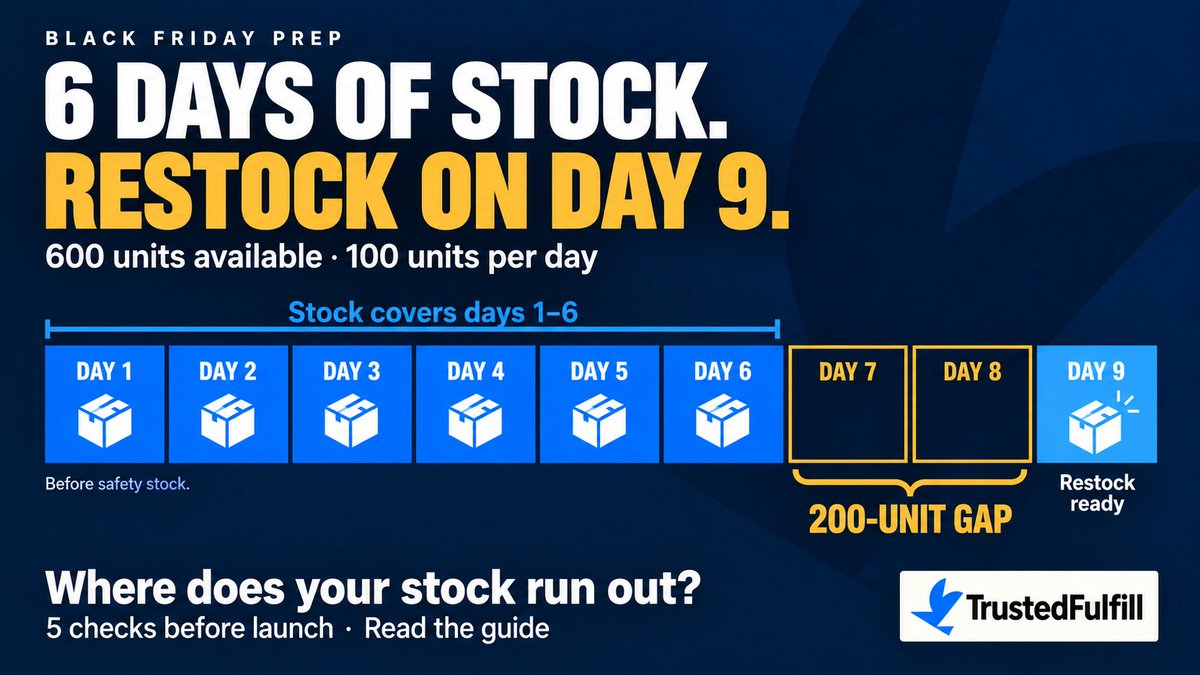
• 600 units available at launch
• Expected sales of 100 units per day
• Replenishment ready to sell at the start of day 9
Current stock covers the first six days.
Days 7 and 8 leave 200 units of demand uncovered—before allowing for any extra reserve.
“The next shipment is arranged” doesn’t answer what happens during that gap.
Spot it now, and you can explore earlier replenishment, promote another variant, or limit the offer.
Spot it after launch, and you’re deciding whether to stop taking orders or ask new customers to accept a longer wait.
The date you need is when the goods have been received, checked, put away, and made available for customer orders.
The rest of the fulfillment plan needs the same scrutiny.
The bundle is ready—but how many can be packed each day?
The parcels are sealed—but when will the carrier collect them?
The customer changed their address—but who confirms the warehouse has the update?
Each step can look covered on its own. Following the whole order shows whether those steps actually line up.
Our blog walks through five checks, from inventory to delivery, and what you can adjust when something doesn’t fit.
Before your stock, packaging, and promotional plans are locked in, see where your next offer could get held up.
🔗 Read the full guide: https://t.co/MAb96tDrNr
#Shopify #BFCM