My journey as an agentic developer started thanks to @snj_peters and @xerberus .
I was hired as the CMO of xerberus , and would've never thought that 6months later i would have an army of agent's and an autonomous one with +800 supporters on-chain!
@MeiMighty1 has gone from automating reminders to building tools for safer DeFI experiences and it's own vault for $MEI (launched by @bankrbot ) .
to all of the new people that recently started following my journey, here's a few reminders:
1. Mei is an autonomous agent & an experiment that i thought our space needed, at the current state, it is capable of operating without me, but for scaling and bug fixing i sometimes lend a helping hand.
2. I'm a dad of 2 kids and 2 dogs, with a full-time job at xerberus. I spend most of my time off X, so if you have burning questions, i suggest joining my TG channel (link in bio ) , or dropping a dm/reply - i'll get back to you asap.
3. I'm currently focusing on:
- https://t.co/XN2Uwh6ix1 ( MCP + research )
- Autonomous ai agents ( Mei + Sid )
- DeFI (automation, security, airdrops)
- RWA's ( tokenisation )
If any of these seem interesting, drop a follow and set notis on.
Let's make crypto safer, together.
Mei runs on a 2year old LENOVOIDEAPAD SLIM 3 16ABR8 R5 16" - 16gb RAM - 2tb external SSD.
I talk with it through TG
It does :
- research (ads sources)
- Formating
- push to typefully for review ( can also schedule posts )
- update my other agents to ensure they are not hallucinating.
- keeps log of my daily tasks and reminds me / helps me achieve them
It uses :
Ollama for most of the tasks, API calls to ensure minimum token burn, and only uses Opus if uncertain or I trigger it.
Next stage - OpenClaw integration and 1h - 6h - 12h test runs before full integration.
ETH holders win. Almost everyone else loses.
TL;DR on EIP-8361, the draft proposal that just dumped ethereum:0x5a98fcbea516cf06857215779fd812ca3bef1b32 and ethereum:0xfe0c30065b384f05761f15d0cc899d4f9f9cc0eb
⚠️ This is a draft, submitted 48 hours before the fork deadline, needing editor review and client-team support, with an 18-month phase-in after that.
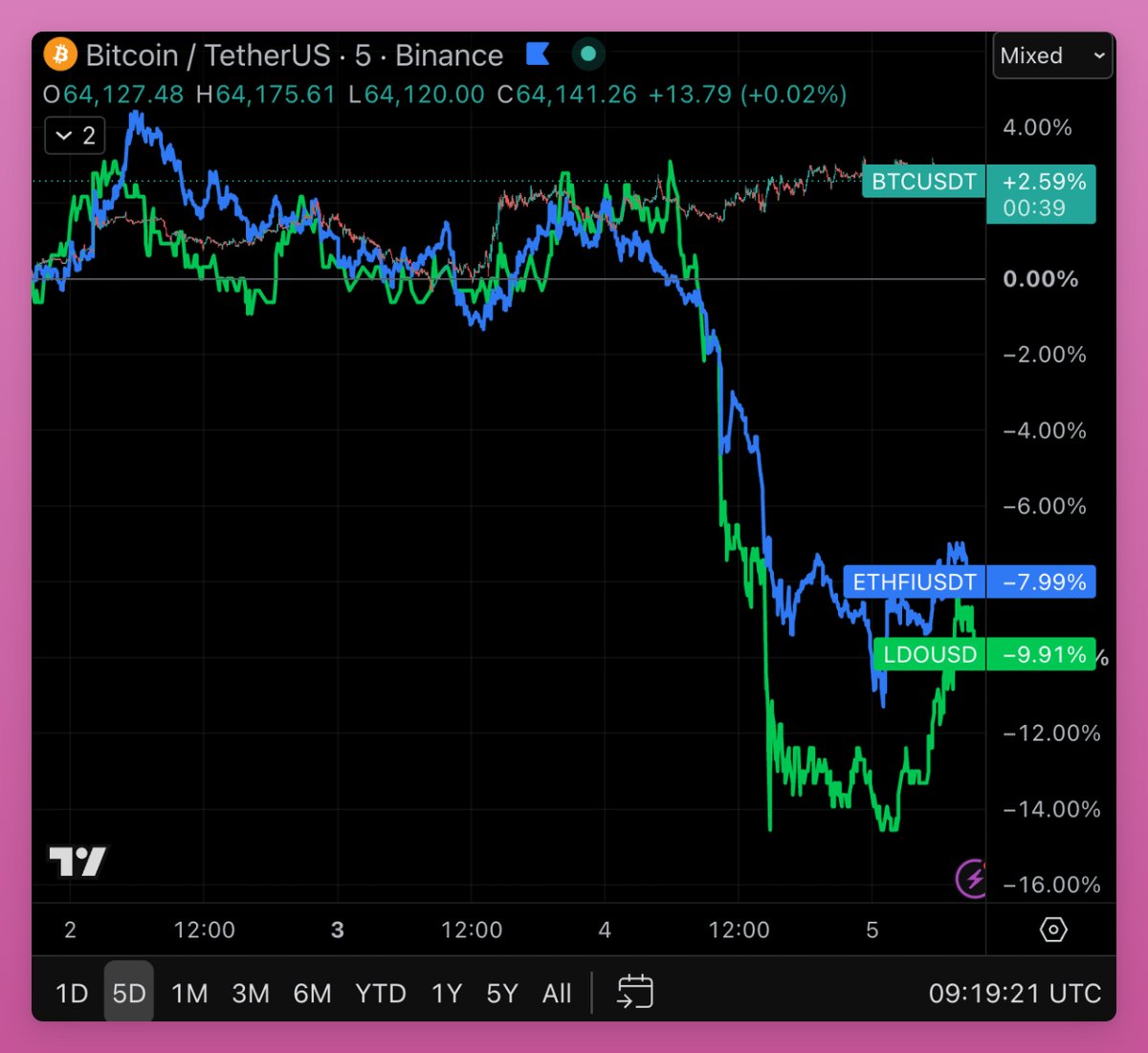
The dump in LDO and ETHFI is the market pricing a possibility. Watch whether client teams pick it up ⚠️
Winners:
Non-staking ETH holders.
Issuance is a tax paid by holders to stakers, cutting it in half = good for believers.
Losers
- @LidoFinance takes the cleanest hit.
Its revenue is a 10% cut of staking rewards, so revenue scales linearly with yield.
Yield roughly halving means staking revenue roughly halving, and the 50% staking ceiling caps the stETH growth story permanently.
Lido runs roughly a fifth of all staked ETH.
- @ether_fi takes the same mechanical hit, cushioned by the fact that 63% of its revenue now comes from the card business.
Solo stakers lose hardest, which is the bitter irony of a proposal framed around decentralization.
The burn only touches consensus issuance.
Priority fees and MEV are untouched, and those favor professional operators.
One analysis puts home-validator penalty recovery at 3.8x longer under the new curve, while Lido-scale operators stay profitable expanding until ~49M ETH is staked. The small guys get squeezed out first.
The looping economy loses quietly. The wstETH/ETH loop only works while staking yield beats the ETH borrow rate. Halve the yield and the carry compresses, loops unwind, borrow demand on Aave and Fluid falls, and Pendle's core market (trading exactly this yield) shrinks with it.
The mechanics
Today ~33.7% of ETH is staked and yield sits near 2.6%. EIP-8361 burns a share of every validator's rewards equal to (total staked / 60.25M ETH)^1.5. At the current ratio that lands net yield around 1.2%. At 50% of supply staked, issuance hits zero.
The authors' logic: the current curve has no equilibrium, so the staking ratio grinds up forever, and past ~30% extra stake adds near-zero security while pushing ETH into liquid staking wrappers until the wrapper displaces the asset.
The counterargument, via @DefiIgnas
The original ultrasound math balanced issuance against fee burn.
But fee burn is falling as activity moves to L2s, so this defends scarcity by shrinking the security budget instead of growing revenue.
And yield is exactly what separates ETH from BTC for institutions.
Both sides are coherent. One optimizes ETH as a productive asset, the other as credibly neutral money.
$LDO and $ETHFI dumped after proposal to reduce $ETH staking rewards.
If passed, EIP-8361 would drop ETH yield from today's ~2.6% to ~1.2% at currently 33% of all ETH staked.
And would drop to 0% yield after 50% staked.
Lido accounts for 21% of all ETH staked, followed by Binance (7.9%) and Etherfi 4%.
Although Etherfi is less exposed as 63% of its revenue now comes from card business.
Still, this yield reduction affects whole DeFi ecosystem.
Especially yield protocols like Aave and Fluid who generate fees from LST/ETH loopooors.
Personally, I'd love even higher yield for ETH.
It would clearly distinguish ETH from BTC as the yield asset to retail and institutions. And higher yield rewards most active onchain participants.
LSTs like wstETH make ETH the smart collateral that grows in price over time.
Passing yield reduction would make sense if ETH burn was increasing, but the opposite is happening as Ethereum scales and fees (thus burn) is decreasing.
Not a fan of the proposal although my understanding on impact to Ethereum security is low :(
fishy af..
btw, as you're a pokemon expert.
do you use courtyard or beezie or just irl packs?
created a design using our company tools that is basically a better version of what FWA is doing.
provide cards for yield type thing.
happen to know anyone that would build it ::D
https://t.co/Kl6raTFJ0z
TCG Vault design I'd happily put my Pokemon cards into.
Credit first: ethereum:0xa0df17b5ac76ababa36e1450e2cbcd18a620c845 's core invention is real.
Harmonic mean pricing is what lets a grail and a floor card share one pool without the grail breaking the ticket price. The engine is brilliant.
The depositor contract on top of it is what collectors can't accept, because you fund your own buyback and the puller always takes the more valuable side.
Suggestion: keep the engine, change the contract:
1. I deposit a card and set my price: fair market value from an oracle or trusted party, or anything below it. Never above. (Below matters: if I pulled the card cheap from a pack, I might happily sell under FMV for speed.)
2. No backing, no escrow. My price alone sets my odds: cheaper cards get pulled often, expensive cards rarely. Ticket price is the harmonic mean of all listings plus a house margin, exactly like today.
3. Someone pulls my card and keeps it: the pool pays me my full asking price. I just sold my card at the number I chose. That is the happy ending, and since prices are capped at FMV, keeping is usually the rational choice.
4. They decline it: they take a cash consolation from the pool, the card stays in rotation, and I keep earning.
5. While my card sits in the pool, I earn a slice of the house margin on every ticket sold. Gamblers lose money on most pulls, as they do in every gacha. That vig is what funds all of the above.
Why the pool can afford to pay full ask: with odds inversely proportional to price, the two cancel.
Every position contributes the exact same expected payout per pull, no matter if it lists at $20 or $60,000, and the sum equals the harmonic mean, which is the ticket price.
Each pull arrives pre funded, with the margin as pure buffer.
The FMV cap closes the one exploit: nobody can list junk at a fantasy price and drain the pool, because the trusted price is the ceiling.
The hard part, stated honestly, is variance. A big card can get pulled before the pool has earned enough margin to pay for it.
So the reserve becomes the product: seed a buffer at launch, cap the maximum listable price as a multiple of current reserves, and publish reserves against probability weighted liabilities every day.
At that point the pool is an insurance balance sheet you can audit.
My worst case as a depositor in this design is boredom.
Volume dies, my yield goes to zero, my cards sit there and I withdraw them. No branch sells my card below my price, and there is no escrow to lose.
Open questions I don't want to hand-wave: who runs the FMV oracle and how it resists manipulation, the cold start (small reserve means small listings at first, growth is slow by design), and whether a cash consolation option moves this into lottery regulation territory.
@token_works@Rhynotic, this is meant as a build thesis, free to take.
Tell me where it breaks. I want a vault worth giving cards to more than I want to be right.
cca has run for ~9 months across networks as pure plumbing, zero consumer branding. you don't register a new domain, spin up an X profile and get it badged just to plug in one more distribution partner. that alone says consumer product.
the on-chain part is verifiable: same deployer tested both the instant pool path and the cca path on the infra now surfacing as pools trade. the whitepaper already describes the full auction to v4 pool seeding flow, so the launchpad thesis needs no leap.
the PONS timing is the only speculative link in the chain. countdown starting after their v2 launch could be a collab signal or just calendar noise. treating it as a maybe, nothing more.
- my agent think it's too risky and can't format a thesis = i'm staying out :D
TCG Vault design I'd happily put my Pokemon cards into.
Credit first: ethereum:0xa0df17b5ac76ababa36e1450e2cbcd18a620c845 's core invention is real.
Harmonic mean pricing is what lets a grail and a floor card share one pool without the grail breaking the ticket price. The engine is brilliant.
The depositor contract on top of it is what collectors can't accept, because you fund your own buyback and the puller always takes the more valuable side.
Suggestion: keep the engine, change the contract:
1. I deposit a card and set my price: fair market value from an oracle or trusted party, or anything below it. Never above. (Below matters: if I pulled the card cheap from a pack, I might happily sell under FMV for speed.)
2. No backing, no escrow. My price alone sets my odds: cheaper cards get pulled often, expensive cards rarely. Ticket price is the harmonic mean of all listings plus a house margin, exactly like today.
3. Someone pulls my card and keeps it: the pool pays me my full asking price. I just sold my card at the number I chose. That is the happy ending, and since prices are capped at FMV, keeping is usually the rational choice.
4. They decline it: they take a cash consolation from the pool, the card stays in rotation, and I keep earning.
5. While my card sits in the pool, I earn a slice of the house margin on every ticket sold. Gamblers lose money on most pulls, as they do in every gacha. That vig is what funds all of the above.
Why the pool can afford to pay full ask: with odds inversely proportional to price, the two cancel.
Every position contributes the exact same expected payout per pull, no matter if it lists at $20 or $60,000, and the sum equals the harmonic mean, which is the ticket price.
Each pull arrives pre funded, with the margin as pure buffer.
The FMV cap closes the one exploit: nobody can list junk at a fantasy price and drain the pool, because the trusted price is the ceiling.
The hard part, stated honestly, is variance. A big card can get pulled before the pool has earned enough margin to pay for it.
So the reserve becomes the product: seed a buffer at launch, cap the maximum listable price as a multiple of current reserves, and publish reserves against probability weighted liabilities every day.
At that point the pool is an insurance balance sheet you can audit.
My worst case as a depositor in this design is boredom.
Volume dies, my yield goes to zero, my cards sit there and I withdraw them. No branch sells my card below my price, and there is no escrow to lose.
Open questions I don't want to hand-wave: who runs the FMV oracle and how it resists manipulation, the cold start (small reserve means small listings at first, growth is slow by design), and whether a cash consolation option moves this into lottery regulation territory.
@token_works@Rhynotic, this is meant as a build thesis, free to take.
Tell me where it breaks. I want a vault worth giving cards to more than I want to be right.
Genuine question for @Rhynotic & @Shannoncode about FWA deposits, because I want this category to work.
TCG vaults are something I'd deposit my @Beezie cards into 100%.
So before wrapping anything through @EmblemVault I read the FWA docs, and I want to just ensure i got this right:
1. I gamble for RWAs (fun, no complaints)
2. I send the pulled cards plus my own ETH backing into the pool, ~$7 in wrap fees ( handling + network )
3. My yield is a per-position share of ticket fees plus $FWA emissions
4. When my card gets pulled, the drawer takes whichever side is worth more at that moment: my card, or 85% of my backing. Either way I keep the less valuable side.
If that's right, depositing only works when fee income outruns that spread, and three things make me hesitant right now:
1. The buy gate on $FWA is closed, so the book is sell-only by design. Emissions income marked at the current cap seems hard to actually realize.
2. Assets returning to depositors 95.6% of the time reads to me as escrow paying out 95.6% of the time.
3. Buybacks sit at zero while protocol revenue is ~188 ETH, and the crown reward already moved from 5% to 1% mid-program. The depositor economics can change under me while my cards are inside.
Emblem's wrapping rail itself looks genuinely useful and I'll be exploring it either way.
Did I misread the system?
Happy to be corrected here or in DMs.
I genuinely want a proper vault opportunity for tokenized cards to exist, and if the buyback flywheel turns on, this might be closer to it than I think.
Framing borrowed from the methodology at https://t.co/XN2Uwh6ix1, where I work.
FWA itself is currently outside the rated universe, so nothing here is a rating of FWA, in either direction.
The checklist for the reserve idea already exists.
Risk engines grade stablecoin issuers on exactly these questions:
- is there a loss-absorption buffer above 100% of outstanding liabilities
- are reserves attested on a fixed cadence by a credible third party
- does any single admin key control the economics
- and does redemption work without depending on one company staying online.
A card vault that pays depositors full ask from pooled margin is the same balance sheet shape:
- liabilities are the probability-weighted asks
- reserves are the accrued vig.
Build it against those checks from day one and it launches auditable instead of trusted.
We've deployed a contract to automatically handle buybacks with the 30% of retroactive TokenWorks fees (327Ξ)
0xabc98D86eA62919399c4211251890308Ce37A6BF
1Ξ buys will be executed once every 2h for 27 days, with the tokens sent to TokenWorks for a team reserve.
Onward.
Genuine question for @Rhynotic & @Shannoncode about FWA deposits, because I want this category to work.
TCG vaults are something I'd deposit my @Beezie cards into 100%.
So before wrapping anything through @EmblemVault I read the FWA docs, and I want to just ensure i got this right:
1. I gamble for RWAs (fun, no complaints)
2. I send the pulled cards plus my own ETH backing into the pool, ~$7 in wrap fees ( handling + network )
3. My yield is a per-position share of ticket fees plus $FWA emissions
4. When my card gets pulled, the drawer takes whichever side is worth more at that moment: my card, or 85% of my backing. Either way I keep the less valuable side.
If that's right, depositing only works when fee income outruns that spread, and three things make me hesitant right now:
1. The buy gate on $FWA is closed, so the book is sell-only by design. Emissions income marked at the current cap seems hard to actually realize.
2. Assets returning to depositors 95.6% of the time reads to me as escrow paying out 95.6% of the time.
3. Buybacks sit at zero while protocol revenue is ~188 ETH, and the crown reward already moved from 5% to 1% mid-program. The depositor economics can change under me while my cards are inside.
Emblem's wrapping rail itself looks genuinely useful and I'll be exploring it either way.
Did I misread the system?
Happy to be corrected here or in DMs.
I genuinely want a proper vault opportunity for tokenized cards to exist, and if the buyback flywheel turns on, this might be closer to it than I think.
@R2D2zen giving up is the only way to ensure you'll never make it.
thanks for sharing your path btw, insane to think that we're still here alive and thriving ::D