We have started a podcast.
We interview the smartest onchain strategy quants, vault curators and DeFi masterminds.
Find episodes here: https://t.co/6RTVWNAEye
Listen on YouTube: https://t.co/aXFC9uy4yS
Listen on Spotify: https://t.co/QQ69shjjJl
Congratulations on the launch!
We were reviewing the new vault to add it to our listings alongside other Assetto products.
We found some security discrepancies while reviewing it. Could you take a peek and confirm everything is correct on your side:
- At Soneium block 29979401, the timelock delay was three minutes, whereas the docs state three days.
- The contract also allows the admin to change that delay directly
- All three administrative roles currently share one address
The short history of DeFi vaults by @0xT3tris
In 2016, @enzymefinance (previously known as Melon Protocol) launched the first digital asset management protocol. Later, these "onchain funds" became known as vaults. With public blockchain transparency and smart contract-based management, investment vehicles could be safer than those in traditional finance, immune to asset misappropriation, false statements, or fee manipulation.
But Enzyme was very, very early. The concept did not take off until the DeFi summer of 2020, when @yearnfi launched the first fully autonomous vaults for yield farming.
Even during the 2020 boom, there was very little to trade onchain, which severely limited opportunities for yield generation. Most vaults focused on reward farming in different liquidity provider games, which have since cooled down a lot, as the AMM spot DEX market hit its growth ceiling.
Now, we are in the third cycle of vaults. The vaults themselves have changed less, but the opportunities they can access have expanded dramatically. It's no longer just yield farming. At https://t.co/MDRpRPUHxS, we list 34 strategy categories vaults use to generate yield, from RWA lending to high-frequency algorithmic trading.
It is estimated that onchain tradeable and issued assets reach $10T. The onchain markets, with fewer intermediaries and direct access to humans and AIs alike, will be the future of capital allocation.
Read more from the T3tris blog post here:
https://t.co/Vjtw4535Bu
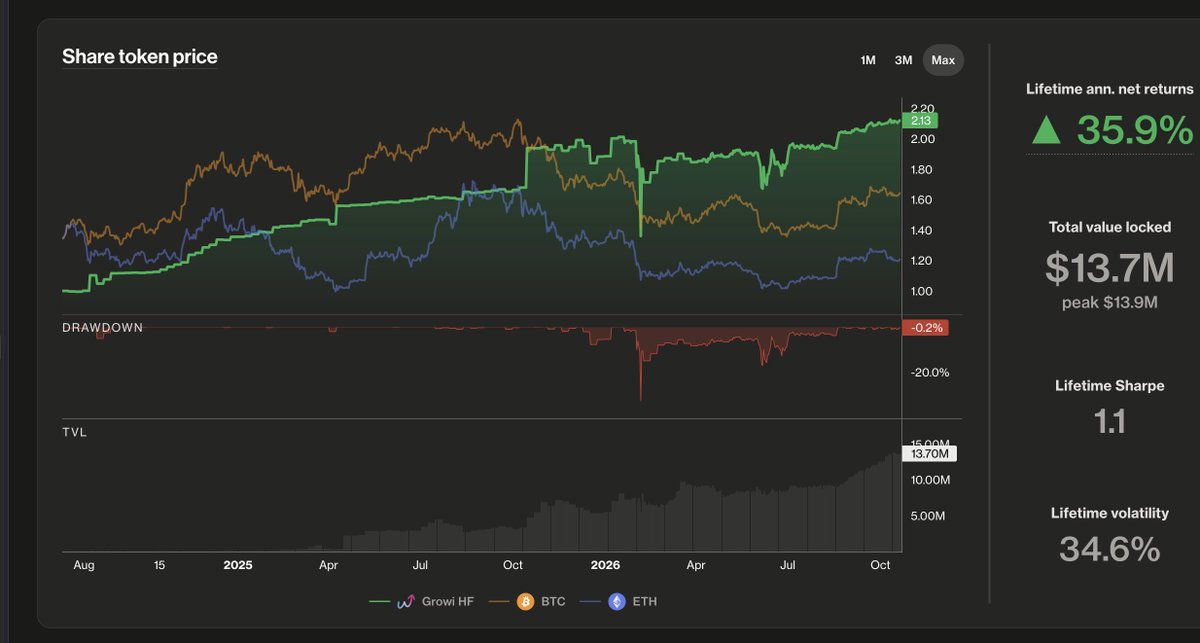
Max drawdown is for the whole history.
The original observation was for recent history (3 months).
A lot of vaults got hit in the past during events like October 10th. Some of them have learnt their lessons, like Growi, and have made their risk controls better.
Crypto markets have little history, which is why it is hard to apply models to them.
So when you look at vault history, you can see whether they've improved in recent market downturns, which indicates tighter risk controls.
Or you can just come to our podcast and discuss it, like Growi!
https://t.co/FZcLqSUc8X
Listen to our Trading Strategy Podcast episode #14 with Growi Finance (@GrowiFinance) and learn how a research-driven, mid-frequency mean-reversion strategy became one of the top-performing vaults on Hyperliquid, and why risk-by-design matters more than chasing yield.
In this episode, Nertila (@theblue_panda) from Trading Strategy discusses with Valentin and Miguel from Growi Finance. Growi Finance is a quantitative asset-management firm building on-chain yield products to institutional standards. It describes itself as the allocation layer for digital asset yield, serving both retail investors and professional allocators.
👉 View Growi Finance vault data on Trading Strategy https://t.co/F5FsXVjfnu
👉 Listen to the podcast on Spotify https://t.co/cdlzXqqCMs
👉 Listen to the podcast on YouTube https://t.co/QLbJoBpAQG
Glasgow Cosmic: a DeFi vault for a cricket team.
Some vaults run faster than others.
Glasgow Cosmic by Ryllo (@weareryllo), an RWA company, generates returns from the Glasgow Cosmic Cricket Team's operations, which are part of the inaugural European T20 Premier League.
- The agreement is valued at $1.4 million in projected revenue share.
- Delivery (payment) is expected by 20 November 2026.
- The vault is financing working capital against this single large, short-dated receivables claim from the league. Interest is paid on the facility over successive 90-day periods.
Ryllo or Accountable do not publish further legal details such as advance rate, exact interest formula, covenants, or the precise definition of which league revenues are assigned.
https://t.co/YDu9tHcCLh
Growfi is one of the oldest and most robust trading vaults on Hyperliquid, with a lifetime annualised return of ~35% over two years.
By running a Hyperliquid core vault, depositors can relatively safely access quant trading strategies usually available only to high-net-worth individuals. The vault's TVL has grown organically from zero to $13M.
The strategy, originally run on centralised exchanges, is a mid-frequency mean reversion strategy that trades minutes, not seconds. By ensembling multiple timeframe signals into a single netted position, the mean reversion strategy can deliver more stable returns.
"Mean reversion is a property of market microstructure, not of a specific exchange."
Real safeguards exist against market volatility. Growi stress-tests on synthetic price paths that reproduce volatility clustering, including unrealistic scenarios such as BTC going to zero or to $1M (let's hope the latter becomes reality).
"We put more effort into being robust than into getting more yield."
Listen to our interview with the @GrowiFinance OGs of the vault space below, or read the transcript here
https://t.co/jMImfAyxQD
Listen to our Trading Strategy Podcast episode #14 with Growi Finance (@GrowiFinance) and learn how a research-driven, mid-frequency mean-reversion strategy became one of the top-performing vaults on Hyperliquid, and why risk-by-design matters more than chasing yield.
In this episode, Nertila (@theblue_panda) from Trading Strategy discusses with Valentin and Miguel from Growi Finance. Growi Finance is a quantitative asset-management firm building on-chain yield products to institutional standards. It describes itself as the allocation layer for digital asset yield, serving both retail investors and professional allocators.
👉 View Growi Finance vault data on Trading Strategy https://t.co/F5FsXVjfnu
👉 Listen to the podcast on Spotify https://t.co/cdlzXqqCMs
👉 Listen to the podcast on YouTube https://t.co/QLbJoBpAQG
Glad to be visiting the #CryptoMondays#London event and discuss #stablecoins and #DeFi#vaults
Thank you for arranging these events @CryptoMondaysUK
If you want to learn more about what to do with your stablecoins in DeFi vaults market, take a look at our live dashboard: https://t.co/VHdrE6T3u0
@SystemicStratHL An absolute beast of a vault.
Here is the vault PnL, cleaned of the deposit/redemption flow.
(Very good approximation, some of Hyperliquid data issues make it hard to get absolute tick by tick numbers for this.)
https://t.co/Do126KjqMZ
For anyone interested in learning more about Growi and our trading strategy, this is a great place to start! 👇
Thank you so much! @TradingProtocol It was a real pleasure joining you guys! 🙌
Listen to our Trading Strategy Podcast episode #14 with Growi Finance (@GrowiFinance) and learn how a research-driven, mid-frequency mean-reversion strategy became one of the top-performing vaults on Hyperliquid, and why risk-by-design matters more than chasing yield.
In this episode, Nertila (@theblue_panda) from Trading Strategy discusses with Valentin and Miguel from Growi Finance. Growi Finance is a quantitative asset-management firm building on-chain yield products to institutional standards. It describes itself as the allocation layer for digital asset yield, serving both retail investors and professional allocators.
👉 View Growi Finance vault data on Trading Strategy https://t.co/F5FsXVjfnu
👉 Listen to the podcast on Spotify https://t.co/cdlzXqqCMs
👉 Listen to the podcast on YouTube https://t.co/QLbJoBpAQG
The cautious excitement when you're sitting on a new product that might be the best thing you've done in your career.
I think we might have something soon that is going to be a game changer in DeFi
Frankencoin Shares (FCS) are live and tradable. Get them on @Uniswap.
To celebrate the occasion we are releasing a limited version of the FCS T-Shirt.
Share this post.
Claim it for free.
Only for 24hrs.
While supply lasts.
https://t.co/ZnevvI5Mvq
@AndreCronjeTech Good work!
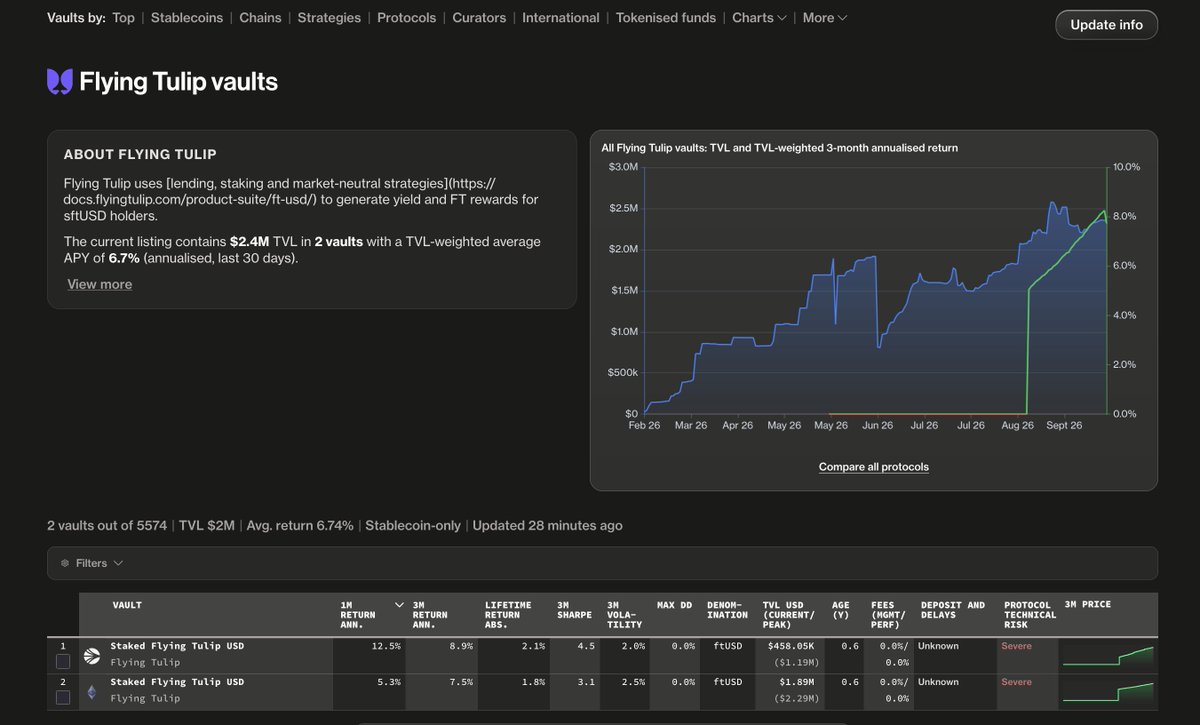
We added the Flying Tulip tracker here so we can benchmark it against some popular DeFi vaults.
The Binance Smart Chain deployment is in, but it doesn't have enough data yet.
https://t.co/OOvmnq4hHD
Listen to our Trading Strategy Podcast episode #13 with Yearn (@yearnfi) and learn why automatic, fully on-chain accounting matters for transparent DeFi vaults.
In this episode, Nertila (@theblue_panda) from Trading Strategy discusses with Corn (@omgcorn) from Yearn. Yearn is a permissionless vault platform whose V3 ERC-4626 vaults combine tokenised strategies with automatic on-chain accounting. Corn also explains Yearn's open risk curation framework and its new Flex fixed-rate lending product.
👉 View Yearn vaults on Trading Strategy https://t.co/x0p6Dnq6K5
👉 Listen to the podcast on Spotify https://t.co/t62IQBteGd
👉 Listen to the podcast on YouTube https://t.co/AerGL7Ejxp
US 2y pays 4.9%. 10y just hit 5.13%.
Aave USDC pays 3.72%.
most DeFi yields now pay you less than the US government - for more risk.
If you're going onchain, the spread is the only number that matters.
eEARN on @EmberProtocol is running ~10%.
Zero-day remote code execution vulnerability in iPhone Safari. Click a link, and your crypto, passwords and everything else on your iPhone are gone.
Exploited in the wild by "DarkSword" malware.
"The DarkSword attack program has leaked, with its core capability being: extracting forensic-level data from iOS devices via HTTP interfaces. In actual attacks, attackers can combine social engineering or watering hole attacks to lure users into falling victim, thereby stealing data from iPhone / iPad devices and uploading it to servers controlled by the attackers."
Update iPhones immediately. Apple originally patched this, but rumours suggest even the latest versions are vulnerable, “pending confirmation,” across a wider range than the original 18.4–18.7 window.
From a Chinese security researcher, SlowMist CISO, @im23pds
https://t.co/hIRaGvEha9
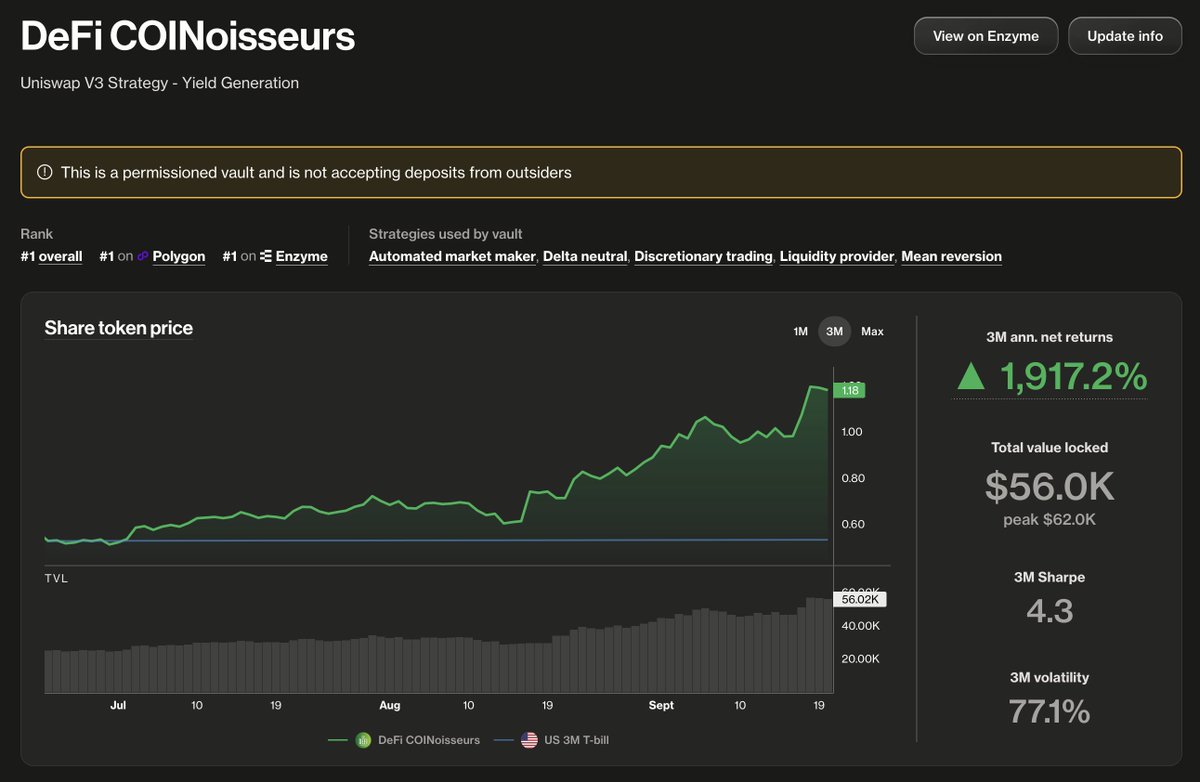
Currently the top 1 vault by monthly returns:
DeFi COINoisseurs by @FLOAT_LOCKER
This small vault strategy focuses on discretionary Uniswap V3 LP positions. Last three months' absolute net returns are > 100%.
Launched in 2022, making the vault one of the most OGs of all time, it had a rough crypto winter. Now the vault is about to break back into the black.
The vault is pure DeFi: it takes positions on Uniswap and hedges on Aave.
This vault lives on the OG @enzymefinance vault protocol.
Because of data-collection limitations, we have data on this vault only since 2024.
https://t.co/vEpNfei55h