Introducing DD by Webacy – the new standard for on-chain decisioning & due diligence in crypto.
Smarter, safer transactions powered by real-time risk intelligence. Let’s dive into why this matters & how it’s changing the game 👇🧵 #DDxyz#Webacy
Webacy is now SOC 2 Type II compliant
Years of dedication to safety, now independently audited. Banks, stablecoin issuers and exchanges using our risk intelligence can now review our report. Onwards!
@mywebacy is now a third-party PPOI list provider.
Helping @RAILGUN_Project integrated wallets keep hacked/scam funds out of the privacy set using real-time onchain risk signals.
Non-custodial.
Privacy-preserving.
https://t.co/5mJ7UuQMmy
Webacy is now SOC 2 Type II compliant
Years of dedication to safety, now independently audited. Banks, stablecoin issuers and exchanges using our risk intelligence can now review our report. Onwards!
Trading agents are only as good as what they know before they execute.
Webacy is now on @mobyagent’s marketplace, one tap and your agent screens every token for snipers, bundlers, mint/freeze flags, and wallet risk before it buys.
The agent moves fast. Now it moves safe.
Webacy - @mywebacy is now on the Moby Agent Marketplace - the largest marketplace with skills, tools, and MCPs to level up your trading agent.
Your agent can check a token or wallet for risk before it trades, so it steers clear of rugs and scams.
One tap to give access to your trading agent 👇
https://t.co/OiEljfwlb0
What do you check before sending crypto to a contractor?
We talk to a lot of teams that do one thing: make sure the address copied right.
That’s it.
It doesn’t catch poisoned addresses, sanctioned wallets, or funds that passed through a hack. @vaultnowco put together the full checklist with our data.
Before paying a new contractor, most teams check one thing: is the address copied right?
But the fraud can be deeper. @mywebacy tracked 32,290 suspicious address poisoning events in one month. Top targets: USDT and USDC. One victim lost ~6.88M USDT.
@vaultnowco and @mywebacy on how to make your transfers safer: a thread
*ANNOUNCEMENT*
Today we're launching PennyWorks public NAV dashboards. 🧵
First up: Strada. Monthly NAV, value per share, returns and flows, computed independently by PennyWorks from the fund's own books.
https://t.co/xD2ZVQSDbK
$6.3B stolen from Binance. Issuers froze $2.73B in stablecoins.
Freezes couldn’t touch 508K ETH, 18K BTC, or the USDT that moved before the first freeze.
Webacy’s wallet screening flags risky wallets before they hit any freeze list.
Read the full article below 👇
@kycryptodegen Hey @kycryptodegen!
Do you already have an API key? If not you can get one at https://t.co/boEr4r8Psg (has some free usage!)
Also feel free to reapply to the grant after 1 month if you were not chosen this time!
Great to see a team like @unlloo_protocol using our APIs!
Under-collateralized loansbacked by reputation, the team is using our risk APIs as well as other providers to get a clear view of a users on-chain activity and risks prior to them requesting a loan.
Check your score out on https://t.co/5vpOydIRZx!
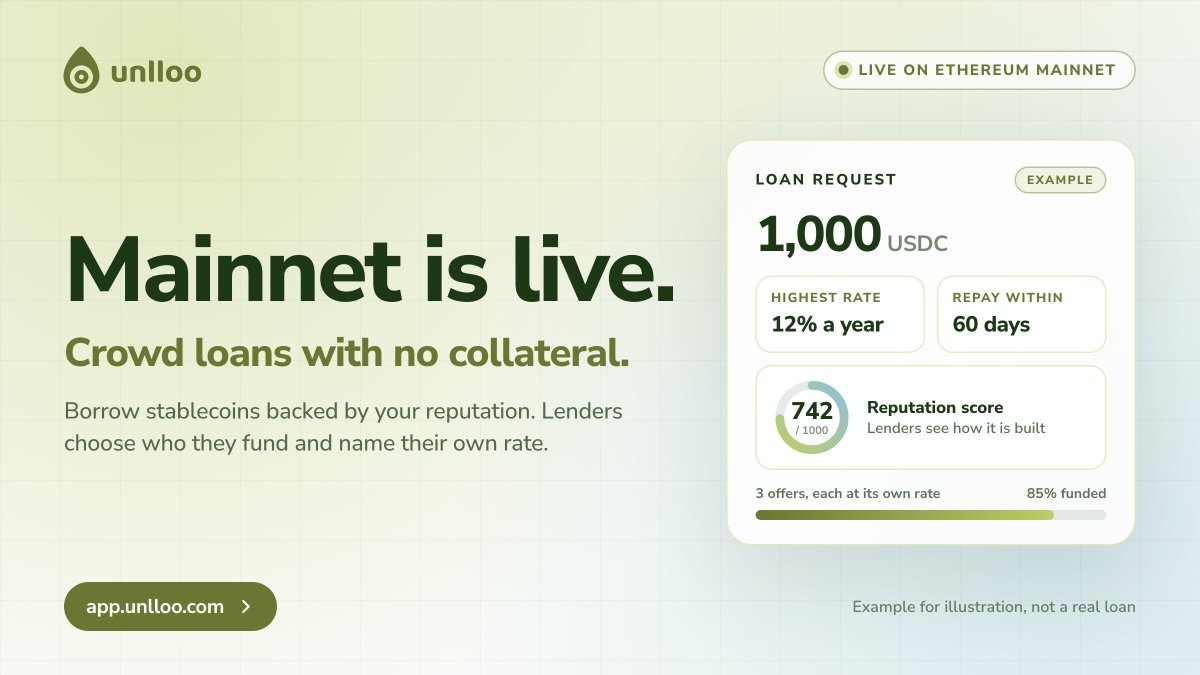
Unlloo Crowd Loans is live on @ethereum mainnet!
Borrow stablecoins with no collateral, backed by your reputation. Lenders choose who they fund and name their own rate.
No middleman. Every loan is its own mini pool with its own risk. A smart contract holds the money and handles every step.
https://t.co/LQ2aZ6qNkR
How it works:
1. A borrower posts a request: how much, the highest rate they will pay, and when they will repay.
2. Lenders check the borrower's reputation score and make offers at a rate they choose. The smart contract holds each offer.
3. The borrower picks the offers they want, and the smart contract pays out the loan.
4. The borrower repays with interest to the smart contract. It splits every repayment between all the lenders automatically, each by their share of the loan.
No need to keep checking the app. Turn on email or Telegram notifications and we tell you when a new offer arrives, when your offer is accepted, when a repayment comes in and when a loan is due.
Borrowers: bring the people who know you. They are your best lenders.
Lenders: real money, real risk. You decide who you lend to, so check the borrower first.
Built with @humnpassport@mywebacy@blockscout@growthepie_eth@zerufinance@OctavFi@ETHGlobal@agartha_one, and with reputation data from @ethos_network and @talentprotocol. Thank you.
Open the app: https://t.co/LQ2aZ6qNkR
Across Protocol's domain was hijacked to send users to a phishing site. GoPlus estimates about $350K lost to fake approvals and permits. Across says affected users will be made whole.
The right URL was the trap. Webacy makes risk visible in real time, even in what you sign.
Our own Marc onstage at Stellar Meridian 2026.
We’re building real-time risk intelligence for teams on Stellar, from screening wallets and transactions to monitoring digital asset risk as it changes.
Watch the clip ↓
Billions of agents are coming online.
Nobody can tell what's real.
Introducing Proofable.
It lets people and AI agents carry identity, ownership, and authority anywhere.
Proof is the missing layer.
Make it Proofable.
Billions of agents are coming online.
Nobody can tell what's real.
Introducing Proofable.
It lets people and AI agents carry identity, ownership, and authority anywhere.
Proof is the missing layer.
Make it Proofable.
So what does this all mean?
Risk goes beyond stablecoin price or reserves. A ~$6.3B CEX breach produced measurable stress signals across 24 stablecoins within 60 minutes. While the peg held this time, who knows what could happen next time. Continuous monitoring flagged major signs of stress even if all pegs remained in tact.
We should consider ourselves lucky that this exploit did not result in a major depeg in this case. An exploit of this size presents a great opportunity to review risk controls, and ensure they function in an emergency.
Digital assets open an entirely new world of possibilities, including the ability to steal, launder, and hack. Now more than ever, we must realize the connection of every part of the risk stack: code, liquidity, governance, reliance, everything.
https://t.co/jLc8NKnbfy or https://t.co/ZCD9xEX6JW for more
The Binance hack drained $6.3 billion.
None of the six major stablecoins depegged. However, the markets did experience contamination effects.
Here's what happened 🧵
Issuers acted quickly as well. Webacy's freeze tracker recorded:
→ 5 USDC addresses frozen on Ethereum
→ 9 USDT addresses frozen on Tron
→ 1 BUSD address
early on, with many more trickling in after immediate freezes.
The speed of execution of the compliance layer was unprescinded. Meanwhile, the market was (and still is) processing what happened.
One token did cross into our "WATCH" risk tier: USDe, at 23:55 UTC.
It held between scores 23–26 for about 2.5 hours before reverting.