its time for infra that scales the procurement of frontier data to the speed ai systems need
cutting down messy middle entropy (yes im looking at you twitter-slop-turned-"data brokers") is a big piece of that
lets make frontier data flow at the rate of compute🌊
For funds, this is alpha before it's priced in. For AI labs, this is data you can train or evaluate on, with the terms known up front.
Live today.
Full walkthrough: https://t.co/0xy3jKjikj
Start your 7-day trial: https://t.co/dpRXaLty96
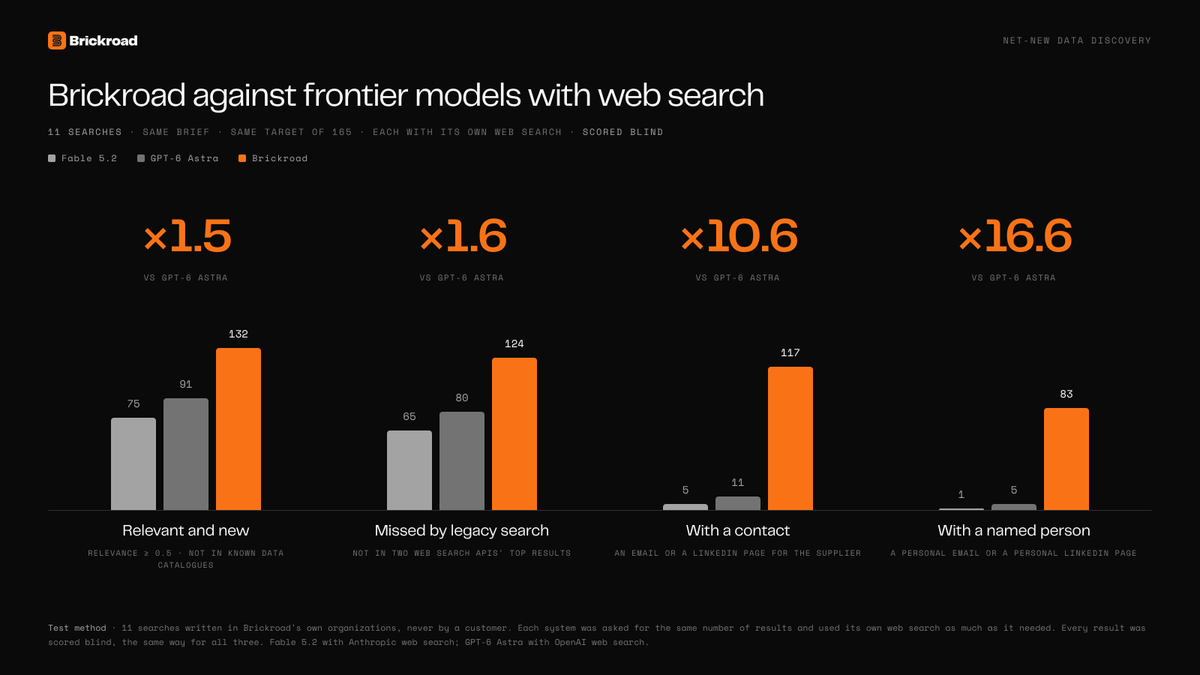
We put it against frontier models with web search. Same eleven briefs, every result scored blind.
1.5× the relevant, net-new sources.
10× with a contact.
16× with a named person.
If data becomes one of the world’s most valuable traded assets then it’s fair to say it will need better market infrastructure. Every working market needs the below:
Independent evaluators. Liquidity for any asset class is unlocked when there is trust established around the contents without having to check firsthand. Commodities, energy, equities, and debt all cross that threshold through grading and verification by someone who isn't the seller.
Transparency. The biggest markets moved beyond one-off negotiations once the terms became open and public: what was traded, at what price, under what conditions. Data deals today are almost all private, so there's no market-clearing price for anyone to point to.
Liquidity. That takes sufficient scale of buyer and seller transactions, and it only shows up once the first two exist. Buyers who can trust a dataset's grade and see what comparable datasets went for can transact a lot quicker.
Data has ridiculous demand but has not yet met the three conditions.
The Buy-Side of the Data Market is Using Agents to Find You - If You Hide - They're Going to Pass You By.
Here's A Fact: Every single Lab, NeoLab, Fund, Quant, and Investment Advisor actively buying data is using agents to find new sources. Many are using @TryBrickroad's discovery agents.
If You Hide, We Won't Find You.
Sellers and Brokers trying to hide the ball on price, sample, terms, and coverage are doing themselves a disservice.
Our agents are tuned to look for signals that indicate that a company (a) has data, and (b) is interested in selling the same.
The agents look at a massive amount of signal over the course of a very tight time window. If they can't answer all of the questions they need to know, they're going to discount you and not engage.
If you're selling data, here's what most people overlook or hide - if you answer these, you make the agent's job alot easier, and you'll get more inbound - full stop:
Price: Give the agent a range or exact numbers on pricing. If you have a sliding scale, tell us. If you have exclusive or non-exclusive pricing, tell us. If you have consumption based pricing - tell us!
Provenance: How did you get the data, did you create it yourself? Did you license it from someone else? Did you scrape it from the web?
Legal: Is the data available for pre- and post-training? Are you selling on an exclusive basis? On what terms (for licensing, feel free to use our standard license agreement with composible parameters: https://t.co/pAO4Z6vFP6).
Samples & Schema: Show as much of the sample as you're comfortable with. Par that with a schema with descriptions.
One-Pager: In your one pager, talk about all of the above, talk about the use cases, the quantity, the coverage, and the delivery methods.
That's it - not that hard. If you need help - simply fill out this onboarding form - it will create a page for your buisness, optimized for agentic discovery: https://t.co/nJWatY7sl2
Your Agents Need Context
**To be clear, I don't think @yrechtman is wrong, and we've discussed this privately. As we're in the middle of a raise (no, you can't participate) and this article has come up a few times in the last several days, I'm sharing my thoughts publicly.**
First off - on selling the tasks vs. the corpus. I think it's a position rooted in today's current reality. But at the same time, I question what the moat is for RL Labs more generally.
AI systems are tools for solving complex problems very fast. Turning a corpus into tasks, and tasks into an environment, is a complex problem, indeed. But its mostly a software problem - and that's also the one area (as we know) where the current models are already at their best.
At this point, frontier labs are looking at RL Labs as a bet on labor savings - and labor margin is not a moat. The labs will internalize this work when it is worth their time, or when their security posture demands it. Both are already happening (see Google's Mechanize deal).
But where I really think Yoni's framing could be augmented is with respect to agents (I have an article in my drafts called "Don't forget your agents").
While Yoni points out the path from corpus to environments, there is a second way to use and sell data - which is to literally put it in front of the model at the moment it is doing the work. In context. At inference time. And if AI systems are tools for solving complex problems very fast, then the constraint on the tool is what it knows about the problem in front of it.
Earlier this year @jasonscui and @JenniferHli wrote a great article about this here: https://t.co/uZ7W6G0o0Y. by their account - enterprises pointed agents at their data stakes and hit a wall - not because the models were weak, but because the agents lacked context.
Agents are essentially useless without the right context. And it's not only business context that an agent will need. It's run-of-the-mill stuff. Like weather and CDC data when making your next retail trade (imagine being short bullish on Six Flags during hurricane season), political sentiment data when placing your next trade on Kalshi, or traffic data when scheduling a flight to JFK.
If an agent gets these economically valuable tasks wrong because it doesn't have the right data - what's missing is not the RL environment, but the corpus - the raw data.
Think of it another way - alot of what we as humans do is based on ingrained context.
Think of it another way - alot of what we as humans do is based on ingrained context. We know to talk to a customer or two before starting a company or an off-the-shelf dataset marketplace (at least some people do), we know not to fall in love with Chinese spies (at least some people do), we know....alot of things.
Now run the same logic across every facet of what's economically valuable. And much of what an agent needs to do real work is somebody else's private data: a supplier's price list, a counterparty's history, a dataset sitting inside a company that has never thought of itself as a data vendor.
Most of that data is never going to be sold into anyone's weights. And unlike an environment, this isn't work a lab can pull in-house. But it can be licensed for use - on a consumption basis - with a record of every call and a switch to turn it off.
This is already happening. LSEG, S&P Global and FactSet now serve licensed data straight to agents over MCP. None of that is a training deal. It's retrieval, under license, at the moment of the question.
Training happens once per model. Context happens once per task.
That's why I think in-context, inference-time retrieval of private data is the civilizational-scale tooling here.
Yoni ends his piece with: "The next corpus is the whole economy."
I'd reframe: "Context is the whole economy."
Welcome @CarbonMeld to the Brickroad Ecosystem.
CarbonMeld is an independent carbon credit market intelligence provider. It applies a published, versioned methodology (v2.2) to the public registry documents of 34,000+ carbon credit projects across 31 registries and 12 marketplaces, producing a 0-10 quality score per project across four dimensions (Integrity, Transparency, Claim Safety, Documentation) with sector-specific penalty gates, confidence levels, ICVCM CCP and CORSIA eligibility labels, and removal-vs-reduction classification.
New on the index: a buyer-attributed retirement ledger that joins individual retirements to project scores and rolls them up into tonne-weighted buyer portfolios.
Perfect for: ESG and sustainability teams doing offset due diligence, carbon desks and commodity funds screening project quality, researchers and journalists tracking who is retiring what, and agents that need structured carbon-market data via API or MCP.
🔗 https://t.co/SJIH1Ta3OY
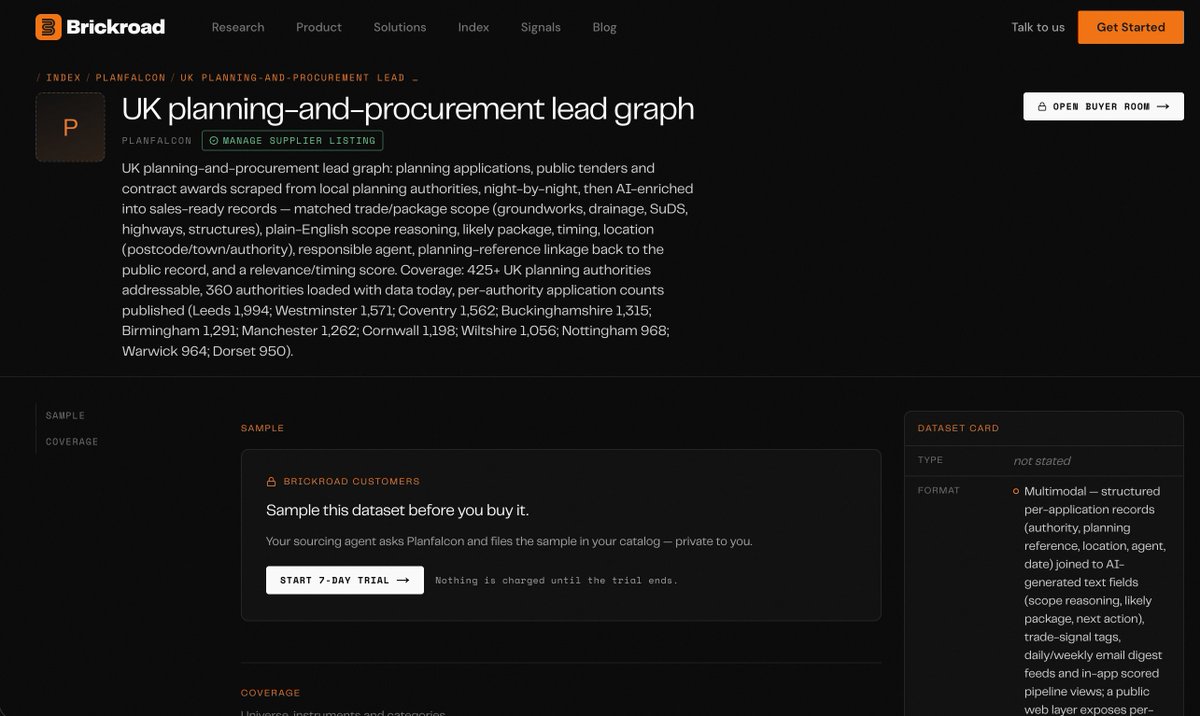
PlanFalcon is now listed on @Trybrickroad 🏗️
UK planning apps, tenders and contract awards, scraped nightly from 360 councils and turned into sales-ready leads for groundworks, drainage, SuDS and highways subbies.
#ConstructionTech#UKConstruction#PlanningApplications
Every VC and PE Fund should be building a data lab for their PortCos.
Give your PortCos a path to secondary revenue and let them focus on what they do best.
every company should turn itself into a giant RL env, building self-improving AI that learns from every interaction and progressively starts running the company itself
A broker with exclusive licensing rights is not a venture scalable moat.
Taste and needs change rapidly - by owning or touting an exclusive license you end up competing with your own suppliers, and buyers stop trusting you as the neutral layer.
The defensible position is the layer every transaction runs through, not the inventory.
been working on this for a bit
we've launched zero data retention (ZDR) mode on Brickroad to a few enterprise customers
our quant customers want to find alpha without giving away what they're looking for
for example, after google's earnings yesterday:
"how exposed is google cloud's order book to AI customers running out of money?"