Zero launches November 30 with ATLAS. Trading apps keep their own frontends. Order flow lands on one engine.
@LayerZero_Core is shipping an L1 for execution and a shared trading engine on top. Zero handles execution and verification. ATLAS is the common exchange layer. Apps build their own interface and compete on distribution and user experience. The order flow sits underneath on the same infrastructure. The design is that each new venue can bring more liquidity to the markets the others already trade on, instead of fragmenting it across separate engines.
LayerZero enters with $15.69B in reported TVL across its existing ecosystem, over $318M in reported funding, and a reported $3B valuation. Institutional names linked to the project include @citsecurities, @tether, and @ARKInvest.
The design splits the work. Block producers execute transactions and generate proofs. Validators check those proofs without re-executing every transaction. The target is up to 2M TPS per zone. That is a design number. Public mainnet throughput is still to be demonstrated.
After venue rebates, 75% of remaining ATLAS fees go to $ZRO buybacks and burns. Venues can receive rebates of 20% to 65% depending on staking and volume. The size of the burns depends on how much trading the venues attract, how much that activity generates in fees, and how much goes back to venues through rebates. $ZRO is expected to serve as gas and staking token on Zero.
Trading apps already listed around the launch include @definedfi, @BasedOneX, @GTE_XYZ, @get_truenorth, @Bullish, @globemkts, and @grid_arena. PerpTools from @DEXToolsApp is also building on ATLAS from day one. The broader list covers DeFi infrastructure, launchpads, NFTs, and gaming.
The parallel to Hyperliquid is in the sequencing. Execution and liquidity first. The application layer can grow around it. On launch day the checks are simple: which venues go live, how much order flow they bring to ATLAS, and what that flow produces in fees. Those are the first signs of whether the shared engine becomes an edge or another fragmented venue.
Source: @LayerZero_Core, Zero docs, BSCN
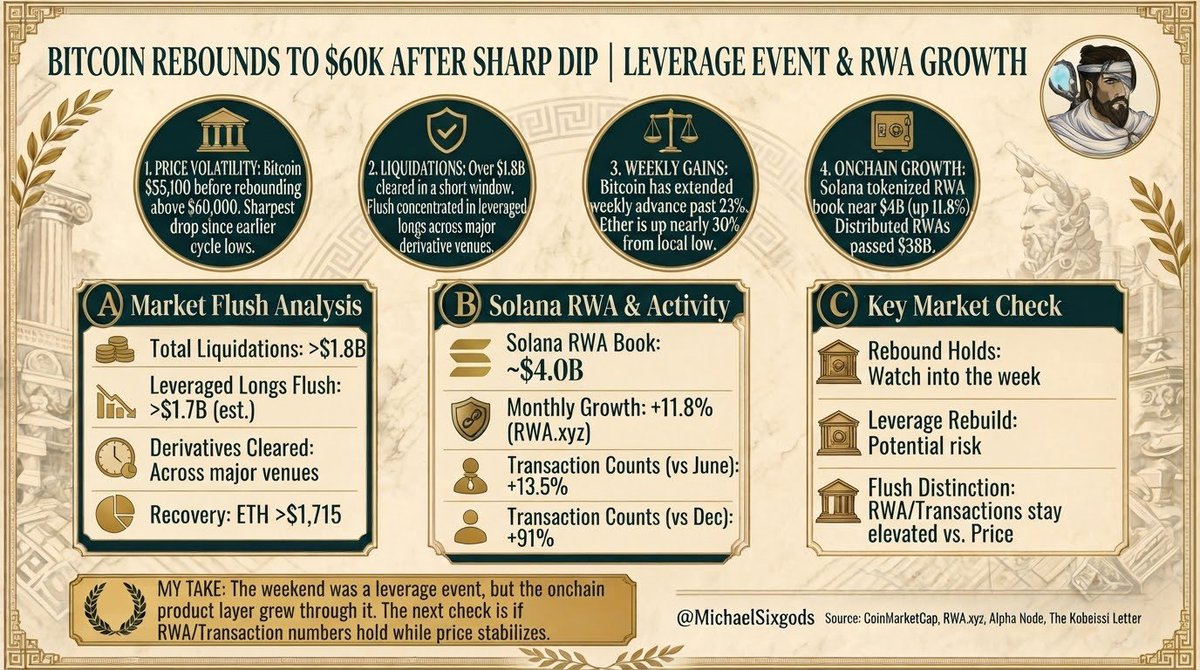
Bitcoin hit $55,100 over the weekend before rebounding above $60,000. The move cleared more than $1.8B in liquidations.
The drop was the sharpest since the multi-year lows earlier in the cycle. Ethereum recovered above $1,715. The flush was concentrated in leveraged longs. Derivative books across major venues were cleared in a short window. Bitcoin has since extended its weekly advance past 23%. Ether is up nearly 30% from the local low.
Solana’s tokenized RWA book is near $4B, up 11.8% over the past month according to https://t.co/Z5jxp2wheF. Distributed RWAs across tracked networks have passed $38B. The RWA number on Solana did not move with the price action. Transaction counts on the chain are also higher, up 13.5% from June and 91% from December.
The weekend was a leverage event. The onchain product layer kept growing through it. The next check is whether the rebound holds into the week or whether the same leverage rebuilds and gets cleared again. If the RWA and transaction numbers stay elevated while price stabilizes, the flush was mostly derivatives. If both fall with any further drop, the recovery is still thin.
Source: CoinMarketCap, https://t.co/Z5jxp2wheF, Alpha Node, The Kobeissi Letter
I think there's still a lot of room for prediction markets to grow.
@OutcomeXYZ is one project I'm keeping tabs on. There's an interesting opportunity here, especially with its connection to the Hyperliquid ecosystem.
Let's see what they do next.
Stablecoin supply fell about $16B in 30 days. Morpho liquidated $111M of debt since November 9.
Nansen put total stablecoin supply near $286B, down roughly $16B over the past month. Ethereum accounted for about $12B of the decline. Large holders redeemed USDT and USDC directly. The contraction started before the late-October Binance incident. Redemptions have slowed to about $3B over the past seven days from $4B the week before.
On Morpho, more than $111M of debt has been liquidated since November 9. That is 3.4 times the prior week. About 95% of the liquidated debt was on Base, led by cbBTC/USDC. Of 8,238 liquidations, only 212 were above $100k, yet those accounted for 68.5% of the debt repaid. Large allocators increased supply into the Base cbBTC/USDC market even as other lenders withdrew. Steakhouse vaults reported zero bad debt.
Morpho still holds $6.49B across 332 vaults. The largest remain under 5%: Steakhouse USDG on Robinhood Chain at ~$537M and 3.8%, Grove x Steakhouse USDC on Base at ~$514M and 4.7%. Higher RWA-linked rates are still in smaller vaults. The deposit base is still concentrated in the large curated vaults. The liquidations cleared leverage against crypto collateral, not against the RWA credit tokens.
Supply is still contracting. The largest vaults absorbed the stress without bad debt. The next check is whether the float stabilizes near $286B and whether more of the RWA credit book moves into the markets that just cleared leverage, or whether the deposits stay in the multi-hundred-million vaults that lend against more standard collateral.
Source: Nansen, Morpho Watch, Steakhouse
Okay One thing I normally look at when researching projects is how they handle change, especially when regulations are involved.
@Oly_Dao recently changed the Bank of OLY to the Guild of OLY. they didn't just rename it and move on, they explained why, while keeping the same structure and mission.
For context, OLY earns from real activity across ETH staking, Uniswap liquidity, and pools trading OLY against tokenised stocks on Robinhood Chain. There's also a payout contract where taxes from every trade go, and holders can view and claim their share.
Now, there’s the Guild: 1,000 founding Guild NFTs, each able to open up to 10 Branches. The model hasn't changed, just the name.
---
The whitelist is open, and mint details will be announced officially soon. I'll be keeping an eye on this one.
Apply here : https://t.co/IXay6V42gr
Applying doesn't guarantee a place but its worth a short.
Largest Morpho vaults sit under 5%. The RWA-linked ones that clear 11% are still small.
Steakhouse USDG on Robinhood Chain holds ~$538M at 3.9%. Grove x Steakhouse USDC on Base holds ~$521M at 4.5%. Sentora Huma PST Main is at ~11.7% on $82M. RockawayX Confidential RWA USDC is at ~11.8% on $16.6M. Flowdesk Confidential High Yield USDT is near 11–12% on $24M.
Hastra PRIME is already posted as collateral across Morpho markets at roughly $240M. The credit products that generate those tokens still total about $1.05B. Most of the deposit base is not chasing the highest RWA-linked rates. It is sitting in the large curated vaults that lend against more standard collateral.
The next check is whether more of the RWA credit book gets accepted as collateral at scale, or whether the 11%+ vaults stay small while the multi-hundred-million vaults remain the ones that actually hold the deposits.
Source: Morpho Watch, https://t.co/Z5jxp2wheF