@deletedcomeback@Ukraine@ZelenskyyUa Every state has some stupid heroes. They think they’re saving their country from bad things. Actually they are just bunch of peasants. They have no idea what are they doing or the damage they are causing.
The State Migration Service of Ukraine has decided to deport Ruslan (Aslan) Khakimov, a volunteer and developer of ground-based drones and robotic systems for the Ukrainian Armed Forces. #ukraine#russia#kazakhstan#Humanrights
After more than 20 years of Turkish bureaucratic obstructions, Haydar Bammat’s archives are being turned into a book by Circassian researcher and writer Cem Kumuk.
As for Alikhan Kantemir’s archive, it was stolen by the Americans from Germany after World War II and transferred to the Columbia University archives. Much like Turkey, they persistently hide these archives and prevent any research from being conducted on them.
I hope these archives, which are of great importance to the Caucasian struggle for freedom, will one day be opened and made available to researchers.
Haydar Bammat and Alikhan Kantemir. Paris, France, 1950s.
Haydar Bammat (1889-1965), a political figure and Minister of Foreign Affairs of the Union of the Mountain Peoples of the Northern Caucasus and Dagestan. An ethnic Kumyk. In emigration since 1921. One of the founders of the "Prometheus" Masonic Lodge, which consisted of Russian-speaking Muslims. He passed away on March 31, 1965, in France and was buried at the Muslim cemetery in Bobigny, near Paris.
Alikhan Kantemir (1886-1963), a public and political figure, ethnic Ossetian, and one of the leaders of the Mountainous Republic (1918-1920). In 1921, he emigrated to Turkey, where he took an active part in the activities of Caucasian political organizations, for which he was expelled from Turkey in 1938 at the request of the USSR Embassy. He lived in Germany. After the end of World War II, he worked at the Institute for the Study of the USSR. He died and was buried in Munich in 1963.
This is not the only example of this kind. On numerous previous occasions, they have detained critically ill, pregnant, and elderly people for no reason whatsoever, and kept them in isolation for months or even years without bringing any charges or holding a trial. This is a system of cruelty established by the Turkish state to intimidate Muslims. Especially Caucasian and Central Asian Muslims.
Camide bir gariban, bir çöp poşetinde elbiseleri yatacak yeri yok hoca camide kalmasına izin vermedi. Dağıstanlı bir Müslüman tedavi için Mısıra gidip gelirken İstanbulda tutuklamışlar 7 sene yatmış işidçisin diye, bişeyden haberi yok, Rus elçiliğine götürdüm evrak çıkarsın diye
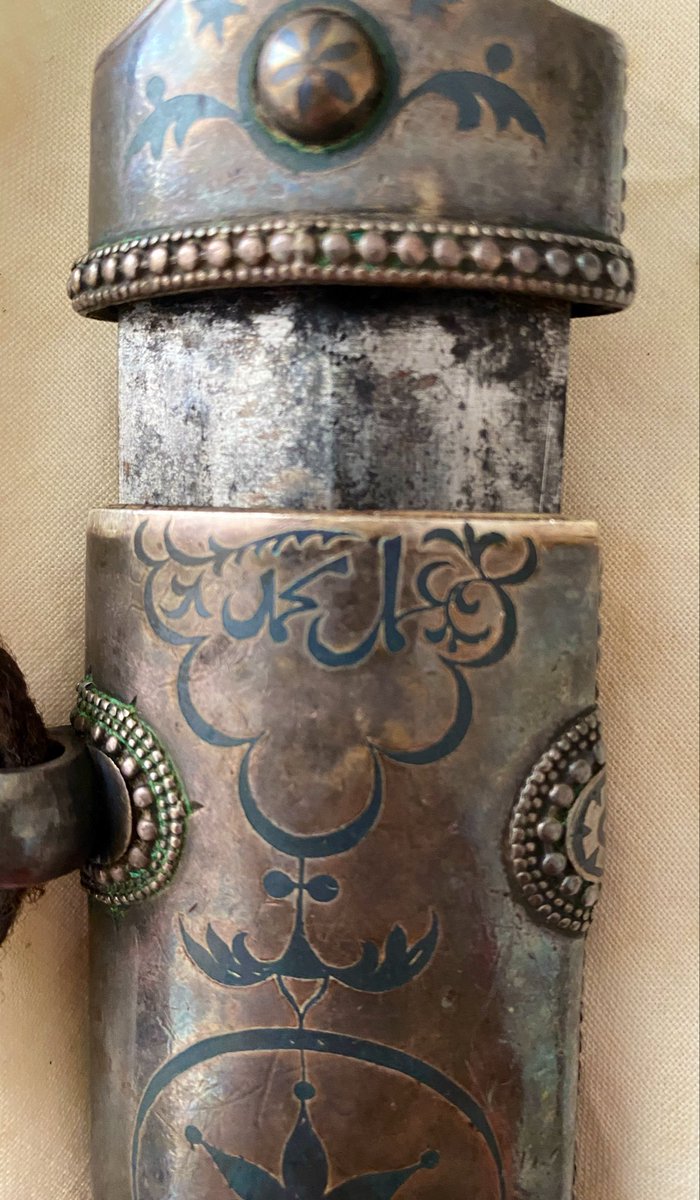
The bladesmith's mark on my own kindjal, passed down to me from my grandfather, and to him from his ancestors. I estimate it to be about 180-200 years old. It is a Dagestani piece with an unfullered steel blade and silver niello work. There is no date, but the name can be clearly read as عمل محمد meaning the work of Muhammad.
Until 1931, the city of Cherkessk was named Battalpashinsky. This name comes from Battal Pasha, whom the Ottoman Empire sent to the region as a fully authorized governor at the head of a 30,000 strong force where more than half of it consisted of Caucasian volunteers. However, he took bribes from the Russians and switched to their side. He simply sold his soldiers, his state and Caucasians for the Russian gold coins.
Because of Battal Pasha’s betrayal, thousands of Ottoman soldiers were devastated against the Russian army, and thousands of Caucasian volunteers who gathered to support them were unfortunately massacred.
Now, the descendants of Battal Pasha are making some bizarre demands. First of all, I advise them to apologize. After that, knowing how to feel ashamed and remaining silent would be the best thing for them.
@GrandWizard_99 While you were wandering around the mountains with your ass exposed, we were a settled culture 5000 years ago. Stop being so gypsy-like. It's 2026 already.
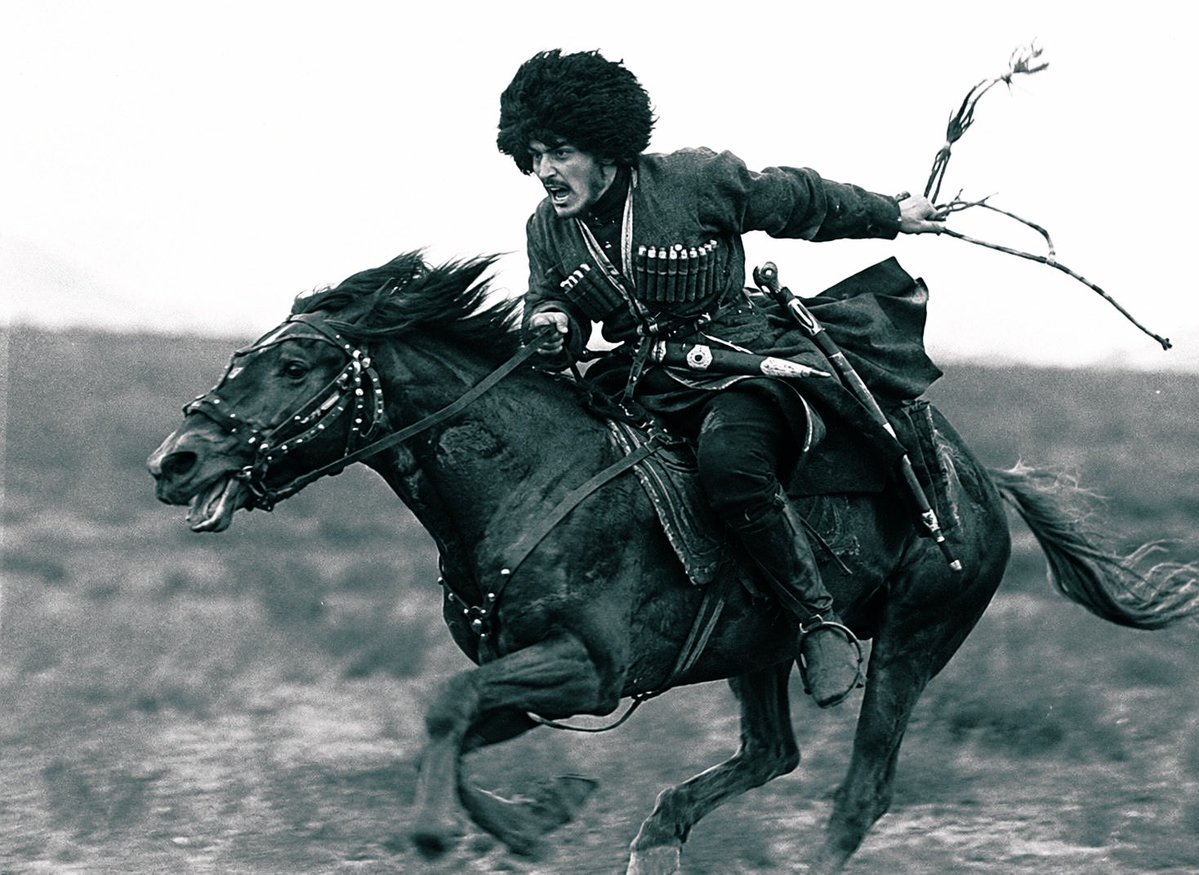
1. The word papakh is not found in the oldest Turkic records, such as the Orkhon Inscriptions or Mahmud al-Kashgari’s Divanu Lugati't-Turk (11th century). This proves it was not a common military or social term during the early periods of Turkic history in Central Asia.
2. It is also missing from important historical dictionaries like the Codex Cumanicus, which reflects the culture of the Cuman/Kipchak people of the northern steppes, and the Mukaddimetü’l-Edeb, which represents the Khwarezm region. This confirms that the "papakh" had no connection with the Khazars or the nomadic tribes of the Eurasian steppes.
3. Detailed studies of the original Dresden manuscript of Dede Korkut also show that the words "papakh" and "kalpak" do not appear. Instead, the text only uses the ancient Turkic word "börk" for headwear.
4. The fact that the word is missing from all major Turkic texts before the 16th-17th centuries confirms that the papakh was a local adaptation. It appeared after Turkic groups settled in the Caucasus. This headwear was likely adopted from local Caucasian peoples (like Circassians, Georgians, Chechens or Dagestanis) to survive the harsh mountain climate and combat conditions.
5. Turkic groups who had no historical contact with the Caucasus (such as the Uyghurs, Tuvans, Chuvash, and Gagauz) do not have this word or the headwear in their languages. This is clear proof that the papakh is a regional development, not a shared ancient heritage.
6. The name Qarapapaq likely started because Azerbaijanis in the Caucasus integrated this specific "black fur hat" into their identity. Because they used this headwear so consistently, other Turkic groups began to identify them by it (like qarapapaqli). Over time, this description turned into a formal name for the tribe.
7. In conclusion, the birth of the papakh as a specific type of headwear and its entry into written records is entirely the result of a cultural synthesis in the Caucasus region.