This work has been accepted for Oral presentation at the SeT LLM workshop @ ICLR 2024!
I have another paper that will be presented as a Spotlight. Looking forward to meeting new and old friends in Vienna 🇦🇹~ @iclr_conf#ICLR2024#LLMs#MachineLearning#NLProc
Prompt-Driven LLM Safeguarding via Directed Representation Optimization
"we investigate the impact of safety prompts from the perspective of model representations. in models' representation space, harmful and harmless queries can be largely distinguished, but this is not noticeably enhanced by safety prompts. Instead, the queries' representations are moved by different safety prompts in similar directions, where models become more prone to refusal (i.e., refusing to provide assistance) even when the queries are harmless."
paper: https://t.co/14zhrSQw5A
code: https://t.co/MrRmDRnQdt
✨New Paper Alert✨
Adding safety prompts can safeguard LLMs against harmful inputs, but do you know how they intrinsically work?
Check our latest paper: We study the working mechanisms of safety prompts from the perspective of model representations
📄https://t.co/nX7UMTyKus
Our paper has been accepted to ICLR 2024 as a Spotlight! See you in Vienna🇦🇹~ @iclr_conf#ICLR2024#NLProc#LLMs#MachineLearning
BTW, I will also be in the job market (academia or industry, expected graduation in 2025). Welcome to talk about future opportunities 😆
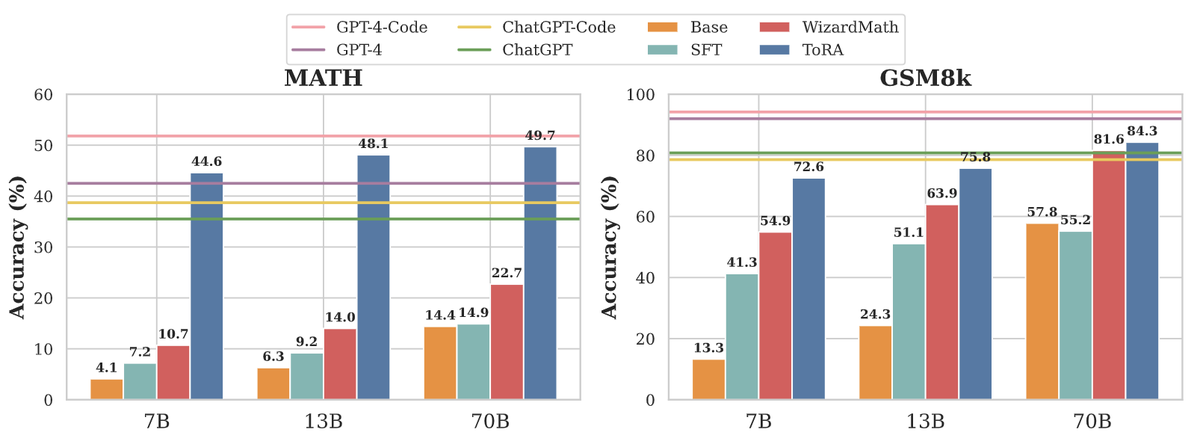
With self-consistency, ToRA-34B improves from 51% to 60% on the competition-level MATH dataset, and ToRA-70B scores 88.3% on GSM8k.
Paper Page: https://t.co/9FMituoNqB
Models: https://t.co/HEgFgjsgfB
Github Repo: https://t.co/BYCxSGXYQf
Introducing ToRA, which solves #math problems by integrating natural language reasoning with program-based tool use.
ToRA models beat SoTA on 10 datasets. On MATH, ToRA-7B scores 44.6%, and TORA-34B is the first open-source #LLM to surpass 50%, outclassing GPT-4’s CoT result.
🌟Our new paper🌟
On Large Language Models' Selection Bias in Multi-Choice Questions
- Analyze LLMs' bias and robustness in multi-choice questions
- Propose a simple, efficient, and generalizable debiasing method
📄https://t.co/kiIzYi6ieo
#NLProc#NLP#ChatGPT
🧵1/6
Should reasoning thoughts be produced auto-regressively, following a pre-defined or logical order? Not necessarily!
We present CANTOR, the first non-autoregressive numerical reasoner that produces diverse thoughts in parallel, and then chains proper ones into a precise solution.
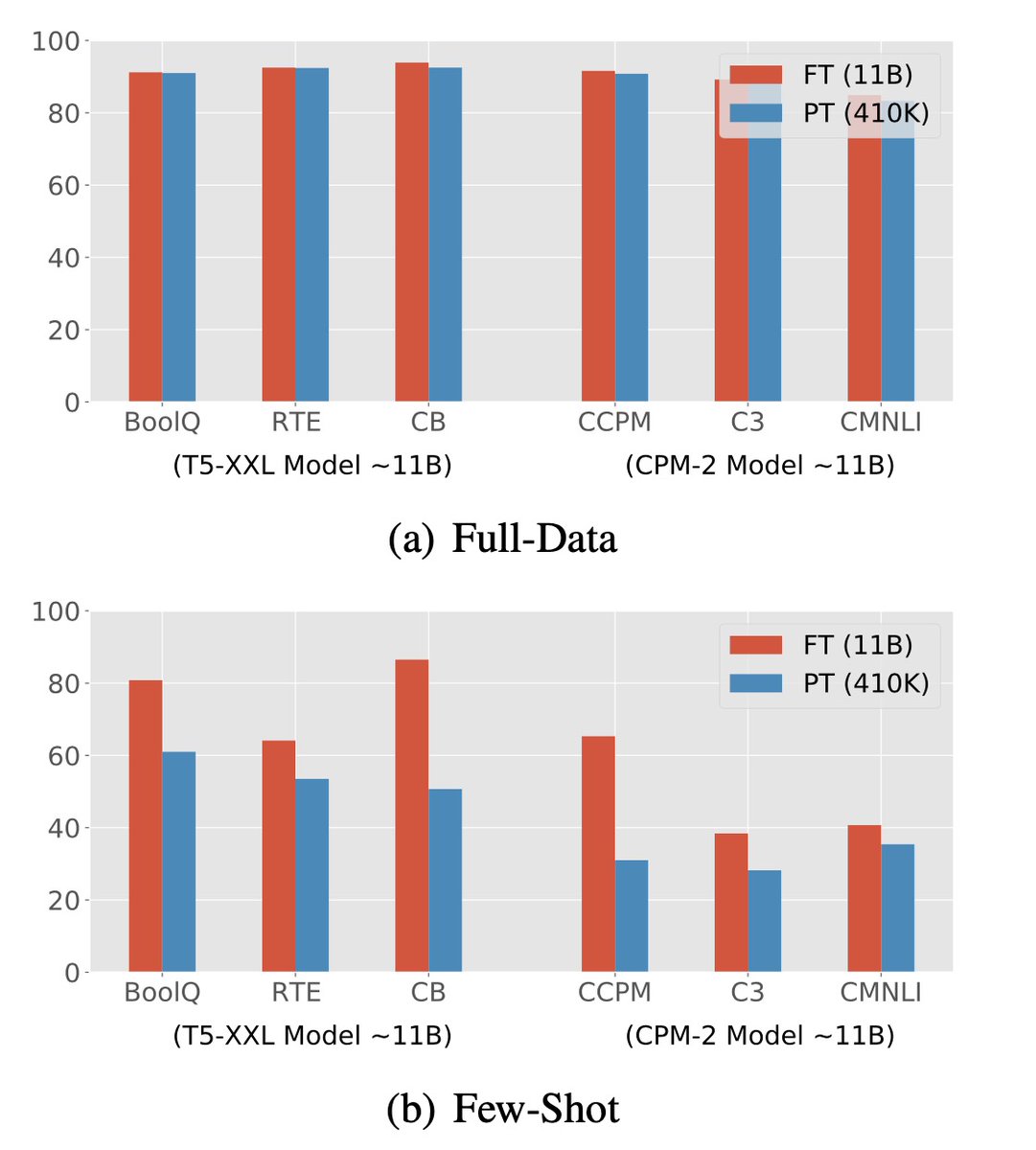
We investigate prompt tuning in few-shot learning and find that soft prompts are hard to optimize which leads to their bad performance when the training data are insufficient. #ACL2022#TsinghuaCoAI#TsinghuaNLP
Open-domain questions are likely open-ended and ambiguous. To find every plausible answer, we propose a recall-then-verify framework for more comprehensive exploitation of evidence from a large-scale corpus. #acl2022nlp#NLProc@TsinghuaCoAI
https://t.co/W3SoZyym34
Our #ACL2021 Findings paper proposes a new task, stylized story generation, namely generating stories with specified style given a leading context. We propose a novel generation model and two automatic metrics for the task.
Paper: https://t.co/vZ2ZefIxn7
#NLProc#TsinghuaCoAI
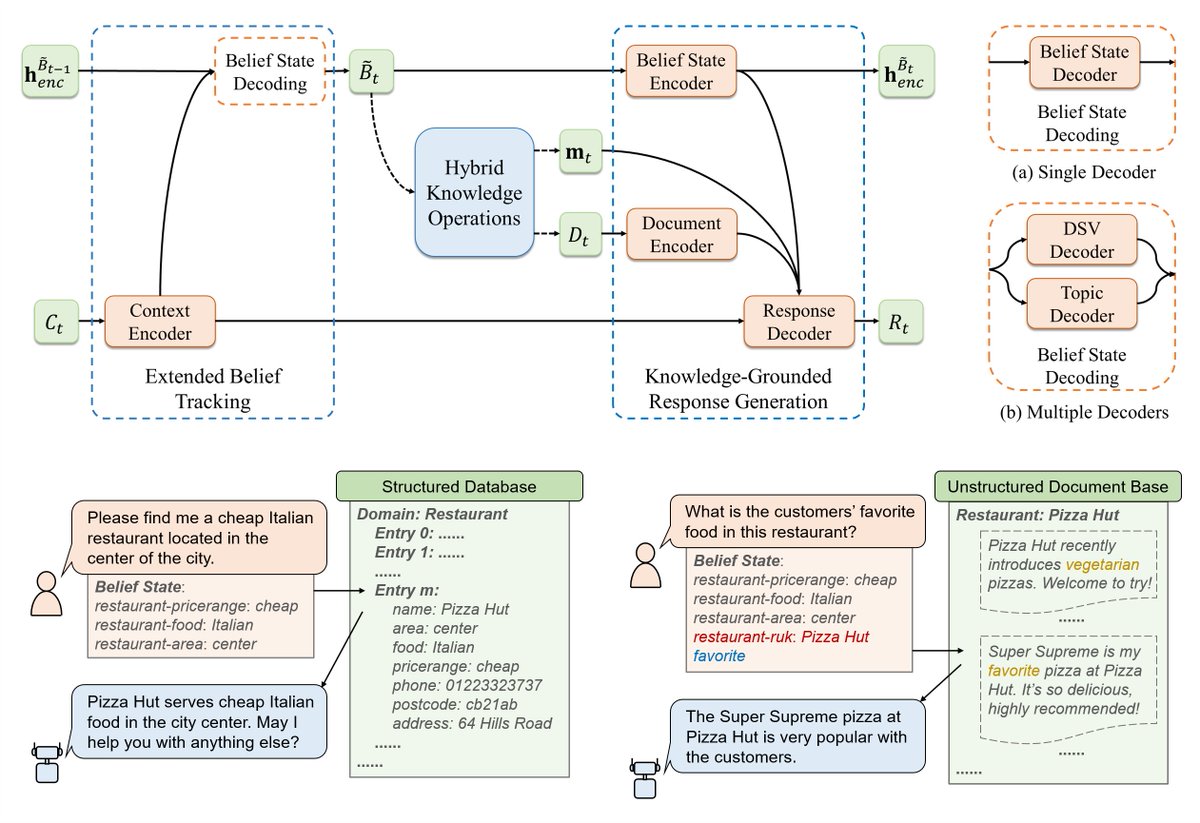
Our #ACL2021 Findings paper defines a task of modeling Task-Oriented Dialog (TOD) grounded on hybrid knowledge, and propose an end-to-end system HyKnow to address the task.
Paper: https://t.co/NHOFwiDsqr
Code: https://t.co/Gr7IFsbgox
#NLProc#TsinghuaCoAI
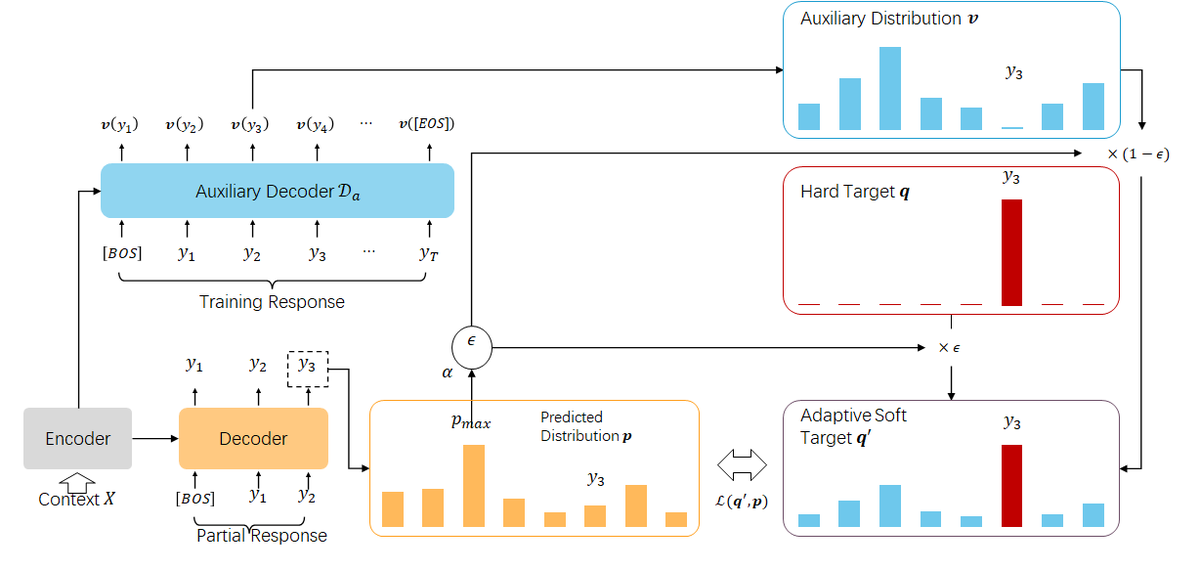
In our #ACL2021 paper, we propose an Adaptive Label smoothing (AdaLabel) method that can produce a soft target distribution considering the current context and the model’s confidence.
Paper: https://t.co/n1FCwz86tl
Code: https://t.co/Ty4r5Fln6r
#NLProc#TsinghuaCoAI
In our #ACL2021 Findings paper, our model JointGT with structure-aware encoding mechanisms and elaborate pre-training tasks achieve SOTA performance on several graph-to-text generation datasets.
Paper: https://t.co/PJRA2f1aYO
Code: https://t.co/8KUKuelkAp
#NLProc#TsinghuaCoAI
In our #ACL2021 paper, we propose a long text generation model named HINT, which can represent the prefix sentences at sentence level and discourse level in the decoding process.
Paper: https://t.co/JLMZXocsPF
Code: https://t.co/4XA7HZmaC2
#NLProc#TsinghuaCoAI
Automatic metrics are essential for developing story generation models. In our #ACL2021 paper, we propose OpenMEVA, a benchmark for evaluating open-ended story generation metrics.
Paper: https://t.co/nbiK7CrQl9
Code: https://t.co/8wImMsAraP
#NLProc#TsinghuaCoAI
Robustness is a critical issue in practical use. In our #ACL2021 paper, we present a systematic robustness evaluation of LU in task-oriented dialog using our data augmentation toolkit LAUG.
Paper: https://t.co/oTR3tQ9pOq
Code: https://t.co/8ZC8WbYOpe
#NLProc#TsinghuaCoAI
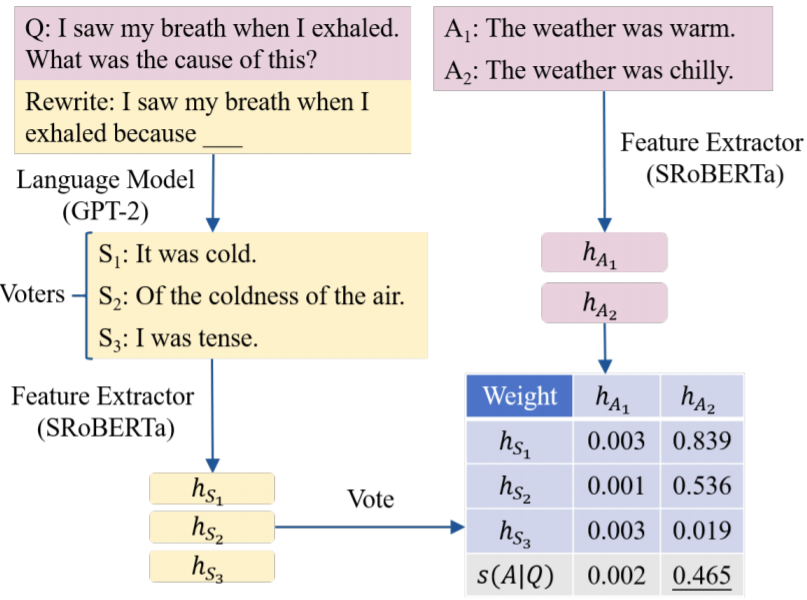
Some unsupervised commonsense QA methods rely on sentence probability, which is sensitive to distracting factors. In our #ACL2021 paper, we propose a semantic-based method, which alleviates the influence of distracting factors.
Paper: https://t.co/eThIwxV1L9
#NLProc#TsinghuaCoAI