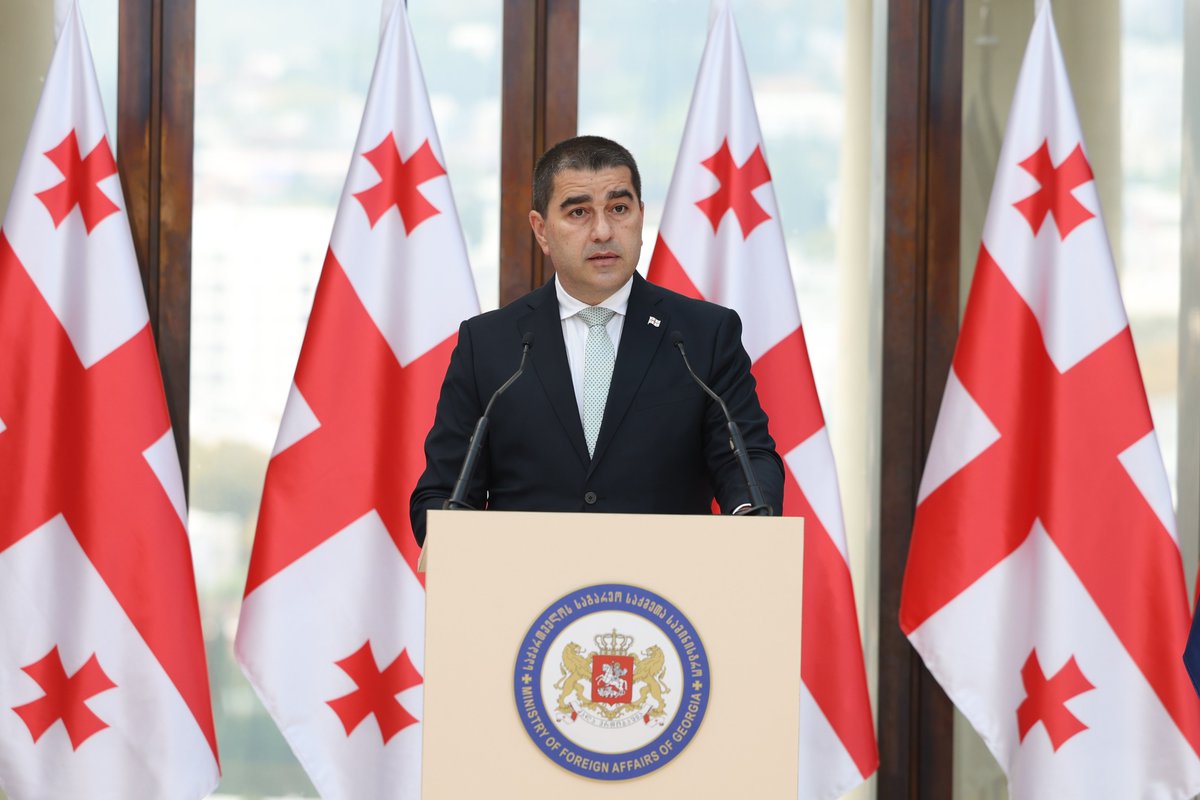
Speech delivered at the event dedicated to Diplomat’s Day
***
Happy Diplomat’s Day! This day is a good opportunity to thank all Georgian diplomats who have served Georgia’s interests in different eras and countries, and continue to do so today. Diplomacy is a profession that often remains behind the scenes, yet an important part of a country’s international standing is shaped there, through daily negotiations and difficult dialogue.
Today I would also like to pay special tribute to the foreign diplomats who represent their countries in Georgia. Diplomatic relations are successful when, despite differing interests, we are able to listen to and respect one another and sustain our partnership. It is on such relations that trust is built, and these relations need honesty, responsibility and restraint most of all.
One year ago, on this same day, I said that the rules-based international order was under unprecedented pressure. The past year has shown us that this was no mere theoretical warning. Today, international relations are increasingly returning to the harsh logic of power, interests and influence. The outbreak of new wars has almost become an everyday occurrence; the sovereignty of countries is undergoing an unprecedented test, while the principles of international law are disregarded precisely when their protection is most needed.
Thirty-five years ago, when Georgia restored independence, we looked much more optimistically toward the world we were rejoining. We thought that the end of the Cold War would usher in an era in which relations between states would be shaped increasingly by law and less by force. Today, we have more experience. Today, we know that international politics has never been a realm of sentiment. States act in accordance with their own interests. Recognizing this is not cynicism; it is a necessary precondition for responsible foreign policy.
Therefore, I want to say this in particular to Georgian diplomats: do not hesitate to defend Georgia’s sovereignty, whether in dealings with an adversary or a friend. Sometimes, it is a friend who most needs to be reminded that partnership does not mean replacing another’s political will with one’s own; friendship does not override sovereignty, and even good intentions cannot justify interference in another state’s domestic affairs.
Georgia should not demand respect for the principle of non-interference from others alone. We must set an example ourselves in respecting international law. A Georgian diplomat in a foreign country should be Georgia’s representative, partner and friend, but not a participant in that country’s domestic political processes. We should respect the choices of other peoples just as we expect our own people’s choices to be respected. If we want to restore the international order, we must return to these simple principles: sovereignty, equality, non-interference and mutual respect.
This is especially important for small and medium-sized states. A large state may sometimes think it can easily bear the cost of violating the rules. For a small state, however, international law and respect for sovereignty are among the main guarantees of security. Therefore, the task of Georgian diplomacy today is not only to explain our positions. Your task is to defend Georgia’s national interests in a world where interests are increasingly intersecting directly and openly. This requires both principle and flexibility, forging of partnerships, and an understanding of where the line lies between compromise and surrendering our own interests.
Georgia’s main state objectives remain unchanged: peaceful reunification of the country, strengthening our independence and sovereignty, and the well-being of the Georgian people. Every foreign policy decision must ultimately serve these goals. Diplomacy has meaning only when it produces tangible results for the country: peace, security, economic opportunities, and friends and partners who respect Georgia - not because it agrees to everything, but because they know it is a state with interests of its own and the ability to defend them.
Dear diplomats, you are often Georgia’s first voice abroad and the first voice of foreign countries in Georgia. You therefore bear a special responsibility: to build bridges, but never to lose sight of the shore from which those bridges begin. That shore is Georgia. Georgia’s sovereignty, national interests, peace and well-being must be the principal measure of your work.
On behalf of the Parliament of Georgia, I congratulate you on your professional day and thank you for your devoted service to the Georgian state. I wish you strength, wisdom and success in serving Georgia.
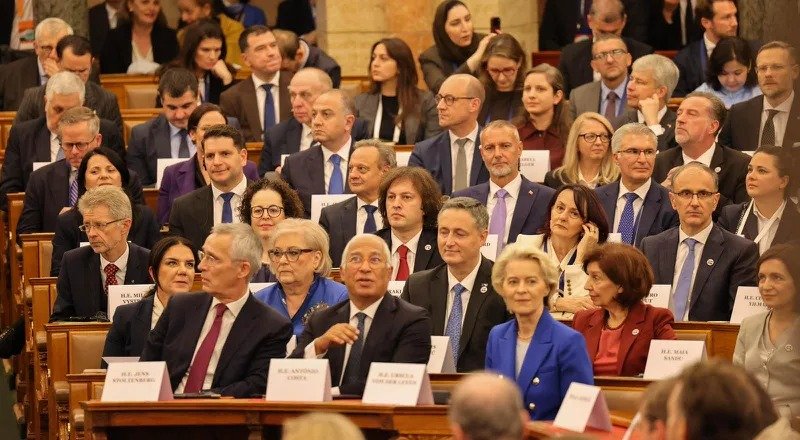
🤝At the invitation of Hungarian Prime Minister Péter Magyar, 🇬🇪Georgian Prime Minister @PM_Kobakhidze attended the 70th-anniversary events dedicated to the Hungarian Revolution in Budapest.
Speech at the European Conference of Presidents of Parliament on “Resilient Democracies: United Against Hybrid Threats”
Democratic resilience begins with a simple truth: a democracy unable to answer to its own citizens, or act in its own national interest, is already compromised before any threat arrives.
Hybrid threats, including disinformation, cyber intrusion, covert funding, foreign interference, rarely act alone. Theyreinforce one another, targeting the same thing: the integrity of our democratic institutions and decisions.
Among these tools, Foreign Information Manipulation and Interference (FIMI) is the most widespread and consequential, typically taking the form of coordinated disinformation campaigns timed to strike especially during elections or political unrest.
In Georgia, two years ago, even with the most advanced technical safeguards for elections in place, disinformation and false allegations of election irregularities enhanced polarization and fueled unrest around the vote. Some groups, funded from abroad, worked to weaken public trust in the fairness and legitimacy of the electoral process itself. This is a clear reminder that resilience in the information space may prove crucial in safeguarding the state sovereignty and, thus, democratic practices.
Covert foreign funding deserves particular scrutiny, because it is often the least visible and most corrosive means of undermining democracy and sovereignty. When outside actors fund specific domestic political forces, they harden divisions, turning ordinary political debate into a vehicle for enforcing their preferred line of thinking and deepening political polarization.
A growing number of states, some that once condemned this kind of legislation elsewhere, now confront these risks at home: Australia, Canada, France, the United Kingdom, the United States, and many others are tightening their own transparency and foreign-funding legislation. This body of legislation has become an important tool for ensuring defensive democracy and strengthening democratic resilience.
Safeguarding transparency of foreign funding is not a departure from democratic values, but, to the contrary, is a means of their defense. The principle is that a government answerable to its people needs visibility over the money and influence moving through its political space.
Interference is rarely one-directional. Many states that decry the erosion of the international order are, at the same time, trying to shape internal affairs of others. National parliaments should not face this challenge in isolation. The Council of Europe’s recent work, from the resolution on foreign interference to ongoing discussions on safeguarding democracy and elections, already provides a foundation.
Foreign interference is dangerous for sovereignty and democracy irrespective of whether it comes from a hostile or non-hostile actor. Foreign interference in itself is a hostile act, because its purpose is the restriction of the people’s freedom and democracy. Therefore, it is hostile whether it comes from enemies or frenemies.
A common international standard is the only way out of this cycle. The time has come to create a standard on transparency and regulation of foreign interference and funding, grounded in sovereignty, accountability, and consent.
Only resilient, accountable democracies, aligned on shared rules, can stand firm together against hybrid threats.
The disinformation-laden statement made yesterday by the EU representative to the United Nations is concerning, as he repeated the customary rhetoric, recycling the worn-out falsehoods about “arbitrary detentions” and “repression” in Georgia.
It is troubling that, once again, a statement by EU officials stands in complete contradiction not only to the facts, but also to the values and principles professed by the European Union itself, which does requirer an answer.
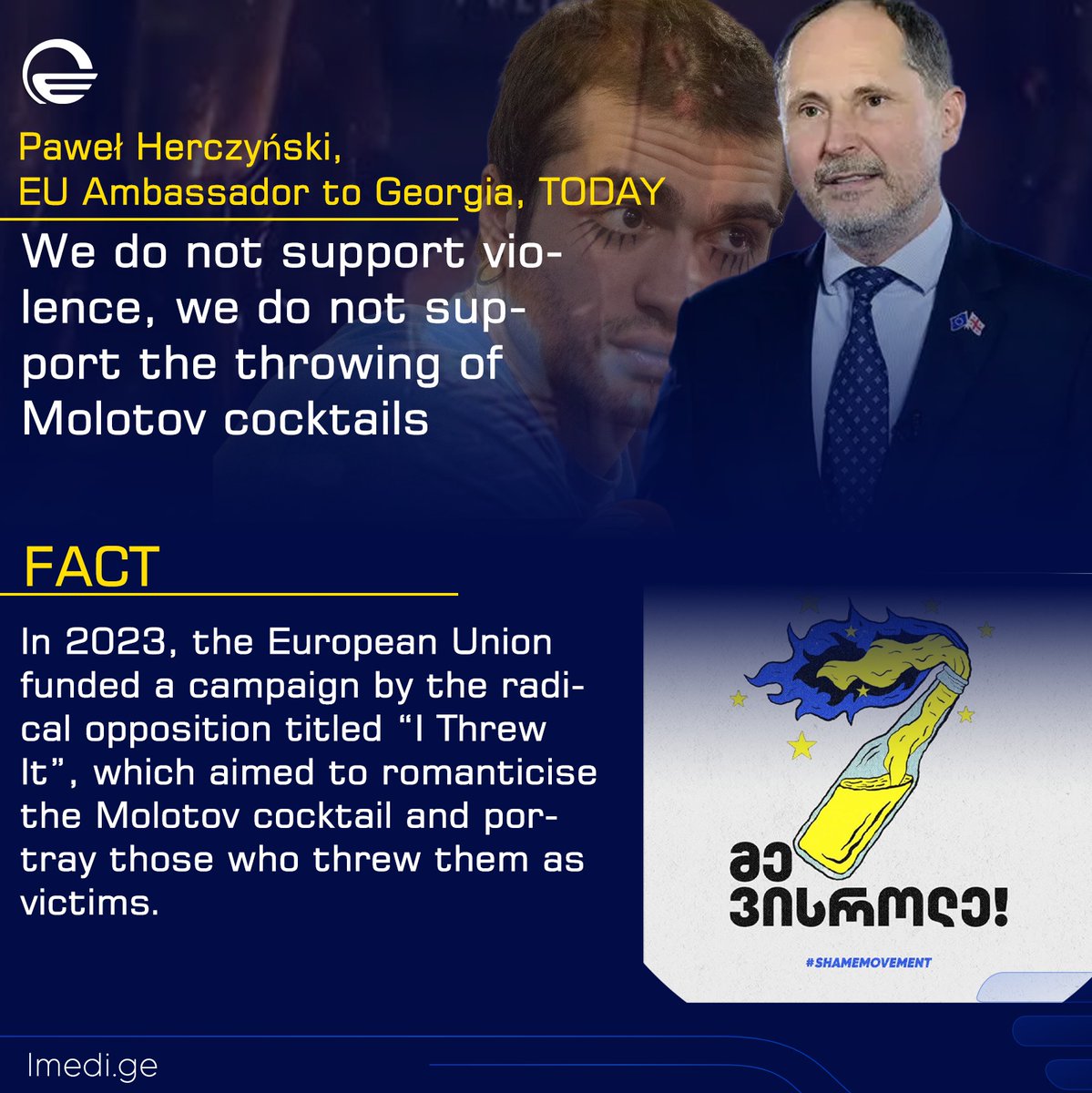
It has now long been clear to everyone that the violent protests against the Georgian Government were financed, in part, with EU funds, including a campaign that justified and encouraged the use of “Molotov cocktails.” Moreover, it was precisely after Brussels gave its virtual green light that the failed attempt to overthrow the Government was launched on 4 October last year.
The people and the Government of Georgia duly defended the country, its freedom, sovereignty, and interests. Today, it is clear to everyone that the foreign-funded revolutionary process, which was underway since 2024, failed. The false reality that was imposed in an attempt to overthrow the Government in Georgia has dissipated. Yet those who financed this falsehood have themselves become prisoners of their own false narrative, so much so that they remain unable to break free from it to this day.
The false narratives of a “rigged election” and a “crackdown on peaceful protests” have been disproved by time and reality. The violent crimes have now been investigated, verdicts have been delivered, and everything has been documented and recorded. Moreover, the crimes have been admitted by the perpetrators themselves. Facts have once again prevailed over perceptions.
A lie cannot become the truth merely because Brussels insists on repeating it, nor can a perpetrator become a victim merely because some EU official wishes it so. Yesterday’s statement by the EU’s official representative once again confirms that Brussels’ policy towards Georgia has reached a dead end. Brussels resembles a soldier who has failed to realize that the war is over and continues to plan military operations.
It is time for Brussels to emerge from its world of illusions. If EU officials wish to normalize relations with Georgia, they must end their aggressive rhetoric, cease providing communications support for the failed revolutionary scenario, and return to the fundamental principles of diplomacy: respect for facts, Georgia’s sovereignty and the democratic choice of the Georgian people.
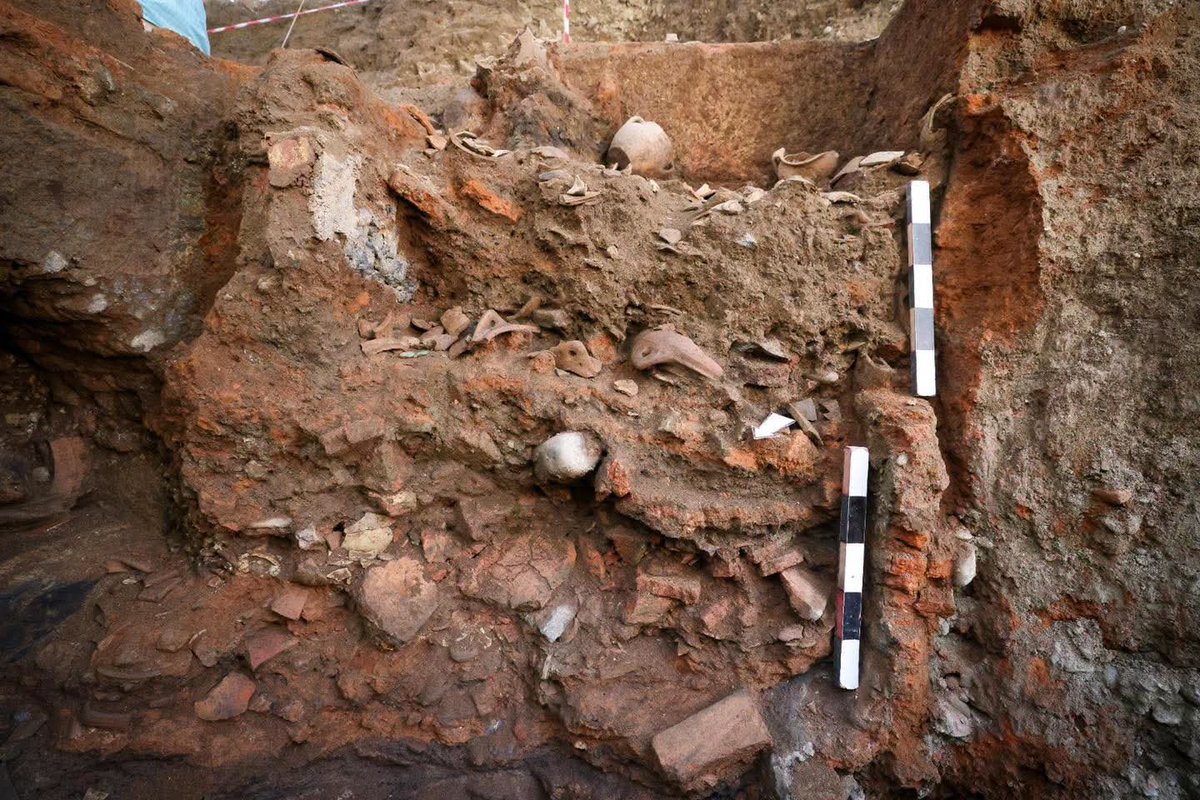
An ancient pottery workshop, along with impressive artefacts, has been unearthed in front of the Georgian Parliament palace during the renovation of Tbilisi’s famed main thoroughfare, the Shota Rustaveli Avenue.
By early estimates, the workshop belongs to X-XI centuries, when the city sat on the renowned Silk Road, connecting East with West. The newly discovered workshop and the artefacts indicate that the level of urban development of Tbilisi was high even a millennium ago and that the Rustaveli avenue, as today, used to be at the center of the city’s life.
There is a growing impression that Europe’s major powers are planning to take over the European Union, an undertaking that would pose a fundamental threat not only to Europe’s political balance and the enlargement process, but also to the values on which the European Union was founded and which have sustained it to this day.
According to the German Foreign Minister, twelve countries have already joined Germany’s initiative to abolish the principle of unanimity in EU decision-making. If this initiative is implemented, the European Union will, almost certainly, be transformed from a union of equal member states into a union ruled by the major powers.
Membership of the European Union is not an end in itself. This is true neither for its current members nor for candidate countries. Brexit is the clearest proof of this.
Membership is a means by which a country can protect its national interests more reliably, expand its opportunities and acquire a degree of influence over international decision-making that it could not attain through its size, economic weight and political resources alone.
For smaller states, the principal guarantee of this opportunity is the principle of unanimity. It is precisely the unanimity rule that ensures that the voice of a small country is not lost amid the interests of the major powers and the arithmetic of the majority. It gives a small state the right to block a decision that would be harmful to it and to demand that its national interests be taken into account.
If the principle of unanimity is abolished and decision-making becomes entirely dependent on the will of major powers or entrenched majorities, smaller countries will lose this fundamental instrument. They will no longer be able to protect their vital interests when those interests do not coincide with the political agenda of the majority.
In such circumstances, the issue would no longer be one of sharing part of a country’s sovereignty through EU membership - a voluntary and balanced choice currently made in pursuit of broader economic, political and security objectives. Instead, it would amount to the almost complete loss of genuine sovereignty.
A state that can no longer block decisions harmful to it, and upon which obligations may be imposed against its will, gradually loses not only its freedom to make decisions, but also its very statehood. From an independent political entity, it is reduced to a small region or province within a much larger political system.
Such a model may be advantageous to the major powers, since their size, economic weight and political influence already give them a considerable advantage in the decision-making process. For smaller countries, however, it would be a catastrophic change.
The question will therefore become increasingly urgent: what is the point of membership if its principal benefits and instruments of influence are taken away from the outset?
EU membership is important precisely because it enables a country to support decisions that benefit it, advance its own interests and prevent decisions that would cause it harm. If a country is deprived of these possibilities, the European Union itself is stripped of its significance as a means of protecting national interests. Consequently, both the political appeal of membership and its fundamental rationale disappear.
Moreover, under such conditions, remaining outside the European Union might even prove more advantageous for a small state, since it would at least retain the freedom to make its own independent decisions.
Nor should it be ruled out that one of the indirect objectives of this discussion is precisely to halt enlargement. It is becoming increasingly clear that no one is contemplating the admission of new members into the European Union in its current form.
Candidate countries are being offered not equal membership in the existing Union, but membership in a pre-emptively altered system in which they would assume all the obligations arising from membership while their principal rights and instruments of influence would be restricted.
The central question, therefore, is not merely when we will be admitted to the European Union. The central question is: what kind of European Union are we being invited to join, with what rights and with what degree of equality as a member?
For membership that deprives a country of its sovereign rights without providing mechanisms for their protection is not integration, but the abolition of sovereignty.
And yet, it appears permissible for Jupiter even to capture Europe.
It would be impossible to illustrate the essence of a terrorist act more precisely than the prominent representatives of the radical opposition have themselves managed to do. Since yesterday, we have been reading and hearing assessments of the political motives behind Aleksandre Elisashvili’s actions, one of the leaders of @ALDEParty member party Lelo - assessments that, in fact, directly demonstrate why we are dealing precisely with terrorism.
When we speak about terrorism, we must understand that terrorists are not maniacs acting without motive. Each of them attempts to find a “noble” justification for their crime. Sometimes it is presented as a struggle for freedom, sometimes for justice, and at other times some other pretext. Elisashvili’s closing statement was therefore a typical example of terrorist thinking: he claimed that he was fighting injustice, oppression, and an occupying force.
However, a crime cannot be justified by the objective proclaimed by its perpetrator. On the contrary, justifying a violent act on political or ideological grounds is one of the principal characteristics of terrorism.
Within minutes of the verdict being announced, another circumstance became clear: we are not dealing merely with one specific terrorist act. We are witnessing a group of people with a terrorist mindset who, in words, supposedly oppose the Soviet past, but who, in practice, have become loyal adherents of the central moral formula of Bolshevik terror: “the end justifies the means.”
They arrived at this point logically and consistently. In fact, in the space of only a few years, we have witnessed an evolution of evil before our very eyes:
▪️ First, they justified verbal violence and violations of human dignity;
▪️ Then, they justified physical violence and harm to human health;
▪️ Afterwards, they justified setting Parliament on fire and storming the Presidential Palace - that is, attacks against the state and its constitutional institutions;
▪️ And now, they are already seeking political and moral justification for terrorism - this unequivocal evil against humanity.
When a person justifies each successive stage of violence, the boundary of what is considered morally permissible becomes increasingly blurred. Society must therefore clearly recognize that those who today justify an attempted terrorist act by invoking “just causes” will tomorrow use the same formula to justify an actual killing.
This is all the more concerning given that we have repeatedly witnessed representatives of this same political circle publicly rejoicing over the deaths of their opponents.
Thus, some willingly and others unwillingly, some consciously and others without fully realizing it, this entire cohort has developed into a hostile fifth column operating against the country - one that believes it has been given an externally sanctioned green light for radicalism, extremism, and now even terrorism.
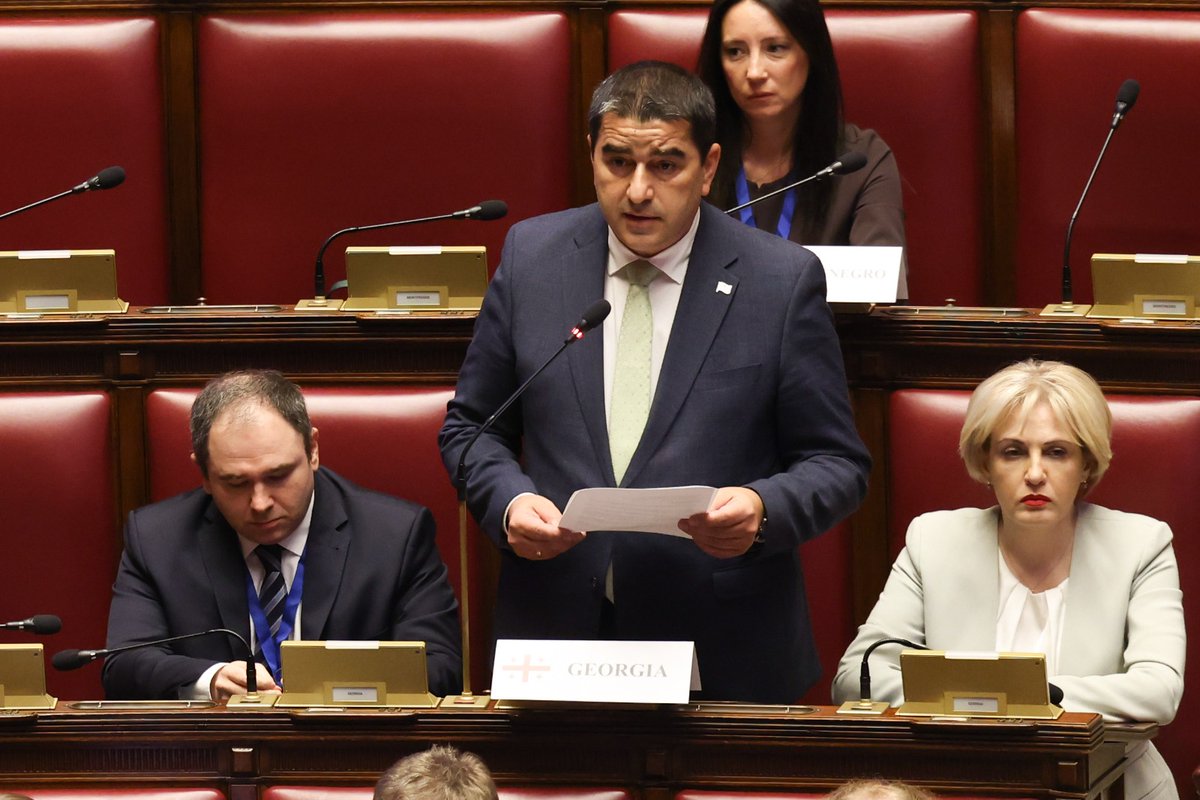
Speech delivered at the Inaugural Conference of the Speakers of Parliaments of EU Candidate Countries in Belgrade, Serbia
****
I thank the National Assembly of Serbia and the Verkhovna Rada of Ukraine for initiating and convening this inaugural gathering of the speakers of parliaments of the EU candidate countries.
It is very important that the coordination of integration efforts of the EU candidate states extends to national parliaments. While governments negotiate, it is the parliaments that give democratic legitimacy to European integration. On behalf of the Parliament of Georgia, I have several messages to share with my colleagues.
First, the enlargement of the European Union is the main vehicle for Europe’s future strategic viability. The new political and economic reality in the world, global competition, and the evolving distribution of power all require EU’s changed attitude towards enlargement. Maintaining a Fortress Europe for decades, without enlargement, is no longer a viable option. The title of our gathering, ‘Shaping Europe’s Future Together’, captures this momentum well: The candidate countries must be seen as participants of the enlargement process, not its objects. The EU cannot afford any more to see itself as an exclusive club that dispenses or withholds the grace of accession to the candidate countries. To the contrary, now EU must get serious about its own overused metaphor: “It takes two to tango”.
Second, the enlargement should be a merit-based process. The achievements and merits of each candidate country must be assessed fairly, predictably, and consistently. Conditions must be clear, the progress must be duly recognized, and the goalposts must not be moved for political purposes. But, unfortunately, every now and then, new and unpredictable preconditions are invented by individual EU member states, or more oddly, by Brussels. These unpredictable preconditions artificially delay the progress of the candidate states. It is more than obvious that these preconditions often resemble political blackmail more than constructive conditionality. They stem from EU’s election cycles, domestic political narratives, or from historical and identity-related disputes. No single candidate state can withstand the asymmetric leverage of an existing member state blocking progress on subjective grounds. Therefore, we must help each other in overcoming these undue obstacles.
Third, we must avoid the impression that candidate countries are competitors rather than partners. Such fragmentation weakens us. When we face problems one-by-one, our voice is weaker, our leverage is reduced, and the enlargement becomes easier to delay, politicize, or treat it as an indefinite process. We should avoid the parliamentary format of the candidate countries becoming a forum for ranking, lecturing or importing bilateral disputes. It should be a forum for practical cooperation and joint initiatives. The joint declaration, which we are to adopt, clearly stipulates that we have gathered for unity, not division, and Georgian parliament fully endorses this message.
And, finally, the best way to address the European Union’s currently weakened geopolitical and economic positions is to step up the game and enlarge to strategically critical geopolitical areas – the Balkans and the Black Sea. This is why, EU should see enlargement as an historic opportunity to revitalize itself and regain global leadership, and not as a burden or charity, as often presented by some.
As Georgia’s national motto puts it, strength is in unity. Let us, therefore, use this gathering for the purpose of shaping our European future together.
The latest resolutions of the European Parliament and the Parliamentary Assembly of the Council of Europe have ultimately crossed the red lines established by the Georgian people and have grossly violated the principles of Georgia’s sovereignty and national independence.
Acting in the name of the European Union and under the banner of European integration, the European Parliament has, in practice, disregarded the independence and sovereignty that the Georgian people won through struggle and bloodshed, and has insulted the very idea of Georgian statehood.
Through the report prepared by Rasa Juknevičienė, the European Parliament has effectively declared that the right to determine the legitimacy of Georgia’s government belongs not to the Georgian people but to the political bureaucracy in Brussels; that it is this bureaucracy that can decide who should govern Georgia and which government is acceptable.
This constitutes a rejection of the fundamental principles of democracy. Democracy is based on the sovereign will of the people, whereas the European Parliament is effectively asserting that the legitimacy of Georgia’s government should be determined not by the choice of the Georgian people but by the confidence of the European Union’s political elite. Such an approach reflects not the logic of a union of equal partners but that of feudal vassalage, according to which sovereignty is not a natural right of the people but a privilege granted from above.
In this way, the European Parliament has, in effect, equated itself with Russia’s occupation policy in its latest report. While Russia denies Georgia’s sovereignty over one-fifth of the country’s territory, the European Parliament refuses to recognize Georgia’s sovereignty over its entire territory.
It is also unprecedented that the European Parliament refers to Georgia’s former president, Salome Zourabichvili, who under the current Constitution and legislation holds no state authority, as the country’s legitimate representative, while describing the parliament, government, and president elected by the people as a “de facto government.” Such an attitude is disrespectful toward the 2.1 million voters who expressed their political will in the parliamentary elections.
The European Parliament’s resolution is not directed solely against Georgia’s democratic institutions. It also directly concerns the second historical pillar of the Georgian state - the Georgian Orthodox Church. Mentioning the Church in the context of Russian religious networks and influence operations constitutes the first open attack by an official European institution on the Georgian Church and insults religious feelings of millions of believers. At the same time, this dangerous precedent creates the impression that, as in other cases, the European Parliament is once again being used to test the ground for similar attacks.
The simultaneous attack on the sovereignty of the Georgian state and on the Georgian Church is, in essence, an attack on the very idea of Georgian statehood. When the European Commission and the ruling political forces of EU member states respond to such disinformation and political subversion with silence or support, they should understand that they will not be able to wash hands by shifting the blame onto the widely discredited European Parliament. Therefore, it is a matter of principle for us that the European Commission clearly distance itself from this crude attack on the Georgian Church by the European Parliament.
The European Parliament’s latest resolution once again demonstrates that the EU bureaucracy must take effective steps to restore dialogue with Georgia. To achieve this, hostile rhetoric toward Georgian people and the Georgian Church must cease; disinformation against Georgia’s democratically elected government must end; Georgia’s state sovereignty must be fully recognized; and the fundamental principles of international law must be upheld without deviation.
It is hypocritical of the European Parliament, on the one hand, to condemn violations of Ukraine’s sovereignty while, on the other hand, attempting to decide the legitimacy of Georgia’s government instead of leaving that decision to the Georgian people. Such selective application of international law and the principle of self-determination means that the European Parliament is abandoning respect for the equality of states and the free will of peoples and is returning the world to an era in which the fate of nations was determined by metropolises rather than by the citizens of those countries themselves.
Expressing deepest appreciation towards 🇺🇸President Trump @POTUS for the congratulatory statement in relation to the National Day of 🇬🇪.
“This year offers fresh opportunities to advance greater security and prosperity for both our nations” - US President congratulates @GeoPresident_ on Independence Day
Today, the 2000 year-old Georgian Apostolic Church elected Metropolitan Shio as new Catholicos-Patriarch of All Georgia.
The election of His Holiness and Beatitude coincides with the 1,700th anniversary of Declaration of Christianity as a state religion in Georgia in 326.
May God will that Shio III is hailed as Catholicos-Patriarch of All Georgia, the Archbishop of Mtskheta-Tbilisi and Metropolitan Bishop of Bichvinta and Tskhum-Abkhazia for many years to come.
I congratulate the Georgian people and the flock of the Georgian Orthodox Church with this historic day and the election of the new Patriarch.