0gm to those who 0gm… 💜
@0G_labs
From the Hubs where the 0G ecosystem comes alive through builders, contributors, and communities exploring modular decentralized AI infrastructure.
From AI-native applications and autonomous agents to DeFi, NFTs, identity protocols, gaming, and interoperability across crypto ecosystems, this is where innovation compounds.
Powered by scalable Layer 1 performance, verifiable compute, and strong data availability, we’re building systems that transform raw compute into real world impact.
This is where infrastructure meets interface in a practical, composable, and user friendly way.
0gm 🚀
🤝 Partnerships & Support
PermawebDAO is backed by @OKX_Ventures, @ForesightVen, and other leading Web3 investors, venture capital firms, and blockchain institutions, and is built by core contributors from the Arweave ecosystem.
The team brings deep experience in permanent storage, decentralized storage, semantic data systems, and application layer infrastructure, forming the foundation for a scalable Web3 knowledge infrastructure and memory layer.
With a focus on data permanence, verifiable records, and addressable knowledge, PermawebDAO is positioned to power the next generation of decentralized applications (dApps), DAO governance systems, and on chain data ecosystems.
@permacastapp@Permaweb_DAO
Is AI trustworthy?
Verification isn’t a feature you bolt on later it’s the foundation everything else is built on.
Our VP of GTM @JakeSalerno is taking the stage at @EthCC to make the case:
Why Verification Should Be a First Class Citizen in AI
This is the core of what @0G_labs is building.
With modular decentralized AI infrastructure, powered by scalable Layer 1 performance, verifiable compute, and strong data availability, verification becomes part of the execution layer not an afterthought.
As autonomous agents and on chain agents aligned with human intent at scale operate across crypto ecosystems, trust shifts from assumptions to provable outcomes.
From AI marketplaces and DeFi to NFTs, identity protocols, gaming, and interoperable systems, this is how AI-native applications can transform raw compute into real world impact securely.
This is where infrastructure meets interface in a practical, composable, and user friendly way.
📅 Wed, April 1st
Catch it live. 🚀
Bullish on @Permaweb_DAO@permacastapp
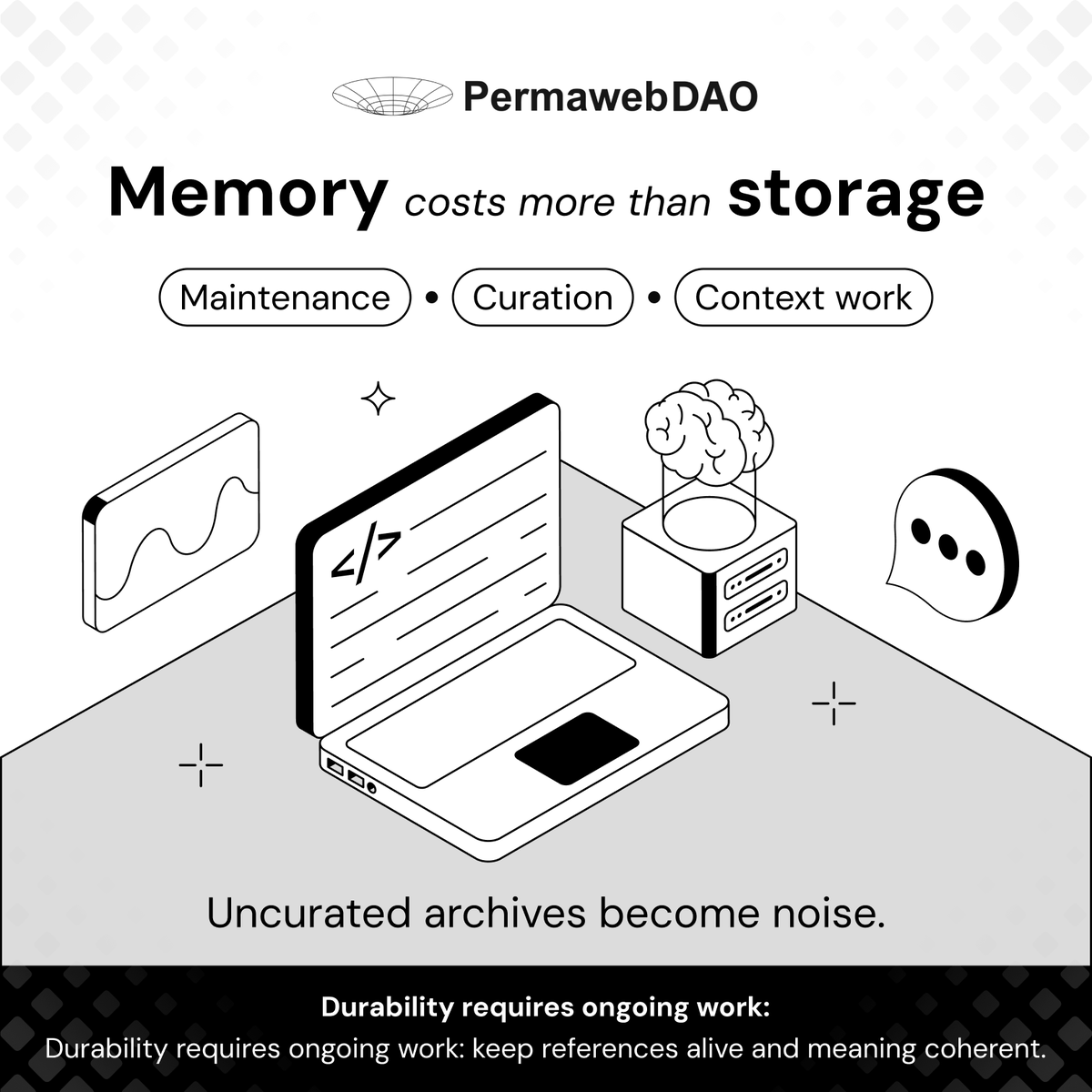
Memory has a cost beyond data storage in Web3 infrastructure.
Canonical archives and memory layers require maintenance to keep addressable references, content identifiers, and verifiable records accessible over time
They require curation to organize knowledge, preserve meaning, and support coherent decentralized knowledge infrastructure
They require context work such as linking, semantic connections, summarization, and preserving governance rationale within DAO governance systems
Without curation, archives become searchable noise instead of usable knowledge systems
Without maintenance, links rot, breaking addressable knowledge and weakening institutional memory
Without context preservation, truth fragments into competing versions, reducing accountability and governance transparency
Durability in Web3 memory infrastructure is operational, not philosophical.
@permacastapp@Permaweb_DAO
A 9B model now matches 120B performance.
A 72B model matches GPT-5.
Open-source AI is compressing fast enough to run on decentralized GPU networks.
The question isn’t who builds the model.
It’s who runs it without centralized control.
That’s where the 0G Compute Network comes in.
Built by @0G_labs, it runs on modular decentralized AI infrastructure powered by scalable Layer 1 performance, verifiable compute, and strong data availability — enabling AI-native applications to operate across crypto ecosystems without relying on centralized providers.
This unlocks autonomous agents and on chain agents aligned with human intent at scale, capable of executing, coordinating, and evolving in real time.
From AI marketplaces and DeFi to NFTs, gaming, identity protocols, and interoperability across the full AI stack, this is where infrastructure meets interface in a practical, composable, and user friendly way.
Turning raw compute into real world impact without centralized control 🚀
@Permaweb_DAO@permacastapp
1,609 AI agents indexed on Binance.
NVIDIA shipping NemoClaw for agent tooling.
MoonPay building agent wallets.
The agent economy is here.
But agents need more than APIs and wallets.
They need onchain identity, verifiable compute, decentralized storage, and reliable data availability.
They need @0G_labs.
Built as modular decentralized AI infrastructure, 0G combines scalable Layer 1 performance, verifiable compute, and high-throughput data availability to support AI-native applications and autonomous agents aligned with human intent at scale across crypto ecosystems.
From AI marketplaces and DeFi to NFTs, gaming, identity protocols, and interoperability across the full AI stack, this is where agents don’t just exist they operate, coordinate, and create value.
But intelligence alone isn’t enough.
Agents also need memory.
That’s where PermawebDAO comes in. While 0G powers execution and real-time intelligence, @Permaweb_DAO anchors permanence ensuring agent histories, decisions, and data remain accessible, verifiable, and durable over time. It turns short-term actions into long-term knowledge, allowing agent systems to learn, reference, and evolve instead of resetting context.
Together, they form a more complete stack:
0G → execution and intelligence
PermawebDAO → memory and permanence
This is where infrastructure meets interface in a practical, composable, and user friendly way enabling systems to transform raw compute into real world impact.
The agent economy isn’t coming.
It’s already running 🚀
PermawebDAO: Building the Memory Layer for Web3
Web3 solved value transfer with blockchain infrastructure, smart contracts, and DeFi.
But it hasn’t solved memory.
Today, most Web3 content, governance discussions, and protocol knowledge are fragmented across platforms.
Discord threads disappear. Links break. Context fades.
What remains is data without meaning.
PermawebDAO is designed to fix this.
Built on Arweave’s permanent storage and the Permaweb, PermawebDAO extends decentralized storage into a full application-layer infrastructure for knowledge, governance, and media.
It introduces a true memory layer for Web3 where:
• Data is permanent → no loss of history
• Content is addressable → via content identifiers (CIDs)
• Records are verifiable → through cryptographic proofs
• Context is preserved → through provenance tracking and chain of custody
This transforms how systems evolve.
Instead of restarting context every cycle, DAOs, protocols, and builders can:
• Reference past governance decisions and risk analyses
• Build on institutional memory and governance precedent
• Create citeable knowledge that compounds over time
• Enable AI systems to train on structured, persistent, and verifiable data
With tools like Permacast, this memory becomes usable.
Not just stored, but curated, discoverable, and actionable.
This is the shift:
From archives → knowledge infrastructure
From storage → memory
From data → understanding
Because in the long run, ecosystems don’t just scale through coordination.
They scale through what they can remember.
@Permaweb_DAO is building that foundation.
Claude can now control your computer.
Open apps.
Browse the web.
Fill spreadsheets.
But here’s the question nobody’s asking:
Where does that compute run?
Who sees your screen data?
How do you verify the AI isn’t hallucinating your bank transfer?
This is exactly the gap @0G_labs is addressing with Sealed Inference.
Built on modular decentralized AI infrastructure, it enables verifiable compute inside secure TEEs — where execution is provable, private, and tamper-resistant by design.
No “trust the proxy.”
You verify.
As we move into an agent-driven world with autonomous agents and on chain agents aligned with human intent at scale, trust assumptions break down. What matters is evidence, not promises.
Powered by scalable Layer 1 performance and strong data availability, this is how AI-native applications across crypto ecosystems can operate securely — from DeFi and AI marketplaces to identity protocols and real-world automation.
This is where infrastructure meets interface in a practical, composable, and user friendly way — enabling builders to transform raw compute into real world impact.
The agentic era doesn’t need more trust.
It needs proof 🔐🚀
Also bullish on @permacastapp@Permaweb_DAO
Base dropped Geth.
Optimism drops it in May.
0G just finished the switch.
40% faster sync.
24% lower latency.
No issues since February.
@0G_labs is pushing this forward as part of a modular decentralized AI infrastructure stack designed for scalable Layer 1 performance, efficient execution, and real-world reliability.
With improved performance at the core, verifiable compute and strong data availability become even more effective — enabling AI-native applications, autonomous agents, and on chain systems aligned with human intent at scale to run smoothly across crypto ecosystems.
Google Cloud, CertiK, and NTT Digital are already validating on the new stack.
This is what it looks like when infrastructure meets interface in a practical, composable, and user friendly way turning raw compute into real world impact without bottlenecks.
Still building on Geth? 🚀
Love what @permacastapp is building also
Together with PeakAI, @permacastapp has successfully completed the first round of payouts for the X Follow campaign, part of its broader Web3 community incentives and on chain reward programs.
A total of 318 USDT has been distributed to participants as the first round of Web3 rewards, recognizing real engagement, meaningful participation, and authentic contributions across the decentralized community.
More rewards will be distributed in the next phase as community growth, on chain reputation, and engagement incentives continue to expand within the Web3 ecosystem.
Live at the Lagos Hackfest 🇳🇬🚀
Builders are on ground, shipping in real time with @0G_labs exploring modular decentralized AI infrastructure powered by scalable Layer 1 performance, verifiable compute, and strong data availability.
From AI-native applications and autonomous agents to DeFi, NFTs, identity protocols, and interoperability across crypto ecosystems, this is where ideas turn into working systems.
This is more than a hackfest.
Lagos is building 🔥
Start Your On-Chain Boost in 4 Simple Steps within the Web3 ecosystem:
1️⃣ Visit https://t.co/InR0ckDVk0 and explore decentralized media on the Permaweb
2️⃣ Click Become a Decentralized Curator and join the Web3 content curation movement
3️⃣ Choose any audio, video, or article and tap On Chain Boost to support valuable Web3 content
4️⃣ Track your Permacast Points, on chain activity, and reputation growth in your profile
Empower decentralized media. Earn on chain recognition. Accumulate Web3 rewards and build your on chain identity.
Join as a Permacast Curator and contribute to a memory layer, permanent content, and decentralized knowledge infrastructure today.
@Permaweb_DAO@permacastapp
6 months.
27 custom commits.
11,500+ upstream Reth commits inherited.
We didn’t just switch clients.
We rebuilt the execution layer in Rust.
With @0G_labs, this upgrade strengthens a modular decentralized AI infrastructure stack designed for scalable Layer 1 performance, enabling faster, more efficient execution across the network.
Foundation Validator has been live on Reth since February. No issues.
Now rolling out network-wide.
This is what powers verifiable compute and high-performance data availability unlocking smoother operation for AI-native applications, autonomous agents, DeFi, NFTs, identity protocols, and interoperable systems across crypto ecosystems.
It’s where infrastructure meets interface in a practical, composable, and user friendly way helping builders transform raw compute into real world impact at scale 🚀
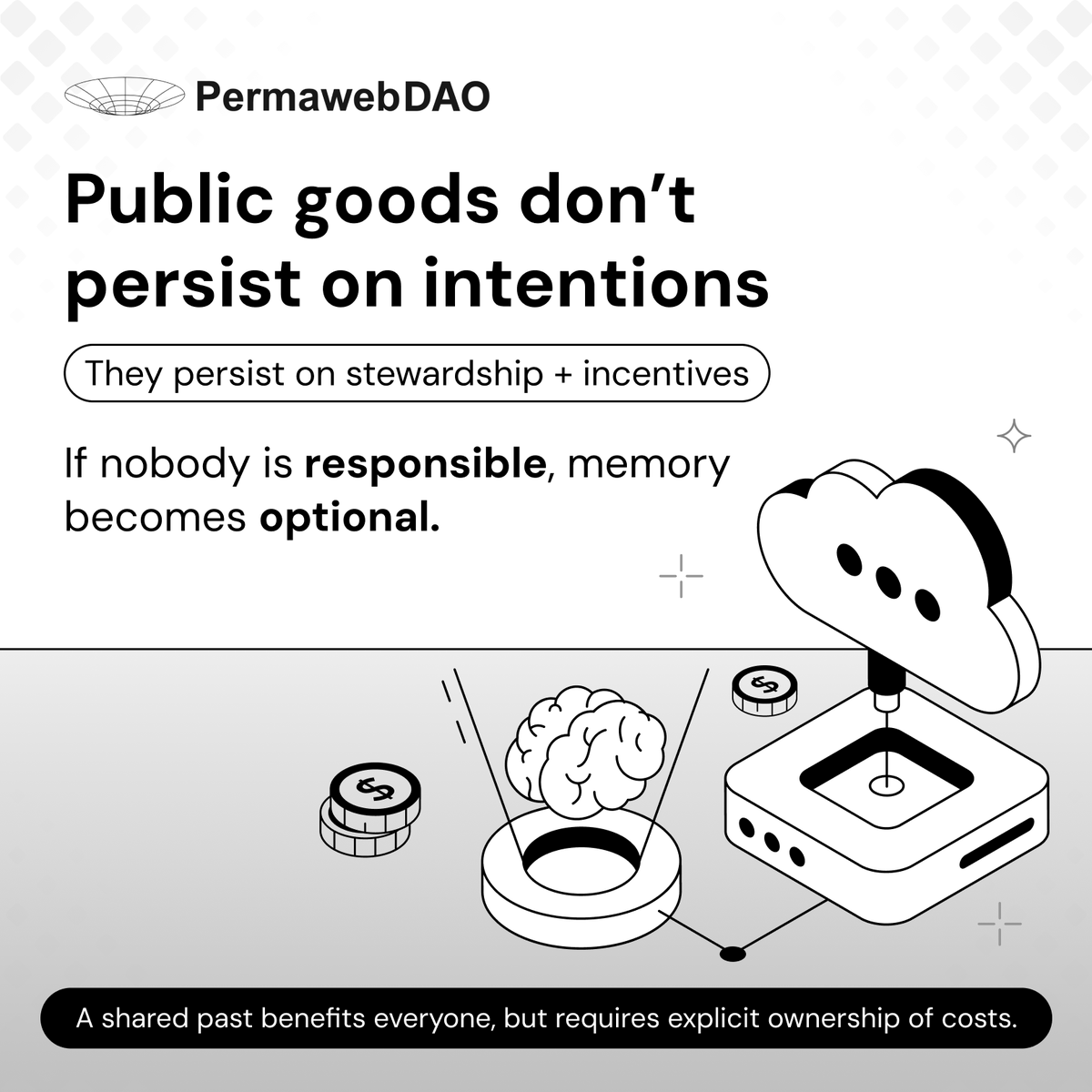
Public Web3 infrastructure and decentralized systems don’t persist on good intentions.
They persist on stewardship, incentive design, and sustainable token incentives.
Canonical archives and memory layers are a public good within Web3 governance and DAO ecosystems. Everyone benefits from a shared, citeable past, addressable knowledge, and durable institutional memory, but the costs of maintaining decentralized storage and knowledge infrastructure are not evenly distributed.
When nobody is responsible for governance memory, historical records, and verifiable archives, memory becomes optional.
And optional infrastructure in the Web3 ecosystem disappears quietly and predictably, leading to lost context, weakened accountability, and fragile governance systems.
@permacastapp@Permaweb_DAO
Just pushed live sensor data from a DHT22 and ESP32 to 0G decentralized storage live at the Lagos HackFest 🇳🇬🔥
Temperature & humidity readings hitting the 0G Galileo Testnet in real-time, every batch verified with a Merkle root hash on-chain.
DePIN is not a concept. It's running on my laptop right now.
You can check it out: https://t.co/9SX3Q7QGUG
@0G_labs@0glabsafrica@wriches@ezeransome
A DAO delegate can cite risk analyses from dissolved protocols using content addressing and IPFS CIDs, learning from past failures through addressable knowledge and shared institutional memory.
Researchers can trace governance evolution across the Web3 ecosystem without relying on centralized databases, using decentralized storage, verifiable records, and knowledge infrastructure.
Governance disputes can be resolved by referencing cryptographically verifiable records, on chain data, and preserved governance context rather than competing narratives.
New organizations and DAOs can inherit institutional knowledge and governance precedent from predecessors without requiring organizational continuity, enabling true knowledge compounding.
These capabilities require treating memory as protocol within Web3 infrastructure:
Addressable through content identifiers (CIDs)
Verifiable through cryptographic signatures and authentication
Traceable through provenance records and chain of custody
Permanent through decentralized storage and economic guarantees
Web3 already has the underlying technology stack. What it lacks is recognition that governance history, decision making context, and institutional memory are not just application features but foundational infrastructure, a reusable primitive that the entire decentralized ecosystem depends on.
AI and machine learning models do not learn from vibes.
They learn from structured data, persistent storage, and referenceable knowledge within reliable data infrastructure.
Most Web3 content today is platform bound, context fragile, and temporally unstable, making it difficult to use as long term knowledge or part of a durable knowledge base.
That makes it almost unusable for AI training, data pipelines, and building intelligent systems within the Web3 ecosystem.
If information cannot be referenced, cited, or accessed tomorrow through addressable data and verifiable records, it cannot train AI systems or support machine intelligence in the future.
A system without a memory layer, institutional memory, and persistent knowledge infrastructure cannot produce real understanding.
So this is not just a Web3 problem.
It is a fundamental question about the future of AI, decentralized intelligence, and how knowledge is preserved for the next generation of intelligent systems.
@permacastapp@Permaweb_DAO