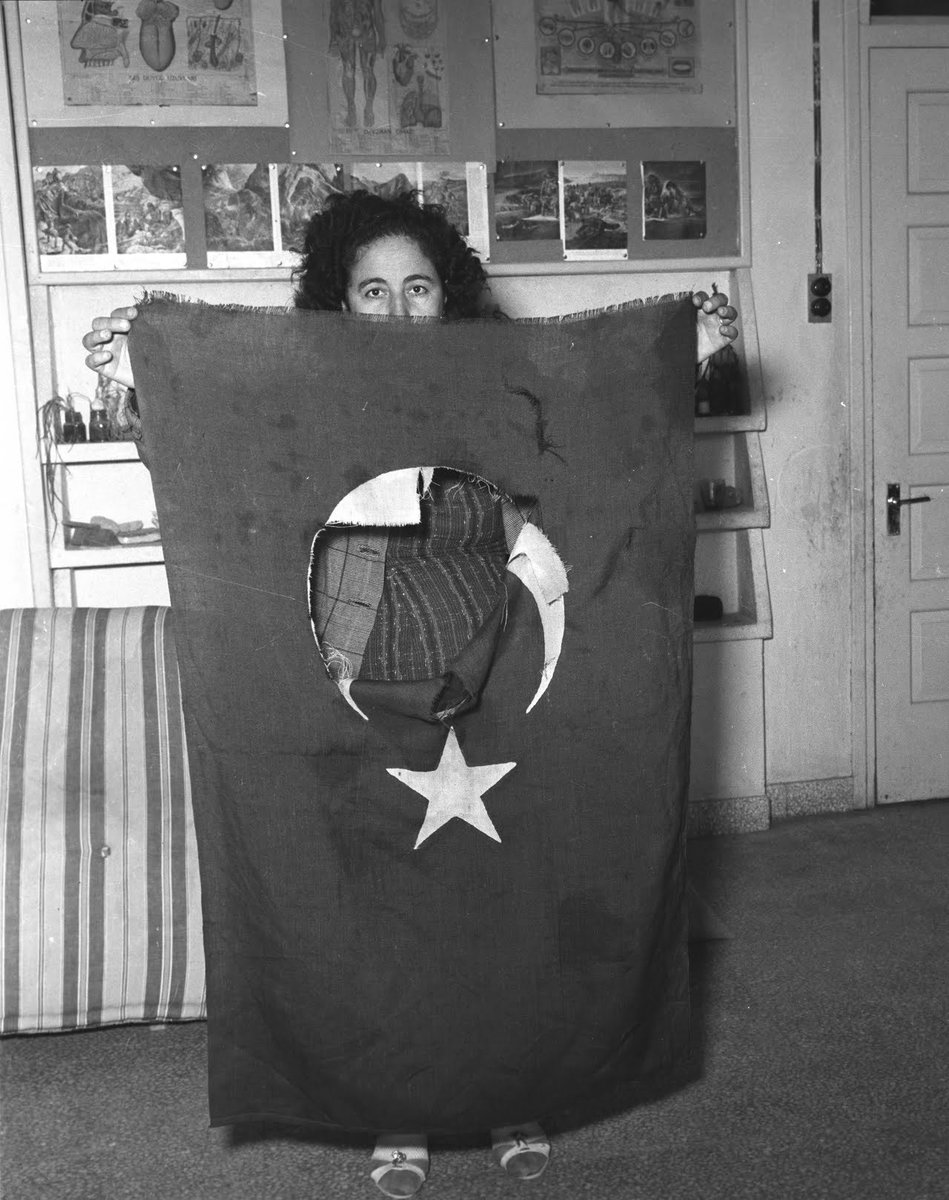
Bloody Christmas
For many around the world, Christmas is a time of giving—a time for celebrating with family and loved ones. For Turkish Cypriots, however, it is a time of grief for the lives lost, a reminder of ethnic cleansing, genocide, and the beginning of life in segregated and besieged enclaves under the constant fear of new massacres. Sixty-one years ago, in December 1963, the 'Bloody Christmas' took place.
More than 30.000 people ethnicaly cleansed from their homes to sieged enclaves, 346 massacred, more than 300 Turkish Cypriot missing to this day.
"When the disturbances broke out in December 1963 and continued during the first part of 1964 thousands of Turkish-Cypriots fled from their homes, taking with them only what they could drive or carry, and sought refuge in what they considered to be safer Turkish Cypriot villages and areas." UN Secretary-General Thant reported to the Security Council at 7 December 1967
Background and Prelude to Violence
The 1960 Zurich and London Agreements established Cyprus as an independent state with a unique bi-communal constitutional structure, aiming to balance Greek and Turkish Cypriot political rights. However, the Greek Cypriot leadership, under Archbishop Makarios, soon expressed dissatisfaction with these arrangements. Makarios remarked that “the agreements do not form the goal—they are the present and not the future” and sought to amend the constitution to reduce Turkish Cypriots' rights.
In 1963, the Greek Cypriot leadership started a covert strategy to systematically weaken Turkish Cypriot political power, aiming ultimately for irredentist Enosis. Lt. General George Karayiannis confirmed this intent, noting that President Makarios prepared to revise the constitution and arm Greek Cypriots in anticipation of clashes.
What really happened at 1963?
Scott Gibbons, who was based in Cyprus at the time as the Middle East correspondent for the London Daily Express, provides insight into what truly happened during Bloody Christmas.
“During the night of 20-21 December 1963, the Greeks launched a series of attacks on Turks throughout the Nicosia area. The combined forces of uniformed Greek Cypriot police and civilian EOKA gunmen began systematically to murder Turks and arrest and disarm Turkish policemen. At the same time, the Greek Cypriots took complete control of the Cyprus government information organisation and announced that the ‘legal’ authorities were putting down a Turkish uprising.
Within days, Turkish civil servants throughout the island had been ousted from their positions and Greeks now ran the entire governmental administration. Armed EOKA thugs physically prevented the vice-president, a Turk, Dr Fazıl Küçük, from entering his office. But, at ground level, the Greek actions seemed so haphazard that although it quickly became obvious the attack on the Turks was premeditated, the extent of the planning was not fully discovered until April 1966, when a Greek Cypriot newspaper, Patris, gave details of what has become known as the Akritas Plan. This was the first exercise in ethnic cleansing - racial extermination or genocide, as I prefer to call it - the Makarios government undertook.
The object of this ethnic cleansing, as the Akritas Plan explained, was to prepare for the amendment of the Constitution in such a way as to allow the government to legally - in its eyes at least - unite the island with Greece, the Greek Cypriot ‘Motherland’. In the plan, there were details given on how to provoke the Turks into taking up arms against the government so that the ‘legal’ forces of the state could be empowered to crush what would be called a Turkish revolt, expel all Turks from the police and every other government institution, seal off the Turkish population in enclaves throughout the island, and pronounce a fait accompli before Christmas 1963. The Akritas Plan envisaged that the Western world would be too preoccupied with Christmas festivities to interfere in time to prevent enosis. Further, not only would the speed of events take Turkey by surprise, but Turkey would also be unable to call a meeting of the two other Guarantor Powers, Britain and Greece, who together were pledged to keep Cyprus independent, in time to prevent the island’s union with Greece.
Patris claimed that Makarios had personally organised the entire scheme and had made the military preparations himself. The paper wrote, “Makarios entrusted Yorgadjis [Polycarpos Yorgadjis, former EOKA gunman and now Minister of the Interior] who took the code name of Akritas, with the task of establishing the organisation. The Minister of Labour, Tassos Papadopoulos, was appointed deputy chief of the organisation, and Glafcos Clerides [then Speaker of the 50-member Cyprus parliament] became the Chief of Operations.” Clerides is now, of course, President of the Greek South Cyprus and recognised by the world as the president of the whole island.
What became known as the Christmas War or, in the Turkish version, Bloody Christmas, was actually the Akritas Plan for genocide. There was bloody slaughter of the Turks and the Greeks also paid a terrible penalty in deaths and injuries when the Turkish fighters hit back, but the Greeks’ aim, enosis, was not realised.
I believe I had a part in wrecking this plan. I was based in Cyprus at that time as the Middle East correspondent of the London Daily Express and had arrived back from an assignment in Africa the day before the shooting began. In fact, I was having dinner in a Nicosia restaurant and heard the first shots ring out. I sent a report on this to my newspaper and gave more details the following day. The result was that the foreign press poured in, swamping the cable office and telephone lines with reports of Greek atrocities. The success of the Akritas Plan was based on suffocating all Turkish protest and keeping the operation as secret as possible while enosis was arranged. Now the whole world knew what was going on and, while the fierce fighting continued, the element of surprise had been lost. Christmas came and went, by which time the three Guarantor Powers had become involved, as had the United Nations, and enosis was not achieved.
But as I said, Akritas Plan for Genocide, was not known for years. In the interval, the now famous Green Line was drawn across the capital city, Nicosia, to protect the Turkish quarter, a United Nations peace force arrived, Makarios received a slap on the wrist and was told to behave himself and the world’s press left. I was sent to Istanbul for a year, after which I quit newspaper work for a time to write a book on the ongoing war in the Yemen.
The bloodshed continued on the island for 11 years after that Christmas, but the world had now lost interest. Those 11 years were hell on earth for the Turkish Cypriots, starved, hounded from pillar to post by the now all-Greek authorities, and pursued by the emergent Greek Cypriot National Guard led by mainland Greek officers. And, where they had owned 35 percent of the land, mostly the best agricultural acreage, they were now squeezed into three percent of it, spread across the island in tiny enclaves.
The Greeks of Cyprus had attempted genocide against their fellow citizens, the Turks, and had failed. 11 years later, they tried again.”
As H. Scott Gibbons whitnessed, it was a genocide attempt. In the 1963/64 massacres alone, more than 800 Turkish Cypriot men, women and children were wounded and murdered.
The distinguished philosopher, Michael Moran, of Sussex University, made the following diagnosis of Greek Cypriot attitudes: “It was because they “were under a kind of ideological spell, a collective mental condition similar to what Marxists used to call “false-consciousness” that the Greek Cypriots could embark upon their particular course of action in December 1963 with all the zeal and confidence they did. Brainwashed through at least a hundred years of purblind school-teaching and sermonising into a set of beliefs pathologically at odds with any plausible account of historical and political realities; lacking contact with a counterbalancing tradition of rational criticism; for the most part incapable of ironic scepticism towards theological obfuscation - the Greek Cypriot leaders were effectively de-sensitised to the equally important rights of the Turkish Cypriots. In this way they were able to treat their Turkish compatriots with such consistent and irrational abuse, hardly noticing that this was in fact what they were doing.”
Lt. Gen. George Karayiannis of the Greek Cypriot militia reported in Ethnikos Kiryx 15 July 1965, “When the Turkish Cypriots objected to the amendment of the constitution Makarios put his plan into effect, and the Greek Cypriot attack began in December 1963" The General is referring to the notorious "Akritas" plan, which was the blueprint for the extermination of the Turkish Cypriots and the annexation of the island to Greece. This plan was prepared in 1960 before the new constitution had been given any chance to work, and was published in Patris on 24th April 1966. Its existence is also admitted by Clerides.
On 28th December 1963 the Daily Express carried the following report from Cyprus: "We went tonight into the sealed-off Turkish Cypriot Quarter of Nicosia in which 200 to 300 people had been slaughtered in the last five days. We were the first Western reporters there and we have seen sights too frightful to be described in print. Horror so extreme that the people seemed stunned beyond tears."
On 1st January 1964 the Daily Herald reported: "When I came across the Turkish homes they were an appalling sight. Apart from the walls they just did not exist. I doubt if a napalm attack could have created more devastation. Under roofs which had caved in I found a twisted mass of bed springs, children's cots, and grey ashes of what had once been tables, chairs and wardrobes. In the neighbouring village of Ayios Vassilios I counted 16 wrecked and burned out homes. They were all Turkish Cypriot. In neither village did I find a scrap of damage to any Greek Cypriot house."
On 12th January 1964 the British High Commission in Nicosia wrote to London “The Greek (Cypriot) police are led by extremists who provoked the fighting and deliberately engaged in atrocities. They have recruited into their ranks as “special constables” gun-happy young thugs. ....... Makarios assured Sir Arthur Clark that there will be no attack. His assurance is as worthless as previous assurances have proved.”
On 14th January 1964 the Daily Telegraph reported that the Turkish Cypriot inhabitants of Ayios Vassilios had been massacred on 26th December 1963, and reported their exhumation from a mass grave in the presence of the Red Cross and British paratroops. This harrowing story and many others from that period and 1974 are recounted by the Chief Matron of the Nicosia Hospital, Nurse Türkan Aziz MBE in her memoirs “The Death of Friendship.” She recalls how Greek Cypriots roamed the hospital wards killing the Turkish Cypriot patients, and found the bodies of two Turkish Cypriot boys who had taken refuge in her own apartments.
“The two sat on chairs exactly where I had left them, but this time they did not rise to greet me with smiles. Dark blood welled through the tattered remnants of their shirts and dripped on the carpet. Their Greek Cypriot “guard” had vanished, spraying the staircase senselessly with bullets as he left”
Matron Aziz describes the horror of Ayios Vasilios as follows:
“a few feet down they found the first bodies, three men thrown on top of each other, then a boy whose hands had been tied behind his knees, then a little girl, then an old man dressed in his peasant-style baggy trousers, then some women. There were 21 bodies, almost all dressed, but not in hospital garb. These were Turkish Cypriot families who had lived in Ayios Vasilios.”
The relevance of “hospital garb” is that the Greek Cypriots “revealed a new depth of sickness of the mind by insisting the bodies were of patients in the hospital who had died of natural causes. They had issued a press statement saying “Turks distort the truth.”
A further massacre of Turkish Cypriots, at Limassol, was reported by The Observer on 16th February 1964, On 17th February 1964 the Washington Post reported that "Greek Cypriot fanatics appear bent on a policy of genocide.” 26 February 1964 The Guardian reported The Greek Cypriot Minister of the Interior admitted that he had controlled the attack in Limassol himself.
On 31st December 1963 "The Guardian" had reported: "It is nonsense to claim, as the Greek Cypriots do, that all casualties were caused by fighting between armed men of both sides. On Christmas Eve many Turkish Cypriot people were brutally attacked and murdered in their suburban homes, including the wife and children of the Turkish Cypriot head of army medical services by a group of forty men, many in army boots and greatcoats." Although the Turkish Cypriots fought back as best they could, there were no massacres of Greek Cypriot civilians.
On 10th September 1964 the Secretary-General reported: "UNFICYP carried out a detailed survey of all damage to properties throughout the island during the disturbances, ......... it shows that in 109 villages, most of them Turkish-Cypriot or mixed villages, 527 houses have been destroyed while 2,000 others have suffered damage from looting. In Ktima 38 houses and shops have been destroyed totally and 122 partially. In the Omorphita suburb of Nicosia, 50 houses have been totally destroyed while a further 240 have been partially destroyed there and in adjacent suburbs."
On 6th February 1964 a British patrol found armed Greek Cypriot police attacking the Turkish Cypriots of Ayios Sozomenos. They were unable to stop the attack. On 13th February 1964 the Greeks and Greek Cypriots attacked the Turkish Cypriot quarter of Limassol with tanks, killing 16 and injuring 35.
On 15th February 1964 "The Daily Telegraph" reported: "It is a real military operation which the Greek Cypriots launched against the six thousand inhabitants of the Turkish Cypriot Quarter yesterday morning. A spokesman for the Greek Cypriot Government has recognised this officially. It is hard to conceive how Greek and Turkish Cypriots may seriously contemplate working together after all that has happened."
Professor Ernst Forsthoff, the neutral President of the Supreme Constitutional Court of Cyprus told Die Welt on 27th December 1963 “Makarios bears on his shoulders the sole responsibility of the recent tragic events. His aim is to deprive the Turkish community of their rights.” In an interview with UPI press agency on 30th December 1963 he said: "All this happened because Makarios wanted to remove all constitutional rights from the Turkish Cypriots."
Despite the arrival of UN troops in Cyprus in March 1964 the Greek Cypriots continued their attacks on Turkish Cypriot civilians. On 7 th August 1964, they attacked Turkish Cypriot villages, provoking the Turkish government to send four warplanes to attack the Greek Cypriot village of Polis. On 8th August thirty Turkish jets flew low over Greek Cypriot towns on the north coast, and on 9th August, sixty-four Turkish planes flew low over northwest Cyprus.
On 12th August the US Ambassador to Greece was instructed to urge the Greek government to stop the attacks on Turkish Cypriots, and Kruschev told the Greek Cypriots that they could expect no support from the Soviet Union Finally the Greek Cypriots desisted, but had it not been for these warning flights there would have been few Turkish Cypriots left alive. They were saved by the Turkish Air Force, not by the UN.
As Gibbons noted, the Greek Cypriots made another attempt in 1974.
Some Inferences
More than 300 Turkish Cypriots are still missing without trace from these massacres of 1963/64. These dreadful events were not the responsibility of "the Greek Colonels" of 1974, or an unrepresentative handful of Greek Cypriot extremists. The persecution of the Turkish Cypriots was an act of policy on the part of the Greek Cypriot political and religious leadership, which has to this day made no serious attempt to bring the murderers to justice.
The Greek Cypriots sometimes allege that it was they who were attacked, by the Turkish Cypriots who were determined to wreck the 1960 agreements. However, the Turkish Cypriots were not only outnumbered by nearly four to one; they were also surrounded in their villages by armed Greek Cypriots, they had no way of protecting their women and children, and Turkey was 40 miles away across the sea. If such had been their plan the Turkish Cypriots would have congregated in the North where arrangements would have been made to house and protect them. The very idea that in those circumstances the Turkish Cypriots were the aggressors, is absurd.
Michael Moran's observations regarding the Greek Cypriots appear accurate: they remain deeply influenced by an ideological framework rooted in the irredentist aspirations of the Megali Idea. This collective mindset, shaped over decades, reflects a widespread unawareness among the Greek population of the atrocities and harm inflicted upon Turkish communities.
Through over a century of selective education and biased rhetoric in schools and religious sermons, a distorted historical narrative has taken hold. This has fostered a belief system that is fundamentally misaligned with any credible interpretation of historical and political realities. Denialism persists to this day, as Greek and Greek Cypriot educational institutions continue to propagate a revisionist version of history. This narrative portrays Greeks exclusively as victims, further perpetuating blind fanaticism and animosity toward others. Therefore, there is a risk of repeating the same mistakes made by their predecessors as they did at '74 which would be our final part of Cyprus Question Series.
This is the first part of our planned three-part series on the Cyprus Question, aimed at providing a comprehensive understanding of the historical facts regarding the island. We invite you to share this work and help ensure the truth reaches a wider audience.
Değerli X yönetimi, @hermes_z gibi saygın bir hesabın askıya alınması büyük bir haksızlıktır. 🇹🇷’ye atılan iftiralara belgelerle yanıt vermesi organize şikâyetlere hedef olmuştur. Adalet için hesabın iadesini talep ediyoruz. @Safety@X@XTurkiye
Konu Türk milleti olunca haklarımızı daima savunan Hermes hesabı Türk düşmanlarının saldırılarıyla maalesef askıya alındı. Hesabın açılması için @Support@X@XTurkiye 'ye yazalım. O zamana kadar @hermesyed hesabından takip edip destek olabiliriz. O bizim için susmadı sıra bizde🇹🇷
Greece’s Forgotten War Crimes- Not a War, But a Cleansing: When Civilians Were the Target
To much of the Western world, Greece evokes images of marble temples, noble myths, and heroic resistance. But behind this romantic veil lies a buried chapter — one written in blood and fire on Anatolian soil between 1919 and 1923.
The Ethnic Purge Greece Doesn’t Remember
Under the banner of the Megali Idea — the dream of a Greater Greece — Greek forces, with Allied backing, launched a brutal campaign deep into western Anatolia. On May 15, 1919, the Greek army landed in İzmir. Within hours, at least 400 Turkish civilians had been killed, as confirmed by Allied observers. British historian Arnold Toynbee, an eyewitness and no apologist for the Ottomans, described systematic killings, looting, and villages reduced to ashes.
What unfolded was not a conventional war, but an ethnic purge. Entire Turkish communities — civilians — were targeted. Churches blessed soldiers as they advanced; some clergy even encouraged bloodshed. The goal: to depopulate and repopulate. Create a Christian homeland by removing a Muslim majority.
American historian Justin McCarthy estimates 640,000 Turkish civilians were killed during the Greek campaign. Pregnant women, the elderly, and children were slaughtered indiscriminately. American Consul James Loder Park reported that cities like Alaşehir and Manisa were almost entirely destroyed — tens of thousands of homes burned, entire neighborhoods wiped out.
Even in retreat, destruction was deliberate. Historian Sydney Fisher described a scorched-earth policy: the Greek army, losing ground, vented its fury on helpless villagers. Orthodox Metropolitan Chrysostomos of İzmir was recorded saying: “The more Turkish blood you spill, the greater your reward in heaven.”
Not a War, But a Cleansing: The Massacre Beneath the Megali Idea
This was not war. It was a campaign of annihilation — rarely acknowledged, often ignored.
Western narratives still struggle to face this truth. But history does not become just by erasing the unjust. What happened in Anatolia is not a footnote — it is a mirror.
To remember is not to hate.
It is to honor those whose voices were never heard.
When the Greek army occupied İzmir, Chrysostomos Kalafatis, a Greek priest, addressed the Greek soldiers with the following speech:
"My soldier sons, children of Hellas, today by re-conquering the ancestral lands, you are performing the greatest miracle of Jesus.
The more Turkish blood you shed and drink in this cause, the more divine merit you will gain.
I myself will quench my hatred and resentment by drinking a glass of Turkish blood.
Come on now, all the saints are behind you. The lands of your ancestors are waiting for you!"
106 years ago, at 15 May 1919 with that speech ethnic cleansing and genocide started by Greece at Anatolia.
Experts estimates that on the Western Front alone, 640,000 Turkish civilians were massacred by the Greek army.
https://t.co/V39anOYRmH
An In-Depth Historical Account of the Greek Occupation in Western Anatolia…
We invite you to watch the documentary, "Silent Witnesses of the Greek Atrocity," which presents a detailed narrative of the events that took place in İzmir and Western Anatolia during the period of Greek occupation.
View the full documentary here: https://t.co/pMxGXoOWUf
#OccupationOfIzmir
#GreekAtrocity
"Here in Van, we observed the inhuman cruelty of the Armenians. They said that the Armenians cut off women's breasts, turned their arms and legs inside out and broke them. I personally saw the victims of this inhuman cruelty. There were about 800 people left."
19 April 1915, Armenians genocided Turkish and Kurdish civillians of Van City. Hundreds of thousands women, children, even the babies killed by Armenians supported by imperialist powers.
19 April 1915, Armenians genocided Turkish and Kurdish civillians of Van City. Hundreds of thousands women, children, even the babies killed by Armenians supported by imperialist powers.
The 1915 Van Observations by Tolstoy's daughter Aleksandra Tolstaya:
"Armenians were burying Turks alive."
I read in the newspapers that the Turks behaved brutally and massacred the Armenians. I don't understand...
Aleksandra Tolstaya joined the Russian army as a volunteer nurse in World War I. On May 20, 1915, after the Russian army invaded Van with the help of Armenian gangs, she arrived in Van. In her memoirs, she describes the Turkish-Kurdish genocide committed by Armenians in Van as follows:
"Dirty bodies on the ground, covered with cloths: Turks. Men, women, old people, young people, children. All piled on top of each other. Moans, delirium, the sound of small children crying. Dirty weak hands reaching towards us, women crying.
I read in the newspapers that the Turks acted brutally, that they massacred Armenians. I don't understand...
Here in Van, we observed the inhuman cruelty of the Armenians. They said that the Armenians cut off women's breasts, turned their arms and legs inside out and broke them. I personally saw the victims of this inhuman cruelty. When we arrived in Van, some of the prisoners had already died. There were about 800 people left.
Every day they would roll 15-20 corpses into old pits and cover them haphazardly with earth."
via: @DokuzTugluKagan
February 8, 1964: A Turkish Cypriot covers the body of his 12-year-old brother.
He was killed by Greek Cypriot paramilitary troops during the Bloody Christmas massacres, in Arpalık, Lefkoşa.
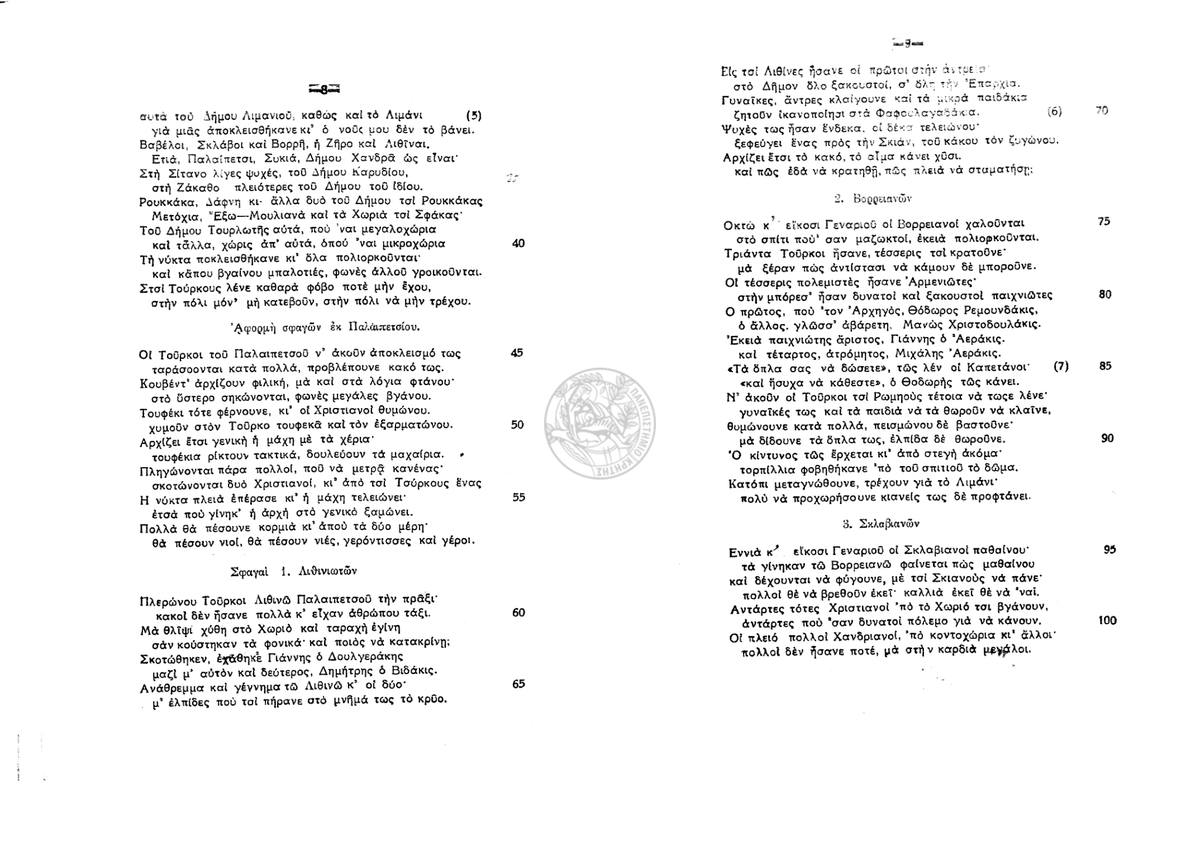
The Lassithi Massacres: A Forgotten Crime Against the Turks in Crete
Turks were massacred,
No one showed them mercy,
Not even women and children were spared.The attacks on the Turks grew,
They struggled to survive,
But their hope was fading.Women and children wept,
Fear ruled the city.Then, Christian leaders
Told the Turks to surrender.
But the Turks did not bow down,
As women and children shed tears,
They stood with their families and fought to the end.
-A poem from a Greek source about the Massacre of the Turks in Crete, 1897.
The Lassithi Massacres of 1897 were a campaign of ethnic violence targeting Turkish and Muslim civilians in Eastern Crete under Ottoman rule. Between 850 and 1,000 people were brutally murdered.
As tensions escalated, the Greek army invaded Crete in 1896. Reports of massacres reached Western consuls, yet initial investigations—led by local Christian Greeks—were covered up. However, a second inquiry conducted by British Consul Alfred Biliotti confirmed the atrocities.
Background
After the Ottoman conquest of Crete in the 17th century, the island remained home to both Muslim Turks and Christian Greeks. Following the Greek War of Independence (1821), tensions between the communities intensified. The situation deteriorated when Greek forces landed in Crete in 1896. Despite early attempts to suppress reports of massacres, Biliotti's findings exposed the extent of the violence.
Massacres
In February 1897, widespread killings took place. Turkish and Muslim civilians were slaughtered, many attempted to flee. Over 4,000 became refugees, with most never returning. Their lands were looted or destroyed.
British Consul Alfred Biliotti reported 851 deaths, including 201 men and 173 girls who were raped before being murdered.
One of the most brutal massacres occurred in the village of Eteà. Muslim women and children sought refuge in a mosque. The building was blown open, and those inside surrendered, believing they would be spared. Instead, they were led to Hagia Sophia Church on a nearby hill, where:
Men were torn apart, women and children were executed, a single young girl, who was left for dead, survived to tell the story.
British archaeologist Arthur Evans, who had lived in Crete for years, returned in 1898 as a journalist and wrote in The Manchester Guardian:
"The most deliberate act of extermination took place in Eteà. Muslim men, women, and children took refuge in a mosque. Its structure was strong, but eventually, the door was blown apart. The defenders surrendered, believing their lives would be spared. They were marched to Hagia Sophia Church—men were butchered, women and children were shot. One young girl, left for dead, survived to tell the tale."
A Hidden History
The Lassithi Massacres were not isolated incidents; they were part of a systematic effort to erase the Turkish population of Crete. Much of this history was either buried or reframed. While Greek sources recorded these events as battles, Western reports and Ottoman records revealed the deliberate targeting of civilians.
Even today, many remain unaware of how the Christian Greek forces, backed by local militias, carried out mass killings of Turkish civilians—a dark chapter in Cretan history that deserves recognition.
Poem About the Massacre in Crete, 1897
Where should I begin, how should I end,
What should I say, what should I turn into song?
When there is no trace left of the Turks in Crete?
Those who lived here for eight hundred years,
When they saw what happened in Setia...
Now, let me begin,
From Kato-Pikounti, for that is where the tale must start.
The Beginning of the Raid
On the second morning, at midday of the second day,
The days were hot, the houses emptied.
The Turks of Kato-Pikounti fled,
Evil spread like fire.
They were devastated and left in ruins,
They said Emir Pasha was to blame.
Even the Albanians in Vourla surrendered,
The fire in Setia grew larger.
Another Albanian fled,
He saved himself but left the others to die.
The children who witnessed it all,
Were killed before they could escape.
The attacks against the Turks intensified,
Fearlessly, with nothing standing in their way...
Meanwhile, in Kato-Pikounti, the Christians gathered,
The Turks were fleeing,
But their pursuers only grew in number.
Christians died too, but they pressed on.
The Turks were slaughtered,
No one showed them mercy,
Not even the women and children were spared.
The Destruction of Turkish Neighborhoods
Ahládia, Pikounti, Serakia, Santali, Paraspori,
And Zoó and Pikokefalo were wiped out,
Along with many other Turkish quarters…
The Battles in Palaiokastro
The Turks of Palaiokastro were under siege,
The pressure was immense, dark days had come.
The Christians launched their attack,
Cries of terror rose in the silence of the night.
The Turks struggled to survive,
But their hopes were fading.
Women and children wept,
Fear ruled the city.
The Fall of Voreia
On the morning of January 8, Voreia was in ruins,
Turkish homes were set ablaze,
Thirty Turkish bodies were found, along with four Albanians.
Four men managed to flee,
But they were caught and killed.
Commander Argyris and Theodoros,
Were the names that stood out in battle.
Then the Christian leaders,
Told the Turks to surrender.
But the Turks did not bow,
As their women and children shed tears,
They stood with their families and fought to the end.
The Battle of Sklavaina
On the second day of January,
A new battle erupted in Sklavaina.
The Christians attacked,
The Turks tried to escape,
But none survived.
As the Christians cried out in victory,
Silence descended upon the city.
The name of the work containing the poems: Αι σφαγαί Σητείας (1897) / Ποίημα Σητειώτου ποιητού Χ. Χ. εκδιδόμενον μετά σημειώσεων υπό Ν. Ι. Π.
Many thanks to @OzizUtku for providing this resource.
https://t.co/SWqZq1AYfu
Katchaznouni's Confessions: The Link Between Armenian Revolts and the Ottoman Relocation Decision
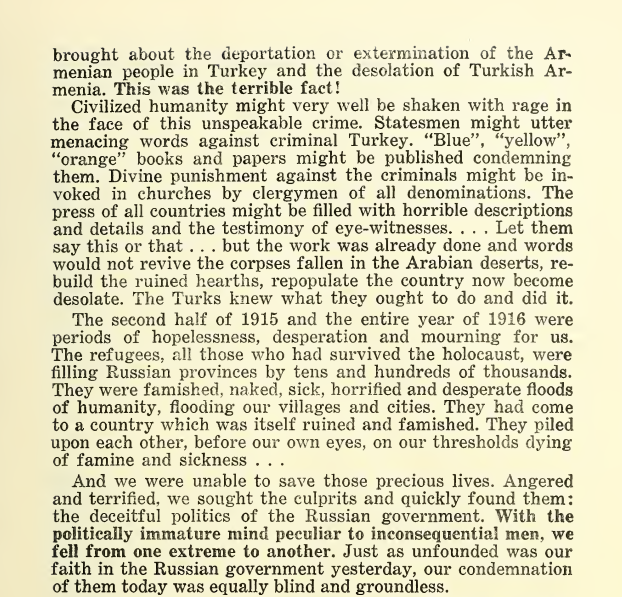
In 1923, Hovannès Katchaznouni, the first Prime Minister of Armenia, openly stated in a speech that preparations for Armenian uprisings had begun well before the Ottoman Empire’s decision on relocation.
According to Katchaznouni, Armenian revolutionary groups initiated rebellion efforts and collaborated with the Russians long before the war began. Notably, as early as the beginning of 1914, even before the Ottoman Empire entered the war, Armenian volunteer units were organized, armed, and began operating within Ottoman territories.
Another critical point highlighted by Katchaznouni was the contradiction between the decision taken at the Erzurum Congress to refrain from rebellion against the Ottoman Empire and the actions on the ground. Despite the decision at the congress, revolutionary groups acted contrary to it, and the Armenian population's miscalculation of support from Russia led to disastrous consequences, as Katchaznouni himself acknowledged in his speech.
According to Katchaznouni's own words:
1. In August-September 1914, Armenian volunteer units were formed and armed with great enthusiasm.
2. The Armenian Revolutionary Federation (Dashnaktsutyun), during its congress held in Erzurum in August 1914, decided not to initiate any rebellious action against the Ottoman Empire. However, contrary to this decision, it supported the formation of volunteer units. (The Erzurum Congress, a significant meeting where Ottoman Armenians made key political and military decisions, declared loyalty to the Ottoman government, but in practice, actions contradicted this commitment.)
3. By the fall of 1914, Armenian volunteer units had already launched attacks against the Ottoman army, a development that stemmed from the separatist mindset fostered within the Armenian community over many years.
4. Katchaznouni admitted that the organization had extensively participated in these activities and emphasized that the roots of these uprisings were not reactions to Ottoman rule but rather the result of internal dynamics within the Armenian community.
The phrase "This was the terrible fact!" as emphasized in his speech, provides critical self-reflection on why the relocation decision was made. Katchaznouni explicitly acknowledged the strategic mistakes and misjudgments made by the Armenian side. This process, as he explained, was not a response to Ottoman policies but a natural outcome of the Armenian community's long-standing pursuit of independence.
In light of these facts, the Ottoman Empire’s decision on relocation becomes more understandable when the security threats posed by the war conditions and the Armenian uprisings are considered.
These are historical proofs...
"The Ottoman Empire's decision to deport Armenians was motivated by security concerns and the association of this decision with “genocide” is incompatible with historical facts."
The Allied Powers' Plans to Divide the Ottoman Empire through Armenian Uprisings in French Archival Documents
Here are striking facts from two critical French archival documents:
The 1915 document reveals plans for uprisings, while the 1920 document shows how these plans were carried out.
A thorough examination of Western records reveals that the allegations concerning the Ottoman Empire during the year 1915 lack factual substantiation.
French reports clearly state:
25,000 Armenian insurgents in Cilicia combined with 15,000 supporters from neighboring provinces, forming a total threat of 50,000 individuals.
These forces, with the backing of the French, had plans to dismantle the Ottoman Empire, as explicitly stated in the documents.
Ironically, when the French did not receive the support they anticipated from their "insurgent allies" and faced betrayal, they deported the Armenians themselves!
In Cilicia, 10,000 Armenian volunteers joined forces with 25,000 insurgents from the region to engage in attempts to occupy Ottoman lands.
Armenian insurgents carried out attacks on Turkish military convoys and logistical routes, while also perpetrating violence against the civilian population.
Armed Armenian groups received weapons and ammunition support from Western powers to execute a comprehensive rebellion plan against the Ottomans.
This threat not only jeopardized the Ottoman military authority but also endangered the safety of civilians living in the region.
EVERY DETAIL IS EVIDENCE – LET’S BEGIN WITH THE 1915 REPORT
A six-page encrypted telegram dated September 29, 1915, sent by French Foreign Minister M. Delcassé to the French Ambassador in London, Paul Cambon, details how Armenians could be organized for an uprising, armed, and supported through logistical plans (e.g., establishing logistical centers in Cyprus and Syria).
This French document clearly reveals how the Allied Powers strategically viewed Armenians as a tool against the Ottomans. It includes reports and correspondences from various French diplomats in 1915, particularly highlighting efforts to organize an Armenian insurgency against the Ottoman Empire.
Details on plans for uprisings, weapons and logistical support, and more demonstrate that these reports were not merely theoretical but included concrete action plans.
Additionally, the coordination of regional uprisings aimed at weakening the Ottoman interior front underscores the organized nature of this collaboration. This document serves as strong evidence of the Allied Powers’ strategy to internally dismantle the Ottoman Empire by supporting Armenian uprisings.
The report from the Armenian Committee, annexed to the letter by the French Foreign Minister (ANNEXE 2), reveals a planned uprising against the Ottomans. Notably, the details include organizing the rebellion in present-day Latakia (Syria), preparing armed Armenian insurgents, and the initial objective of capturing Suweida.
This plan was not merely a local movement but a large-scale uprising coordinated with the support of the Allied Powers. It also emphasizes that success without military support, such as an allied coastal landing, was unlikely. The report explicitly illustrates Armenian attempts to collaborate with the Allies in a joint resistance strategy against the Ottoman authority.
Key statements from the report:
At this stage, the July 24, 1915 report prepared by the so-called Armenian National Defense Committee in Cairo (ANNEXE 2) should be highlighted.
This report vividly illustrates the scale and organized nature of Armenian uprisings, shedding light on the background of this crisis and the threat faced by the Ottomans. Most importantly, it reveals that these plans were initiated long before the Ottoman decision on deportation.
Rebellion Plan Based in Cyprus:
Armenian insurgents planned to gather in Cyprus and organize an uprising and sabotage movement with the support of the British army.
By closely collaborating with the British and French, they sought to pave the way for armed intervention against the Ottoman Empire.
Planned Actions after Preparation:
The Armenian Committee guaranteed the preparation of an insurgent force comprising 10,000 Armenian volunteers, 25,000 insurgents from the Cilicia region, and an additional 15,000 Armenian insurgents from neighboring provinces, forming a total force of 50,000 insurgents.
Securing full support from the Armenian population in the region.
Occupying key locations such as Iskenderun, Mersin, Adana, the Belen Pass, and other passes.
Gathering insurgents in the mountains and launching guerrilla warfare throughout Cilicia (Adana, Mersin, Tarsus, Osmaniye, Hatay, Iskenderun).
According to the Armenians’ own statement in the document: “This project remains our national ideal, and along with all our citizens, we declare that we are at the disposal of His Majesty’s British military authorities to implement this plan. If our volunteers and insurgents can occupy certain key points immediately, the Turks will be unable to use their forces throughout the winter season.”
The archival document highlights facts from the main letter of the French Foreign Minister, showing full support for all the Armenian Committee’s proposals:
Armenians collaborated with the Allied Powers to prepare an armed rebellion plan against the Ottomans, aiming to form an insurgent force of 50,000 individuals.
The main strategy of the rebellion was to cut Ottoman communication lines, sabotage railways, blow up bridges, and occupy strategic points to alter the course of the war.
The Committee requested military support, weapons, and ammunition from Britain and pledged to act under British direction.
These statements prove that the Ottomans faced a significant rebellion threat, endangering not only their territorial integrity but also the safety of their people.
Highlights from the main letter of the French Foreign Minister in the archival document, showing his support for all the proposals of the Armenian Committee:
- The Armenians, in cooperation with the Allied powers, prepared a plan for an armed rebellion against the Ottoman Empire and aimed to create a rebel force of 50,000 men.
- The main strategy of the rebellion was to cut the Ottoman lines of communication, sabotage railroads, blow up bridges and occupy strategic points to change the course of the war.
- The Committee requested military support, arms and ammunition from Britain, and undertook to act under British guidance.
These statements prove that the Ottoman Empire was facing a grave danger of rebellion that threatened not only its territorial integrity but also the safety of its people.
- The so-called Armenian defense committee demands that some of the Armenian refugees in Port Said be armed for anti-Ottoman activities.
- This demand includes a plan to launch a rebellion movement, especially in the region of Çukurova (referred to in the report as Cilicia). The proposed strategy envisages the creation of launching points in areas such as Suweida and Musa Dagh.
- The 40-day revolt of the Armenians in Musa Dagh, which was eventually suppressed by Ottoman forces, is presented as an example and it is emphasized that this movement could have achieved greater success with more support.
- France and Britain assessed that such a move could weaken the Ottoman Empire, but questioned whether it was militarily practical.
- Moreover, the concern is expressed that if such an initiative fails, the responsibility may fall on the Entente States.
AS FOR THE 1920 DOCUMENT
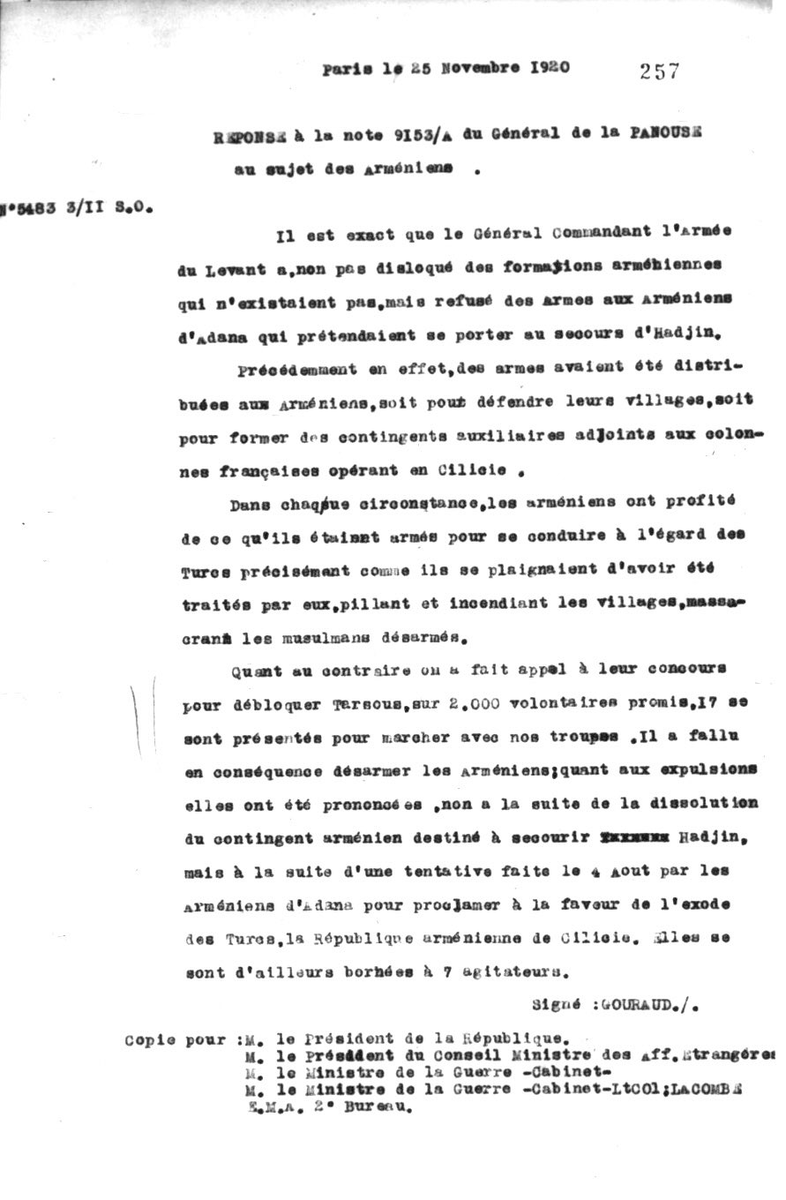
This document is General Gouraud's Response to General de la Panouse's Note on Armenians, dated November 25, 1920.
Judging by the tone of the writing, General Gouraud seems to be completely frustrated with the Armenians.
The document reveals that the French see Armenians as a threat due to their “rebellion and excesses” in the Cilicia region (present-day Adana, Mersin, Osmaniye, Hatay).
Arms were distributed to Armenians either to defend their villages or to form auxiliary units for French troops operating in Cilicia.
General Gouraud's own words are very important here:
“In every case, the Armenians took advantage of the fact that they were armed to loot and burn villages and massacre unarmed Muslims, exactly as they themselves claimed to have been treated by the Turks”.
“Taking advantage of the exodus of the Turks, Armenians attempted to declare the Armenian Republic of Cilicia on August 4, 1920. After this attempt, it was decided to disarm and deport the Armenians.”
The facts are clear: The Ottoman Empire's decision to deport Armenians was motivated by security concerns and the association of this decision with “genocide” is incompatible with historical facts.
These documents reveal once again that the Armenians collaborated with Western powers in 1915 to dismember the Ottoman Empire and were eventually discredited even by these powers.
HISTORY cannot be changed by distortions, it is WRITTEN BY DOCUMENTS WITH PROOF!...
Note: We owe a great debt of gratitude to the French historian Maxime Gauin -@MaximeGauin- for providing these very important documents...
These documents are taken from “Documents diplomatiques français. 1915, Tome III, 15 septembre-31 décembre” published by the French Ministry of Foreign Affairs. In particular, the report dated 29 September 1915 and entitled “Note sur une opération militaire en Cilicie” provides details on the military operations of the Armenian national defense committee in Ottoman territory. The documents were obtained from the digital library of the diplomatic archives of France.
Link:
https://t.co/Whz0AkFmIy
https://t.co/uQC08AuwQL
Fransa’nın Arşiv Belgelerinde İtilaf Devletlerinin Ermeni İsyanlarıyla Osmanlı'yı Parçalama Planı
İşte, iki önemli Fransız arşiv belgesinden çarpıcı gerçekler:
1915’teki belge, isyan planlarını açıklarken, 1920’deki belgede ise bunların nasıl gerçekleştirildiği anlaşılıyor.
Kendi belgeleri, kendi iddialarının hiçbir dayanağı olmadığını gösteriyor!
Fransız raporlarında şu bilgiler açıkça yer alıyor:
- Çukurova’daki 25.000 Ermeni isyancı, çevre illerden 15.000 destekçi ile birleşerek toplamda 50.000 kişilik bir tehdit oluşturdu.
- Bu güçlerin, Fransızların desteğiyle Osmanlı’yı parçalama planı yaptığı belgelerde açıkça yazılmıştır.
- Ancak işin ironik tarafı: Fransızlar bile bu "isyancı müttefiklerinden" bekledikleri desteği göremeyince ve ihanet görünce, Ermenileri sürgüne göndermiş!
- Kilikya’daki (Çukurova) 10.000 Ermeni gönüllüsü, çevredeki 25.000 isyancı ile birleşerek Osmanlı topraklarını işgal etmeye yönelik girişimlerde bulunmuştur.
- Ermeni isyancılar, Türk askeri konvoylarına ve lojistik hatlarına saldırılar düzenlemiş, sivil halka yönelik şiddet olaylarına karışmıştır.
- Silahlı Ermeni gruplar, Batılı güçlerden silah ve mühimmat desteği alarak Osmanlı’ya karşı kapsamlı bir ayaklanma planı yürütmüşlerdir.
- Bu tehdit, Osmanlı’nın sadece askeri otoritesini değil, aynı zamanda bölgede yaşayan sivillerin güvenliğini de riske atmıştır.
HER AYRINTI BİRER KANIT - 1915 TARİHLİ RAPORDAN BAŞLAYALIM
Fransa Dışişleri Bakanı M. Delcassé'nin, Londra Büyükelçisi Paul Cambon'a gönderdiği 29 Eylül 1915 tarihli, Ermenileri bir isyan için nasıl organize edebileceklerini, nasıl silahlandırabileceklerini, Ermeni isyanlarını desteklemek için lojistik planlarını (Kıbrıs ve Suriye’de lojistik merkezleri kurulması v.s.) ayrıntısıyla betimleyen 6 sayfalık bir mektuba ait şifreli telgraf.
Bu Fransızca belge, İtilaf Devletleri'nin Osmanlı'ya karşı stratejik olarak Ermenileri nasıl bir araç olarak gördüklerini net şekilde ortaya koyuyor. 1915 yılında Fransa'nın çeşitli diplomatlarından gelen raporlar ve yazışmalardan oluşuyor. Özellikle Ermenilerle ilgili bölümlerde, Fransız yetkililerin ve Ermeni gruplarının Osmanlı İmparatorluğu'na karşı bir isyan hareketi organize etme çabalarını tartıştıkları görülüyor.
Özellikle isyan planlarının detaylandırılması, silah ve lojistik desteğin nasıl sağlanacağı gibi unsurlar, bu raporların sadece fikir düzeyinde kalmayıp somut bir eylem planı içerdiğini gösteriyor.
Ayrıca, bölgesel ayaklanmaların Osmanlı'nın iç cepheyi zayıflatma hedefi doğrultusunda planlanması, bu iş birliğinin ne kadar organize olduğunu vurguluyor. Bu belge, İtilaf Devletleri'nin Ermeni isyanlarını destekleyerek Osmanlı'yı içten parçalama stratejisinin güçlü bir kanıtıdır.
Fransa Dışişleri Bakanının mektubunun ekinde bulunan Ermeni Komitesi'nin raporu (ANNEXE 2), Osmanlı'ya karşı planlı bir isyan girişimini ortaya koyuyor. Özellikle bugünkü Lazkiye’de (Suriye) isyanın örgütlenmesi, silahlı Ermeni isyancıların hazırlanması ve ilk olarak Süveyde'nin işgal edilmesi gibi adımlarla isyanın detaylandırıldığı görülüyor.
Bu plan, yalnızca yerel bir hareket değil, İtilaf Devletleri'nin desteğiyle koordine edilen geniş bir ayaklanma olarak tasarlanmış ve müttefiklerin kıyı çıkarması gibi askeri destekleri olmadan başarı şansının düşük olduğu da ifade edilmiştir. Rapor, Ermenilerin Osmanlı otoritesine karşı müttefiklerle ortak bir direniş stratejisi yürütmeye çalıştığını açıkça göstermektedir.
Raporda öne çıkan bazı ifadeler:
Bu aşamada, raporun ekindeki 24 Temmuz 1915 tarihli Kahire’deki sözde Ermeni Milli Savunma Komitesi'nin hazırladığı bir raporu (ANNEXE 2) öne almak gerekir.
Bu rapor, Ermeni isyanlarının boyutunu ve organize yapısını, bu krizin arka planını ve Osmanlı’nın karşı karşıya kaldığı tehdidi çarpıcı şekilde ortaya koyuyor. En önemlisi, içeriğindeki ifadelerden Osmanlı’nın tehcir kararını almasından çok önce planlanmaya başlandığını gözler önüne seriyor.
Kıbrıs merkezli isyan planı:
- Ermeni isyancıları Kıbrıs’ta toplayarak İngiliz ordusunun desteğiyle bir isyan ve sabotaj hareketi organize etmeyi planladılar.
- İngiliz ve Fransızlarla yakın iş birliği yaparak, Osmanlı'ya karşı silahlı müdahaleye zemin hazırladılar.
Hazırlığın tamamlanmasının ardından planlananlar:
- Ermeni komitesi, 10.000 kişiden oluşan bir Ermeni gönüllü birliğiyle bağlantı kurulması, Çukurova bölgesindeki 25.000 isyancı Ermeni ile çevre illerden gelecek 15.000 Ermeni isyancı olmak üzere toplamda 50.000 kişilik bir isyancı kuvvetin hazırlanabileceğini garanti ediyor.
- Bölgedeki Ermeni nüfusunun tam desteğinin sağlanması.
- İskenderun, Mersin, Adana, Belen Geçidi ve diğer geçitlerin işgal edilmesi.
- İsyancıların dağlarda toplanması ve tüm Kilikya’da (Adana, Mersin, Tarsus, Osmaniye, Hatay, İskenderun) gerilla savaşı başlatılması.
Ermenilerin belgedeki kendi ifadesiyle: “Bu proje bizim ulusal idealimiz olmaya devam etmektedir ve tüm yurttaşlarımızla birlikte, Majesteleri Britanya askeri makamlarının bu planı hayata geçirmeleri için emrine amade olduğumuzu ifade ederiz. Eğer gönüllülerimiz ve isyancılarımız bazı önemli noktaları hemen işgal edebilirlerse, Türkler kış mevsimi boyunca güçlerini kullanamayacaktır”.
Arşiv belgesinde Fransa Dışişleri Bakanının ana mektubundan öne çıkan ve Ermeni Komitesinin tüm önerilerini desteklediğini gösteren gerçekler:
- Ermeniler, Müttefik devletlerle iş birliği yaparak Osmanlı'ya karşı bir silahlı isyan planı hazırlamış ve 50.000 kişilik bir isyancı kuvvet oluşturmayı hedeflemiştir.
- İsyanın temel stratejisi, Osmanlı'nın iletişim hatlarını kesmek, demiryollarını sabote etmek, köprüleri havaya uçurmak ve stratejik noktaları işgal ederek savaşın seyrini değiştirmektir.
- Komite, İngiltere'den askeri destek, silah ve mühimmat talep etmiş, aynı zamanda İngilizlerin yönlendirmesiyle hareket etmeyi taahhüt etmiştir.
Bu ifadeler, Osmanlı'nın sadece toprak bütünlüğünü değil, halkının can güvenliğini de tehdit eden büyük bir isyan tehlikesiyle karşı karşıya olduğunu kanıtlamaktadır.
- Sözde Ermeni savunma komitesi, Osmanlı karşıtı faaliyetlerde kullanılmak üzere Port Said'deki Ermeni mültecilerin bir kısmının silahlandırılmasını talep ediyor.
- Bu talep, özellikle Çukurova (raporda Kilikya olarak bahsediliyor) bölgesinde bir isyan hareketini başlatma planını içeriyor. Önerilen strateji, Süveyde ve Musa Dağı gibi bölgelerde isyan başlatma noktalarının oluşturulmasını öngörüyor.
- Musa Dağı'ndaki Ermenilerin 40 gün süren, ancak en sonunda Osmanlı kuvvetlerince bastırılan isyanı bir örnek olarak sunuluyor ve daha fazla destek verilseydi bu hareketin daha büyük bir başarıya ulaşabileceği vurgulanıyor.
- Fransa ve İngiltere, böyle bir hareketin Osmanlı'yı zayıflatabileceğini değerlendiriyor, ancak askeri açıdan bunun pratik olup olmadığını sorguluyorlar.
- Ayrıca, böyle bir girişimin başarılı olmaması durumunda sorumluluğun İtilaf Devletlerine yıkılabileceği endişesi dile getiriliyor.
1920 TARİHLİ BELGEYE GELELİM
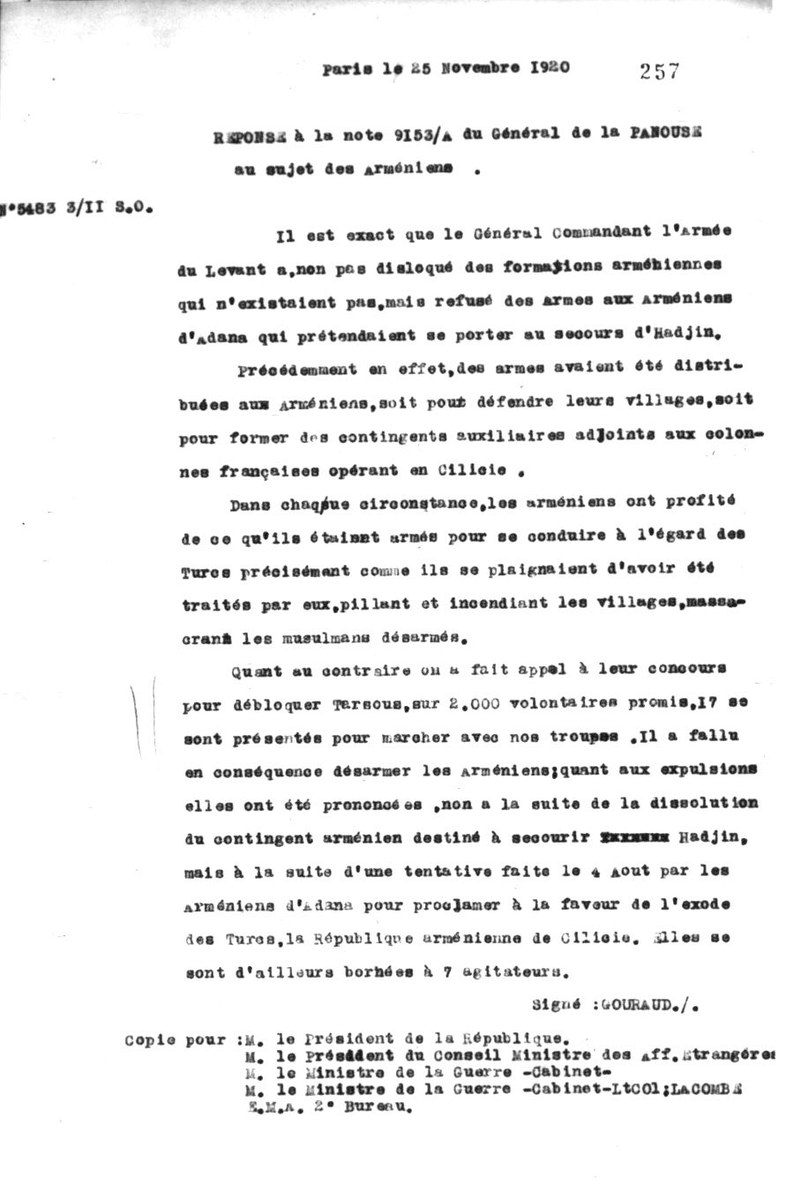
Bu belge, General Gouraud’un General de la Panouse’un Ermenilerle İlgili Notuna 25 Kasım 1920 tarihli Yanıtıdır.
General Gouraud, tam anlamıyla Ermenilerden yaka silker vaziyette.
Belgede, Fransızların, Çukurova bölgesindeki (günümüz Adana, Mersin, Osmaniye, Hatay) "isyan ve taşkınlıkları" nedeniyle Ermenileri tehdit olarak gördükleri anlaşılıyor.
Ermenilere ya köylerini savunmaları için ya da Kilikya’da (Çukurova) (operasyon yapan Fransız birliklerine yardımcı birlikler oluşturmak için silahlar dağıtıldığı ifade ediliyor.
Burada General Gouraud’un kendi ifadeleri çok önemli:
“Her durumda, Ermeniler silahlı olmalarının avantajını, Türklere karşı, tam da kendilerinin Türklerden gördüğünü iddia ettikleri muameleye benzer bir şekilde, köyleri yağmalayarak ve yakarak, silahsız Müslümanları katlederek kullanmışlardır”.
"Ermeniler, Türklerin göçlerini fırsat bilerek 4 Ağustos 1920’de Kilikya Ermeni Cumhuriyeti'ni ilan etmeye çalışmışlardır. Bu girişim sonrası Ermenilerin silahsızlandırılması ve sürgün edilmesi kararlaştırılmıştır."
🔍 Gerçekler ortada: Osmanlı Devleti’nin tehcir kararını almasının arkasında güvenlik kaygıları yatmaktadır ve bu kararın "soykırım" ile ilişkilendirilmesi tarihi gerçeklerle bağdaşmamaktadır.
Bu belgeler, Ermenilerin 1915’te Osmanlı’yı parçalamak için Batılı güçlerle iş birliği yaptığını ve sonunda bu güçler tarafından bile gözden çıkarıldığını bir kez daha ortaya koyuyor.
TARİH, çarpıtmalarla değiştirilemez! BELGELERLE YAZILIR!..
Not: Bu çok önemli belgeleri sağlayan Fransız tarihçi Maxime Gauin’e -@MaximeGauin-büyük bir teşekkür borçluyuz…
Bu belgeler, Fransa Dışişleri Bakanlığı tarafından yayınlanan "Documents diplomatiques français. 1915, Tome III, 15 septembre-31 décembre" adlı arşiv çalışmasından alınmıştır. Özellikle 29 Eylül 1915 tarihli ve "Note sur une opération militaire en Cilicie" başlıklı rapor, Ermeni ulusal savunma komitesinin Osmanlı topraklarındaki askeri operasyonları üzerine detaylar sunmaktadır. Belgeler, Fransa’nın diplomatik arşivlerine ait dijital kütüphaneden temin edilmiştir.
Link:
https://t.co/Whz0AkFmIy
https://t.co/uQC08AuwQL
Bence Avrupa'da olan Türkofobiyi anlatmamız gerekiyor diye düşünüyorum (Flood'ı okuyun lütfen) .
> 27 Aralık 1992 sabah erken saatlerinde, Şahin Çalışır, Kuzey Ren-Vestfalya’daki Meerbusch şehri yakınlarında, A52 otobanında hayatını kaybetti.
Şahin Çalışır 20 yaşındaydı.
Türklere yapılan soykırım ve katliamların Google Haritalar'da gösterimi. Soldaki "Ayrıntılar" bölümünde harita üzerindeki işaretli her olayın açıklaması mevcut. Çok yararlı bir çalışma.
💥BATI TRAKYA’da YUNAN FAŞİZMİ DEVAM EDİYOR
Gümülcine’de Batı Trakya Türk ahalisinden küçük bir çocuğa zorla “Yaşasın Kasidiaris” demesi için ŞİDDET uyguluyor Yunanlılar.
Kasidiaris, Altın Şafak elebaşlarından.
Altın Şafak, 2020'de suç örgütü ilan edilmiş olsa da, sempatizanları hala Türk toplumu üzerinde baskılarını sürdürüyor.
Yunan barbarlığına karşı bütün Türkler birleşmeli.
Batı Trakya Türkleri Yalnız Değildir
#WeAreTurks
#WesternThraceTurks
Yunanistan - Gümülcine: Aşırı sağcılar Türk çocuğunu korkutup - "Yaşasın Kasidiaris" dedirttiler.
Videoda, yaklaşık 10 yaşında ve Yunanca aksanı nedeniyle Yunanistan'daki Batı Trakya Türk Azınlığı’na mensup olduğu düşünülen bir çocuğun köşeye sıkışmış halde korkuyla söyledikleri dikkat çekiyor.
Aşırı sağcılar, çocuğun sözlerini alayla karşılayarak kahkahalar atıyor ve ardından kaçmasını söylüyor. Video, yaklaşık iki ay önce Instagram’da “Komotini Milliyetçileri” adlı bir profil tarafından paylaşıldı. Ancak ne zaman çekildiği bilinmiyor. 2019’da Altın Şafak’ın Gümülcine ofisinin kapatılmasına rağmen, bölgede aşırı sağcı grupların etkisini sürdürdüğü belirtiliyor.
Videoda, eski Altın Şafak üyesi İlias Kasidiaris'e destek sloganlarının zorla söyletilmesi, Yunanistan'da büyük tepkiye neden oldu.
Altın Şafak (Hrisi Avgi), Yunanistan’da aşırı sağcı ve neo-Nazi ideolojisiyle bilinen bir partiydi. 2020’de suç örgütü ilan edilip lider kadrosu hapis cezasına çarptırıldıktan sonra siyasi etkisini kaybetti.
Remembering what evil (i.e. Turkey) is capable of on the world stage and gets away with it.
The destruction of the Armenians in the most hideous unspeakable methods during the #ArmenianGenocide by the Turks was the corner stone of Turkish statehood.
Image bellow, who does this?
Remembering ‘Bloody Christmas’
Join us on Saturday 21st December 2024, 5–7 PM, at 13 St James’s Square, London, to honour the victims of the brutal events of Bloody Christmas 1963.
This was more than an attack on Turkish Cypriots - it was an assault on democracy, freedom and equality.
Under the dictatorship of Makarios, the Greek Cypriot controlled Republic of Cyprus became a ruthless regime, oppressing Turkish Cypriots with a brutal fist.
Bloody Christmas marked the destruction of the Republic, the massacre of hundreds, the displacement of tens of thousands, the start of an attempted genocide and the beginning of an 11-year campaign of ethnic cleansing.
Let us stand together to remember those lost and ensure the world does not forget this dark chapter in history.
🚨#Breaking
Various reports from Northeast Syria indicate that the Kurdish-led Syrian Democratic Forces (SDF), supported by the United States, are allegedly targeting civilians from Arab, Turkmen, Yazidi, and Assyrian communities with live bullets. These incidents reportedly started as a opposition to the racial and ideological opression of Kurdish organizations, including the PKK, which is designated as a terrorist organization by the U.S. and the EU, in regions where these communities form the majority population. Such actions raise serious concerns about potential ethnic cleansing. We urge Secretary Blinken (@SecBlinken) and U.S. Central Command (@CENTCOM) to cease support for entities engaging in violence against civilians.
SDF elements fire bullets against the Syrian locals during raising of new Syrian flag in Raqqa, killing and injuring locals, Syrian Observatory reports


![TurkicGenocide's tweet photo. Bloody Christmas
For many around the world, Christmas is a time of giving—a time for celebrating with family and loved ones. For Turkish Cypriots, however, it is a time of grief for the lives lost, a reminder of ethnic cleansing, genocide, and the beginning of life in segregated and besieged enclaves under the constant fear of new massacres. Sixty-one years ago, in December 1963, the 'Bloody Christmas' took place.
More than 30.000 people ethnicaly cleansed from their homes to sieged enclaves, 346 massacred, more than 300 Turkish Cypriot missing to this day.
"When the disturbances broke out in December 1963 and continued during the first part of 1964 thousands of Turkish-Cypriots fled from their homes, taking with them only what they could drive or carry, and sought refuge in what they considered to be safer Turkish Cypriot villages and areas." UN Secretary-General Thant reported to the Security Council at 7 December 1967
Background and Prelude to Violence
The 1960 Zurich and London Agreements established Cyprus as an independent state with a unique bi-communal constitutional structure, aiming to balance Greek and Turkish Cypriot political rights. However, the Greek Cypriot leadership, under Archbishop Makarios, soon expressed dissatisfaction with these arrangements. Makarios remarked that “the agreements do not form the goal—they are the present and not the future” and sought to amend the constitution to reduce Turkish Cypriots' rights.
In 1963, the Greek Cypriot leadership started a covert strategy to systematically weaken Turkish Cypriot political power, aiming ultimately for irredentist Enosis. Lt. General George Karayiannis confirmed this intent, noting that President Makarios prepared to revise the constitution and arm Greek Cypriots in anticipation of clashes.
What really happened at 1963?
Scott Gibbons, who was based in Cyprus at the time as the Middle East correspondent for the London Daily Express, provides insight into what truly happened during Bloody Christmas.
“During the night of 20-21 December 1963, the Greeks launched a series of attacks on Turks throughout the Nicosia area. The combined forces of uniformed Greek Cypriot police and civilian EOKA gunmen began systematically to murder Turks and arrest and disarm Turkish policemen. At the same time, the Greek Cypriots took complete control of the Cyprus government information organisation and announced that the ‘legal’ authorities were putting down a Turkish uprising.
Within days, Turkish civil servants throughout the island had been ousted from their positions and Greeks now ran the entire governmental administration. Armed EOKA thugs physically prevented the vice-president, a Turk, Dr Fazıl Küçük, from entering his office. But, at ground level, the Greek actions seemed so haphazard that although it quickly became obvious the attack on the Turks was premeditated, the extent of the planning was not fully discovered until April 1966, when a Greek Cypriot newspaper, Patris, gave details of what has become known as the Akritas Plan. This was the first exercise in ethnic cleansing - racial extermination or genocide, as I prefer to call it - the Makarios government undertook.
The object of this ethnic cleansing, as the Akritas Plan explained, was to prepare for the amendment of the Constitution in such a way as to allow the government to legally - in its eyes at least - unite the island with Greece, the Greek Cypriot ‘Motherland’. In the plan, there were details given on how to provoke the Turks into taking up arms against the government so that the ‘legal’ forces of the state could be empowered to crush what would be called a Turkish revolt, expel all Turks from the police and every other government institution, seal off the Turkish population in enclaves throughout the island, and pronounce a fait accompli before Christmas 1963. The Akritas Plan envisaged that the Western world would be too preoccupied with Christmas festivities to interfere in time to prevent enosis. Further, not only would the speed of events take Turkey by surprise, but Turkey would also be unable to call a meeting of the two other Guarantor Powers, Britain and Greece, who together were pledged to keep Cyprus independent, in time to prevent the island’s union with Greece.
Patris claimed that Makarios had personally organised the entire scheme and had made the military preparations himself. The paper wrote, “Makarios entrusted Yorgadjis [Polycarpos Yorgadjis, former EOKA gunman and now Minister of the Interior] who took the code name of Akritas, with the task of establishing the organisation. The Minister of Labour, Tassos Papadopoulos, was appointed deputy chief of the organisation, and Glafcos Clerides [then Speaker of the 50-member Cyprus parliament] became the Chief of Operations.” Clerides is now, of course, President of the Greek South Cyprus and recognised by the world as the president of the whole island.
What became known as the Christmas War or, in the Turkish version, Bloody Christmas, was actually the Akritas Plan for genocide. There was bloody slaughter of the Turks and the Greeks also paid a terrible penalty in deaths and injuries when the Turkish fighters hit back, but the Greeks’ aim, enosis, was not realised.
I believe I had a part in wrecking this plan. I was based in Cyprus at that time as the Middle East correspondent of the London Daily Express and had arrived back from an assignment in Africa the day before the shooting began. In fact, I was having dinner in a Nicosia restaurant and heard the first shots ring out. I sent a report on this to my newspaper and gave more details the following day. The result was that the foreign press poured in, swamping the cable office and telephone lines with reports of Greek atrocities. The success of the Akritas Plan was based on suffocating all Turkish protest and keeping the operation as secret as possible while enosis was arranged. Now the whole world knew what was going on and, while the fierce fighting continued, the element of surprise had been lost. Christmas came and went, by which time the three Guarantor Powers had become involved, as had the United Nations, and enosis was not achieved.
But as I said, Akritas Plan for Genocide, was not known for years. In the interval, the now famous Green Line was drawn across the capital city, Nicosia, to protect the Turkish quarter, a United Nations peace force arrived, Makarios received a slap on the wrist and was told to behave himself and the world’s press left. I was sent to Istanbul for a year, after which I quit newspaper work for a time to write a book on the ongoing war in the Yemen.
The bloodshed continued on the island for 11 years after that Christmas, but the world had now lost interest. Those 11 years were hell on earth for the Turkish Cypriots, starved, hounded from pillar to post by the now all-Greek authorities, and pursued by the emergent Greek Cypriot National Guard led by mainland Greek officers. And, where they had owned 35 percent of the land, mostly the best agricultural acreage, they were now squeezed into three percent of it, spread across the island in tiny enclaves.
The Greeks of Cyprus had attempted genocide against their fellow citizens, the Turks, and had failed. 11 years later, they tried again.”
As H. Scott Gibbons whitnessed, it was a genocide attempt. In the 1963/64 massacres alone, more than 800 Turkish Cypriot men, women and children were wounded and murdered.
The distinguished philosopher, Michael Moran, of Sussex University, made the following diagnosis of Greek Cypriot attitudes: “It was because they “were under a kind of ideological spell, a collective mental condition similar to what Marxists used to call “false-consciousness” that the Greek Cypriots could embark upon their particular course of action in December 1963 with all the zeal and confidence they did. Brainwashed through at least a hundred years of purblind school-teaching and sermonising into a set of beliefs pathologically at odds with any plausible account of historical and political realities; lacking contact with a counterbalancing tradition of rational criticism; for the most part incapable of ironic scepticism towards theological obfuscation - the Greek Cypriot leaders were effectively de-sensitised to the equally important rights of the Turkish Cypriots. In this way they were able to treat their Turkish compatriots with such consistent and irrational abuse, hardly noticing that this was in fact what they were doing.”
Lt. Gen. George Karayiannis of the Greek Cypriot militia reported in Ethnikos Kiryx 15 July 1965, “When the Turkish Cypriots objected to the amendment of the constitution Makarios put his plan into effect, and the Greek Cypriot attack began in December 1963" The General is referring to the notorious "Akritas" plan, which was the blueprint for the extermination of the Turkish Cypriots and the annexation of the island to Greece. This plan was prepared in 1960 before the new constitution had been given any chance to work, and was published in Patris on 24th April 1966. Its existence is also admitted by Clerides.
On 28th December 1963 the Daily Express carried the following report from Cyprus: "We went tonight into the sealed-off Turkish Cypriot Quarter of Nicosia in which 200 to 300 people had been slaughtered in the last five days. We were the first Western reporters there and we have seen sights too frightful to be described in print. Horror so extreme that the people seemed stunned beyond tears."
On 1st January 1964 the Daily Herald reported: "When I came across the Turkish homes they were an appalling sight. Apart from the walls they just did not exist. I doubt if a napalm attack could have created more devastation. Under roofs which had caved in I found a twisted mass of bed springs, children's cots, and grey ashes of what had once been tables, chairs and wardrobes. In the neighbouring village of Ayios Vassilios I counted 16 wrecked and burned out homes. They were all Turkish Cypriot. In neither village did I find a scrap of damage to any Greek Cypriot house."
On 12th January 1964 the British High Commission in Nicosia wrote to London “The Greek (Cypriot) police are led by extremists who provoked the fighting and deliberately engaged in atrocities. They have recruited into their ranks as “special constables” gun-happy young thugs. ....... Makarios assured Sir Arthur Clark that there will be no attack. His assurance is as worthless as previous assurances have proved.”
On 14th January 1964 the Daily Telegraph reported that the Turkish Cypriot inhabitants of Ayios Vassilios had been massacred on 26th December 1963, and reported their exhumation from a mass grave in the presence of the Red Cross and British paratroops. This harrowing story and many others from that period and 1974 are recounted by the Chief Matron of the Nicosia Hospital, Nurse Türkan Aziz MBE in her memoirs “The Death of Friendship.” She recalls how Greek Cypriots roamed the hospital wards killing the Turkish Cypriot patients, and found the bodies of two Turkish Cypriot boys who had taken refuge in her own apartments.
“The two sat on chairs exactly where I had left them, but this time they did not rise to greet me with smiles. Dark blood welled through the tattered remnants of their shirts and dripped on the carpet. Their Greek Cypriot “guard” had vanished, spraying the staircase senselessly with bullets as he left”
Matron Aziz describes the horror of Ayios Vasilios as follows:
“a few feet down they found the first bodies, three men thrown on top of each other, then a boy whose hands had been tied behind his knees, then a little girl, then an old man dressed in his peasant-style baggy trousers, then some women. There were 21 bodies, almost all dressed, but not in hospital garb. These were Turkish Cypriot families who had lived in Ayios Vasilios.”
The relevance of “hospital garb” is that the Greek Cypriots “revealed a new depth of sickness of the mind by insisting the bodies were of patients in the hospital who had died of natural causes. They had issued a press statement saying “Turks distort the truth.”
A further massacre of Turkish Cypriots, at Limassol, was reported by The Observer on 16th February 1964, On 17th February 1964 the Washington Post reported that "Greek Cypriot fanatics appear bent on a policy of genocide.” 26 February 1964 The Guardian reported The Greek Cypriot Minister of the Interior admitted that he had controlled the attack in Limassol himself.
On 31st December 1963 "The Guardian" had reported: "It is nonsense to claim, as the Greek Cypriots do, that all casualties were caused by fighting between armed men of both sides. On Christmas Eve many Turkish Cypriot people were brutally attacked and murdered in their suburban homes, including the wife and children of the Turkish Cypriot head of army medical services by a group of forty men, many in army boots and greatcoats." Although the Turkish Cypriots fought back as best they could, there were no massacres of Greek Cypriot civilians.
On 10th September 1964 the Secretary-General reported: "UNFICYP carried out a detailed survey of all damage to properties throughout the island during the disturbances, ......... it shows that in 109 villages, most of them Turkish-Cypriot or mixed villages, 527 houses have been destroyed while 2,000 others have suffered damage from looting. In Ktima 38 houses and shops have been destroyed totally and 122 partially. In the Omorphita suburb of Nicosia, 50 houses have been totally destroyed while a further 240 have been partially destroyed there and in adjacent suburbs."
On 6th February 1964 a British patrol found armed Greek Cypriot police attacking the Turkish Cypriots of Ayios Sozomenos. They were unable to stop the attack. On 13th February 1964 the Greeks and Greek Cypriots attacked the Turkish Cypriot quarter of Limassol with tanks, killing 16 and injuring 35.
On 15th February 1964 "The Daily Telegraph" reported: "It is a real military operation which the Greek Cypriots launched against the six thousand inhabitants of the Turkish Cypriot Quarter yesterday morning. A spokesman for the Greek Cypriot Government has recognised this officially. It is hard to conceive how Greek and Turkish Cypriots may seriously contemplate working together after all that has happened."
Professor Ernst Forsthoff, the neutral President of the Supreme Constitutional Court of Cyprus told Die Welt on 27th December 1963 “Makarios bears on his shoulders the sole responsibility of the recent tragic events. His aim is to deprive the Turkish community of their rights.” In an interview with UPI press agency on 30th December 1963 he said: "All this happened because Makarios wanted to remove all constitutional rights from the Turkish Cypriots."
Despite the arrival of UN troops in Cyprus in March 1964 the Greek Cypriots continued their attacks on Turkish Cypriot civilians. On 7 th August 1964, they attacked Turkish Cypriot villages, provoking the Turkish government to send four warplanes to attack the Greek Cypriot village of Polis. On 8th August thirty Turkish jets flew low over Greek Cypriot towns on the north coast, and on 9th August, sixty-four Turkish planes flew low over northwest Cyprus.
On 12th August the US Ambassador to Greece was instructed to urge the Greek government to stop the attacks on Turkish Cypriots, and Kruschev told the Greek Cypriots that they could expect no support from the Soviet Union Finally the Greek Cypriots desisted, but had it not been for these warning flights there would have been few Turkish Cypriots left alive. They were saved by the Turkish Air Force, not by the UN.
As Gibbons noted, the Greek Cypriots made another attempt in 1974.
Some Inferences
More than 300 Turkish Cypriots are still missing without trace from these massacres of 1963/64. These dreadful events were not the responsibility of "the Greek Colonels" of 1974, or an unrepresentative handful of Greek Cypriot extremists. The persecution of the Turkish Cypriots was an act of policy on the part of the Greek Cypriot political and religious leadership, which has to this day made no serious attempt to bring the murderers to justice.
The Greek Cypriots sometimes allege that it was they who were attacked, by the Turkish Cypriots who were determined to wreck the 1960 agreements. However, the Turkish Cypriots were not only outnumbered by nearly four to one; they were also surrounded in their villages by armed Greek Cypriots, they had no way of protecting their women and children, and Turkey was 40 miles away across the sea. If such had been their plan the Turkish Cypriots would have congregated in the North where arrangements would have been made to house and protect them. The very idea that in those circumstances the Turkish Cypriots were the aggressors, is absurd.
Michael Moran's observations regarding the Greek Cypriots appear accurate: they remain deeply influenced by an ideological framework rooted in the irredentist aspirations of the Megali Idea. This collective mindset, shaped over decades, reflects a widespread unawareness among the Greek population of the atrocities and harm inflicted upon Turkish communities.
Through over a century of selective education and biased rhetoric in schools and religious sermons, a distorted historical narrative has taken hold. This has fostered a belief system that is fundamentally misaligned with any credible interpretation of historical and political realities. Denialism persists to this day, as Greek and Greek Cypriot educational institutions continue to propagate a revisionist version of history. This narrative portrays Greeks exclusively as victims, further perpetuating blind fanaticism and animosity toward others. Therefore, there is a risk of repeating the same mistakes made by their predecessors as they did at '74 which would be our final part of Cyprus Question Series.
This is the first part of our planned three-part series on the Cyprus Question, aimed at providing a comprehensive understanding of the historical facts regarding the island. We invite you to share this work and help ensure the truth reaches a wider audience.](https://pbs.twimg.com/media/GduKa6jXcAAki9A.jpg)
![TurkicGenocide's tweet photo. Bloody Christmas
For many around the world, Christmas is a time of giving—a time for celebrating with family and loved ones. For Turkish Cypriots, however, it is a time of grief for the lives lost, a reminder of ethnic cleansing, genocide, and the beginning of life in segregated and besieged enclaves under the constant fear of new massacres. Sixty-one years ago, in December 1963, the 'Bloody Christmas' took place.
More than 30.000 people ethnicaly cleansed from their homes to sieged enclaves, 346 massacred, more than 300 Turkish Cypriot missing to this day.
"When the disturbances broke out in December 1963 and continued during the first part of 1964 thousands of Turkish-Cypriots fled from their homes, taking with them only what they could drive or carry, and sought refuge in what they considered to be safer Turkish Cypriot villages and areas." UN Secretary-General Thant reported to the Security Council at 7 December 1967
Background and Prelude to Violence
The 1960 Zurich and London Agreements established Cyprus as an independent state with a unique bi-communal constitutional structure, aiming to balance Greek and Turkish Cypriot political rights. However, the Greek Cypriot leadership, under Archbishop Makarios, soon expressed dissatisfaction with these arrangements. Makarios remarked that “the agreements do not form the goal—they are the present and not the future” and sought to amend the constitution to reduce Turkish Cypriots' rights.
In 1963, the Greek Cypriot leadership started a covert strategy to systematically weaken Turkish Cypriot political power, aiming ultimately for irredentist Enosis. Lt. General George Karayiannis confirmed this intent, noting that President Makarios prepared to revise the constitution and arm Greek Cypriots in anticipation of clashes.
What really happened at 1963?
Scott Gibbons, who was based in Cyprus at the time as the Middle East correspondent for the London Daily Express, provides insight into what truly happened during Bloody Christmas.
“During the night of 20-21 December 1963, the Greeks launched a series of attacks on Turks throughout the Nicosia area. The combined forces of uniformed Greek Cypriot police and civilian EOKA gunmen began systematically to murder Turks and arrest and disarm Turkish policemen. At the same time, the Greek Cypriots took complete control of the Cyprus government information organisation and announced that the ‘legal’ authorities were putting down a Turkish uprising.
Within days, Turkish civil servants throughout the island had been ousted from their positions and Greeks now ran the entire governmental administration. Armed EOKA thugs physically prevented the vice-president, a Turk, Dr Fazıl Küçük, from entering his office. But, at ground level, the Greek actions seemed so haphazard that although it quickly became obvious the attack on the Turks was premeditated, the extent of the planning was not fully discovered until April 1966, when a Greek Cypriot newspaper, Patris, gave details of what has become known as the Akritas Plan. This was the first exercise in ethnic cleansing - racial extermination or genocide, as I prefer to call it - the Makarios government undertook.
The object of this ethnic cleansing, as the Akritas Plan explained, was to prepare for the amendment of the Constitution in such a way as to allow the government to legally - in its eyes at least - unite the island with Greece, the Greek Cypriot ‘Motherland’. In the plan, there were details given on how to provoke the Turks into taking up arms against the government so that the ‘legal’ forces of the state could be empowered to crush what would be called a Turkish revolt, expel all Turks from the police and every other government institution, seal off the Turkish population in enclaves throughout the island, and pronounce a fait accompli before Christmas 1963. The Akritas Plan envisaged that the Western world would be too preoccupied with Christmas festivities to interfere in time to prevent enosis. Further, not only would the speed of events take Turkey by surprise, but Turkey would also be unable to call a meeting of the two other Guarantor Powers, Britain and Greece, who together were pledged to keep Cyprus independent, in time to prevent the island’s union with Greece.
Patris claimed that Makarios had personally organised the entire scheme and had made the military preparations himself. The paper wrote, “Makarios entrusted Yorgadjis [Polycarpos Yorgadjis, former EOKA gunman and now Minister of the Interior] who took the code name of Akritas, with the task of establishing the organisation. The Minister of Labour, Tassos Papadopoulos, was appointed deputy chief of the organisation, and Glafcos Clerides [then Speaker of the 50-member Cyprus parliament] became the Chief of Operations.” Clerides is now, of course, President of the Greek South Cyprus and recognised by the world as the president of the whole island.
What became known as the Christmas War or, in the Turkish version, Bloody Christmas, was actually the Akritas Plan for genocide. There was bloody slaughter of the Turks and the Greeks also paid a terrible penalty in deaths and injuries when the Turkish fighters hit back, but the Greeks’ aim, enosis, was not realised.
I believe I had a part in wrecking this plan. I was based in Cyprus at that time as the Middle East correspondent of the London Daily Express and had arrived back from an assignment in Africa the day before the shooting began. In fact, I was having dinner in a Nicosia restaurant and heard the first shots ring out. I sent a report on this to my newspaper and gave more details the following day. The result was that the foreign press poured in, swamping the cable office and telephone lines with reports of Greek atrocities. The success of the Akritas Plan was based on suffocating all Turkish protest and keeping the operation as secret as possible while enosis was arranged. Now the whole world knew what was going on and, while the fierce fighting continued, the element of surprise had been lost. Christmas came and went, by which time the three Guarantor Powers had become involved, as had the United Nations, and enosis was not achieved.
But as I said, Akritas Plan for Genocide, was not known for years. In the interval, the now famous Green Line was drawn across the capital city, Nicosia, to protect the Turkish quarter, a United Nations peace force arrived, Makarios received a slap on the wrist and was told to behave himself and the world’s press left. I was sent to Istanbul for a year, after which I quit newspaper work for a time to write a book on the ongoing war in the Yemen.
The bloodshed continued on the island for 11 years after that Christmas, but the world had now lost interest. Those 11 years were hell on earth for the Turkish Cypriots, starved, hounded from pillar to post by the now all-Greek authorities, and pursued by the emergent Greek Cypriot National Guard led by mainland Greek officers. And, where they had owned 35 percent of the land, mostly the best agricultural acreage, they were now squeezed into three percent of it, spread across the island in tiny enclaves.
The Greeks of Cyprus had attempted genocide against their fellow citizens, the Turks, and had failed. 11 years later, they tried again.”
As H. Scott Gibbons whitnessed, it was a genocide attempt. In the 1963/64 massacres alone, more than 800 Turkish Cypriot men, women and children were wounded and murdered.
The distinguished philosopher, Michael Moran, of Sussex University, made the following diagnosis of Greek Cypriot attitudes: “It was because they “were under a kind of ideological spell, a collective mental condition similar to what Marxists used to call “false-consciousness” that the Greek Cypriots could embark upon their particular course of action in December 1963 with all the zeal and confidence they did. Brainwashed through at least a hundred years of purblind school-teaching and sermonising into a set of beliefs pathologically at odds with any plausible account of historical and political realities; lacking contact with a counterbalancing tradition of rational criticism; for the most part incapable of ironic scepticism towards theological obfuscation - the Greek Cypriot leaders were effectively de-sensitised to the equally important rights of the Turkish Cypriots. In this way they were able to treat their Turkish compatriots with such consistent and irrational abuse, hardly noticing that this was in fact what they were doing.”
Lt. Gen. George Karayiannis of the Greek Cypriot militia reported in Ethnikos Kiryx 15 July 1965, “When the Turkish Cypriots objected to the amendment of the constitution Makarios put his plan into effect, and the Greek Cypriot attack began in December 1963" The General is referring to the notorious "Akritas" plan, which was the blueprint for the extermination of the Turkish Cypriots and the annexation of the island to Greece. This plan was prepared in 1960 before the new constitution had been given any chance to work, and was published in Patris on 24th April 1966. Its existence is also admitted by Clerides.
On 28th December 1963 the Daily Express carried the following report from Cyprus: "We went tonight into the sealed-off Turkish Cypriot Quarter of Nicosia in which 200 to 300 people had been slaughtered in the last five days. We were the first Western reporters there and we have seen sights too frightful to be described in print. Horror so extreme that the people seemed stunned beyond tears."
On 1st January 1964 the Daily Herald reported: "When I came across the Turkish homes they were an appalling sight. Apart from the walls they just did not exist. I doubt if a napalm attack could have created more devastation. Under roofs which had caved in I found a twisted mass of bed springs, children's cots, and grey ashes of what had once been tables, chairs and wardrobes. In the neighbouring village of Ayios Vassilios I counted 16 wrecked and burned out homes. They were all Turkish Cypriot. In neither village did I find a scrap of damage to any Greek Cypriot house."
On 12th January 1964 the British High Commission in Nicosia wrote to London “The Greek (Cypriot) police are led by extremists who provoked the fighting and deliberately engaged in atrocities. They have recruited into their ranks as “special constables” gun-happy young thugs. ....... Makarios assured Sir Arthur Clark that there will be no attack. His assurance is as worthless as previous assurances have proved.”
On 14th January 1964 the Daily Telegraph reported that the Turkish Cypriot inhabitants of Ayios Vassilios had been massacred on 26th December 1963, and reported their exhumation from a mass grave in the presence of the Red Cross and British paratroops. This harrowing story and many others from that period and 1974 are recounted by the Chief Matron of the Nicosia Hospital, Nurse Türkan Aziz MBE in her memoirs “The Death of Friendship.” She recalls how Greek Cypriots roamed the hospital wards killing the Turkish Cypriot patients, and found the bodies of two Turkish Cypriot boys who had taken refuge in her own apartments.
“The two sat on chairs exactly where I had left them, but this time they did not rise to greet me with smiles. Dark blood welled through the tattered remnants of their shirts and dripped on the carpet. Their Greek Cypriot “guard” had vanished, spraying the staircase senselessly with bullets as he left”
Matron Aziz describes the horror of Ayios Vasilios as follows:
“a few feet down they found the first bodies, three men thrown on top of each other, then a boy whose hands had been tied behind his knees, then a little girl, then an old man dressed in his peasant-style baggy trousers, then some women. There were 21 bodies, almost all dressed, but not in hospital garb. These were Turkish Cypriot families who had lived in Ayios Vasilios.”
The relevance of “hospital garb” is that the Greek Cypriots “revealed a new depth of sickness of the mind by insisting the bodies were of patients in the hospital who had died of natural causes. They had issued a press statement saying “Turks distort the truth.”
A further massacre of Turkish Cypriots, at Limassol, was reported by The Observer on 16th February 1964, On 17th February 1964 the Washington Post reported that "Greek Cypriot fanatics appear bent on a policy of genocide.” 26 February 1964 The Guardian reported The Greek Cypriot Minister of the Interior admitted that he had controlled the attack in Limassol himself.
On 31st December 1963 "The Guardian" had reported: "It is nonsense to claim, as the Greek Cypriots do, that all casualties were caused by fighting between armed men of both sides. On Christmas Eve many Turkish Cypriot people were brutally attacked and murdered in their suburban homes, including the wife and children of the Turkish Cypriot head of army medical services by a group of forty men, many in army boots and greatcoats." Although the Turkish Cypriots fought back as best they could, there were no massacres of Greek Cypriot civilians.
On 10th September 1964 the Secretary-General reported: "UNFICYP carried out a detailed survey of all damage to properties throughout the island during the disturbances, ......... it shows that in 109 villages, most of them Turkish-Cypriot or mixed villages, 527 houses have been destroyed while 2,000 others have suffered damage from looting. In Ktima 38 houses and shops have been destroyed totally and 122 partially. In the Omorphita suburb of Nicosia, 50 houses have been totally destroyed while a further 240 have been partially destroyed there and in adjacent suburbs."
On 6th February 1964 a British patrol found armed Greek Cypriot police attacking the Turkish Cypriots of Ayios Sozomenos. They were unable to stop the attack. On 13th February 1964 the Greeks and Greek Cypriots attacked the Turkish Cypriot quarter of Limassol with tanks, killing 16 and injuring 35.
On 15th February 1964 "The Daily Telegraph" reported: "It is a real military operation which the Greek Cypriots launched against the six thousand inhabitants of the Turkish Cypriot Quarter yesterday morning. A spokesman for the Greek Cypriot Government has recognised this officially. It is hard to conceive how Greek and Turkish Cypriots may seriously contemplate working together after all that has happened."
Professor Ernst Forsthoff, the neutral President of the Supreme Constitutional Court of Cyprus told Die Welt on 27th December 1963 “Makarios bears on his shoulders the sole responsibility of the recent tragic events. His aim is to deprive the Turkish community of their rights.” In an interview with UPI press agency on 30th December 1963 he said: "All this happened because Makarios wanted to remove all constitutional rights from the Turkish Cypriots."
Despite the arrival of UN troops in Cyprus in March 1964 the Greek Cypriots continued their attacks on Turkish Cypriot civilians. On 7 th August 1964, they attacked Turkish Cypriot villages, provoking the Turkish government to send four warplanes to attack the Greek Cypriot village of Polis. On 8th August thirty Turkish jets flew low over Greek Cypriot towns on the north coast, and on 9th August, sixty-four Turkish planes flew low over northwest Cyprus.
On 12th August the US Ambassador to Greece was instructed to urge the Greek government to stop the attacks on Turkish Cypriots, and Kruschev told the Greek Cypriots that they could expect no support from the Soviet Union Finally the Greek Cypriots desisted, but had it not been for these warning flights there would have been few Turkish Cypriots left alive. They were saved by the Turkish Air Force, not by the UN.
As Gibbons noted, the Greek Cypriots made another attempt in 1974.
Some Inferences
More than 300 Turkish Cypriots are still missing without trace from these massacres of 1963/64. These dreadful events were not the responsibility of "the Greek Colonels" of 1974, or an unrepresentative handful of Greek Cypriot extremists. The persecution of the Turkish Cypriots was an act of policy on the part of the Greek Cypriot political and religious leadership, which has to this day made no serious attempt to bring the murderers to justice.
The Greek Cypriots sometimes allege that it was they who were attacked, by the Turkish Cypriots who were determined to wreck the 1960 agreements. However, the Turkish Cypriots were not only outnumbered by nearly four to one; they were also surrounded in their villages by armed Greek Cypriots, they had no way of protecting their women and children, and Turkey was 40 miles away across the sea. If such had been their plan the Turkish Cypriots would have congregated in the North where arrangements would have been made to house and protect them. The very idea that in those circumstances the Turkish Cypriots were the aggressors, is absurd.
Michael Moran's observations regarding the Greek Cypriots appear accurate: they remain deeply influenced by an ideological framework rooted in the irredentist aspirations of the Megali Idea. This collective mindset, shaped over decades, reflects a widespread unawareness among the Greek population of the atrocities and harm inflicted upon Turkish communities.
Through over a century of selective education and biased rhetoric in schools and religious sermons, a distorted historical narrative has taken hold. This has fostered a belief system that is fundamentally misaligned with any credible interpretation of historical and political realities. Denialism persists to this day, as Greek and Greek Cypriot educational institutions continue to propagate a revisionist version of history. This narrative portrays Greeks exclusively as victims, further perpetuating blind fanaticism and animosity toward others. Therefore, there is a risk of repeating the same mistakes made by their predecessors as they did at '74 which would be our final part of Cyprus Question Series.
This is the first part of our planned three-part series on the Cyprus Question, aimed at providing a comprehensive understanding of the historical facts regarding the island. We invite you to share this work and help ensure the truth reaches a wider audience.](https://pbs.twimg.com/media/GduKHo1XIAEY-0c.jpg)
![TurkicGenocide's tweet photo. Bloody Christmas
For many around the world, Christmas is a time of giving—a time for celebrating with family and loved ones. For Turkish Cypriots, however, it is a time of grief for the lives lost, a reminder of ethnic cleansing, genocide, and the beginning of life in segregated and besieged enclaves under the constant fear of new massacres. Sixty-one years ago, in December 1963, the 'Bloody Christmas' took place.
More than 30.000 people ethnicaly cleansed from their homes to sieged enclaves, 346 massacred, more than 300 Turkish Cypriot missing to this day.
"When the disturbances broke out in December 1963 and continued during the first part of 1964 thousands of Turkish-Cypriots fled from their homes, taking with them only what they could drive or carry, and sought refuge in what they considered to be safer Turkish Cypriot villages and areas." UN Secretary-General Thant reported to the Security Council at 7 December 1967
Background and Prelude to Violence
The 1960 Zurich and London Agreements established Cyprus as an independent state with a unique bi-communal constitutional structure, aiming to balance Greek and Turkish Cypriot political rights. However, the Greek Cypriot leadership, under Archbishop Makarios, soon expressed dissatisfaction with these arrangements. Makarios remarked that “the agreements do not form the goal—they are the present and not the future” and sought to amend the constitution to reduce Turkish Cypriots' rights.
In 1963, the Greek Cypriot leadership started a covert strategy to systematically weaken Turkish Cypriot political power, aiming ultimately for irredentist Enosis. Lt. General George Karayiannis confirmed this intent, noting that President Makarios prepared to revise the constitution and arm Greek Cypriots in anticipation of clashes.
What really happened at 1963?
Scott Gibbons, who was based in Cyprus at the time as the Middle East correspondent for the London Daily Express, provides insight into what truly happened during Bloody Christmas.
“During the night of 20-21 December 1963, the Greeks launched a series of attacks on Turks throughout the Nicosia area. The combined forces of uniformed Greek Cypriot police and civilian EOKA gunmen began systematically to murder Turks and arrest and disarm Turkish policemen. At the same time, the Greek Cypriots took complete control of the Cyprus government information organisation and announced that the ‘legal’ authorities were putting down a Turkish uprising.
Within days, Turkish civil servants throughout the island had been ousted from their positions and Greeks now ran the entire governmental administration. Armed EOKA thugs physically prevented the vice-president, a Turk, Dr Fazıl Küçük, from entering his office. But, at ground level, the Greek actions seemed so haphazard that although it quickly became obvious the attack on the Turks was premeditated, the extent of the planning was not fully discovered until April 1966, when a Greek Cypriot newspaper, Patris, gave details of what has become known as the Akritas Plan. This was the first exercise in ethnic cleansing - racial extermination or genocide, as I prefer to call it - the Makarios government undertook.
The object of this ethnic cleansing, as the Akritas Plan explained, was to prepare for the amendment of the Constitution in such a way as to allow the government to legally - in its eyes at least - unite the island with Greece, the Greek Cypriot ‘Motherland’. In the plan, there were details given on how to provoke the Turks into taking up arms against the government so that the ‘legal’ forces of the state could be empowered to crush what would be called a Turkish revolt, expel all Turks from the police and every other government institution, seal off the Turkish population in enclaves throughout the island, and pronounce a fait accompli before Christmas 1963. The Akritas Plan envisaged that the Western world would be too preoccupied with Christmas festivities to interfere in time to prevent enosis. Further, not only would the speed of events take Turkey by surprise, but Turkey would also be unable to call a meeting of the two other Guarantor Powers, Britain and Greece, who together were pledged to keep Cyprus independent, in time to prevent the island’s union with Greece.
Patris claimed that Makarios had personally organised the entire scheme and had made the military preparations himself. The paper wrote, “Makarios entrusted Yorgadjis [Polycarpos Yorgadjis, former EOKA gunman and now Minister of the Interior] who took the code name of Akritas, with the task of establishing the organisation. The Minister of Labour, Tassos Papadopoulos, was appointed deputy chief of the organisation, and Glafcos Clerides [then Speaker of the 50-member Cyprus parliament] became the Chief of Operations.” Clerides is now, of course, President of the Greek South Cyprus and recognised by the world as the president of the whole island.
What became known as the Christmas War or, in the Turkish version, Bloody Christmas, was actually the Akritas Plan for genocide. There was bloody slaughter of the Turks and the Greeks also paid a terrible penalty in deaths and injuries when the Turkish fighters hit back, but the Greeks’ aim, enosis, was not realised.
I believe I had a part in wrecking this plan. I was based in Cyprus at that time as the Middle East correspondent of the London Daily Express and had arrived back from an assignment in Africa the day before the shooting began. In fact, I was having dinner in a Nicosia restaurant and heard the first shots ring out. I sent a report on this to my newspaper and gave more details the following day. The result was that the foreign press poured in, swamping the cable office and telephone lines with reports of Greek atrocities. The success of the Akritas Plan was based on suffocating all Turkish protest and keeping the operation as secret as possible while enosis was arranged. Now the whole world knew what was going on and, while the fierce fighting continued, the element of surprise had been lost. Christmas came and went, by which time the three Guarantor Powers had become involved, as had the United Nations, and enosis was not achieved.
But as I said, Akritas Plan for Genocide, was not known for years. In the interval, the now famous Green Line was drawn across the capital city, Nicosia, to protect the Turkish quarter, a United Nations peace force arrived, Makarios received a slap on the wrist and was told to behave himself and the world’s press left. I was sent to Istanbul for a year, after which I quit newspaper work for a time to write a book on the ongoing war in the Yemen.
The bloodshed continued on the island for 11 years after that Christmas, but the world had now lost interest. Those 11 years were hell on earth for the Turkish Cypriots, starved, hounded from pillar to post by the now all-Greek authorities, and pursued by the emergent Greek Cypriot National Guard led by mainland Greek officers. And, where they had owned 35 percent of the land, mostly the best agricultural acreage, they were now squeezed into three percent of it, spread across the island in tiny enclaves.
The Greeks of Cyprus had attempted genocide against their fellow citizens, the Turks, and had failed. 11 years later, they tried again.”
As H. Scott Gibbons whitnessed, it was a genocide attempt. In the 1963/64 massacres alone, more than 800 Turkish Cypriot men, women and children were wounded and murdered.
The distinguished philosopher, Michael Moran, of Sussex University, made the following diagnosis of Greek Cypriot attitudes: “It was because they “were under a kind of ideological spell, a collective mental condition similar to what Marxists used to call “false-consciousness” that the Greek Cypriots could embark upon their particular course of action in December 1963 with all the zeal and confidence they did. Brainwashed through at least a hundred years of purblind school-teaching and sermonising into a set of beliefs pathologically at odds with any plausible account of historical and political realities; lacking contact with a counterbalancing tradition of rational criticism; for the most part incapable of ironic scepticism towards theological obfuscation - the Greek Cypriot leaders were effectively de-sensitised to the equally important rights of the Turkish Cypriots. In this way they were able to treat their Turkish compatriots with such consistent and irrational abuse, hardly noticing that this was in fact what they were doing.”
Lt. Gen. George Karayiannis of the Greek Cypriot militia reported in Ethnikos Kiryx 15 July 1965, “When the Turkish Cypriots objected to the amendment of the constitution Makarios put his plan into effect, and the Greek Cypriot attack began in December 1963" The General is referring to the notorious "Akritas" plan, which was the blueprint for the extermination of the Turkish Cypriots and the annexation of the island to Greece. This plan was prepared in 1960 before the new constitution had been given any chance to work, and was published in Patris on 24th April 1966. Its existence is also admitted by Clerides.
On 28th December 1963 the Daily Express carried the following report from Cyprus: "We went tonight into the sealed-off Turkish Cypriot Quarter of Nicosia in which 200 to 300 people had been slaughtered in the last five days. We were the first Western reporters there and we have seen sights too frightful to be described in print. Horror so extreme that the people seemed stunned beyond tears."
On 1st January 1964 the Daily Herald reported: "When I came across the Turkish homes they were an appalling sight. Apart from the walls they just did not exist. I doubt if a napalm attack could have created more devastation. Under roofs which had caved in I found a twisted mass of bed springs, children's cots, and grey ashes of what had once been tables, chairs and wardrobes. In the neighbouring village of Ayios Vassilios I counted 16 wrecked and burned out homes. They were all Turkish Cypriot. In neither village did I find a scrap of damage to any Greek Cypriot house."
On 12th January 1964 the British High Commission in Nicosia wrote to London “The Greek (Cypriot) police are led by extremists who provoked the fighting and deliberately engaged in atrocities. They have recruited into their ranks as “special constables” gun-happy young thugs. ....... Makarios assured Sir Arthur Clark that there will be no attack. His assurance is as worthless as previous assurances have proved.”
On 14th January 1964 the Daily Telegraph reported that the Turkish Cypriot inhabitants of Ayios Vassilios had been massacred on 26th December 1963, and reported their exhumation from a mass grave in the presence of the Red Cross and British paratroops. This harrowing story and many others from that period and 1974 are recounted by the Chief Matron of the Nicosia Hospital, Nurse Türkan Aziz MBE in her memoirs “The Death of Friendship.” She recalls how Greek Cypriots roamed the hospital wards killing the Turkish Cypriot patients, and found the bodies of two Turkish Cypriot boys who had taken refuge in her own apartments.
“The two sat on chairs exactly where I had left them, but this time they did not rise to greet me with smiles. Dark blood welled through the tattered remnants of their shirts and dripped on the carpet. Their Greek Cypriot “guard” had vanished, spraying the staircase senselessly with bullets as he left”
Matron Aziz describes the horror of Ayios Vasilios as follows:
“a few feet down they found the first bodies, three men thrown on top of each other, then a boy whose hands had been tied behind his knees, then a little girl, then an old man dressed in his peasant-style baggy trousers, then some women. There were 21 bodies, almost all dressed, but not in hospital garb. These were Turkish Cypriot families who had lived in Ayios Vasilios.”
The relevance of “hospital garb” is that the Greek Cypriots “revealed a new depth of sickness of the mind by insisting the bodies were of patients in the hospital who had died of natural causes. They had issued a press statement saying “Turks distort the truth.”
A further massacre of Turkish Cypriots, at Limassol, was reported by The Observer on 16th February 1964, On 17th February 1964 the Washington Post reported that "Greek Cypriot fanatics appear bent on a policy of genocide.” 26 February 1964 The Guardian reported The Greek Cypriot Minister of the Interior admitted that he had controlled the attack in Limassol himself.
On 31st December 1963 "The Guardian" had reported: "It is nonsense to claim, as the Greek Cypriots do, that all casualties were caused by fighting between armed men of both sides. On Christmas Eve many Turkish Cypriot people were brutally attacked and murdered in their suburban homes, including the wife and children of the Turkish Cypriot head of army medical services by a group of forty men, many in army boots and greatcoats." Although the Turkish Cypriots fought back as best they could, there were no massacres of Greek Cypriot civilians.
On 10th September 1964 the Secretary-General reported: "UNFICYP carried out a detailed survey of all damage to properties throughout the island during the disturbances, ......... it shows that in 109 villages, most of them Turkish-Cypriot or mixed villages, 527 houses have been destroyed while 2,000 others have suffered damage from looting. In Ktima 38 houses and shops have been destroyed totally and 122 partially. In the Omorphita suburb of Nicosia, 50 houses have been totally destroyed while a further 240 have been partially destroyed there and in adjacent suburbs."
On 6th February 1964 a British patrol found armed Greek Cypriot police attacking the Turkish Cypriots of Ayios Sozomenos. They were unable to stop the attack. On 13th February 1964 the Greeks and Greek Cypriots attacked the Turkish Cypriot quarter of Limassol with tanks, killing 16 and injuring 35.
On 15th February 1964 "The Daily Telegraph" reported: "It is a real military operation which the Greek Cypriots launched against the six thousand inhabitants of the Turkish Cypriot Quarter yesterday morning. A spokesman for the Greek Cypriot Government has recognised this officially. It is hard to conceive how Greek and Turkish Cypriots may seriously contemplate working together after all that has happened."
Professor Ernst Forsthoff, the neutral President of the Supreme Constitutional Court of Cyprus told Die Welt on 27th December 1963 “Makarios bears on his shoulders the sole responsibility of the recent tragic events. His aim is to deprive the Turkish community of their rights.” In an interview with UPI press agency on 30th December 1963 he said: "All this happened because Makarios wanted to remove all constitutional rights from the Turkish Cypriots."
Despite the arrival of UN troops in Cyprus in March 1964 the Greek Cypriots continued their attacks on Turkish Cypriot civilians. On 7 th August 1964, they attacked Turkish Cypriot villages, provoking the Turkish government to send four warplanes to attack the Greek Cypriot village of Polis. On 8th August thirty Turkish jets flew low over Greek Cypriot towns on the north coast, and on 9th August, sixty-four Turkish planes flew low over northwest Cyprus.
On 12th August the US Ambassador to Greece was instructed to urge the Greek government to stop the attacks on Turkish Cypriots, and Kruschev told the Greek Cypriots that they could expect no support from the Soviet Union Finally the Greek Cypriots desisted, but had it not been for these warning flights there would have been few Turkish Cypriots left alive. They were saved by the Turkish Air Force, not by the UN.
As Gibbons noted, the Greek Cypriots made another attempt in 1974.
Some Inferences
More than 300 Turkish Cypriots are still missing without trace from these massacres of 1963/64. These dreadful events were not the responsibility of "the Greek Colonels" of 1974, or an unrepresentative handful of Greek Cypriot extremists. The persecution of the Turkish Cypriots was an act of policy on the part of the Greek Cypriot political and religious leadership, which has to this day made no serious attempt to bring the murderers to justice.
The Greek Cypriots sometimes allege that it was they who were attacked, by the Turkish Cypriots who were determined to wreck the 1960 agreements. However, the Turkish Cypriots were not only outnumbered by nearly four to one; they were also surrounded in their villages by armed Greek Cypriots, they had no way of protecting their women and children, and Turkey was 40 miles away across the sea. If such had been their plan the Turkish Cypriots would have congregated in the North where arrangements would have been made to house and protect them. The very idea that in those circumstances the Turkish Cypriots were the aggressors, is absurd.
Michael Moran's observations regarding the Greek Cypriots appear accurate: they remain deeply influenced by an ideological framework rooted in the irredentist aspirations of the Megali Idea. This collective mindset, shaped over decades, reflects a widespread unawareness among the Greek population of the atrocities and harm inflicted upon Turkish communities.
Through over a century of selective education and biased rhetoric in schools and religious sermons, a distorted historical narrative has taken hold. This has fostered a belief system that is fundamentally misaligned with any credible interpretation of historical and political realities. Denialism persists to this day, as Greek and Greek Cypriot educational institutions continue to propagate a revisionist version of history. This narrative portrays Greeks exclusively as victims, further perpetuating blind fanaticism and animosity toward others. Therefore, there is a risk of repeating the same mistakes made by their predecessors as they did at '74 which would be our final part of Cyprus Question Series.
This is the first part of our planned three-part series on the Cyprus Question, aimed at providing a comprehensive understanding of the historical facts regarding the island. We invite you to share this work and help ensure the truth reaches a wider audience.](https://pbs.twimg.com/media/GdtkXZvXkAA91wK.jpg)


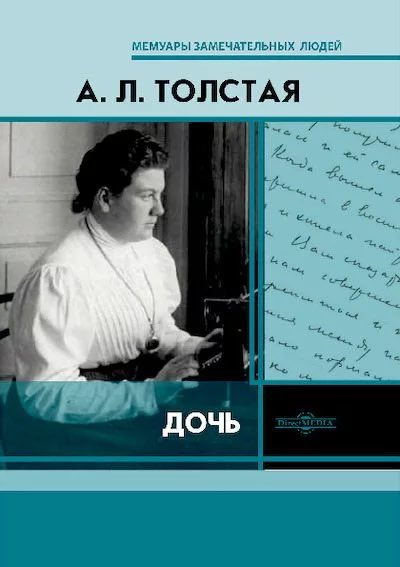


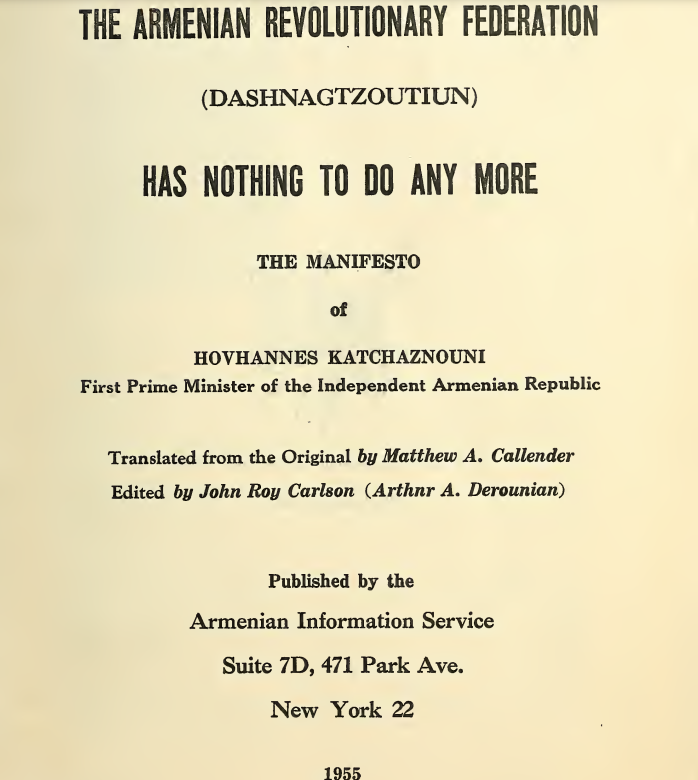


![TurkicGenocide's tweet photo. Bloody Christmas
For many around the world, Christmas is a time of giving—a time for celebrating with family and loved ones. For Turkish Cypriots, however, it is a time of grief for the lives lost, a reminder of ethnic cleansing, genocide, and the beginning of life in segregated and besieged enclaves under the constant fear of new massacres. Sixty-one years ago, in December 1963, the 'Bloody Christmas' took place.
More than 30.000 people ethnicaly cleansed from their homes to sieged enclaves, 346 massacred, more than 300 Turkish Cypriot missing to this day.
"When the disturbances broke out in December 1963 and continued during the first part of 1964 thousands of Turkish-Cypriots fled from their homes, taking with them only what they could drive or carry, and sought refuge in what they considered to be safer Turkish Cypriot villages and areas." UN Secretary-General Thant reported to the Security Council at 7 December 1967
Background and Prelude to Violence
The 1960 Zurich and London Agreements established Cyprus as an independent state with a unique bi-communal constitutional structure, aiming to balance Greek and Turkish Cypriot political rights. However, the Greek Cypriot leadership, under Archbishop Makarios, soon expressed dissatisfaction with these arrangements. Makarios remarked that “the agreements do not form the goal—they are the present and not the future” and sought to amend the constitution to reduce Turkish Cypriots' rights.
In 1963, the Greek Cypriot leadership started a covert strategy to systematically weaken Turkish Cypriot political power, aiming ultimately for irredentist Enosis. Lt. General George Karayiannis confirmed this intent, noting that President Makarios prepared to revise the constitution and arm Greek Cypriots in anticipation of clashes.
What really happened at 1963?
Scott Gibbons, who was based in Cyprus at the time as the Middle East correspondent for the London Daily Express, provides insight into what truly happened during Bloody Christmas.
“During the night of 20-21 December 1963, the Greeks launched a series of attacks on Turks throughout the Nicosia area. The combined forces of uniformed Greek Cypriot police and civilian EOKA gunmen began systematically to murder Turks and arrest and disarm Turkish policemen. At the same time, the Greek Cypriots took complete control of the Cyprus government information organisation and announced that the ‘legal’ authorities were putting down a Turkish uprising.
Within days, Turkish civil servants throughout the island had been ousted from their positions and Greeks now ran the entire governmental administration. Armed EOKA thugs physically prevented the vice-president, a Turk, Dr Fazıl Küçük, from entering his office. But, at ground level, the Greek actions seemed so haphazard that although it quickly became obvious the attack on the Turks was premeditated, the extent of the planning was not fully discovered until April 1966, when a Greek Cypriot newspaper, Patris, gave details of what has become known as the Akritas Plan. This was the first exercise in ethnic cleansing - racial extermination or genocide, as I prefer to call it - the Makarios government undertook.
The object of this ethnic cleansing, as the Akritas Plan explained, was to prepare for the amendment of the Constitution in such a way as to allow the government to legally - in its eyes at least - unite the island with Greece, the Greek Cypriot ‘Motherland’. In the plan, there were details given on how to provoke the Turks into taking up arms against the government so that the ‘legal’ forces of the state could be empowered to crush what would be called a Turkish revolt, expel all Turks from the police and every other government institution, seal off the Turkish population in enclaves throughout the island, and pronounce a fait accompli before Christmas 1963. The Akritas Plan envisaged that the Western world would be too preoccupied with Christmas festivities to interfere in time to prevent enosis. Further, not only would the speed of events take Turkey by surprise, but Turkey would also be unable to call a meeting of the two other Guarantor Powers, Britain and Greece, who together were pledged to keep Cyprus independent, in time to prevent the island’s union with Greece.
Patris claimed that Makarios had personally organised the entire scheme and had made the military preparations himself. The paper wrote, “Makarios entrusted Yorgadjis [Polycarpos Yorgadjis, former EOKA gunman and now Minister of the Interior] who took the code name of Akritas, with the task of establishing the organisation. The Minister of Labour, Tassos Papadopoulos, was appointed deputy chief of the organisation, and Glafcos Clerides [then Speaker of the 50-member Cyprus parliament] became the Chief of Operations.” Clerides is now, of course, President of the Greek South Cyprus and recognised by the world as the president of the whole island.
What became known as the Christmas War or, in the Turkish version, Bloody Christmas, was actually the Akritas Plan for genocide. There was bloody slaughter of the Turks and the Greeks also paid a terrible penalty in deaths and injuries when the Turkish fighters hit back, but the Greeks’ aim, enosis, was not realised.
I believe I had a part in wrecking this plan. I was based in Cyprus at that time as the Middle East correspondent of the London Daily Express and had arrived back from an assignment in Africa the day before the shooting began. In fact, I was having dinner in a Nicosia restaurant and heard the first shots ring out. I sent a report on this to my newspaper and gave more details the following day. The result was that the foreign press poured in, swamping the cable office and telephone lines with reports of Greek atrocities. The success of the Akritas Plan was based on suffocating all Turkish protest and keeping the operation as secret as possible while enosis was arranged. Now the whole world knew what was going on and, while the fierce fighting continued, the element of surprise had been lost. Christmas came and went, by which time the three Guarantor Powers had become involved, as had the United Nations, and enosis was not achieved.
But as I said, Akritas Plan for Genocide, was not known for years. In the interval, the now famous Green Line was drawn across the capital city, Nicosia, to protect the Turkish quarter, a United Nations peace force arrived, Makarios received a slap on the wrist and was told to behave himself and the world’s press left. I was sent to Istanbul for a year, after which I quit newspaper work for a time to write a book on the ongoing war in the Yemen.
The bloodshed continued on the island for 11 years after that Christmas, but the world had now lost interest. Those 11 years were hell on earth for the Turkish Cypriots, starved, hounded from pillar to post by the now all-Greek authorities, and pursued by the emergent Greek Cypriot National Guard led by mainland Greek officers. And, where they had owned 35 percent of the land, mostly the best agricultural acreage, they were now squeezed into three percent of it, spread across the island in tiny enclaves.
The Greeks of Cyprus had attempted genocide against their fellow citizens, the Turks, and had failed. 11 years later, they tried again.”
As H. Scott Gibbons whitnessed, it was a genocide attempt. In the 1963/64 massacres alone, more than 800 Turkish Cypriot men, women and children were wounded and murdered.
The distinguished philosopher, Michael Moran, of Sussex University, made the following diagnosis of Greek Cypriot attitudes: “It was because they “were under a kind of ideological spell, a collective mental condition similar to what Marxists used to call “false-consciousness” that the Greek Cypriots could embark upon their particular course of action in December 1963 with all the zeal and confidence they did. Brainwashed through at least a hundred years of purblind school-teaching and sermonising into a set of beliefs pathologically at odds with any plausible account of historical and political realities; lacking contact with a counterbalancing tradition of rational criticism; for the most part incapable of ironic scepticism towards theological obfuscation - the Greek Cypriot leaders were effectively de-sensitised to the equally important rights of the Turkish Cypriots. In this way they were able to treat their Turkish compatriots with such consistent and irrational abuse, hardly noticing that this was in fact what they were doing.”
Lt. Gen. George Karayiannis of the Greek Cypriot militia reported in Ethnikos Kiryx 15 July 1965, “When the Turkish Cypriots objected to the amendment of the constitution Makarios put his plan into effect, and the Greek Cypriot attack began in December 1963" The General is referring to the notorious "Akritas" plan, which was the blueprint for the extermination of the Turkish Cypriots and the annexation of the island to Greece. This plan was prepared in 1960 before the new constitution had been given any chance to work, and was published in Patris on 24th April 1966. Its existence is also admitted by Clerides.
On 28th December 1963 the Daily Express carried the following report from Cyprus: "We went tonight into the sealed-off Turkish Cypriot Quarter of Nicosia in which 200 to 300 people had been slaughtered in the last five days. We were the first Western reporters there and we have seen sights too frightful to be described in print. Horror so extreme that the people seemed stunned beyond tears."
On 1st January 1964 the Daily Herald reported: "When I came across the Turkish homes they were an appalling sight. Apart from the walls they just did not exist. I doubt if a napalm attack could have created more devastation. Under roofs which had caved in I found a twisted mass of bed springs, children's cots, and grey ashes of what had once been tables, chairs and wardrobes. In the neighbouring village of Ayios Vassilios I counted 16 wrecked and burned out homes. They were all Turkish Cypriot. In neither village did I find a scrap of damage to any Greek Cypriot house."
On 12th January 1964 the British High Commission in Nicosia wrote to London “The Greek (Cypriot) police are led by extremists who provoked the fighting and deliberately engaged in atrocities. They have recruited into their ranks as “special constables” gun-happy young thugs. ....... Makarios assured Sir Arthur Clark that there will be no attack. His assurance is as worthless as previous assurances have proved.”
On 14th January 1964 the Daily Telegraph reported that the Turkish Cypriot inhabitants of Ayios Vassilios had been massacred on 26th December 1963, and reported their exhumation from a mass grave in the presence of the Red Cross and British paratroops. This harrowing story and many others from that period and 1974 are recounted by the Chief Matron of the Nicosia Hospital, Nurse Türkan Aziz MBE in her memoirs “The Death of Friendship.” She recalls how Greek Cypriots roamed the hospital wards killing the Turkish Cypriot patients, and found the bodies of two Turkish Cypriot boys who had taken refuge in her own apartments.
“The two sat on chairs exactly where I had left them, but this time they did not rise to greet me with smiles. Dark blood welled through the tattered remnants of their shirts and dripped on the carpet. Their Greek Cypriot “guard” had vanished, spraying the staircase senselessly with bullets as he left”
Matron Aziz describes the horror of Ayios Vasilios as follows:
“a few feet down they found the first bodies, three men thrown on top of each other, then a boy whose hands had been tied behind his knees, then a little girl, then an old man dressed in his peasant-style baggy trousers, then some women. There were 21 bodies, almost all dressed, but not in hospital garb. These were Turkish Cypriot families who had lived in Ayios Vasilios.”
The relevance of “hospital garb” is that the Greek Cypriots “revealed a new depth of sickness of the mind by insisting the bodies were of patients in the hospital who had died of natural causes. They had issued a press statement saying “Turks distort the truth.”
A further massacre of Turkish Cypriots, at Limassol, was reported by The Observer on 16th February 1964, On 17th February 1964 the Washington Post reported that "Greek Cypriot fanatics appear bent on a policy of genocide.” 26 February 1964 The Guardian reported The Greek Cypriot Minister of the Interior admitted that he had controlled the attack in Limassol himself.
On 31st December 1963 "The Guardian" had reported: "It is nonsense to claim, as the Greek Cypriots do, that all casualties were caused by fighting between armed men of both sides. On Christmas Eve many Turkish Cypriot people were brutally attacked and murdered in their suburban homes, including the wife and children of the Turkish Cypriot head of army medical services by a group of forty men, many in army boots and greatcoats." Although the Turkish Cypriots fought back as best they could, there were no massacres of Greek Cypriot civilians.
On 10th September 1964 the Secretary-General reported: "UNFICYP carried out a detailed survey of all damage to properties throughout the island during the disturbances, ......... it shows that in 109 villages, most of them Turkish-Cypriot or mixed villages, 527 houses have been destroyed while 2,000 others have suffered damage from looting. In Ktima 38 houses and shops have been destroyed totally and 122 partially. In the Omorphita suburb of Nicosia, 50 houses have been totally destroyed while a further 240 have been partially destroyed there and in adjacent suburbs."
On 6th February 1964 a British patrol found armed Greek Cypriot police attacking the Turkish Cypriots of Ayios Sozomenos. They were unable to stop the attack. On 13th February 1964 the Greeks and Greek Cypriots attacked the Turkish Cypriot quarter of Limassol with tanks, killing 16 and injuring 35.
On 15th February 1964 "The Daily Telegraph" reported: "It is a real military operation which the Greek Cypriots launched against the six thousand inhabitants of the Turkish Cypriot Quarter yesterday morning. A spokesman for the Greek Cypriot Government has recognised this officially. It is hard to conceive how Greek and Turkish Cypriots may seriously contemplate working together after all that has happened."
Professor Ernst Forsthoff, the neutral President of the Supreme Constitutional Court of Cyprus told Die Welt on 27th December 1963 “Makarios bears on his shoulders the sole responsibility of the recent tragic events. His aim is to deprive the Turkish community of their rights.” In an interview with UPI press agency on 30th December 1963 he said: "All this happened because Makarios wanted to remove all constitutional rights from the Turkish Cypriots."
Despite the arrival of UN troops in Cyprus in March 1964 the Greek Cypriots continued their attacks on Turkish Cypriot civilians. On 7 th August 1964, they attacked Turkish Cypriot villages, provoking the Turkish government to send four warplanes to attack the Greek Cypriot village of Polis. On 8th August thirty Turkish jets flew low over Greek Cypriot towns on the north coast, and on 9th August, sixty-four Turkish planes flew low over northwest Cyprus.
On 12th August the US Ambassador to Greece was instructed to urge the Greek government to stop the attacks on Turkish Cypriots, and Kruschev told the Greek Cypriots that they could expect no support from the Soviet Union Finally the Greek Cypriots desisted, but had it not been for these warning flights there would have been few Turkish Cypriots left alive. They were saved by the Turkish Air Force, not by the UN.
As Gibbons noted, the Greek Cypriots made another attempt in 1974.
Some Inferences
More than 300 Turkish Cypriots are still missing without trace from these massacres of 1963/64. These dreadful events were not the responsibility of "the Greek Colonels" of 1974, or an unrepresentative handful of Greek Cypriot extremists. The persecution of the Turkish Cypriots was an act of policy on the part of the Greek Cypriot political and religious leadership, which has to this day made no serious attempt to bring the murderers to justice.
The Greek Cypriots sometimes allege that it was they who were attacked, by the Turkish Cypriots who were determined to wreck the 1960 agreements. However, the Turkish Cypriots were not only outnumbered by nearly four to one; they were also surrounded in their villages by armed Greek Cypriots, they had no way of protecting their women and children, and Turkey was 40 miles away across the sea. If such had been their plan the Turkish Cypriots would have congregated in the North where arrangements would have been made to house and protect them. The very idea that in those circumstances the Turkish Cypriots were the aggressors, is absurd.
Michael Moran's observations regarding the Greek Cypriots appear accurate: they remain deeply influenced by an ideological framework rooted in the irredentist aspirations of the Megali Idea. This collective mindset, shaped over decades, reflects a widespread unawareness among the Greek population of the atrocities and harm inflicted upon Turkish communities.
Through over a century of selective education and biased rhetoric in schools and religious sermons, a distorted historical narrative has taken hold. This has fostered a belief system that is fundamentally misaligned with any credible interpretation of historical and political realities. Denialism persists to this day, as Greek and Greek Cypriot educational institutions continue to propagate a revisionist version of history. This narrative portrays Greeks exclusively as victims, further perpetuating blind fanaticism and animosity toward others. Therefore, there is a risk of repeating the same mistakes made by their predecessors as they did at '74 which would be our final part of Cyprus Question Series.
This is the first part of our planned three-part series on the Cyprus Question, aimed at providing a comprehensive understanding of the historical facts regarding the island. We invite you to share this work and help ensure the truth reaches a wider audience.](https://pbs.twimg.com/media/GduK4NHWIAAB1XG.jpg)