FICO $FICO CEO: “We are not aware of anyone moving to VantageScore since the announcement.
With the FICO Score, which has been in place now for 20 years, virtually every participant in the industry has built models and infrastructure around that score. It's the only score that has actually been in use and therefore, for which we have data going through a full economic cycle, including 2008, the downturn.
And so any time you make any kind of a move away from that, you have to think through what are the implications for remodeling.”
On-ground checks amid ongoing global tensions — what we are seeing so far:
Over the past few days, our team connected with multiple companies across sectors to understand how the current situation is unfolding at the ground level. A few key observations:
1. Demand remains resilient across sector till now
Encouragingly, there is no visible demand destruction so far. Most of sectors in-fact said demand has been quite decent till now. For eg: most auto ancillary companies indicated that OEM schedules for even April–May remain healthy. However, given recent price increases across sector, some moderation in demand over the coming months cannot be ruled out.
2.Margins holding up (for now)
Margins remain stable as companies are still consuming lower-cost inventory.Price hikes have been meaningful across sectors, and most corporates are proactively securing raw material supplies to ensure business continuity. However if situation persist then margin headwind could be see in 1Q and part could be negated by higher top-line growth.
3. Shift towards shorter-term contracts:
There is a clear preference for shorter-duration contracts—fortnightly or monthly—on both raw materials and finished goods. With uncertainty around commodity prices, companies are avoiding long-term commitments at elevated levels.
4. Unorganised sector under pressure, market share shift to leaders across sectors
Smaller players are facing challenges due to working capital constraints and raw material volatility. This is leading to a gradual shift in market share towards stronger, well-capitalised leaders.
5. Labour availability becoming a constraint for MSMEs:
Several companies highlighted emerging labour challenges. In certain pockets, workers are returning to their villages due to issues like LPG availability, upcoming elections, and lingering fears of a Covid-like disruption. This is beginning to impact operations across small scale industries.
6. Logistics disruptions increasing lead times:
Logistics is becoming a bottleneck, with fuel availability at highways turning inconsistent. Delivery timelines, which were earlier around 4 days, are now stretching to 7–8 days in many cases. Freight rates from China to India has gone by 2x.
7. Chemicals sector seeing tailwinds:
The chemical sector continues to witness strong demand. Supply pressures from China have eased due to logistics disruptions and currency movements, supporting better spreads. However, raw material availability remains a constraint.
8. Petrochemical chain seeing availability constraints:
The broader petrochemical value chain is witnessing both availability constraints and pricing volatility, creating uncertainty across multiple downstream industries.
9. Innovation and adaptability on display
Encouragingly, companies are responding with agility. For instance, some AC/EMS players that were dependent on gas cylinders for welding and paint shops are now shifting to alternative processes like oxy-acetylene, helping mitigate supply disruptions and maintain continuity.
10. Preparing for structurally higher energy costs
Many corporates believe that even if the war subsides, oil prices may remain elevated. Countries are likely to build strategic reserves after this energy shock, keeping demand firm. As a result, the entire oil value chain could see sustained inflation—creating top-line tailwinds for several sectors, even as cost pressures persist.
11.Inflation: not all bad for earnings
A moderate level of inflation is often supportive for corporate earnings and nominal GDP growth, as it drives higher realisations and revenue growth. While there could be some pressure on margins and currency in the near term, the overall setup remains constructive.
Periods like these often accelerate market share gains for stronger players, while also setting the stage for nominal growth tailwinds in an inflationary environment.
The best stock I've found this year:
Trading below cash.
Profitable.
Owns real estate worth the entire market cap.
Read that again.
You're buying dollars for 50 cents and getting a free building on top.
A Hindu boy in Mussoorie started singing the Hanuman Chalisa by the roadside - no stage, no big setup, just a mic and a guitar.
He sang so beautifully and melodiously that his voice made people stop and listen. Gradually, a crowd gathered, and many joined him in singing the Hanuman Chalisa together.
The entire atmosphere turned devotional and spiritually uplifting.
Our new generation is truly unapologetic and deeply rooted in their faith.
Hats off to the young man.
8 minutes that will truly touch your soul - watch it completely. ❤️🚩
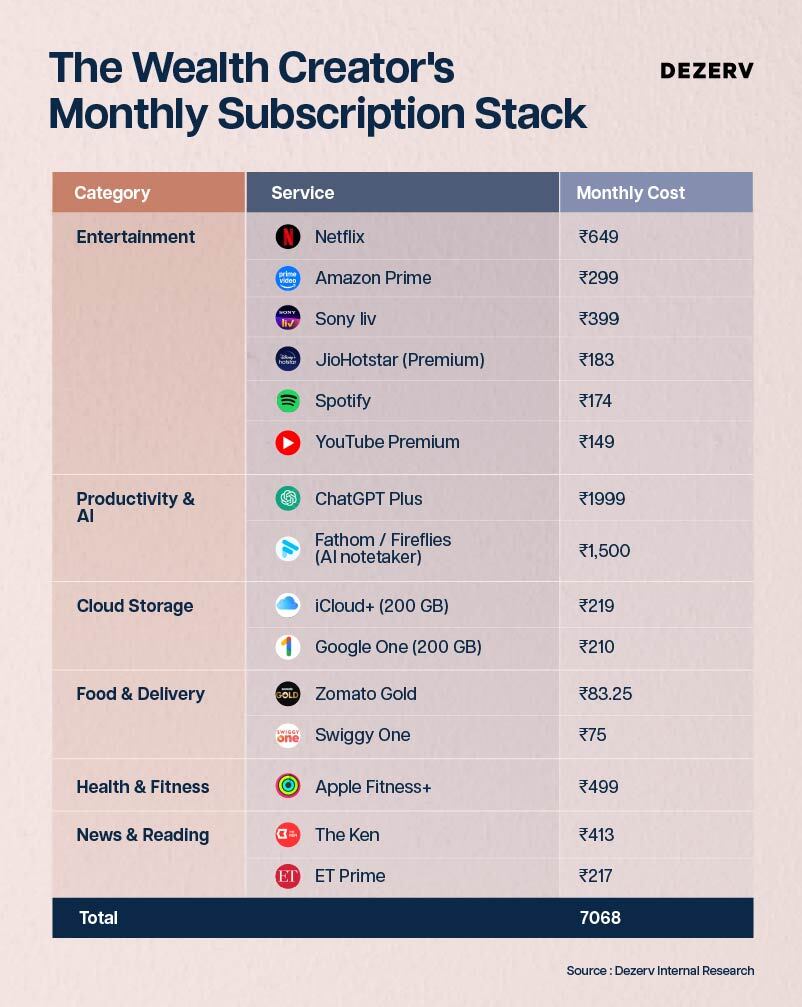
You're spending ₹50 lakhs on things you'll never own.
Last week, my phone told me I was out of storage. I didn't delete anything. I just tapped "Upgrade" on iCloud and forgot about it.
That evening, I asked a few team members to list every subscription they pay for monthly.
For a typical affluent Indian household, you're looking at ₹6,000 to ₹8,500 every month.
This is what normalisation looks like.
Let me present you with an alternate scenario.
₹5,000 a month in an index SIP at 12% annual returns over 20 years compounds to roughly ₹50 lakhs. That's a child's college fund or a down-payment for a house.
And it's only going in one direction. India's subscription economy is projected to reach ₹3.2 lakh crore by 2033.
It has become the most resilient business architecture of the last two decades.
I'm not saying stop subscribing. Some of these services genuinely add value to our lives and work.
But I do have an issue with the direction we're all moving towards.
When everything in your life is leased and nothing is owned, the fundamentals of ownership and transfer begin to evaporate.
Your subscriptions die with your last payment. Decades of paying for Audible, Spotify, and Netflix leaves your family with zero books, zero music, and zero films.
We are slowly becoming hostage to models where the price only goes up, the content only exists as long as you keep paying, and switching feels impossible because your memories and data are locked in.
That's the part that should concern every wealth creator.
In this week's Create Wealth newsletter, I've broken down the full economics of the subscription economy. Why cloud storage is the one bill that never stops growing. And a simple 4-step audit framework to take back control.
We've also built a Subscription Audit Calculator. A Google Sheet where you can plug in your subscriptions and see the total cost over 1, 3, and 10 years compared to what the same amount would grow to as a SIP.
👉 Make a copy to personalise it for yourself.
🔗 Read the full newsletter: https://t.co/LR4yeDCC9N
🔗 Subscription Audit Calculator:
https://t.co/EEkRtVLRFh
#SubscriptionEconomy #PersonalFinance #CreateWealth #Dezerv #WealthManagement
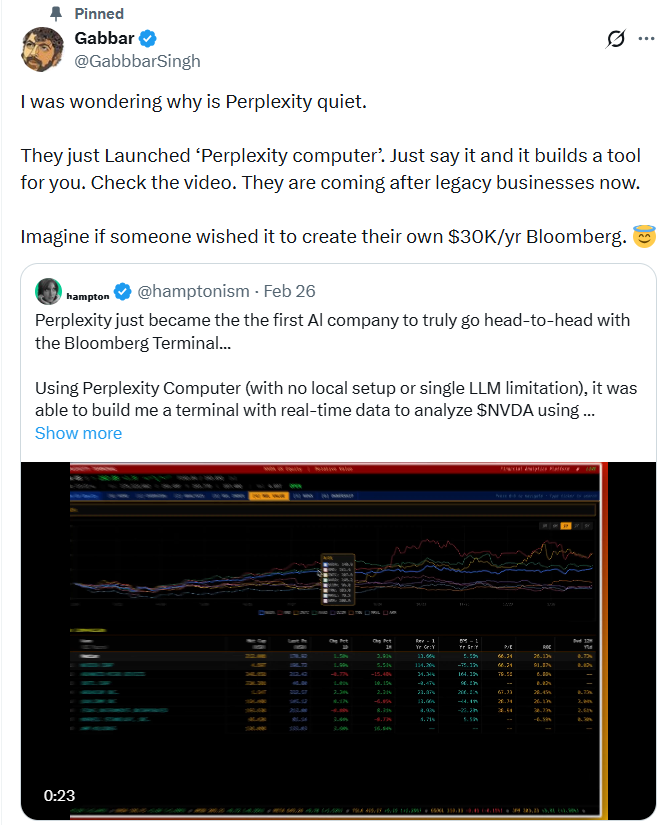
The Perplexity vs Bloomberg comparison totally misunderstands what Bloomberg actually is.
The UI is notoriously ugly, nobody pays $30K for the interface. Bloomberg is an entire financial information infrastructure built over 40 years.
The actual surface area:
FIXED INCOME & BOND DATA
BVAL - Evaluated pricing for 2.5 million+ securities daily, including illiquid and hard-to-price bonds
TRACE feed - Real-time OTC corporate bond trade reporting
MSRB municipal bond data
Government bond pricing across all countries
Broker dealer quote aggregation
SRCH - Fixed income search across 1.5 million+ bonds
Evaluated pricing for MBS, CDOs, ABS, structured products
EQUITIES
Real-time feeds from 330+ global exchanges
Bloomberg composite tickers and indices
B-PIPE - consolidated normalized market data feed at millisecond latency
35 million instruments across all asset classes
Bloomberg Second Measure (BSM) - billions of US consumer transactions giving near real-time revenue signals before earnings
COMMODITIES & PHYSICAL WORLD INTELLIGENCE
Live AIS vessel tracking - oil tankers, LNG carriers, bulk carriers
Oil rig counts and drilling activity
Port congestion and cargo flow data
Sanctions monitoring via ship tracking
Pipeline flow data
Power grid and electricity market data
Weather overlays on commodity positions
Agricultural data - frost maps, crop reports
Steel, metals, chemical, and solar energy pricing
PORTFOLIO & RISK ANALYTICS
PORT - full portfolio analytics, factor decomposition, risk attribution, VaR
MARS - Multi-Asset Risk System for derivatives and exotic options pricing
AIM - Asset & Investment Manager
BQuant - programmatic data access for quantitative research
EXECUTION & TRADING NETWORKS
FXGO - FX execution
TSOX - fixed income execution
BMTG - equities execution
Bloomberg IB - the closed institutional messaging network where actual trades get negotiated. This alone is irreplaceable.
REFERENCE & REGULATORY DATA
Reference data on 50 million+ securities with 56,000 fields
Full audit trail infrastructure satisfying SEC, FINRA, MiFID II
Corporate actions, ESG, and regulatory compliance data
RESEARCH & INTELLIGENCE
Bloomberg Intelligence - 350+ in-house analysts publishing original research
300+ third-party proprietary datasets
Alternative data - foot traffic, web traffic, satellite, transaction data
NEWS & MEDIA
2,700+ journalists globally
Real-time market-moving news classification
Central bank communication tracking
ENTERPRISE INFRASTRUCTURE
40,000+ data fields via enterprise feed
20+ years of historical data delivery
BloombergGPT - their own LLM already trained on their proprietary financial corpus
In this example, Perplexity built one layer of one category, public data.
Bloomberg is operating across every single one of these simultaneously, with proprietary data that took 40+ years and billions of dollars to accumulate. And none of it is publicly scrapable.
My Podcast Agent now saves me ~1 hour per week
I subscribe to 20 podcast shows - which translates to ~5 hours per day. However, I only have time to listen to ~2 hours worth of material (even on 1.5x while I’m at the gym or doing other time pass)
Previously, for episodes I couldn’t listen to - I would spend ~10 mins (on average) to find the podcast transcript online (YT or otherwise), then upload the PDF into ChatGPT & get the summary output in my desired format.
But now, without writing a line of code, built using OpenClaw & a Notion integration through Composio, my Podcast Agent has automated all of this:
Your Basic Blood Work Checklist for Preventive Health
Diabetes screening
- HbA1C
- Fasting Glucose
- Fasting Insulin
- PP Glucose
- PP Insulin
Complete Blood Count
- Hemoglobin
- RBC count
- WBC count
- Platelet count
- Hematocrit
- RDW
- MCV
- MCH
- MCHC
Lipid Profile
- Total Cholesterol
- HDL
- LDL
- Triglyceride
- ApoB
- LpA
Iron Studies
- Serum Iron
- TIBC
- TSAT
- Ferritin
Thyroid Profile
- T3
- T4
- TSH
Inflammation
- Hs CRP
- Homocysteine
Vitamins
- Vitamin B12
- Vitamin D
- Vitamin B9
Liver function
- SGOT
- SGPT
- GGR
- Serum Albumin
- Bilirubin
- ALP
Kidney function
- Creatinine
- Uric acid
- BUN
- Calcium
- Sodium
- Chloride
Hormones
- Testosterone (Free/Total)
-
⚠️ You don’t need to test every test every single time.
🔵 How often you need to get these tests done depends on your current health status, your doctor & your preferences of course.
🔵 Generally these tests are fine once in 6 months (for a healthy person)
- HbA1C, Fasting Insulin, Fasting Glucose, PP Glucose, Lipids, Vitamin B12, Vitamin B9, Vitamin D, Iron studies (women)
🔵 Once a year is fine for these
- Iron studies (Men), CBC, LFT, KFT, Thyroid profile, Hs CRP, Homocysteine, PP Insulin
🔵 ApoB is something you can do once a 2-3 years
🔵 LpA is a once a lifetime test
🔵 Also useful to keep track your hormones like Testosterone, SHBG, FSH etc
BREAKING: AI can now build financial plans like Goldman Sachs wealth advisors (for free).
Here are 12 insane Claude prompts that replace $5,000/hour financial planners (Save for later)
What is the biggest bottleneck in AI right now?
Jensen Huang | CEO $NVDA - Power generation and grid capacity
Lip Bu Tan | CEO $INTC - Memory shortage (specifically High Bandwidth Memory)
Lisa Su | CEO $AMD - Scaling massive data centers within power limits.
Elon Musk | CEO $TSLA - The electrical grid growing too slowly.
Satya Nadella | CEO $MSFT - Fully permitted buildings with power connected.
Mark Zuckerberg | CEO $META - Securing raw power before competitors do.
Andy Jassy | CEO $AMZN - Decade-long wait times for grid connections.
Sundar Pichai | CEO $GOOGL - Local building permits and a lack of electricians.
Michael Dell | CEO $DELL - Customers lacking office power and liquid cooling.
Larry Ellison | CTO $ORCL - The need for gigawatt-scale power plants.
C.C. Wei | CEO $TSM - Sold-out machines for advanced chip packaging
SingularityResearch: Anything required for data centers (Power, machines, memory)
Introducing Perplexity Computer.
Computer unifies every current AI capability into one system.
It can research, design, code, deploy, and manage any project end-to-end.
The power grid upgrade is probably one of the clearest themes for the next 3-5 years.
Aside from $XLU, the best names at current valuations I think are:
1. $ITRI: Smart grid, metering, and utility tech.
2. $FLNC: BESS for grid stability. If you're bullish on solar and wind energy, then BESS for stability is going to have huge demand. Slight issues with profitability, but trades very low for the growth.
3. $AES: The "safer" play with PPAs from $GOOGL and other hyperscalers.
4. $MYRG: Electrical infrastructure contractor trading at 17x NTM EBITDA for 18% EBITDA growth.
5. $PWR: So far, the clear winner but trades at a PE of 43x ahead of the pack.
All of these plays are going to benefit from huge tailwinds in the sector.
- Rate cuts
- Huge CapEx cycle expected to top $1T in a couple years
It was 4 pm at a plush Wealth Management office in Nariman Point, Mumbai.
Arjun, 40 years old, a high-frequency trader from London, walked in straight from the airport. He was wearing a bespoke suit and carried two iPhones that buzzed incessantly with market alerts. His father, Vishwanath, a retired government clerk, had passed away a week ago.
Arjun looked at his watch. "I have exactly forty minutes. I need to liquidate my father’s portfolio, sign the probate documents, and head back to the airport. I have a major opening on the London Stock Exchange tomorrow."
Vikram, the family’s long-time financial consultant, sat across from him. He had a thick file ready on the desk.
"Arjun, your father was a very disciplined man," Vikram said softly. "He started investing with me thirty years ago."
Arjun tapped his fingers on the mahogany table. "I’m sure he was. But let’s be realistic—he was a clerk. How much could he have saved? Five lakhs? Ten? Just give me the total Net Asset Value (NAV). I’ll sign the papers, and you can wire the money to my UK account. I don’t have time for a presentation."
Vikram didn't open the digital spreadsheet. Instead, he handed Arjun a small, old-fashioned leather diary and a single envelope.
"Your father told me that on the day you come to 'collect' your inheritance, I should give you this first. He said the numbers won't make sense without the words."
Arjun sighed, visibly annoyed, but opened the envelope. The handwriting was shaky, the ink slightly faded.
"Dear Arjun,
I know you are looking at your watch right now. I know you are calculating the 'opportunity cost' of sitting in this office instead of a trading floor.
Son, I watched you grow up. I watched you turn into a man who knows the price of everything but the value of nothing. You always told me, 'Dad, money makes money.' But you forgot that money is also supposed to buy time.
In this folder, you won't find a massive fortune. You will find something else. I have invested in 'Time.'
Every year, instead of buying a bigger car or a luxury watch, I bought 'Freedom.' I have cleared the mortgage on our ancestral home. I have set aside a fund that yields exactly what you earn in a month in London. I did this so that if one day you felt tired—if your heart felt heavy from the race—you could stop.
I didn't invest so you could become richer. I invested so you could afford to be 'Poor' for a while and spend time with your daughter, the way you couldn't spend with me.
The compounding I cared about wasn't just interest. It was the compounding of memories. Please, don't liquidate this. Use the dividends to buy a Sunday afternoon. Use the principal to buy a peaceful sleep.
Your father, who always had enough because he had you."
Arjun stopped tapping the table. The buzzing of his iPhones suddenly felt like noise, not signals.
He looked at the portfolio. It wasn't billions, but it was enough. It was a safety net woven out of thirty years of his father’s sacrifices—small SIPs, avoided luxuries, and quiet discipline.
His father hadn't been building a "Portfolio"; he had been building a "Prison Break" for his son.
The phone in Arjun’s hand vibrated again. A "Sell" alert. Arjun looked at it for a long second, then turned the phone face down.
"Vikram," Arjun’s voice was thick. "I’m not liquidating anything today."
"Are you going to miss your flight?" Vikram asked.
Arjun looked at the old leather diary, where his father had noted down every dividend he ever received, alongside notes like "Arjun’s 10th birthday—bought 10 extra shares today."
"The market will open tomorrow without me," Arjun said, a tear finally hitting the glass of his expensive watch. "But my daughter’s childhood won't wait for a bull market."
The Lesson
In the world of investing, we often obsess over CAGR, Alpha, and Portfolio Diversification. We treat money as a scoreboard to prove we are winning.
But the greatest return on investment (ROI) isn't more money—it is Autonomy. * Real Wealth is the ability to say "No" to a job you hate or a meeting you don't want to attend.
True Legacy isn't leaving behind a pile of cash; it's leaving behind the gift of "Time" for those you love.
Don't just invest to retire. Invest so that your loved ones don't have to sacrifice their soul for a paycheck.
Lot of BDC takes flying around. Most focused on NAV marks and software exposure.
That's the wrong place to look.
BDCs borrow money to lend money. The liability stack tells you what breaks first.
Downgrades already starting. Spreads already widening.
Wrote a primer on BDC debt...the part nobody talks about until it's too late.
https://t.co/Hd5lBotS8D