The next 6 to 12 months are the ones where you change your life.
But, If you don't understand this little concept on how to prepare yourself for the next bull run, then forget about a 100x....
🧵
@PeterObi I don’t need to verify… PO you are the only man that defeated corruption and the love of money…
It is clear and obvious that the people of Nigeria wants you
Revenue driven buybacks are becoming a bigger part of the crypto market.
More protocols are starting to use the money their platforms generate to buy back or burn their own tokens.
• 6 projects in these categories you’d want to watching closely:
1. $HYPE — @HyperliquidX
99% of eligible protocol fees allocated to buybacks.
2. $UNI — @Uniswap
17% of activated protocol fees directed toward UNI burns.
3. $PUMP — @Pumpfun
50% of net revenue allocated to buybacks and burns.
4. $STONK — @StonkFun
Around 60% of platform revenue allocated to buybacks, with over $21M reportedly spent.
5. $PONS — @ponsdotfamily
80% of protocol fees allocated to buybacks and burns.
6. $JUP — @JupiterExchange
50% of onchain revenue allocated to token buybacks.
But there's something I think is more important than these percentages.
A protocol allocating 99% of fees to buybacks doesn't automatically make its token undervalued.
Personally, I'd rather look at:
→ How much revenue the protocol actually generates.
→ How much money is spent buying tokens.
→ Buyback value relative to market cap.
→ Whether the buybacks are sustainable.
→ How much new token supply enters circulation.
A 50% buyback allocation from a protocol generating substantial revenue could have more impact than a 100% allocation from one generating very little.
Revenue matters. Actual buyback activity matters more.
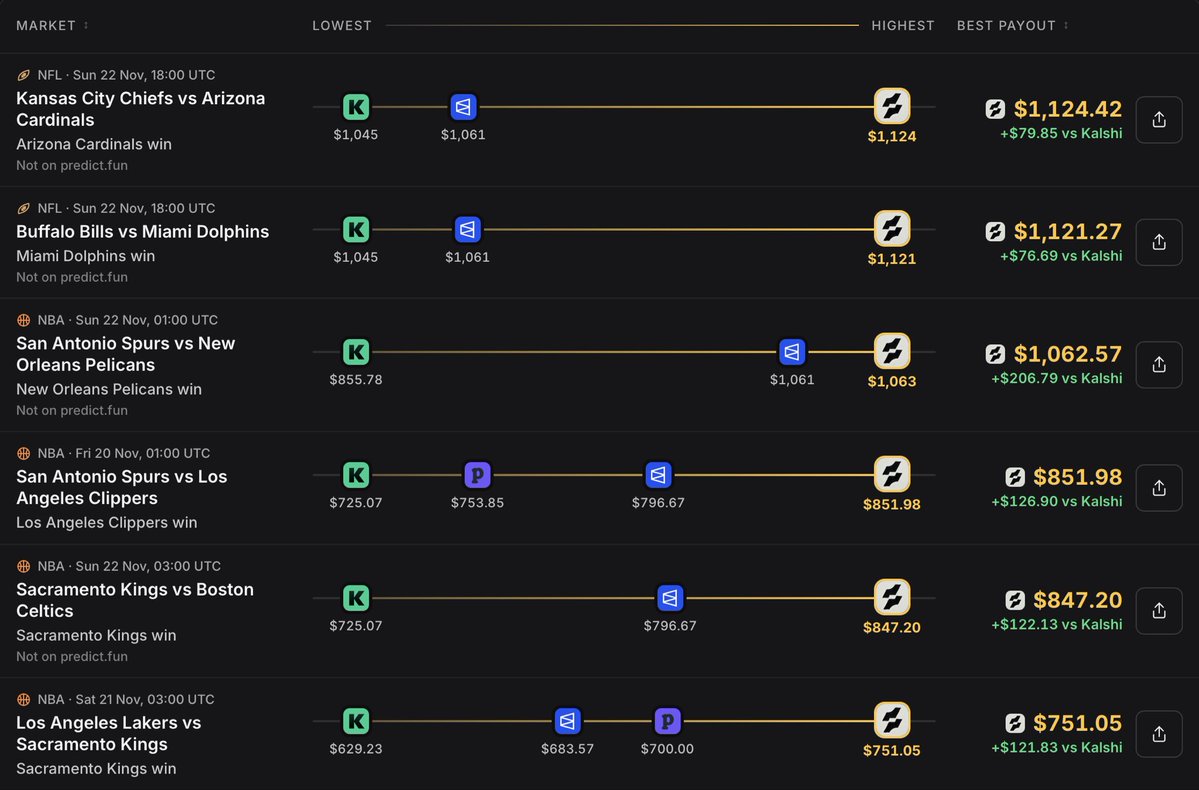
This is obviosuly the same prediction pattern but different payouts.
Live NFL and NBA markets shared by @OutcomeAhmed, Outcome showed higher potential returns than Kalshi, Polymarket and predict-fun across every market compared.
I think the price you get matters just as much as the prediction itself.
@heisrema was not a rema fan until i saw wizzy collaboration coming..
but wait nah this suger nah Raves they enjoy since?
abeg make i no get diabetes ooh🤣
This is obviosuly the same prediction pattern but different payouts.
Live NFL and NBA markets shared by @OutcomeAhmed, Outcome showed higher potential returns than Kalshi, Polymarket and predict-fun across every market compared.
I think the price you get matters just as much as the prediction itself.
On every market in this table, a winning position on @Outcomexyz pays more than the same position on Kalshi, Polymarket or predict-fun, by up to $200.
Stop leaving money on the table.
@CCSoludo Soludo is another miserable governor..
A man that has done absolutely nothing for the people of anambra state, a man with ZERO honer.
shame on you!
Private and anonymous are not the same thing.
@primus_labs is aiming for the first one, and the difference is bigger than it sounds.
People hear “privacy” in crypto and often think “anonymous,” so let me separate the two.
Anonymous means nobody knows who you are.
That makes it hard for banks, funds and regulated companies to touch.
Confidential means you may be known, but your sensitive details aren’t on display. A company can have a verified identity and still keep its trades private.
That second version is what real finance runs on. Your bank knows who you are, but your neighbors don’t know your balance.
Here’s how it plays out.
Say a fund wants to show it holds enough assets for a deal.
With confidential verification it can prove “yes, we have enough” without listing every position.
You hide the amounts and keep the truth. That’s the balance Primus is going for.
Still early make sure you start earning your XP here: http:// https://t.co/BvaLrcYb6W
This is an important distinction.
store less, Collect less is a good privacy principle.
But there's another part people often overlook, the data still needs to be useful.
You need to verify information, run computations, and make decisions without exposing the underlying sensitive data.
That's where @primus_labs comes in.
With zkTLS, data can be verified.
With FHE, it can be computed on while remaining encrypted.
The goal isn't to make data inaccessible. It's to make it usable without unnecessarily exposing the raw information.
That's a more practical approach to privacy, especially for institutions and applications that still need to work with sensitive data.
The goal should be to use data without making everyone else's business visible.
Still early make sure you start earning your XP here: https://t.co/eqGUgsBCk6
Random chart checking has a problem. You never see the full picture.
You see whatever X puts in front of you that day. Then you forget it.
A Watchlist changes that.
You decide what matters first, then you check it on your own schedule.
Three things that helped me:
• Add tokens when you find them, not later
• Keep the list short enough that you’ll really look at it all
• Every few weeks, remove what you’ve lost interest in
I already added $TAO and $HYPE to my already existing @GeckoTerminal list.
If your list is 60 items long, you’ve just built another timeline.
How long is yours?
Watchlist link : https://t.co/UQH2FlM8zR
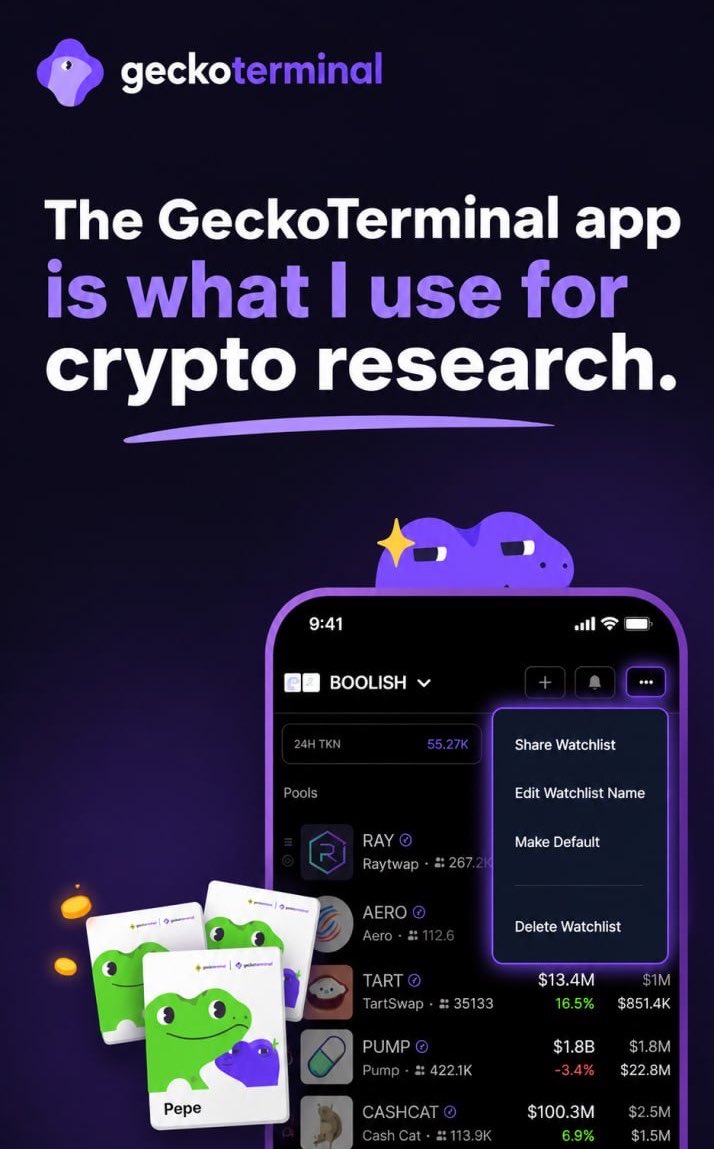
Most of my crypto research doesn’t happen at a desk.
It happens in line, on a bus, or during a boring break. The @GeckoTerminal app is what I use for that.
Here’s what I do in about two minutes:
• Open my Watchlist
• Look at what changed
• Tap into anything that looks off and read the pool and trading activity
• Close it and move on
If something needs a deeper look, I save the note for when I’m at my laptop. The phone is just for keeping up.
When do you usually do your research?