Britain now arrests more people for social media posts than China, Russia, and Turkey combined nearly matching the rest of the top 10 countries combined
Britain really leads the world on these thought crimes
Insane how the UK, which used to be a free country, turned out to be so totalitarian
This is how science should work. (Not by decisions rendered by directors of government agencies, heads of international agencies, and editors of scientific journals).
Milton Friedman on inflation:
“Inflation is just like alcoholism. In both cases when you start drinking or when you start printing too much money, the good effects come first. The bad effects only come later.”
“That’s why in both cases there is a strong temptation to overdo it: to drink too much and to print too much money.”
“When it comes to the cure, it’s the other way around. When you stop drinking or when you stop printing money, the bad effects come first and the good effects only come later.”
“That’s why it’s so hard to persist with the cure.”
Milton Friedman's greatest regret.
The federal government discovered the perfect crime in 1943: make employers collect taxes before workers ever see their paychecks. You think you earn $60,000 per year, but you actually earn $75,000 and hand over $15,000 to politicians without ever touching it. The psychological difference is enormous.
Before payroll withholding, Americans wrote quarterly checks directly to the Treasury. Picture yourself sitting at your kitchen table, writing a $3,750 check to the IRS every three months. The pain was immediate and visceral. Politicians faced constant pressure to justify every dollar because citizens felt the extraction in real time.
Withholding transforms this concrete loss into an abstract accounting entry. Your employer becomes an unpaid tax collector, and you never experience the actual cost of government. Worse, most people celebrate their tax refunds as government generosity rather than recognizing them as interest-free loans they provided to politicians. The Treasury collects your money throughout the year, spends it immediately, then returns your own cash and receives gratitude.
This system enables the explosion in government spending you witness today. Defense contractors billing $640 for toilet seats, agricultural subsidies for corn syrup, and congressional salaries for 535 people who rarely show up to work. When taxation feels painless, voters stop demanding accountability for how their money gets spent.
Milton Friedman helped design withholding as a wartime emergency measure and later called it his greatest regret. Free market economists recognized that the psychological pain of direct taxation creates political pressure for fiscal restraint. The temporary always becomes permanent in government hands, and the emergency justification disappears while the extraction mechanism remains forever.
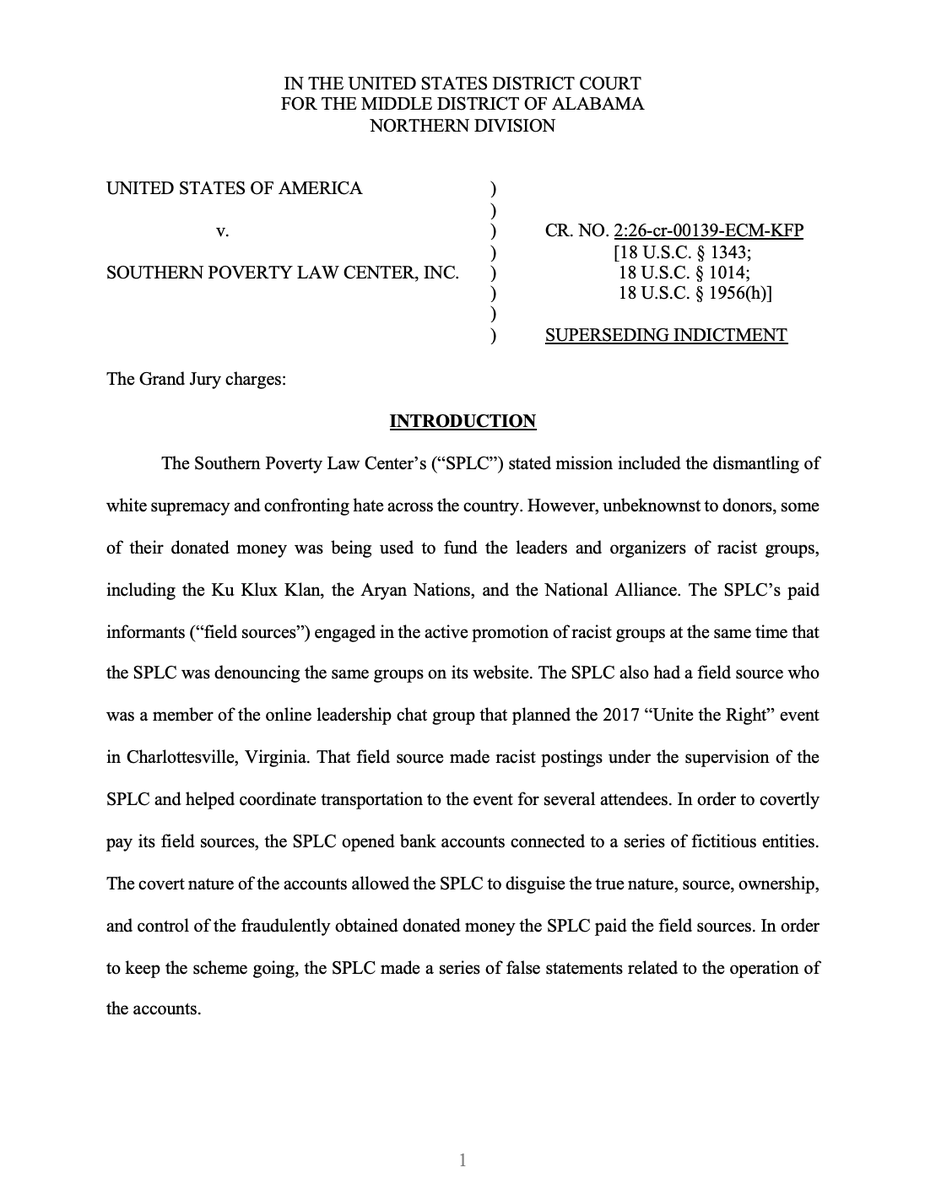
🚨READ IT
The Justice Department just secured a superseding indictment against the Southern Poverty Law Center, and it reveals some new bombshells
🧵1/20
https://t.co/uRCbnWaBzr
@SteveHiltonx Of all ways to generate electricity, nuclear fission is by far the most expensive. That’s why no commercial business in the world is interested unless massive government subsidies are offered. Nuclear fusion may be another matter, but we are far from commercial viability.
Milton Friedman: “Keep your eye on one thing and one thing only: how much government is spending, because that’s the true tax.”
“If you’re not paying for it in the form of explicit taxes, you’re paying for it indirectly in the form of inflation or borrowing.”
The 🇨🇳 government ordered New York Times reporter Vivian Wang to leave the country in Feb, and the Trump administration has responded by revoking the visa of a 🇨🇳 national working in the US for Chinese state news agency 🇨🇳 Xinhua.
Chinese officials told The Times they acted against Wang, a China correspondent for the paper since 2020, in response to the appearance by video of Taiwan’s president at a Times DealBook summit in New York in Dec; Wang played no role in the event.
But Chinese officials had complained for months about Wang’s coverage, which focused on the lives of ordinary Chinese people and often addressed sensitive matters such as censorship, Beijing’s unpopular response to the coronavirus pandemic and the steady expansion of China’s security state.
After Wang’s expulsion in Feb, Times editors engaged in many weeks of discussions with the Chinese government pressing for her return. Chinese officials agreed to grant a 7-day visa to Wang, along with several other Times journalists, to cover Trump’s visit to Beijing this month. But they refused to allow her to resume her assignment as a correspondent based in the country.
Chinese authorities did agree to let Wang return once more this week, on a short-term nonjournalist visa, to pack up her Beijing apartment.
Wang spent 2 years in Hong Kong before relocating to Beijing in 2022. In 2021, she was part of a team that won the Pulitzer Prize in public service for coverage of the coronavirus pandemic.
The number of correspondents from American media outlets allowed to work in China “has now fallen to an alarmingly low level, at a time when the need for people everywhere to understand China is greater than ever.”
A couple of dozen foreign journalists employed by American news organizations are believed to currently be based in China. Several major American outlets that had a robust presence in the country before Xi’s consolidation of power over the last decade are now barely present, if at all. With the departure of Wang, The Times has just one correspondent based in mainland China, down from a peak of roughly a dozen. The Washington Post has not had one for several years.
One reason for the decline is a sharp reduction in long-term visas issued to American journalists. China’s foreign ministry is now more likely to grant short-term visas to reporters, which may not be renewed if Beijing officials dislike their coverage.
In an Apr 20 statement, the Foreign Correspondents’ Club of China denounced what it called a “spate of targeted attacks on press freedom in China,” including “temporary detention, visa revocation and a growing pattern of intimidation directed at interview partners and journalists themselves, alongside the denial of access to official events.”
The group added that such actions “have been directed against major foreign media companies and individual foreign correspondents after they published reports deemed sensitive or uncomfortable by the Chinese government.”
About 100 Chinese journalists are now reporting from the US, down from 160 before China and the US started taking restrictive moves against each other’s correspondents during the first Trump administration.
In Sep 2018, the Justice Department ordered the American branches of Xinhua and CGTN to register as foreign agents. In Feb 2020, three Wall Street Journal correspondents were expelled from mainland China after the newspaper published an opinion essay critical of Beijing that angered Chinese officials. The expelled reporters had no role in the essay’s publication.
Around the same time, the Trump administration declared that five state-run Chinese news organizations operating within the United States — Xinhua, CGTN, China Radio, China Daily and People’s Daily — would be subject to regulations similar to those that apply to foreign diplomats. US officials also capped at 100 the number of journalists allowed to work for those organizations in the US.
https://t.co/E52mAJLLUX
Aluminium was once the most expensive metal on Earth - costlier than gold
Not because it was rare (it's the most abundant metal in Earth's crust, ~8% of it), but because extracting it from its ore was incredibly difficult
The Hall–Héroult process, invented in 1886 by two 22-year-olds, changed that — and with it, aluminium went from a luxury metal to something you wrap your sandwich in
The funniest maths in modern environmentalism.
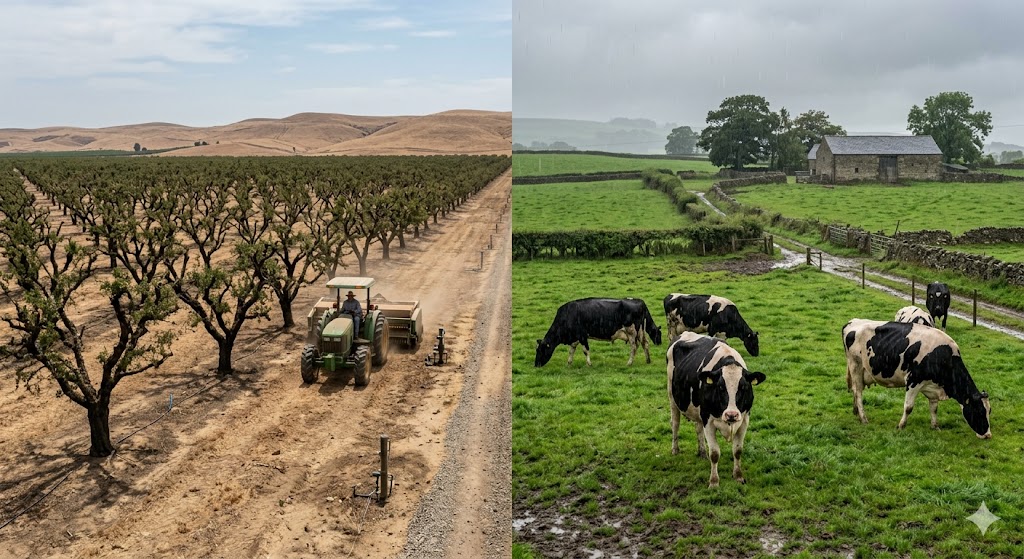
One almond requires 12 litres of irrigated water to produce. Peer-reviewed, ScienceDirect, 2017. A glass of almond milk contains roughly 50 of them. 600 litres of water before the carton is filled.
The water comes from the San Joaquin Valley in California, which sits over one of the most over-extracted aquifers on earth. The valley floor has subsided by up to nine metres in places due to groundwater depletion. The carton is then refrigerated, sailed across the Atlantic, refrigerated again, lorried to a Manchester Tesco, and bought by someone who is concerned about the environmental impact of dairy.
Meanwhile, in Cheshire.
A British dairy cow drinks roughly 70 to 100 litres of water a day and produces around 28 litres of milk. That's about 3.5 litres of water per litre of milk. The water is rainwater that fell on her field or came from a local stream fed by the same rainwater. The rain was going to fall on the field whether the cow stood in it or not. 80% of her moisture intake comes from the grass itself, which is also rain.
She converts the grass, free of charge, into a litre of milk containing seven times the protein and four times the calcium of almond milk, and shipped roughly 18 miles to the same Tesco.
To recap.
600 litres of stolen aquifer, flown halfway round the world for nutritionally worthless beige water.
Or 3.5 litres of rain that was already falling, converted by an animal you can pet, into actual food.
The shopper picks the almond.
She has been told this is the ethical position.
The aquifer would like a word.
NEW: SPECIAL REPORT | Ukraine is actively challenging the positional character of the war that has dominated the battlefield since 2023. Russian battlefield gains are approaching net zero while Ukrainian forces are setting conditions potentially to break out of positional warfare by reintroducing limited elements of mechanized maneuver at the tactical level.
Ukraine has re-secured an overall drone advantage and fielded systems capable of disrupting Russian forces throughout their operational depth in support of planned Ukrainian offensive or defensive ground operations. Neither Russia nor Ukraine is able to conduct operational maneuver yet, however.
Ukraine’s success in blunting Russian advances and reversing Russian gains in some sectors of the line, in tandem with Ukraine’s limited reintroduction of elements of tactical mechanized maneuver may nevertheless mark the beginning of a new phase of the war.
Combat in Ukraine will likely become less positional and feature more tactical maneuver until Russia’s innovation cycle renders Ukraine’s current operational concepts ineffective. Ukraine likely has a unique and time-constrained opportunity to exploit its current initiative while Russian forces remain vulnerable.
Ukraine’s partners should expand their support to these Ukrainian efforts at a moment when Russia is reeling from both battlefield setbacks and Ukraine’s deep strike campaign with the aim of forcing Russian President Vladimir Putin to reevaluate his approach to this conflict.