ARLINGTON — $1 million is on the line.
Hello from Spikes Under The Lights, the first college volleyball event at AT&T Stadium.
Nebraska, Florida, Penn State and SMU are competing tonight. Each team earns $200,000 for showing up, and the winner takes home another $200,000.
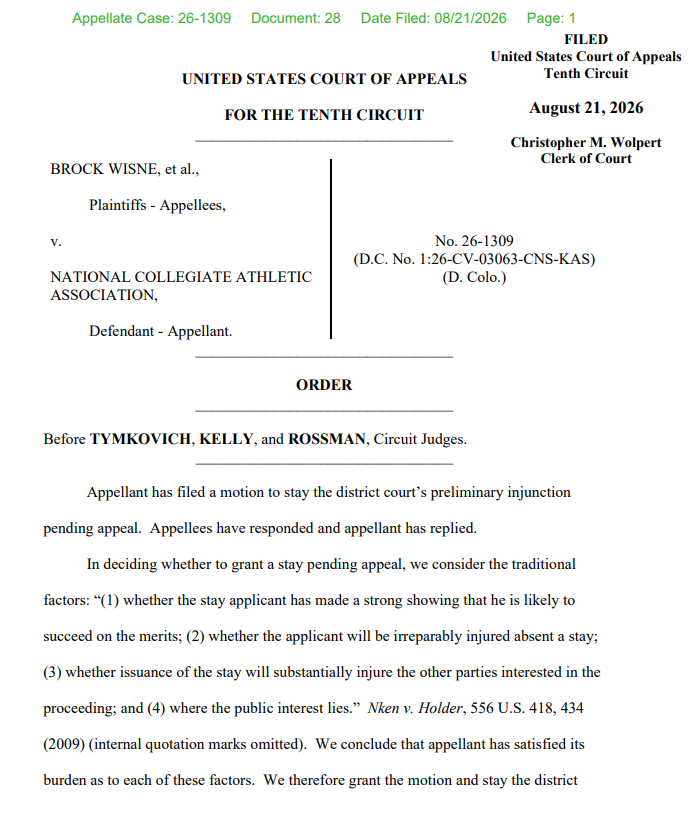
Big news. Class of 2022 athletes who exhausted four years of eligibility this past spring are now ineligible unless they are part of their own lawsuit/injunction.
Not much in terms of rationale, but, notably, one of the three judges on the panel would have denied the stay.
The College Sports Commission is continuing to interview athletes across the country. Much of it is a fishing expedition. I can't stress how important it is for athletes to have independent counsel provide advice and guidance in the lead-up to and during the interview process.
Evan Otten checks in from Vilnius, where the team learned more about Lithuania's history.
He also found a special value meal at a fast food restaurant that caught his attention!
More: https://t.co/GrlbLvl9G1
Arizona is having an open men’s basketball practice. Here’s big guys doing a post-up drill: Mo Krivas, Ugnius Jarusevicius, Evan Otten, Mabil Mawut, Endurance Aiyamenkhue
I read this letter from the NABC and had a visceral reaction . . .
In 2025, schools owed $228 million in buyouts to fired coaches (a record by nearly $100 million). Since 2004, schools have paid more than $1.1 billion to coaches not to coach. Thirteen head coaches are making at least $9 million this season.
The NABC's very high-minded letter says the sport is on "a trajectory that cannot be sustained." Seems that way. But why ignore the elephant in the room -- obscene amounts of money are going to coaches to sit on their couches?
The PCSA has a great deal to say about what athletes may earn. On coaches it contains exactly one provision, and §110 doesn't touch a dollar.
In response, it seems quite reasonable for athletes to ask for an amendment to PCSA which provides:
(1) A permanent cap on coaching compensation, set as a percentage of athletic revenue.
(2) A clearinghouse reviewing every coaching agreement over $600 for valid business purpose and fair market value before funds are disbursed.
(3) One penalty-free coaching move; a second costs a season.
(4) A five-week window, opening seven days after the final game, during which a coach may be contacted by another school. Outside it, tampering.
(5) Coaches' agents capped at five percent, with a public registry and decertification.
(6) A limited antitrust exemption, so none of it can be challenged in court.
Every one of those is lifted from the bill. Only the subject changes.
The NABC closes by saying that "our athletes, coaches, universities and fans simply deserve better." I agree with that sentence more than the letter does.
If the problem is unsustainable cost, reform should start with the largest cost. And if the answer is that Congress has no business setting private employment terms -- that's a fair answer. It's also an argument against the rest of the bill.
All this turmoil in DC over making major corporations agree to say they swear on their mother's grave they're not trying to use college sports accounting gymnastics to route funds to players.
It's hard to take some of these people seriously.
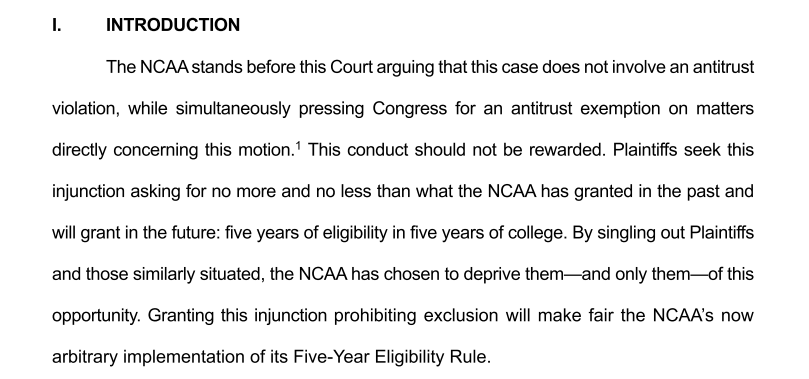
Getting some questions about scope: because the court granted class certification, the injunction applies to all athletes who meet the definition in the screenshot attached here.
There is no limitation on sport.
It is notable the three places where college athletes have attempted to organize: Northwestern, Dartmouth, and now Stanford. These are all places where the student body is overwhelmingly high achieving, from higher income, traditionally educated, capitalist, and well advised.
SMH. College athletics needs to fix itself and start exercising a modicum of fiscal discipline. It is hard to overstate how many hundreds of millions of dollars are wasted because this industry has normalized contracting practices that virtually no other industry in America would tolerate.
Yet instead of making relatively simple changes to save money, the system seems to demand restraint only when the money might reach athletes.
A quick briefing schedule has been set in this Colorado federal court case.
Notably, the TRO was filed alongside a motion for class certification. This means that, if granted, a TRO would apply to *all* 2022 HS grads declared ineligible for 2026-27 based on four seasons of play.
Important policy change for international student athletes to watch. This new policy will limit them to four years (unless they get an extension) and also limits their ability to change majors or transfer. The final rule with all of its details should be published by the government soon.
There's a lot of people who look at the body of eligibility rule litigation as a whole and read it as athletes trying to break the system and sure, maybe there's some of that... but there's a lot of awful, awful stories like this one too.
This one deserves a lawsuit.
Gearing up to file a few more state court lawsuits with lawyer Ryan Downton on the NCAA’s 5-in-5 rule excluding 2022 class basketball players. We will start shifting to also focusing on other sport athletes this week.