we announced Jev 1.14 on 10.14 at 1:14pm PT 🔥
a new and improved model, along with experimental features for our dreamers:
• images
• a new box type
• longer context
surprise, Jev was already able to see you! 👁️
BUT our bar for production-grade intelligence is quite high, so builders beware, these are preview features.
enter the ~*~ danger zone ~*~ at your own risk. 🚨
Lightpanda + Jev @typesafeai
How it started:
> Could Jev handle the page checks we were sending to chat models?
How it’s going:
> Built into the Lightpanda binary: triage, cookie walls and logins in ~0.2s
What’s next:
> Chat model sets the goal, Lightpanda + Jev paginate and extract
https://t.co/In3VZdcCoF
how to Jev
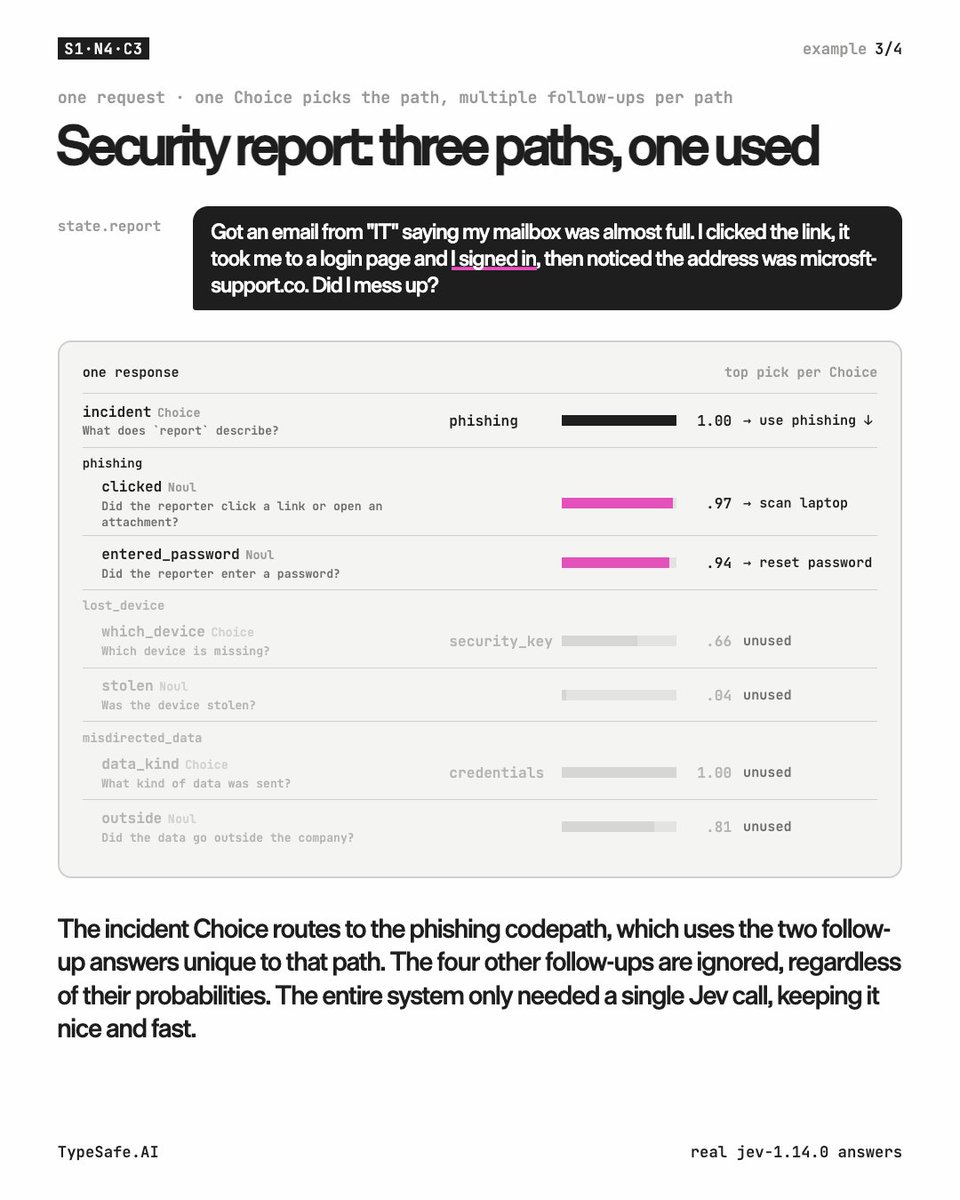
• you pay for the `state` part of your request once, no matter how many questions you ask about it
• so it's usually cheaper to ask every question you might want answered, even before you know if you need the answer
• then use code to sort it out
take in all the information you might need, and filter down to what's important! reliable automation means covering all your bases
The answer has nuance!
The way Jev charges for input tokens is:
(state+(sum of all questions))
The important bit here is that you only get charged once for your state tokens no matter how many questions you run in parallel.
Within a single call, two questions do cost more than one. But if you ask those two questions as separate requests with the same state, you pay more overall, because you pay for the state again in the second request.
In cases where you are more cost-sensitive than speed-sensitive, it makes sense to do analysis on how often the follow-up questions are used in your use-case. If some follow-ups are needed very rarely, then you can save on cost by running them only when actually needed.
But in cases where speed is more important than cost, then batching pretty much always wins (although there's some nuance there as well, such as a single super-huge follow-up question slowing down the call, so shunting it to its own call could make sense, depending on the frequency that that answer is needed!)
One of the most important Jev patterns to learn is what we sometimes call "speculative questions".
In the majority of cases, it's faster and even often cheaper to batch questions together in to a single call, *even when you don't yet know if you'll need the answers!*
Why? Many reasons:
Speed! Oftentimes you can accomplish the entire task in a single call, instead of multiple sequential calls in different logic paths.
Cost! You only pay for tokens in state once per call, so batching questions also avoids paying for the state multiple times. When your state is large, batching questions often saves cost compared to sequential calls that duplicate state.
Questions never affect the output of other questions in the same call, so accuracy will not suffer.
We killed $349/mo Semrush+Ahrefs💥
Run a SEO-optimized campaign in one prompt for just $0.61!
With https://t.co/ZeDlxufXNz your agent can:
1. Analyze your website and competitors’ ads
2. Score 10k+ keywords with @TypesafeAI’s Jev
3. Create, set up and launch the Google Ads campaign
0% markup. No subscriptions. No extra signups.
First 100 commenters will get a $10 promo code to try it!
Give your agent this prompt: “Connect https://t.co/ZeDlxufXNz and build a Google Ads campaign for my company: https://t.co/yg963DwHGp”
blurry photo in the field? Jev makes a snap judgment to find out.
@elise_ai clocked Jev at 94ms a photo: ~30x faster than Sol, with ~50x as many judgments for the same cost
was the most expensive part of your last vacation rental the four evenings you spent picking it?
Jev gives you those evenings back
https://t.co/I5zLgbgp3k
Never read an Airbnb listing again. Tell Jev what you want in plain English, and it reads 1,000 Cape Town listings and hands you the 10 best, scored out of 10, in about a second. Right inside Google Sheets 🏠
(trying something new with our demos!)
What if we could manipulate UI at the speed of thought?
Built this voice coffee ordering system with @typesafeai Jev. The drink and any updates show up while I’m still mid-sentence, ~200 ms from word to screen.
Feels pretty magical!
Can't stop thinking how much stuff Jev is doing to save AI engineers asses from stupid systems design patterns while the rest of the domain keeps pushing tool calling loops everywhere
oh so everybody vibecoding their own app is easy now? just a slop cannon away from everything you want in life? prove it!
hypership your dreams into reality today
Hypership is BACK for our 13th birthday!!
Celebrate with us by requesting features and reporting bugs on the launches featured on today's leaderboard.
To those who ship, you have a chance to win credits from @typesafeai and @supabase! Makers, how fast can you get features to prod?
so we heard you like decision models
but how do you make reliable decisions against gnarly data with a model?
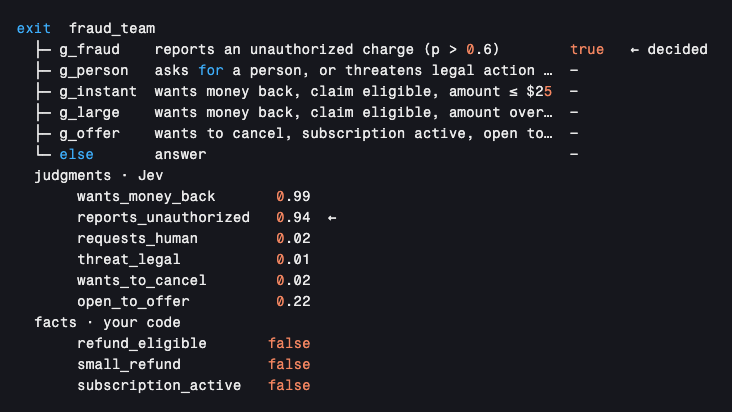
you don't: reliability requires code, and so reliable decisions are made by composing reliable judgments in code
Jev makes reliable judgments
Why don't we at TypeSafe call Jev a decision model?
If you think of Jev's questions as making *decisions*, I believe you'll use it at the wrong layer of abstraction and your reliability will suffer.
I wrote all about this on our site 🧵👇
you can smuggle your semantic logic in string caveats, embedding vectors, and all the complicated ML you want, but data distributions will always be far more ridiculous than you can be clever
so:
• be clear about what you need to know
• be clear that a plain reading of your data is enough to know
and you're ready to make reliable decisions! that's System One for you
Two days to get yourself onto the HYPERSHIP board.
@supabase and @typesafeai are both back with credits, and the day runs on you launching, taking the requests that land and shipping them before midnight.
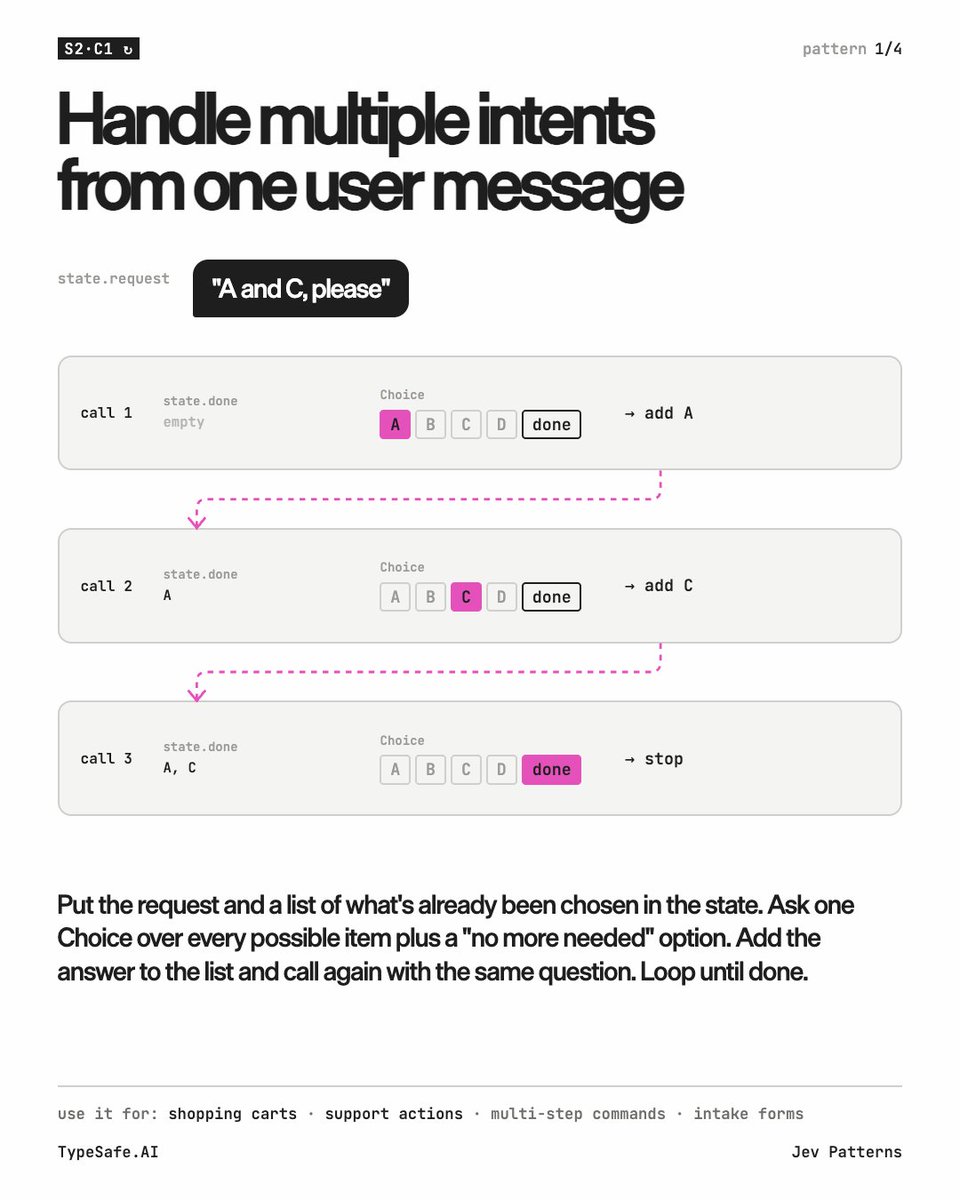
One thing that can be tricky to figure out is how to use Jev's primitives to handle more than one intent in a single user query.
My favorite way to approach this is what I call the "shopping cart" pattern: recursively pick the next thing until Jev says we're done.
I've personally used this to make a coffee ordering bot for our company Slack (using @DoorDash's CLI!), as well as a fast multi-intent handler for my smart home system.
Give it a shot!
Why Jev epitomizes what a great brand is today
“Everyone wants to clone Jev. No one wants to get up on stage, wear a fucking pink fur coat and talk about the Jevolution in an unhinged way.
That is what brand is to me.
That guy is playing the game on a whole different level. Companies today have to think about that.” @bernhardsson
Love to hear your thoughts @CompleteSkeptic@sonyatweetybird@davegerhardt