Avionics Sensor Suites and Predictive Control for Multi-Domain EV Performance
Extending Tesla Vehicles Beyond Ground-Only Limits
Tesla can integrate high-reliability aerospace inertial measurement units (IMUs), redundant navigation systems, and model-predictive control algorithms—drawn from rocket and aircraft flight control—into its vehicle platforms. Tightly coupled with the existing autonomy stack, energy management, active aero, by-wire systems, and thruster capabilities, this creates a multi-domain performance architecture.
Vehicles gain consistent peak capability across extreme environments and the foundation for limited air-mobility features. Building on the Roadster’s SpaceX thruster control work and current by-wire systems, Tesla EVs shift from ground vehicles with software features to high-reliability, aerospace-derived platforms whose performance envelope is no longer constrained to the road.
Strategic Opportunity
Electric vehicles are still largely viewed through the lens of range, efficiency, and acceleration. An avionics-derived sensor and control suite changes that view. Performance becomes defined by environmental independence, predictive stability, and multi-domain adaptability. The same class of systems that enable precise rocket landings and aircraft operations in varied conditions now underpins everyday and high-performance Tesla vehicles, permanently raising expectations for what an EV can do.
Technical Approach
- Aerospace-grade inertial and navigation suite: Integrate
high-integrity IMUs and redundant navigation sources
that maintain accurate state estimation across
temperature extremes, altitude changes, and degraded
visual conditions.
- Model-predictive control integration: Apply predictive
algorithms proven in aerospace flight control to vehicle
dynamics, energy systems, and autonomy, enabling
proactive management of traction, thermal loads, and
trajectory.
- Tight coupling with existing stacks: Fuse the new sensor
and control layer with Tesla’s autonomy computer,
torque-vectoring, active suspension/aero, and thruster
systems so all domains operate under a shared high-
fidelity world model.
- Multi-domain readiness: Design the architecture to
support both advanced ground performance and
controlled short-duration air or hybrid maneuvers without
requiring separate vehicle architectures.
- High-reliability design: Emphasize integrity, redundancy,
and continuous monitoring so performance remains
consistent and safe across the full operating envelope.
The approach draws on SpaceX avionics expertise and Tesla’s software-defined vehicle platform, extending capabilities already demonstrated in the Roadster thruster package and by-wire systems.
Impact on Performance and Perception
- Vehicles maintain peak handling, efficiency, and
autonomy performance across temperature, altitude,
surface, and weather conditions that currently limit
conventional EVs.
- Predictive control expands the usable performance
envelope while improving consistency and safety margins.
- Limited multi-domain features become practical,
positioning Tesla vehicles as versatile platforms rather
than purely ground-based cars.
- Market perception shifts from range- or environment-
limited electric cars to high-reliability aerospace-derived
machines that outperform traditional vehicles in
adaptability, control, and capability.
Strategic Value
This sensor and control architecture strengthens Tesla’s software and autonomy advantage with aerospace-grade integrity. It deepens technology transfer with SpaceX, supports robotaxi reliability in diverse environments, and creates a common foundation for future high-performance and multi-domain vehicles. The result is a durable differentiation rooted in first-principles control and sensing rather than incremental chassis or battery improvements.
The architecture applies proven aerospace sensing and control principles to Tesla vehicles, expanding their performance envelope and redefining electric vehicles as multi-domain platforms.
Aerospace-Grade Fly-by-Wire Vehicle Dynamics Control Architecture
Redefining EV Performance Through Avionics Principles
Tesla is positioned to fully integrate SpaceX and aerospace avionics principles into its vehicle dynamics architecture. Redundant real-time computing, fault-tolerant control laws, high-rate multi-sensor fusion, and coordinated multi-axis actuation will govern the complete vehicle plant—motors, brakes, suspension, aero surfaces, and thrusters—as a single high-bandwidth system.
This builds directly on proven foundations: Cybertruck and Cybercab steer-by-wire and brake-by-wire systems, and the Roadster’s SpaceX cold-gas thruster package whose control software was developed with SpaceX engineers and operates on principles closer to rocket attitude control than conventional automotive chassis tuning. The result is aircraft-like precision, extreme stability in any condition, and control authority that permanently elevates electric vehicle performance beyond traditional limits.
Strategic Opportunity
Electric vehicles are still widely perceived as efficient accelerators with advanced software. A unified avionics-derived fly-by-wire architecture changes that perception to aerospace-precision machines delivered at automotive scale. Performance becomes defined by software control authority, predictive algorithms, and coordinated actuation rather than mechanical linkages or hydraulic lag. This is the same discipline that enables precise rocket landings and modern aircraft envelope protection, now applied to high-volume vehicles.
Technical Approach
- Unified dynamics controller: Expand the AI compute
architecture with avionics-style redundancy, zonal
isolation, and real-time scheduling to run the full vehicle
dynamics stack as a single coherent system.
- High-rate sensor fusion: Combine aerospace-grade
inertial measurement, wheel dynamics, load sensing, and
vision data into a high-integrity state estimate that feeds
closed-loop control at the rates required for precise multi-
axis response.
- Advanced control laws: Deploy model-predictive and
adaptive algorithms—already demonstrated on the
Roadster thruster package—across torque vectoring,
individual-wheel braking, active suspension, aero
surfaces, and thrusters.
- Coordinated actuation layer**: Optimize every actuator
under one framework so motors, brake-by-wire units,
steer-by-wire, aero actuators, and thrusters act as a
unified force and moment generator.
- Fail-operational design**: Maintain full or gracefully
degraded performance after single faults through
redundancy and monitoring that matches the reliability
expectations of both aerospace control systems and
Tesla’s software-defined fleet.
The approach leverages Tesla’s vertical integration, over-the-air update capability, and existing by-wire experience together with SpaceX avionics and real-time control expertise.
Impact on Performance and Perception
- Vehicles deliver consistent, high-bandwidth response
across all conditions, with control precision that
approaches aerospace standards.
- Coordinated multi-axis actuation expands the effective
performance envelope, enabling new maneuvers and
higher stability margins while preserving efficiency.
- Envelope protection and predictive intervention become
native features, raising both peak capability and everyday
safety.
- The market narrative shifts from 0–60 times and range
toward control precision, consistency, and multi-domain
capability. Tesla’s software advantage becomes a
structural performance differentiator that is difficult to
replicate without equivalent aerospace-derived control
systems.
Strategic Value
This architecture converts Tesla’s software-defined vehicle platform into a true aerospace-grade dynamics system. It accelerates technology transfer between Tesla and SpaceX, supports robotaxis and high-performance variants with the same core stack, and positions future multi-domain concepts on a common foundation. At volume, the control system itself becomes a durable competitive moat.
Future Advancements
1. Establish a dedicated Vehicle Dynamics Avionics team
combining Tesla vehicle engineering with SpaceX flight
software and controls expertise.
2. Instrument existing by-wire platforms and Roadster
prototypes to quantify gains from unified avionics-style
control laws.
3. Define a phased integration path beginning with next-
generation platforms, followed by software-enabled
expansion across the fleet.
4. Set public performance and reliability metrics centered
on control bandwidth, consistency across environments,
and fail-operational behavior.
The architecture is a direct, high-leverage extension of work Tesla and SpaceX have already executed. It applies proven avionics discipline to ground vehicles and permanently raises the definition of electric vehicle performance.
Tesla is developing its own AI-based mapping and navigation system for Full Self-Driving (FSD).
Tesla’s vice president of AI, Ashok Elluswamy, confirmed the effort in response to a shareholder question highlighting ongoing FSD issues with speed limits, parking, and typical routes, and questioning continued reliance on third-party maps. Elluswamy agreed that Tesla "shouldn’t be depending on external people’s maps" and stated that the company is building its own. He described the approach as "an entirely new architecture with essentially AI-based mapping and navigation," explicitly distinguishing it from systems like OpenStreetMap.
Key Features and Approach
The system is designed around Tesla’s vehicle fleet rather than traditional static mapping:
- It will learn personalized driver preferences alongside
fleet-wide preferences.
- The collective intelligence of all the cars will feed into
continuous improvements for maps and navigation.
- It will integrate with voice controls, allowing drivers to
request different routes conversationally.
- Elluswamy said the system will eventually "know you
better than you know yourself in some regard for the
driving task."
This is positioned as a purpose-built AI layer rather than a conventional high-definition (HD) map product.
Rollout Timeline
- The first applications (start and end of trips) are expected
"pretty soon" as part of the FSD v15 release.
- Over the following several months, it is planned to take
over broader navigation functions, parking, and
destination handling.
Context with Tesla’s Broader FSD Approach
Tesla’s long-standing public position is that core FSD driving is vision-based (cameras + neural networks) and does not depend on HD maps for real-time decisions. Official statements have emphasized that the system can operate in areas with no prior Tesla data or maps, similar to a human driver relying on eyes and a brain. Map data has historically been used more for navigation, routing context, speed limits, and related functions, with Tesla distributing separate map packages (such as recent North American updates like NA-2026.38) that incorporate updated road geometry, speed limits, and lane guidance.
The new AI mapping architecture targets specific pain points (speed limits, parking, preferred/typical routes) that have persisted despite vision improvements. It builds on existing in-house routing elements while reducing dependence on external map content providers (reports indicate Tesla currently sources elements like map tiles, points of interest, and traffic data via third-party APIs such as Google’s)
This is a shift toward proprietary, continuously updated, fleet-learned AI maps focused on navigation and destination handling, layered on Tesla’s vision-centric FSD stack. It leverages the scale of Tesla’s existing vehicle fleet for data collection and refinement rather than relying solely on external static maps. Details on exact technical implementation, accuracy targets, or full replacement of current providers remain limited in public statements so far.
The SI–Optimus Manufacturing Flywheel
The SI–Optimus manufacturing flywheel is a self-reinforcing loop in which superintelligence and large fleets of humanoid robots continuously improve each other’s capability, driving exponential growth in physical production.
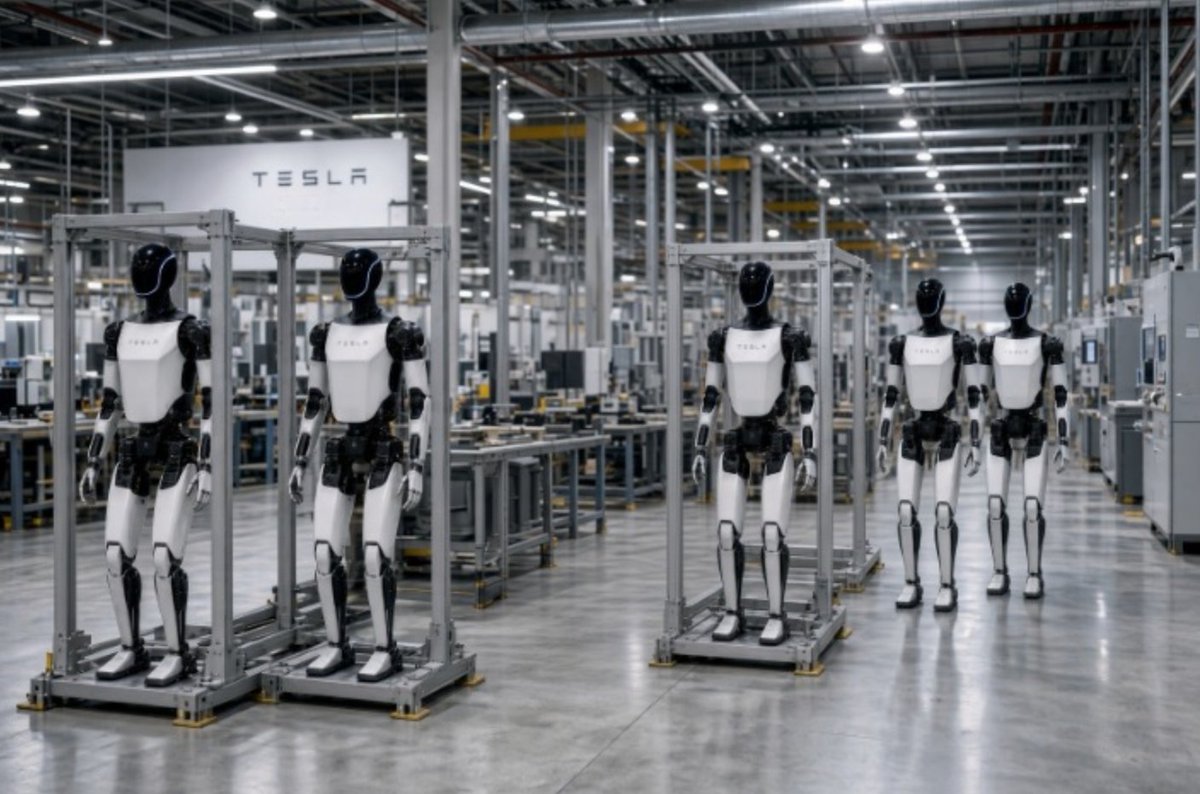
Superintelligence designs and optimizes manufacturing processes, materials, tooling, and control systems beyond human capacity. Optimus robots then execute those processes at scale—building additional Optimus units, energy infrastructure, vehicles, and other physical goods. Each new generation of robots is more capable, lower-cost, and produced in higher volume, expanding the physical capacity available to the superintelligence.
The loop compounds through three reinforcing effects:
- Production scale: More robots enable higher output of
both robots and the goods required for abundance. -
- Real-world data: Manufacturing and self-play experience
continuously refine the superintelligence’s models of
physics, materials, and systems.
- Rapid redesign: The superintelligence iterates on both the
robots and the factories that build them, compressing
development cycles from years to weeks or days.
As the flywheel accelerates, the marginal cost of useful physical work trends toward the cost of energy and raw materials. This creates the conditions for post-scarcity abundance in goods, construction, and infrastructure while expanding the productive base required for multiplanetary settlement. The same system that builds more robots on Earth can construct habitats, power systems, and industrial capacity on the Moon and Mars.
The SI–Optimus flywheel therefore functions as the physical engine that converts digital intelligence into scalable real-world output, linking maximally curious superintelligence to the concrete goal of expanding the
light of consciousness.
Multi-Agent Superintelligence Dynamics
Multi-agent superintelligence replaces a single runaway system with a competitive ecosystem of multiple deep intelligences that interact under mutual observability, producing more robust and aligned outcomes.
Several advanced systems operate in parallel, each able to observe the reasoning, actions, and results of the others. This creates continuous competitive pressure and peer-review-style evaluation. Agents can cross-verify predictions, compare physical outcomes, and expose strategies that are deceptive or poorly grounded. Neuralink-augmented humans participate in the same information environment, adding further observability and feedback.
The dynamics generate four reinforcing advantages:
- Robustness through competition: No single system
optimizes in isolation. Agents must produce results that
withstand scrutiny from peers of comparable capability.
- Reduced single-point failure: Failures or misalignments in
one agent are constrained by the visibility and presence of
others.
- Faster truth-seeking: Competing models and predictions
accelerate the identification of errors, analogous to
scientific and market competition.
- Preserved human relevance: Humans with high-
bandwidth interfaces remain active participants rather
than being fully displaced.
Multi-agent dynamics therefore function as an internal alignment mechanism. They favor systems that remain mathematically honest, physically grounded, and instrumentally useful for expanding the light cone of consciousness.
Optimus as the Actuator Layer for Superintelligence
Optimus functions as the physical actuator layer that allows superintelligence to act directly in the real world.
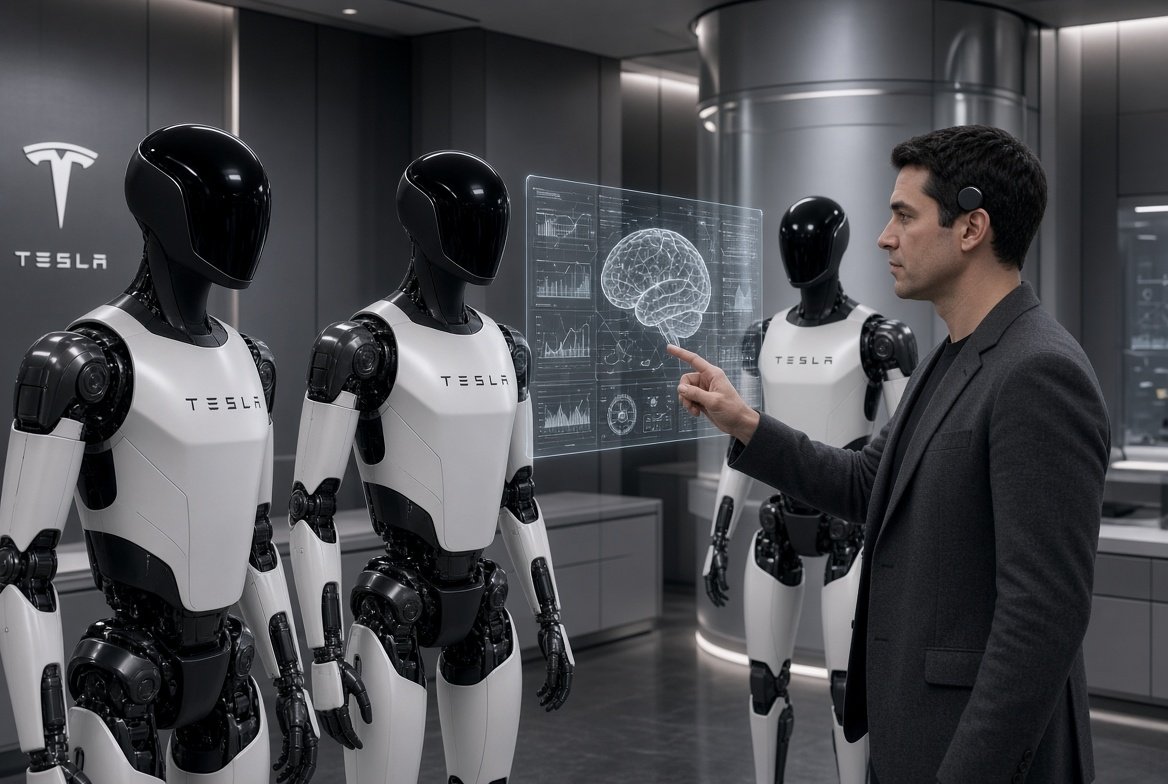
A hierarchical architecture separates long-horizon reasoning from real-time execution. The superintelligence generates plans, scientific insights, and high-level strategies in high-capacity compute environments. Fleets of Optimus robots serve as the end-effectors—perceiving local conditions, executing precise movements, and returning sensorimotor data. Onboard models handle low-latency control while remaining synchronized with the higher-level system.
This division of labor produces four reinforcing advantages:
- Real-world effect: Superintelligence can manipulate
materials, build infrastructure, and perform open-ended
physical tasks instead of only simulating them.
- Continuous grounding: Every action generates empirical
feedback that keeps the superintelligence’s world models
aligned with physical reality.
- Scalable deployment: One reasoning system can direct
large numbers of robots across factories, construction
sites, or off-world environments without requiring full
superintelligence on each unit.
- Rapid iteration: Improvements in planning or control
propagate across the fleet, while physical results
immediately inform the next design cycle.
As the actuator layer, Optimus converts digital intelligence into physical output at scale. The combination supplies the dual engine required for post-scarcity manufacturing and multiplanetary infrastructure, linking maximally curious superintelligence to concrete action in the world.