HAARP research campaign scheduled Dec 27. Times, frequencies, and modes are variable due to the constantly changing nature of the ionosphere.
More information is available here: https://t.co/JDKNChgHtT
HAARP campaign scheduled October 19-28. Times, frequencies, and modes are variable due to the constantly changing nature of the ionosphere. More information is available here: https://t.co/ZCJZ2SUNSr
We're back! The fourth HAARP Open House 2022 is on Saturday, Aug. 27, from 9 a.m. to 3 p.m. Tickets are free but availability is limited, so please register in advance. https://t.co/kDHXIKzwi9
Register today for the fourth HAARP Open House 2022 Saturday, Aug. 27, from 9 a.m. to 3 p.m. Tickets are free, but availability is limited. https://t.co/LWicHifBbc
• Go behind the scenes on a self-guided tour, about 90 minutes.
Our summer research campaign is scheduled for June 2021. Days, times, frequencies & modes are variable due to constantly changing nature of the ionosphere. Investigations: interactions of high power radio waves w/ space plasmas & propagation phenomena associated w/ the ionosphere
Researchers from @uafgi and HAARP have received a $9.3 million grant from @NSF to establish the Subauroral Geophysical Observatory for Space Physics and Radio Science to study the Earth’s upper atmosphere and geospace environment. #NanookNation#hamradio
https://t.co/HMxonRZsER
We have a new website!
Discover a diagnostic suite of on-site geophysical instruments and view real-time data.
In addition, learn about our news, FAQs, diagnostic instruments, research support and more.
Come check out our new online home: https://t.co/J8KCAh5G3s
Want to know what the weather is like at HAARP right now? We had a weather station installed this summer, and now it can be accessed via Weather Underground. https://t.co/0SFlcFxALW
Just in time for this weekend's forecasted very high aurora activity, we got an all-sky camera installed at HAARP. See the aurora over Gakona, Alaska, live in real time at https://t.co/9wqvN794J0. (In this image, north is at the bottom.)
#Cleveland#volcano overflight #FLIR video, from 9 August 2019, by J Lyons @USGSVolcanoes / AVO. Hottest temps observed in collapsed center of dome; about 550-600C.
An antenna array designed to detect radio signals from Jupiter was installed at HAARP in August 2019 as part of the Radio JOVE project. HAARP is happy to support radio science education.
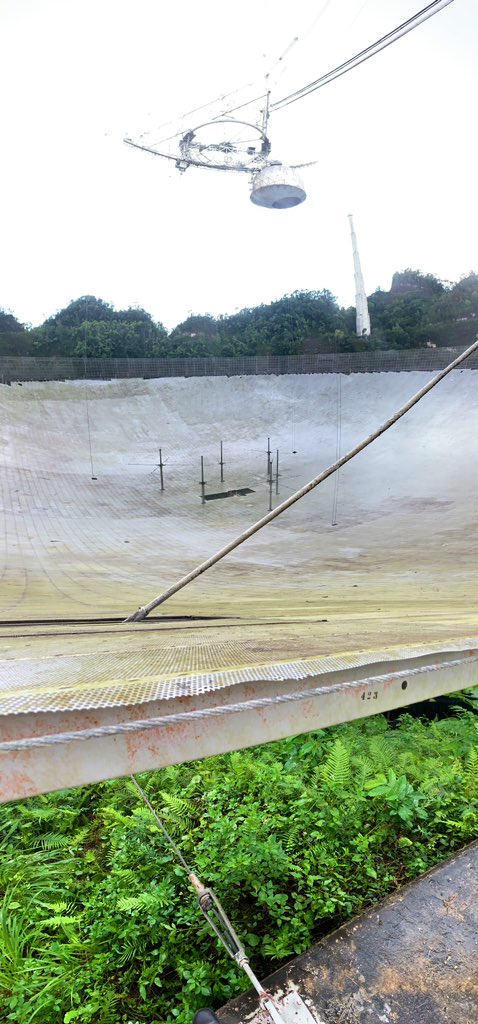
There are exactly two operational ionosphere HF heaters in the USA and territories: @uafhaarp and @NAICobservatory (Arecibo). One big difference between the two is that dropping a mobile phone at one is a much bigger problem than at the other. (Don’t use your mobile at Arecibo.)
It's taking so long because I love watching the videos and listening to the audio that people sent, and reading the beautiful texts and descriptions. Trying to write a personal note to each person @uafhaarp
Going through and replying to all of the reception reports for https://t.co/NmOOT0NKLi is taking a lot longer than I expected... There are 197 emails... I've gotten through 97... 100 left to go... this will likely take me a few days. Thanks for your patience! @uafhaarp
we have made a database with information from all of the reception reports: location, antenna, receiver, signal strength, etc. etc. and are also working on an easily searchable blog for scientists and researchers who might want info on propagation and reception. @uafhaarp
We’re making improvements to HAARP this year, so won’t be having our annual open house this year. We hope to see everyone next summer. In the meantime, follow our progress here or by searching for #UAFHAARP.
Timelapse of an afternoon at HAARP, near summer solstice. We are working this summer to revitalize many of the passive research instruments on site and install new equipment @uafgi Ionospheric and Radio Science Laboratory. More at https://t.co/qNYnTXKiZf. #NanookNation