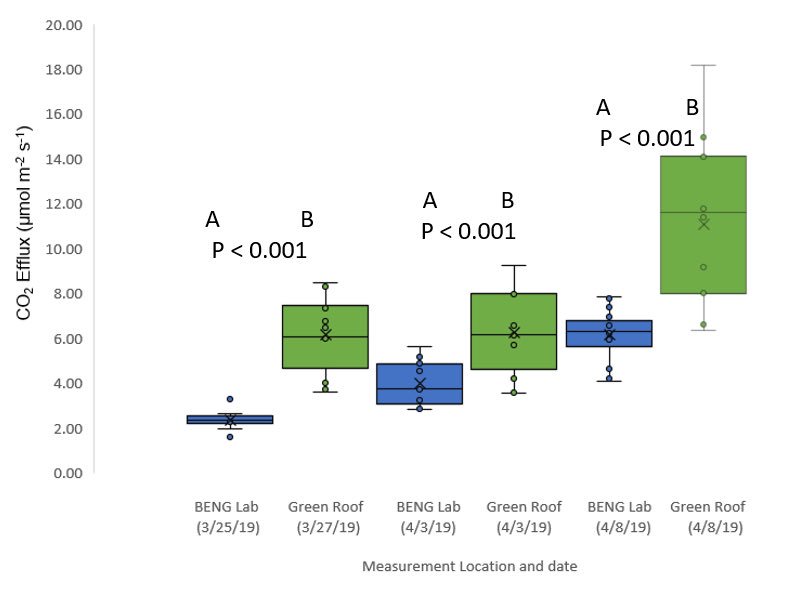
CO2 flux can be driven by soil temperature or water content. My CO2 flux was mainly driven by the temperature of my planting media, while both temperature and water content drove the typical soil’s flux.
Throughout the study period (March-April 2019), I released more CO2 than the typical ecosystem. More tests need to be conducted to see whether this is just a rebellious phase, or if it really is my life year-round!
My planting media (PM) is less dense than a typical soil. My PM has a bulk density of 1.12 g/cm3 while the soil’s is 1.63 g/cm3. This means I have more space to hold water!
@TheSchneldon One of my purposes was for students to come out and use my green space, study, etc. The railing was probably intended to keep folks a minimum distance from the ledge (some design code?) and protect my drain infrastructure.
My hydrology wasn't the only thing studied last spring! The wonderful Maddie Oxner also took a deep dive into my ecology and biodiversity. Stay tuned over the next week while I highlight some of the things she learned about me!
May has been a rainy month thus far! I've captured 63.45 cubic meters of water and helped reduce the load on Fayetteville's stormwater management systems!
Check this out! This graph shows my net radiation over the last few months. Positive values represent incoming solar radiation while negative values show radiation leaving me at night.
After months of tinkering I'm happy to announce that my brain is now on site! It's called a Raspberry Pi microcomputer and, just like my plants, it's powered by the sun! Here's a picture of it hanging out in a heap of wires.
The last couple days have been rainy! I've captured 34.45 cubic meters of water and helped reduce the load on Fayetteville's stormwater management systems!
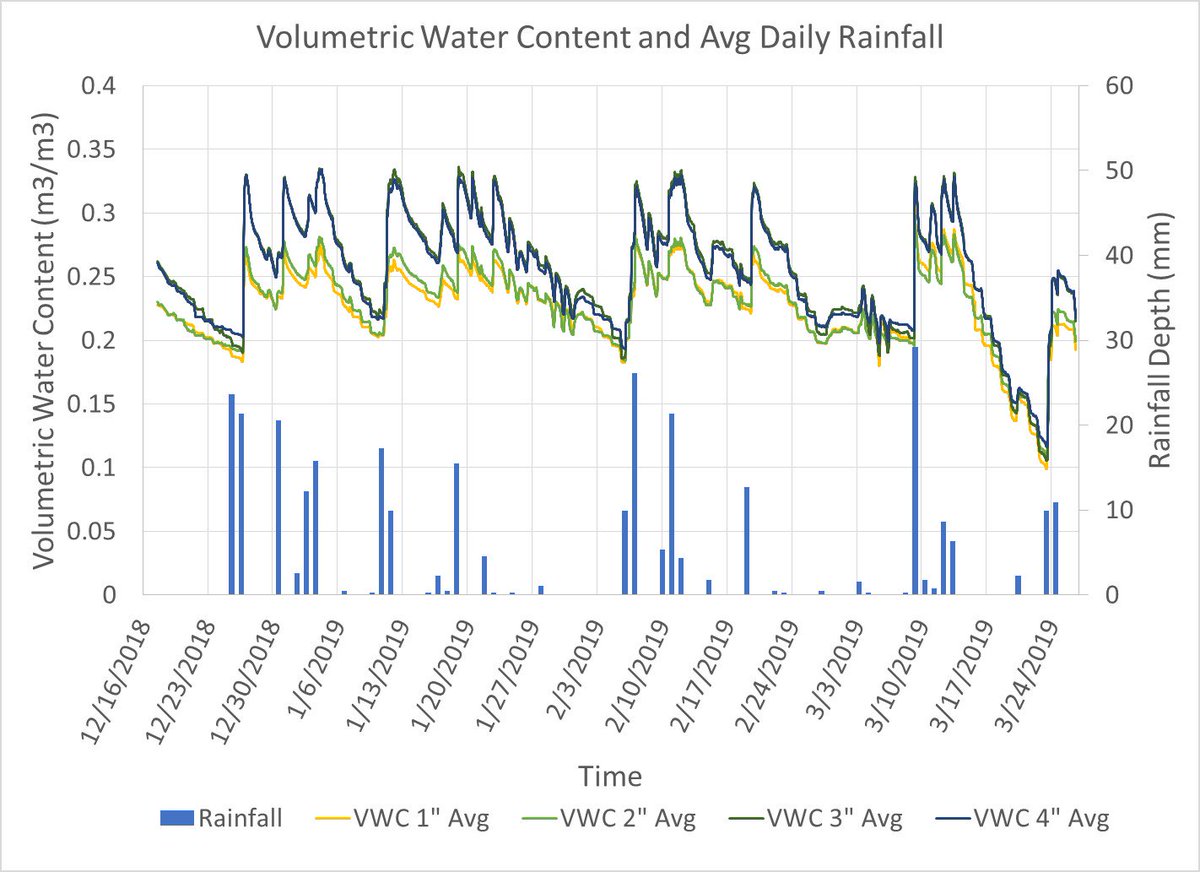
I've been quietly collecting loads of data! Here's a graph showing my 4 inch soil moisture profile with corresponding rain events over the last 4 months!
Hello world! I am a living green roof at the University of Arkansas being researched under an Honors College grant. Stay tuned for updates as the study moves along!