Exploring Christianity, UAP, non-human intelligence, history, science, and theology. Evidence-based inquiry into one of the most profound questions of our time.
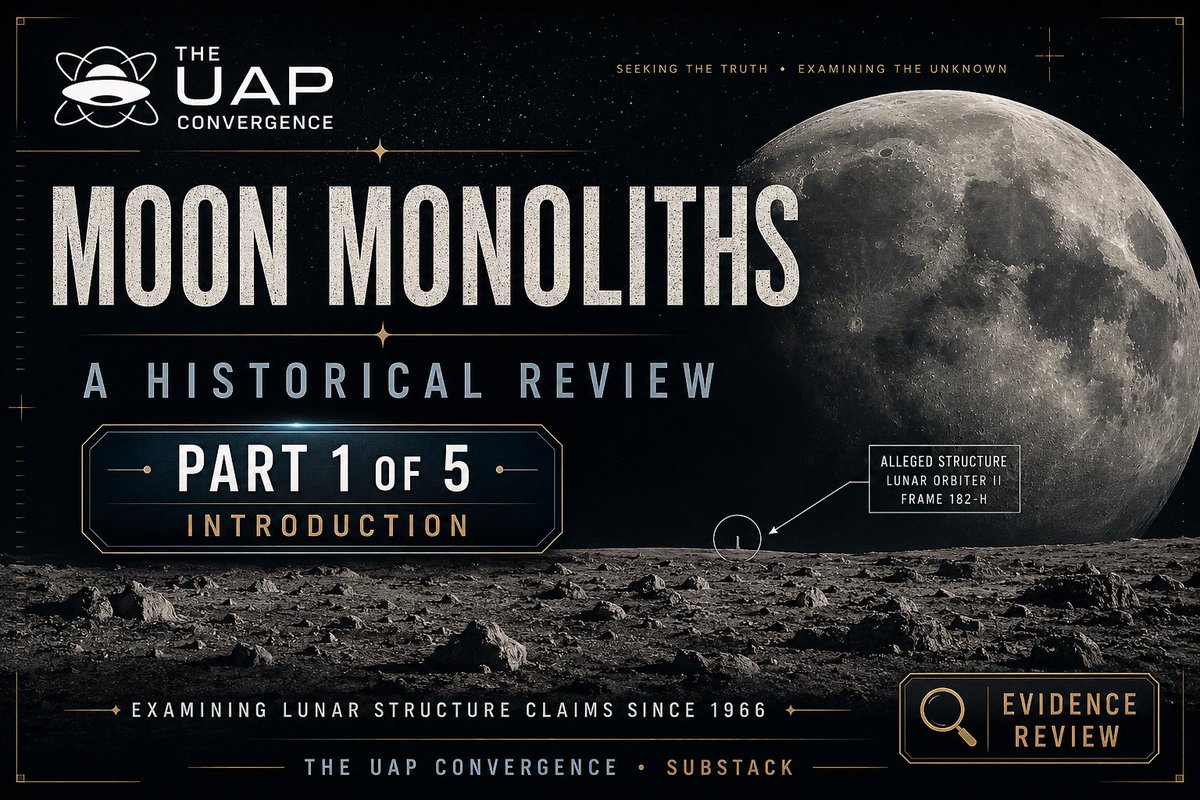
Moon Monoliths? A Historical Review (Part 1 of 5)
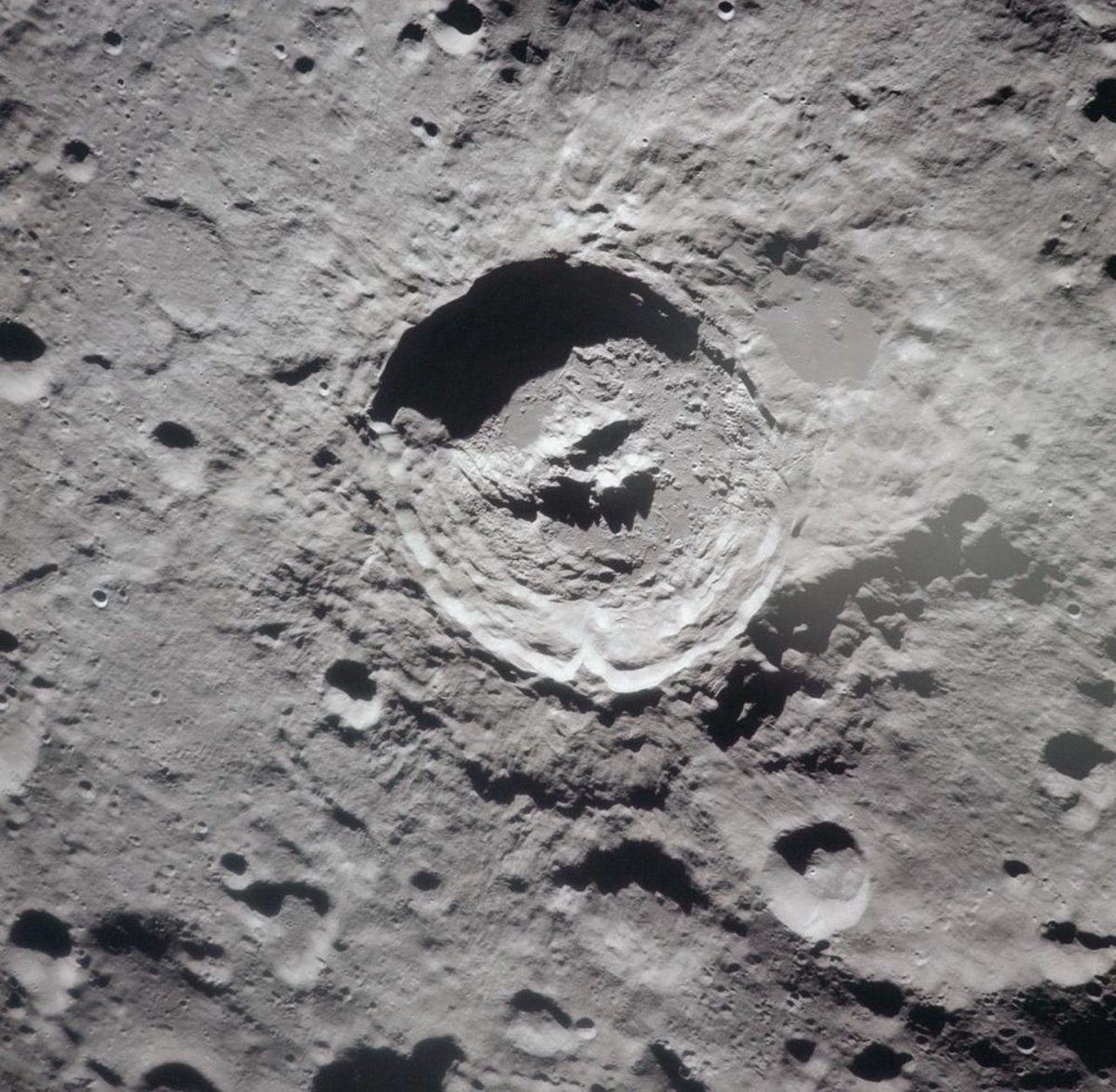
Luis Elizondo’s recent comments about alleged photographs showing large monolithic structures on the Moon have revived a mystery that stretches back nearly 60 years.
Long before today’s UAP disclosure movement, NASA imagery, military testimony, published analyses, and later government-related claims led some researchers to argue that unusual features on the Moon may deserve closer examination. Others maintain they are entirely natural, explained by geology, lighting, perspective, and image resolution.
Over the next five days, I’ll examine some of the best-known lunar structure claims—from the 1966 Blair Cuspids and Karl Wolfe’s testimony to more recent analyses and Elizondo’s latest statements.
This isn’t an attempt to prove or debunk these claims. It’s an evidence review. We’ll separate documented facts from interpretation and speculation, identify what is actually known, and let the evidence speak for itself.
Tomorrow: The Blair Cuspids (1966)—the Lunar Orbiter photographs that started decades of speculation about possible lunar obelisks.
That assumes the descriptions are intended as literal physical portraits rather than iconographic descriptions. Throughout Scripture, heavenly beings are described with different imagery depending on the theological point being made. Cherubim are composite creatures in Ezekiel, seraphim are fiery winged beings in Isaiah, and the Messiah himself is simultaneously described as a lion, a lamb, a door, a root, a branch, a stone, and a bridegroom. None of those images are literal anatomical descriptions. In think a literal interpretation of symbolic descriptions isn't warranted. The writers weren't trying to create a lesson in heavenly biology.
Me as well, and you also.
But...
If the “guardian cherub” in Ezekiel 28 is iconographic rather than a literal biological description, then the apparent conflict with the nāḥāš largely disappears.
In the ancient Near East, cherubim were throne guardians, not a biological species in the modern sense. The title “anointed guardian cherub” could be describing function, office, or status rather than anatomy.
This is how I see it.
Ezekiel’s vision itself is highly symbolic, with composite creatures full of theological imagery rather than zoological description.
Under that reading:
The nāḥāš is the rebellious divine being in Eden.
“Guardian cherub” describes that being’s former role as a protector or throne guardian.
The serpent imagery reflects either his appearance in Eden or his symbolic identity.
There is no contradiction because “cherub” is an office or iconographic designation, while “nāḥāš” describes the being in another way.
This is essentially how Heiser defended his position. He argued that “cherub” is not the creature’s species but its role in the divine council.
@PelleyDm@TheUfoJoe I believe Trump has done what he said he would do ~ and that's all. Release files of which maybe 90% were already known and now just a tiny bit less redacted. Videos with no senor data. In other words he's "done disclosure" and he's moving on.
Because ha-nachash and “cherub” are serving different purposes in the text.
In Genesis 3, the being is introduced in its role as the deceiver—the shining/divine nachash in Eden. Only later, passages like Ezekiel 28 identify the rebel as an “anointed cherub who covers,” looking back on the same Eden narrative from a different perspective.
One passage emphasizes function in the temptation; the other emphasizes status and office in God’s heavenly court.
I think you agree that ancient Hebrew literature often describes the same figure with different titles depending on the point being made, so there is no requirement that Genesis introduce him as a cherub.
The absence of the word “cherub” in Genesis 3 is therefore no more problematic than calling someone a “king” in one passage and a “shepherd” in another—they describe different aspects of the same individual.
Lastly, if the ancient writers described these creatures through symbolic imagery, then a Cherub does not physically resemble what the text states. Perhaps all of these creatures, regardless of their role, have a serpentine likeness.
Luis Elizondo’s recent comments about the release of alleged photographs showing large monolithic structures on the Moon have revived a mystery that stretches back nearly 60 years. Are there really alien structures on the Moon?
Long before today’s UAP disclosure movement, NASA imagery, military testimony, published analyses, and later government-related claims led some researchers to argue that unusual features on the Moon may deserve closer examination. Others maintain they are entirely natural, explained by geology, lighting, perspective, and image resolution.
Over the next five days, I’ll examine some of the best-known lunar structure claims—from the 1966 Blair Cuspids and Karl Wolfe’s testimony to more recent analyses and Elizondo’s latest statements.
This isn’t an attempt to prove or debunk these claims. It’s an evidence review. We’ll separate documented facts from interpretation and speculation, identify what is actually known, and let the evidence speak for itself.
Tomorrow: The Blair Cuspids (1966)—the Lunar Orbiter photographs that started decades of speculation about possible lunar obelisks.
Moon Monoliths? A Historical Review (Part 1 of 5)
Luis Elizondo’s recent comments about alleged photographs showing large monolithic structures on the Moon have revived a mystery that stretches back nearly 60 years.
Long before today’s UAP disclosure movement, NASA imagery, military testimony, published analyses, and later government-related claims led some researchers to argue that unusual features on the Moon may deserve closer examination. Others maintain they are entirely natural, explained by geology, lighting, perspective, and image resolution.
Over the next five days, I’ll examine some of the best-known lunar structure claims—from the 1966 Blair Cuspids and Karl Wolfe’s testimony to more recent analyses and Elizondo’s latest statements.
This isn’t an attempt to prove or debunk these claims. It’s an evidence review. We’ll separate documented facts from interpretation and speculation, identify what is actually known, and let the evidence speak for itself.
Tomorrow: The Blair Cuspids (1966)—the Lunar Orbiter photographs that started decades of speculation about possible lunar obelisks.
We would need to review the terms of agreement for that reported grant. However, it’s unlikely that the average person in this community will benefit from it. At best, it will be allocated to a university faculty member, but there aren’t many interested in or have access to classified psionic assets and programs.
@PostDisclosure Post-disclosure world? Isn't that now? I mean, Trump dumped three loads of data for us to read and see. And it's July 8. You know the day that everyone said Trump was going to announce to the world that aliens are here?
I'm being sarcastic. 😁
Claims without Evidence: The Waiting Game
•••••••••••••••••••
Elizondo continues to make significant claims that have not yet been independently verified.
Ross Coulthart has made significant allegations about Elizondo that likewise rest largely on confidential sources.
Neither set of claims should be accepted—or rejected—solely on the basis of reputation.
The discussion ultimately turns on evidence that can be independently examined.
We are still waiting.
The handwritten dates are interesting, but they’re not decisive.
If someone had access to authentic Air Force files—or even photographs of them—they could imitate administrative details like handwritten dates, routing marks, file numbers, stamps, or initials.
The key questions are:
• When were the dates added?
• Who wrote them?
• Were they contemporaneous with the documents or added later?
• Does the same handwriting appear across numerous authenticated Air Force records?
Document examiners don’t authenticate records based on one feature. They weigh the totality of the evidence: provenance, signatures, paper, typewriter characteristics, formatting, historical consistency, filing practices, and handwriting.
A shared handwritten date is suggestive, but by itself it isn’t enough to establish authenticity.
As we know, military terminology can be easily misunderstood. Perhaps these were officers from the United States Air Force Space Command (not the Space Force, as it didn’t exist at the time) who were tasked with evaluating non-terrestrial objects and related space phenomena. Recall the general who gained attention when he claimed to have observed “little green men” in the Crimea? He was actually referring to Russian insurgents.
Additional thoughts: The claim that alien objects have been seen on the moon goes back to 1976. People without knowledge of the history of this subject might not be aware.
We should talk about the 1976 book Somebody Else Is on the Moon by George H. Leonard. In that book, Leonard argued that NASA lunar photographs showed evidence of artificial activity on the Moon, including what he called “X-drones.”
The key points were:
Leonard believed the X-shaped objects were enormous autonomous machines.
He proposed they were involved in mining, excavation, and rock processing on the lunar surface.
He described them as being capable of changing configuration or function, almost like modular robotic construction equipment rather than conventional vehicles.
His interpretation relied heavily on Apollo-era NASA photographs, which he believed contained overlooked evidence of artificial structures, machinery, geometric features, and lights.
He did not claim the images were redacted by NASA. Instead he said the objects were overlooked.
Nothing regarding his claims has been verified officially. All are considered cases of normal pattern recognition (pareidolia).
Images:
Official NASA images which Leonard claimed demonstrated mining operations with X drone machines.
A sketch by Leonard of what he termed X drones; large mechanical apparatus that posssed flexible arms for mining.
Agreed. This was never really convincing and while he does believe this to be true, none of us have seen the evidence. And numerous images of the other side of the moon have been taken since then. One can argue they have all been altered but that's a big claim too. Many moon features can cause pareidolia. There's nothing to say these men might have legitimately observed what they thought to be structures only to have the images examined and declared null. The far side of the moon has been photographed by at least six different orbiters since his claim. Nothing shows alien structures.
New study suggests orb UAP are meteoric dust plasmas.
A Foo Fighter incident reported in November 1944 has been cited by skeptic Michael Shermer as an example of how a new Harvard study might explain some UAP reports.
While flying along the Rhine north of Strasbourg, Allied pilots reported seeing “8 to 10 bright orange lights off the left wing… flying through the air at high speed. Later they appeared farther away. The display continued for several minutes and then disappeared.”
The new paper by atmospheric chemist John Birks proposes that some “orbs” may be weakly ionized dusty plasmas formed through the stabilization of meteoric dust in the lower atmosphere. The hypothesis has attracted the attention of Michael Shermer, who has long argued that anomalous reports should first be evaluated in terms of ordinary physical or psychological explanations unless compelling evidence indicates otherwise.
It is therefore not surprising that Shermer would highlight this paper as a potentially important explanation for a class of UAP reports.
The difficulty is that a single mechanism rarely accounts for every report within a highly heterogeneous dataset. The UAP literature spans decades and includes observations with very different reported characteristics:
* Brief stationary glowing lights.
* Orange or white spheres drifting with the wind.
* Persistent lights during meteor showers.
* Radar-correlated objects.
* Objects reportedly pacing aircraft.
* Structured metallic craft.
* Daylight disc-shaped objects.
* Infrared-only targets.
* Cases involving multiple independent sensors.
The dusty plasma hypothesis may ultimately explain some luminous orb reports, particularly those occurring under the atmospheric conditions predicted by the model. However, extending that explanation to all orb reports requires evidence the paper does not currently provide.
For example, if an orb:
* appears indoors,
* is simultaneously detected on radar,
* performs abrupt accelerations,
* physically interacts with an aircraft,
* or exhibits behavior inconsistent with atmospheric transport,
then the dusty plasma model would need to demonstrate how those observations can be explained.
At present, the paper presents a scientifically testable hypothesis for one potential class of orb phenomena—not a comprehensive explanation for every reported orb or UAP case.
https://t.co/4Wzjz06ekQ
This is a hypothesis not an answer to all UAP. That’s where I think the paper becomes much less convincing.
Shermer, you have long argued that the default explanation for anomalous reports should be ordinary physical or psychological causes unless compelling evidence points elsewhere. It’s therefore not surprising that you would highlight this paper as a potentially broad explanation.
It's not.
The difficulty is that one mechanism rarely accounts for every report in a heterogeneous dataset. The UAP literature spans many decades and includes observations with very different reported characteristics:
☑️ Brief stationary glowing lights.
☑️ Orange or white spheres drifting with the wind.
☑️ Persistent lights during meteor showers.
☑️ Radar-correlated objects.
☑️ Objects reportedly pacing aircraft.
☑️ Structured metallic craft.
☑️ Daylight disc-shaped objects.
☑️ Infrared-only targets.
☑️ Cases involving multiple independent sensors.
A dusty plasma hypothesis may turn out to explain some luminous orb reports, especially if they occur under the atmospheric conditions the paper predicts. But extending that to all orb reports requires evidence that the paper does not currently provide.
The current paper is a hypothesis, not a comprehensive explanation for every such case.
Chris Bledsoe has repeatedly claimed that humanity is approaching a profound spiritual or world-changing event and publicly associated that expectation with the Easter 2026 timeframe.
When no widely recognized global event occurred this past Easter, the timeline gradually shifted toward later 2026, 2027, and more general assertions that “something big is coming.”
Most recently, Bledsoe suggested that this green orb he filmed is another sign that a significant event is drawing near.
While his personal experiences may be sincerely reported, the repeated revision of expected timelines without a clear, testable outcome has led many to criticize the pattern as an example of “moving the goalposts,” where predictions are continually postponed rather than confirmed or disproven.