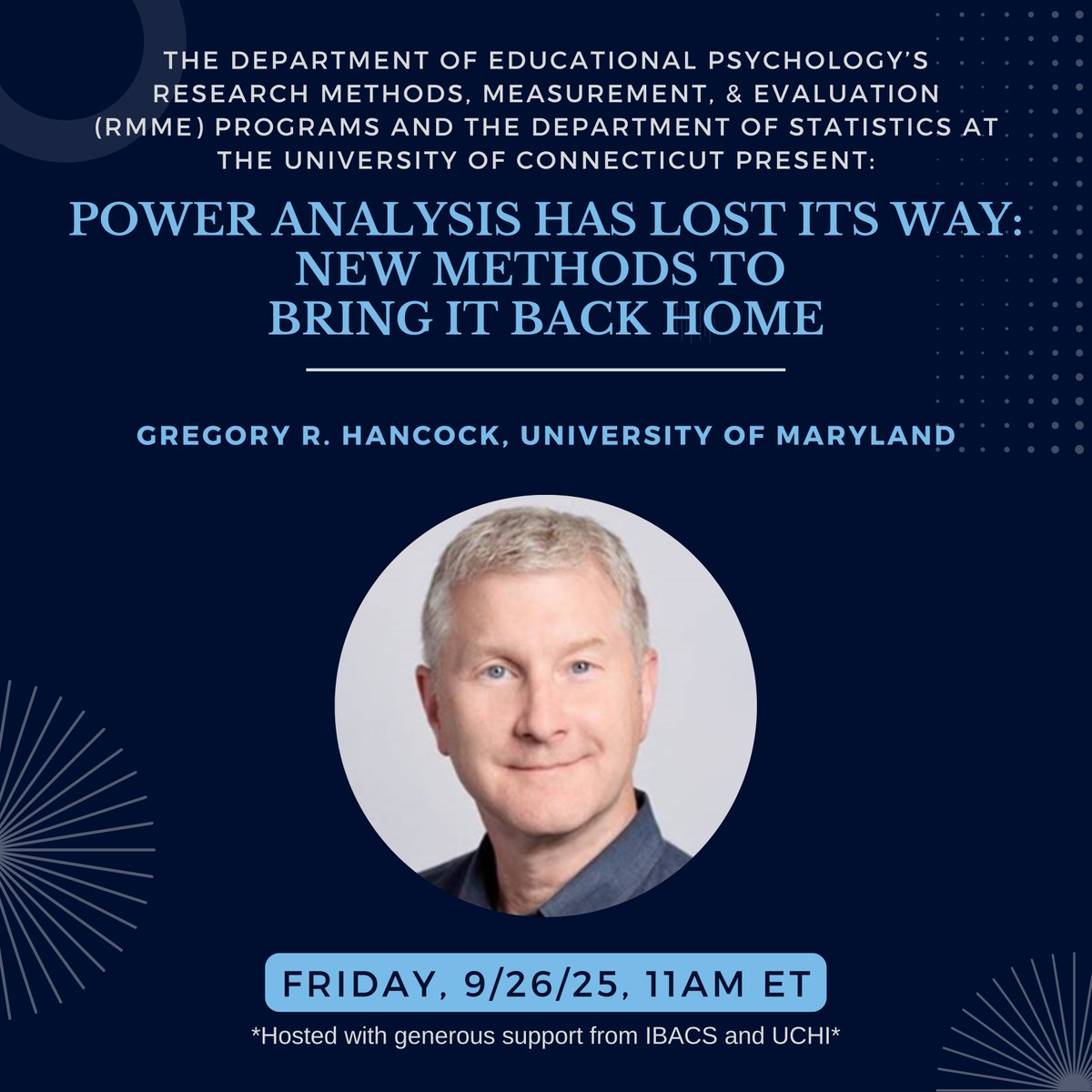
Neag's Department of #Educational#Psychology is the home of UConn - Research Methods, Measurement, & Evaluation (RMME) #Programs!!!! We are so excited to celebrate this amazing accomplishment with all of our EPSY colleagues!!!!
Congratulations to the newly elected board members, who will take office at the 2026 NCME Annual Meeting!
✔️ VP/President Elect: Susan Davis-Becker, ACS Ventures
✔️ State or Federal Agency Rep: Chris Rozunick, Texas Education Agency
✔️ Member at Large: Laura Hamilton, NCIEP
Australian Council for Educational Research (ACER) is looking to hire a Research Director, Methodology and Measurement.
Learn more: https://t.co/YpNKVJNFIt
Scholarships to attend the 2026 NCME Annual Meeting will be made available to doctoral students who come from an educational, cultural, or geographic background that is underrepresented in the field of educational measurement and assessment.
More: https://t.co/HtGEfSgKNi
Over 1,000 evaluation professionals have registered to attend #Eval25 in Kansas City, November 10-14. Join them to experience firsthand why gathering together is so much more rewarding than staying at your desk. Claim your spot today: https://t.co/WcEsL0ak9o
#AEA#Evaluation
Throughout the year, the Neag School is proud to share the latest achievements of its faculty, staff, students, and alumni. Check out their most recent promotions, awards, retirements, and publications.
https://t.co/EC6UOaqs4y
The NCME Nominating Committee is now accepting nominations for three NCME Board positions: Vice President / President-Elect; Board Member from a State or Federal Educational Agency or Organization; and Board Member at Large.
Nominate by November 14: https://t.co/VrjkER4mJT
Furthermore, we extend this framework to develop Bayesian (nonlinear) growth mixture mediation models (B(N)GMMM), which assess heterogeneous treatment effects (HTE) of the intervention variable X on the longitudinal dependent variable Y, mediated by longitudinal variable M.
We also examine the impact of omitting confounders in (non)linear mediation models using data from the Early Childhood Longitudinal Study-Kindergarten Cohort (ECLS-K).
We propose two models: a linear trend model (L-BREMM) and a segmented trend model using linear-linear piecewise functions with random changepoints (P-BREMM).
This study develops Bayesian (non)linear random effects mediation models (B(N)REMM) to directly estimate both linear and nonlinear longitudinal mediation effects, overcoming limitations in existing structural equation modeling (SEM) approaches.