Established in 1958, UNESDA is a Brussels-based association representing corporates and national soft drinks associations. We're here to listen, learn & share.
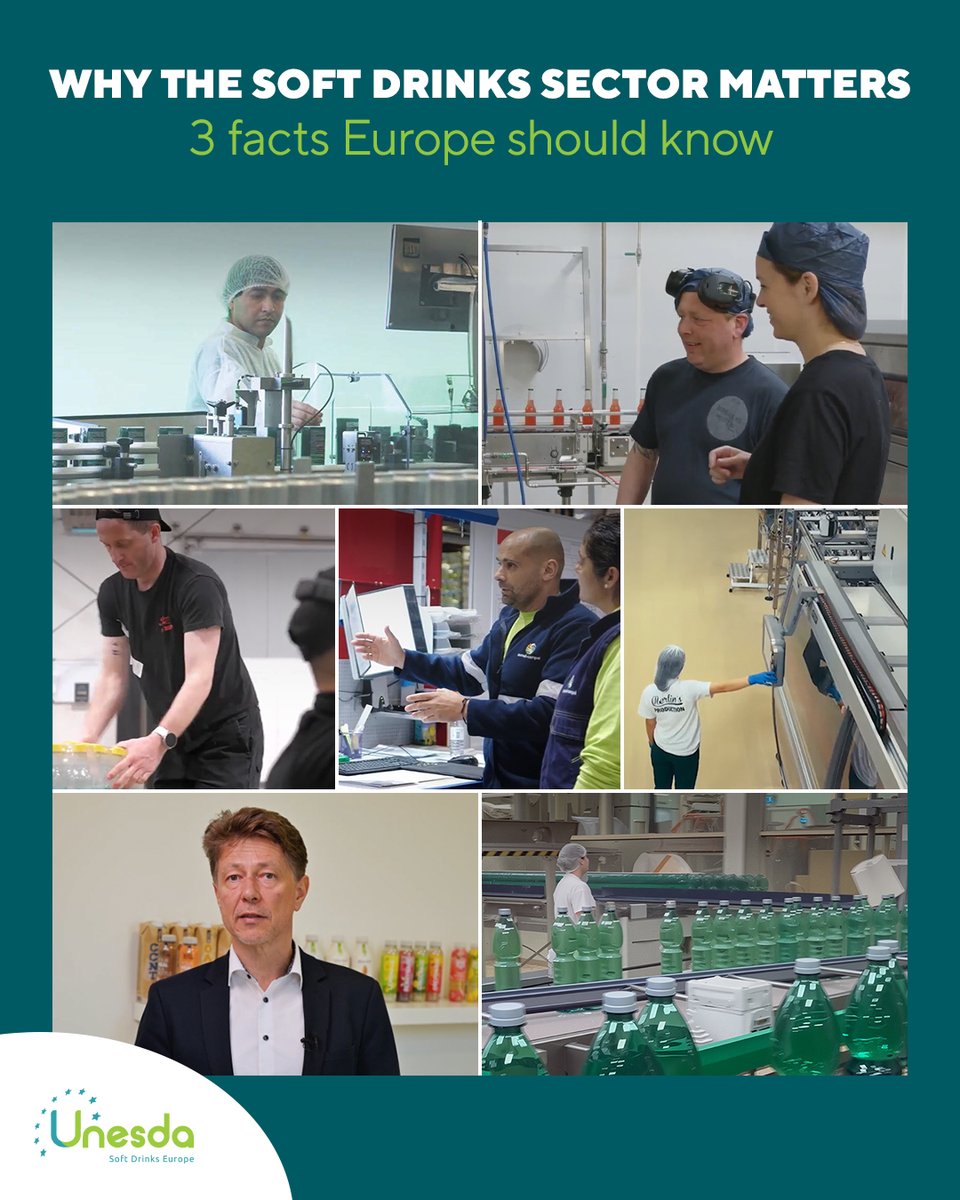
We have the perfect read for you to find out why #OurSectorMatters to Europe! All in just three key facts:
1.Our sector is a key driver of jobs and economic growth. Discover the stories of local #SoftDrinks companies across Europe.
2. Our sector innovates. In fact, we are the most innovative in the food and drink industry
3. Our sector takes ambitious actions that drive meaningful progress across Europe
🔎 Discover more in our NEW article in @euronews 👇
https://t.co/AAFVexEBUS
🌍🌿 EU Green Week is here and our Director General, Nicholas Hodac, is out with a new article on the upcoming EU Circular Economy Act (CEA).
In his article, Nicholas outlines the key policy enablers that our sector has put forward to the @EU_Commission so that the CEA helps build a well-functioning market for secondary raw materials, including by:
♻️ Supporting the fair access principle introduced in the EU Packaging and Packaging Waste Regulation (PPWR) as a tool to prioritise high-quality recycling, safeguard fair access to rPET for beverage use, and promote closed-loop recycling in other sectors
♻️ Addressing potential market disruptions with targeted measures that ensure a level playing field between virgin and recycled materials, such as fiscal incentives for investments in recycling facilities or tax credits related to the use of recycled content, as well as lowering the costs of rPET production
♻️ Avoiding unjustified restrictions on imported rPET that could result in increased prices in Europe and discourage industry’s commitment to this valuable material: a broad definition of ‘Europe’ (e.g. EU27+EFTA+FTA partners) and appropriate safeguard mechanisms (e.g. in case of supply, quality or price issues) are necessary
♻️ Recognising the value of recycled aluminium (rALU) in driving circularity by supporting high collection and recycling rates and ensuring access to sufficient food-grade recycled material for the industry
🔎 Read Nicholas’ article in The Parliament magazine 👇
https://t.co/a0s4bZ7om2
📌🌍 Producing 30 million soft drinks every year in Slovakia, using locally sourced ingredients? Yes.
👨👩🦰 Supporting local jobs by employing 186 people? Of course.
🤝 Generating value for Slovakia’s economy and families? Naturally.
That’s McCarter, a Slovak company operating in Dunajská Streda that continuously invests and innovates to meet consumers’ changing needs and expectations and drive environmental sustainability.
🔎 Swipe to find out more about McCarter and watch the video about the company below. ⬇️
➡️ Across Europe, our sector contributes significantly to local economies and communities. We operate more than 500 plants on the continent where over 97% of our beverages are produced. As we operate locally, we support over 1.8 million jobs and generate €242 billion across our European supply chain.
➡️ To continue creating jobs, investing and innovating for Europe, our sector needs a supportive regulatory environment with simple, coherent, stable policies grounded in solid evidence that foster innovation, including by removing unnecessary barriers to innovation, such as the 30% energy reduction rule. This EU rule limits the use of low-/no-calorie sweeteners by allowing food manufacturers to only use a low/no-calorie sweetener if the energy value has been reduced by at least 30%. This requirement has no technical and scientific justification and does not exist elsewhere in the world.
🎥 Watch the video to discover how McCarter is boosting jobs and growth in Slovakia
👉 https://t.co/33QepEMfbq
📣 The Swedish🇸🇪 soft drinks sector has made an announcement, and it is a big one!
👏 Member companies of the Swedish Brewers Association (member of UNESDA) have jointly committed to reducing the amount of sugar in carbonated soft drinks by 40% by 2030, against a 2019 baseline.
👏 This marks another important step in the sector’s longstanding efforts to support balanced diets in Sweden, building on a 28% sugar reduction already achieved since 2019.
🎯 The 40% target will be achieved through recipe reformulation for sugar reduction, more low- or no-sugar beverages, increased availability of smaller pack sizes, responsible marketing, and industry-wide monitoring of progress towards achieving the target.
🗨️ 'We want to take greater responsibility for public health and inspire more food producers to contribute to reduced sugar intake. Beverage producers in Sweden have been working together on sugar reduction since 2019 and have taken a leading role in sugar reduction internationally,' says Anna-Karin Fondberg, CEO of the Swedish Brewers Association.
🔎 Read more in the press release from the Swedish Brewers Association (in Swedish) 👇
https://t.co/FSxUZq513F
🤝 It is always valuable when Deposit Return Systems (DRS) operators, policymakers, industry representatives and NGOs come together for in-depth discussions on the role of DRS in accelerating beverage packaging circularity, the impact of the implementation of the EU Packaging and Packaging Waste Regulation (PPWR) and the upcoming EU Circular Economy Act (CEA) on the circularity transition, and how Europe can balance its circularity ambitions with industrial competitiveness.
That is what happened yesterday.
Our Director General, Nicholas Hodac, was very pleased to speak at the first conference excellently hosted by the European Deposit Return Systems Association (EDRSA) in Bratislava, which UNESDA was proud to support.
🎤 DRS are a key enabler of circularity. As recognised by Rastislav Chovanec, State Secretary, Ministry of Foreign and European Affairs of Slovakia:
‘Transition from a linear economy to circular economy is fundamental for Europe. DRS plays a key role.'
🎤 The circularity journey depends on close stakeholder collaboration. That was a message underlined by Miriam Lexmann, Member of the European Parliament:
‘Achieving our green goals can only happen with proper dialogue with stakeholders.'
🎤 Representing our sector, Nicholas highlighted our ongoing commitment to advancing Europe’s circularity transition and our strong support for the wider rollout of well-designed, efficient DRS:
‘Well-designed DRS are demonstrating how circularity works in practice every day across Europe. They are delivering impressive collection rates for beverage containers, making it possible for them to be recycled into new ones. This is not just about DRS that have been in place for decades, like those in the Nordic countries. We are also seeing remarkable results (collection rates of over 80%) in DRS that have only been in place for one or two years.'
Then, Nicholas went on to set out the key policy enablers that our sector needs from the upcoming CEA to help Europe drive further circularity, eg:
♻️ Prioritising high-quality and closed-loop recycling to scale circular models across industries and materials, including by:
➡️ Building on the fair access principle introduced in the PPWR to ensure a sufficient and affordable supply of rPET
➡️ Supporting the promotion of closed-loop systems in sectors where they are lacking, such as textiles and automotive
♻️ Addressing market failures that hinder sectoral targets, in particular:
➡️ Tackling the cost disadvantages of recycled materials
➡️ Fixing the definition of ‘bottle’ (i.e. the body of the bottle itself, its cap, and label or sleeve) in the Single-Use Plastics Directive (SUPD) to facilitate compliance with rPET targets
♻️ Fostering an EU market for secondary raw materials, for example by:
➡️ Simplifying import procedures for compliant feedstock from third countries to close short-term supply gaps
👏 Really big congratulations to Marian Ac, Milan Jezovica, Borbála Agócsová from EDRSA for such a fantastic conference! WELL DONE! 👏
💡 UNESDA #FridayTip
🏃♂️🏃♀️ Looking for some exercise this weekend?
Then, the Brussels 20km race may be just what you need.
Our Director General, Nicholas Hodac, couldn’t resist the challenge! 🙂
Say hi if you spot him, and don’t forget to make good use of the hydration points to stay hydrated. And have fun running!
👉https://t.co/c2adZOLKur
End of the month already? Time for a quick recap of our key highlights from May:
🎤🔄 All things circular!
Our Director General, Nicholas Hodac, joined the Circular Economy Forum in Brussels, hosted by the @Parlimag, where he outlined what the upcoming EU Circular Economy Act should deliver for our sector to help us build on our progress and further accelerate circularity. Here are our sector’s key policy asks 👇
https://t.co/P1OsaYU2Yy
👏 What a great first conference of the European Deposit Return Systems Association (EDSRA), which UNESDA was pleased to support!
Our Director General, Nicholas Hodac, contributed valuable insights on the crucial role that Deposit Return Systems (DRS) play in advancing circularity of beverage containers, while also highlighting the key enablers that our sector needs the upcoming EU Circular Economy Act to deliver to help us accelerate the circularity transition.
🔎 More here 👇
https://t.co/12qyXpvw3w
♻️ 👀 How does Austria’s Deposit Return System (DRS) work in practice, a little over one year after its launch?
That was the purpose of our visit to Vienna, organised by the European Alliance for Best-in-Class DRS, which is led by Reloop. Read our thoughts 👇
https://t.co/5lWBLGly6K
💙 We are Europe, and we matter:
We marked Europe Day with a short video explaining our sector’s deep European roots: we produce more than 97% of our beverages in Europe, we invest in and innovate across the continent, we support over 1.8 million jobs and generate €242 billion in revenue across our European supply chain.
🎥 Watch the video 👇
https://t.co/uTCuuAZYWG
There’s more happening in June. Stay tuned! 😉
👏 Our member Suntory Beverage & Food Europe (SBFE) has reformulated more than 300 drinks across Europe and reduced added sugar across its portfolio by 35% over the past decade.
It may sound simple, but reducing sugar in soft drinks is not straightforward.
🗨️ ‘It involves rebalancing the whole recipe, with careful testing to make sure products remain safe, compliant and enjoyable’, explains Pierre Decroix, CEO of SBFE.
🗨️ ‘Developing drinks that suit those everyday needs and moments is the starting point - reformulation has to make sense in people’s lives, not just on paper. The aim is to create products that fit naturally into how and when people drink them, and ultimately enhance those moments rather than disrupt them’, adds Pierre.
✨ SBFE and the rest of the European soft drinks sector are continuously supporting balanced diets through reformulation, including reducing sugar content, offering smaller portion sizes, expanding low- and no-calorie beverages, and providing transparent nutrition information to help consumers make informed choices.
As mentioned by Pierre, making further progress in sugar reduction requires policymakers to support:
🔔 evidence‑based policies grounded in nutrition science and real‑world consumption data
🔔 regulatory predictability and stability to enable innovation and long-term investment in reformulation
🔔 the removal of rules that hinder food innovation, such as the EU requirement to achieve a 30% energy reduction before certain authorised sweeteners can be used, which has no technical or scientific justification. This makes it difficult to advance sugar reduction and develop new low- and no-calorie beverages.
🔎 Read the interview with Pierre in the @Parlimag to find out more about what reformulation means in practice, what it has already delivered for SBFE, and how it contributes to Europe’s healthier food system 👇
https://t.co/0LhbG0qUSt
📍🏠 It is local. It is ‘Made in Italy’ soft drinks🇮🇹.
📍🏠 It is Galvanina, a beverage company operating near Rimini that provides jobs for 136 people and generates an annual value of over €99 million.
🎥 Watch the video to find out from Matteo Biguzzi, Research & Development Manager at Galvanina, how the company produces its beverages using local ingredients and stays close to consumers’ tastes and preferences. ⬇️
➡️ Galvanina aims to keep innovating and thriving, as does the rest of our sector across Europe. This is possible with clear, coherent and evidence-based policies that promote fairness across the entire food value chain and support innovation.
🔎 Explore our sector’s socio-economic footprint across Europe 👉https://t.co/XFu15krxo3
#OurSectorMatters
💡 UNESDA #FridayTip
🎾 Is tennis your thing?
Roland-Garros is underway! How much do you know about this iconic French tournament?
Take this quiz and find out! 👇
https://t.co/3fVp5JQlXl
📣 The Close the Glass Loop Annual Event is almost here!
♻️ The glass packaging value chain and EU policymakers will come together to discuss how Europe can advance a circular economy for glass packaging, while maintaining the competitiveness of the glass packaging industry.
♻️ Discussions will largely focus on the implementation of the EU Packaging and Packaging Waste Regulation (PPWR), the upcoming Circular Economy Act and the EU Clean Industrial Act.
🔎 The event will also include project updates from the national platforms of Close the Glass Loop and an interactive session to explore future Close the Glass Loop initiatives to improve and increase the collection and recycling of glass packaging.
Don’t miss it!
🗓️ 4 June
🕣 -16:00
📍Town Hall Europe, Brussels🇧🇪
✍️ Register now:
https://t.co/FR57uNLDol
✨ UNESDA is a member of Close the Glass Loop, a platform created with the glass packaging value chain to achieve a 90% glass packaging collection rate for recycling in the EU by 2030.
Know Sanmy🇪🇸?
It is Spain’s oldest soft drinks company, employing more than 176,000 people and generating over €10.7 billion in revenue. A strong example of our sector’s local roots.
⬇️ Discover how Sanmy supports Spain’s economy and communities.
→ Our sector plays an important role in making Europe more competitive and innovative. With 500+ plants across the continent, we produce more than 97% of our soft drinks here in Europe, supporting over 1.8 million jobs and generating €242bn in revenue across our European supply chain.
→ Boosting competitiveness depends on clear, coherent and evidence-based policies that do not discriminate against any food, drink or ingredient, and that drive innovation.
🔎 Explore our sector’s socio-economic footprint across Europe 👉https://t.co/XFu15krxo3
#OurSectorMatters