You create incredible value without any monetary cost, by being kind, being trustworthy, showing up for causes you believe in & standing up for what is right.
@GaryMarcus Intolerable sadness, it didn't have to be this way, there are no gatekeepers left to stop it unfortunately, nor an uncompromised 'free press' to open the curtain.
🇦🇺🔋 Boom! Australia just installed 400,000 home batteries in just over 10 months, delivering a massive 11.2 GWh of storage capacity.
That’s ~1,250 systems per day under the Cheaper Home Batteries program.
I agree, the housing market is broken!
Previous Labor govts acted to ensure there was an alternative-public housing.Stop feeding a failed market and invest in modern, efficient public housing.
Create a new hi tech modular housing industry building public housing for Australians
Greece jumped from 8% renewables in 2000 to ~50% today. Fossils collapsed from 92% to ~53%. This isn't just transition. This is a system replacement at scale. Coal gone, gas is next. The curve isn’t gradual, it’s exponential. Cost always wins & #Bettrification in Europe surges!
Zoom out and the story is simply brutal. In 2000, Greece was ~92% fossil. Renewables were just 8%, mostly hydro. Wind and solar were barely on the map.
Today, renewables are hovering near 50%, driven by a surge in wind and solar over the last decade. Fossils have been cut nearly in half. That’s a 40+ point shift in a single system. Not some hippy theory. Not woke targets. Reality.
Now, some will point to 2025 and say “see, renewables stalled.” They didn’t. Renewable generation actually increased. What changed was gas ramped faster, pushing its share higher and slightly diluting the percentage of wind and solar.
Shares can fall while output rises. That’s what happens in a growing system.
Why did gas step in? Timing. This isn’t just about how much energy is produced, it’s about when it arrives. Solar floods the grid midday. Wind fills variability. Gas plugs the gaps while the system catches up.
That last ~50% fossil isn’t stubborn demand. It’s timing, storage, and system inertia.
This is the messy middle. One system dying, another taking over. It's part of the journey.
Coal is already gone. Gas is the temporary layer holding things together. Not the future. The delay.
Next phase is obvious. Storage scales, overbuild kicks in, and gas gets squeezed the same way coal did.
And zoom out again. If Greece can swing 40+ points in two decades, this isn’t unique. It’s a template.
Winston Churchill fought his depression with bricks. He'd lay them for hours at his country home in Kent. He joined the bricklayers' union. And in 1921 he wrote about why it worked. It took psychology another 75 years to catch up.
He called his depression the "Black Dog." It followed him for decades. His method for fighting it back was as basic as it sounds: laying brick after brick, hour after hour.
Churchill spelled out his theory in a long essay for The Strand Magazine. People who think for a living, he wrote, can't fix a tired brain just by resting it. They have to use a different part of themselves. The part that moves the eyes and the hands. Woodworking, chemistry, bookbinding, bricklaying, painting. Anything that drags the body into a problem the mind can't solve by itself.
Modern psychology now calls this behavioral activation. It's one of the most-studied depression treatments out there. Depression sets a behavior trap. You feel bad, so you stop doing things, and doing less means less to feel good about. Feeling worse makes you do even less. The loop tightens until you can't breathe inside it.
Behavioral activation breaks the loop from the action side. You schedule the activity first, even when every part of you doesn't want to. Doing it produces small rewards: a wall gets straighter, a painting fills in, a messy room gets clean. Those small rewards slowly rewire the brain. Action comes first, and the feeling follows.
Researchers at the University of Washington put this to the test in 2006. They studied 241 adults with major depression and compared three treatments: behavioral activation, regular talk therapy, and antidepressants. For the people who were most severely depressed, behavioral activation matched the drugs. It beat the talk therapy. A 2014 review of more than 1,500 patients across 26 trials backed up the result.
Physical work like bricklaying does something extra on top of this. It crowds out rumination, the looping bad thoughts that grind people down during the worst stretches of depression. Bricklaying needs both hands and gives feedback brick by brick: each one is straight or crooked. After an hour you can see exactly how much wall you built. No room left for the mental chewing.
The line George Mack used in his post, "depression hates a moving target," is good poetry. The science behind it is sharper. Depression hates a brain that has somewhere else to be.
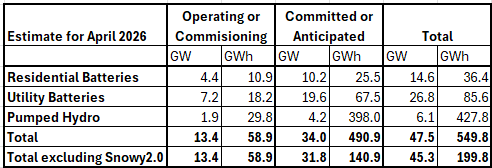
Within a few years, the NEM will have 45GW/200GWh of storage, excluding anything from Snowy2.0.
My weekly simultion assumes much less than this - 24GW/120GWh & reaches 98% renewable.
The 2026 Draft ISP assumes 44GW/202GWh excluding Snowy2.0 & is 96% renewable by FY2040.
/1
80 panels per hour or one every 45 seconds. 1,920 per day.
I love it. This is something we should scale up massively: affordable energy, which is necessary for everyone.
🚨 Researchers at the Institute of Metal Research under the Chinese Academy of Sciences developed an all-iron flow battery using a redesigned electrolyte that eliminates the degradation and leakage that plagued previous iron battery designs.
The battery completed over 6,000 charge-discharge cycles equivalent to more than 16 years of daily grid use with zero capacity loss and 99.4 percent leak-proof efficiency at 78.5 percent energy efficiency under high output. Iron costs approximately 80 times less than lithium making the technology viable for large-scale renewable energy grid storage where lithium supply constraints are a concern. Commercial deployment is still in development.
Source: Chinese Academy of Sciences / Institute of Metal Research / ScienceDaily (2026)