Each year, researchers at LPSC present findings that expand our understanding of the Moon, Mars and the broader solar system. Where is your #LPSC2027 abstract headed? Reply with your topic. Abstracts due Jan. 5. #PlanetaryScience
Each year, researchers at LPSC present findings that expand our understanding of the Moon, Mars and the broader solar system. Where is your #LPSC2027 abstract headed? Reply with your topic. Abstracts due Jan. 5. #PlanetaryScience
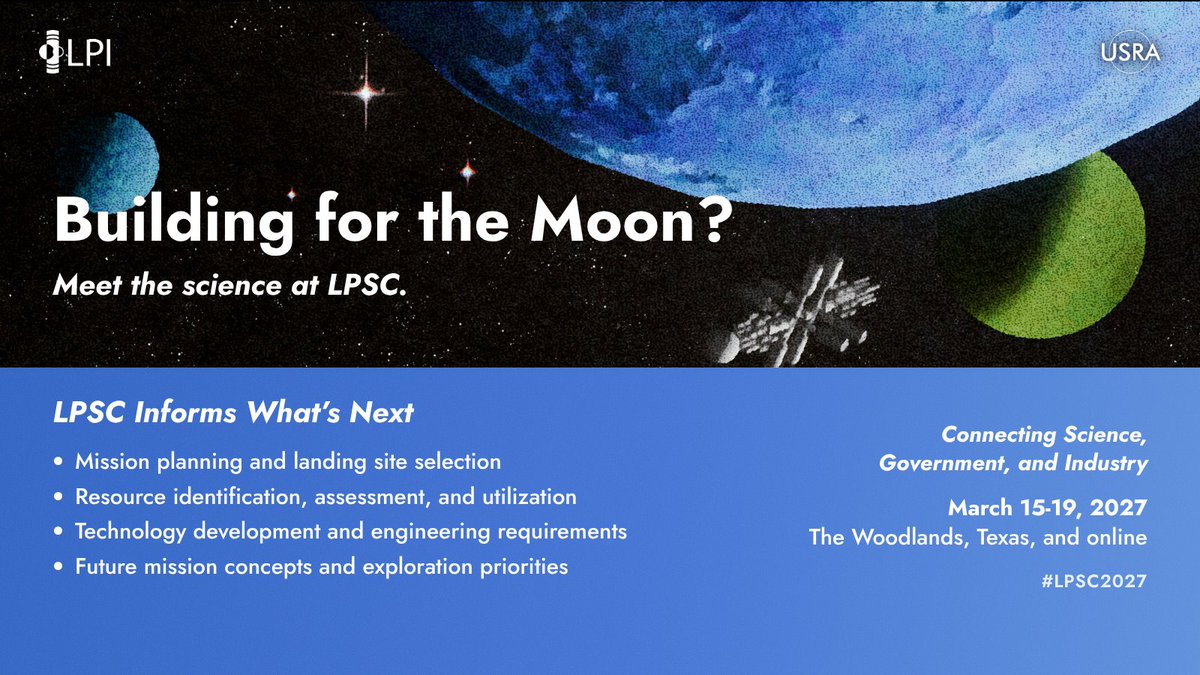
#LPSC2027, the world's leading conference for lunar and planetary science, is March 15-19, 2027, in The Woodlands, Texas, and online. Abstracts are due Jan. 5. Will we see your work there?
https://t.co/EF7xtvztXI
Join us for the upcoming webinar, Mysteries of Moondust! The speaker is Dr. Addie Dove, the Deputy-PI of the NASA SSERVI-funded Center for Lunar and Asteroid Surface Science, and of the Lunar-VISE mission scheduled to land on the Moon in 2028. https://t.co/oASI8kS9dh.
✨ USRA's Dr. Amanda Smith-Hackler spoke with Tariq Malik (@TWiT) and Rick Jenet about how the @AFResearchLab Scholars Program is "turning inspiration into education and...ultimately, a career in STEM."
#Artemis
👓Watch now!
🗓️Apply soon!
https://t.co/TKafBAjJjN
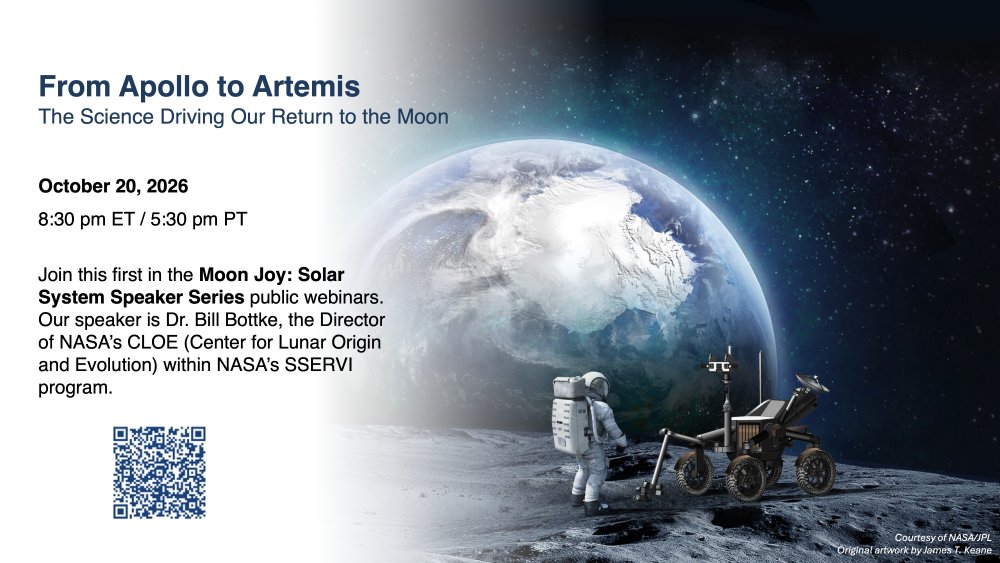
All are welcome to join us for the upcoming webinar, "From Apollo to Artemis: The Science Driving Our Return to the Moon." 🚀🌕Bill Bottke from the CLOE SSERVI node will speak on October 20, 2026, at 7:30 pm CT. Register today: https://t.co/G1OJUiiEwP
✨ USRA is honored to recognize General Lyles’ lifetime of achievement and the lasting impact he has had on the Air & Space Forces and the broader national security community.
https://t.co/xsRx0kGIgd
🏈🏈 🌑 NASA’s Lunar Reconnaissance Orbiter Camera team recently discovered a new crater on the Moon that is twice the length of an American football field.
https://t.co/7fNxYuoVI6
42 years ago today, DNA fingerprinting was discovered at Leicester. 🧬
Prof Sir Alec Jeffreys’ discovery went on to transform forensic science and change lives around the world.
Not bad for a morning in the lab.
#CitizensOfChange#DNA42#MadeAtUni
LPI has 50+ years of space science leadership. It’s also part of USRA, which has 124+ member research universities. That’s the powerful network behind every partnership LPI builds with commercial space companies taking part in the Artemis generation.
https://t.co/MXdFvzdCOC
LPI's Summer Internship Program is wrapping up — another cohort of future planetary scientists trained alongside NASA-affiliated researchers. What advice would you give a student just starting a science career? #STEM#ArtemisGeneration#USRA
https://t.co/KuZ9FBl5QL
USRA's Dr. David Kring joined "This Week in Space" to break down the science behind NASA's Artemis program — a good watch for anyone following the return to the Moon.
https://t.co/7xU62w7pDj
LPI's David Kring helped link Mexico's Chicxulub crater to the dinosaur extinction, then developed a theory that impacts like it may have helped start life on Earth. He also trained Artemis II's crew before launch. #MeetTheScientist#ArtemisII
Earlier this year, Artemis II carried four astronauts around the far side of the Moon and back — the farthest humans have ever traveled from Earth. LPI's own David Kring personally trained the crew. Guess how — full story tomorrow. #ArtemisII
📸credit: NASA
Did you know planning conferences isn't just a side skill at LPI? Our certified team runs everything from 10-person workshops to 2,000-person conferences, live, virtual or hybrid. Got a meeting to plan? DM us — we'll take it from there. #EventPlanning#PlanetaryScience
Internships aren't the only way LPI builds tomorrow's planetary scientists. ENComPSS workshops and postdoc positions — many jointly supervised with NASA — do the same at every career stage. Which career stage do you think needs more support right now? #PlanetaryScience#LPI#USRA
☄️Perseid meteor shower recap: this year's new moon meant some of the darkest skies in years for viewing. Each streak is debris from Comet Swift-Tuttle burning up in Earth's atmosphere. Did you catch it? #Perseids2026#LPI#USRA
☀️A total solar eclipse crosses Greenland, Iceland and northern Spain today -- the first visible from mainland Europe since 1999. We won't be able to see if from LPI in Houston, but how will you be following along?
#SolarEclipse2026#PlanetaryScience
https://t.co/VhBkrm5AyF