Looks bullish for $NOK $LITE $CIEN $MRVL $AAOI $COHR and other optical stocks as AI data center demand surges and optical component supply remains tight.
Optical Stocks in Focus — $LITE $COHR $MRVL $FN $AAOI $INFN $ANET $CRDO $AVGO $NOK $CIEN
The expansion of AI infrastructure is accelerating demand across the optical networking industry.
NVIDIA-backed Lumentum ($LITE) reporting that its optical components are sold out through early 2029 highlights the growing importance of high-speed connectivity in AI data centers. As AI clusters become larger, the need for high-bandwidth optical interconnects, fiber networks and advanced transceivers is increasing to enable faster data transmission between GPUs.
$NOK (Nokia), $CIEN (Ciena), $COHR (Coherent), $FN (Fabrinet), $AAOI (Applied Optoelectronics) and $INFN (Infinera) are companies worth watching across the optical, fiber and networking ecosystem. Meanwhile, $MRVL (Marvell), $AVGO (Broadcom), $CRDO (Credo) and $ANET (Arista Networks) are positioned across AI data center chips, high-speed connectivity and networking solutions. In my view, this is not just an AI chip story — it is also a broader infrastructure trend centered on moving data faster across AI data centers.
🚨 $NOK Nokia Optical Network Catalyst
Arelion completed a live 500-km Amsterdam–London network trial using Nokia’s 1830 Global Express (GX) Super C & Super L open line system, CHMQ6 thin transponders and ICE-X 400G/800G ZR+ coherent pluggable optics.
👉 Key Highlights:
➤ Demonstrated ~21% expansion in usable optical spectrum
➤ Increased capacity over existing fiber infrastructure
➤ Supports high-bandwidth AI, cloud & data-center workloads
➤ Nokia’s CHMQ6 + ICE-X provide modular, lower-power high-capacity optical transport
➤ Helps Arelion scale backbone capacity while improving cost and energy efficiency
➤ Strengthens Nokia’s position in AI-driven optical networking & data-center connectivity
🔥 Another positive validation of Nokia’s optical technology as AI traffic drives massive demand for high-capacity networks.
$NOK is currently in a long consolidation phase after its major correction, with strong support around $9.80–$10.00 and resistance near $10.80–$11.20; a breakout above $11.20 could signal a bullish trend reversal toward $12–$13, while a break below $9.80 would weaken the setup.
𝐇𝐢 𝐅𝐚𝐦 👋
😂 𝐇𝐮𝐡𝐡𝐡… 𝐀𝐟𝐭𝐞𝐫 $NOK & $BB 𝐈’𝐦 𝐖𝐚𝐭𝐜𝐡𝐢𝐧𝐠 $CSCO 𝐂𝐥𝐨𝐬𝐞𝐥𝐲 👀
$CSCO is no longer just the old networking hardware story.
Cisco is shifting toward AI networking, high-speed switching, optics, security & software, while its massive installed base + channel ecosystem remain major advantages.
🚀 𝐀𝐈 𝐍𝐞𝐭𝐰𝐨𝐫𝐤𝐢𝐧𝐠 𝐈𝐬 𝐓𝐡𝐞 𝐊𝐞𝐲 𝐆𝐫𝐨𝐰𝐭𝐡 𝐃𝐫𝐢𝐯𝐞𝐫
FY2026 Revenue: $63.33B (+12%)
Networking Revenue: $34.67B (+22%)
The bigger story is AI infrastructure.
Cisco generated ~$4B in AI infrastructure revenue in FY2026 and is guiding for ~$7.5B in FY2027.
Key technologies: Silicon One + Acacia Optics
Cisco is positioning across scale-out and scale-across AI architectures.
🏢 𝐂𝐚𝐦𝐩𝐮𝐬 + 𝐄𝐧𝐭𝐞𝐫𝐩𝐫𝐢𝐬𝐞 𝐑𝐞𝐟𝐫𝐞𝐬𝐡
The AI story isn’t limited to hyperscalers.
In Q4:
Campus orders: ~+20%
Enterprise orders: +21%
Data-center networking orders: +35%+
That gives Cisco two major growth engines:
AI Infrastructure + Enterprise/Campus Refresh
🤝 𝐂𝐮𝐬𝐭𝐨𝐦𝐞𝐫𝐬 & 𝐄𝐜𝐨𝐬𝐲𝐬𝐭𝐞𝐦
Cisco has 40K–50K+ channel partners, with roughly 80–90% of product revenue flowing through the channel.
Key relationships include:
$NVDA | Bell Canada | $TSM | Splunk
Cisco has also highlighted multiple hyperscaler Silicon One design wins, while Meta has publicly discussed Cisco Silicon One systems.
🛡️ 𝐒𝐞𝐜𝐮𝐫𝐢𝐭𝐲 𝐈𝐬 𝐑𝐞-𝐀𝐜𝐜𝐞𝐥𝐞𝐫𝐚𝐭𝐢𝐧𝐠
FY2026 Security Revenue: $8.23B (+2%)
Q4 Security Growth: +14%
Firewall Orders: +30%+
New products including Hypershield, AI Defense, Secure Access & XDR are expanding the opportunity.
The Splunk acquisition could become increasingly important for future growth.
📊 𝐅𝐢𝐧𝐚𝐧𝐜𝐢𝐚𝐥 𝐌𝐨𝐦𝐞𝐧𝐭𝐮𝐦
FY2026:
Revenue: $63.33B (+12%)
GAAP EPS: $3.33 (+31%)
Non-GAAP EPS: $4.33 (+14%)
FCF: ~$12.8B
Q4 revenue reached $17.25B (+18%), with Networking up 28%.
🎯 𝐅𝐘𝟐𝟎𝟐𝟕 𝐆𝐮𝐢𝐝𝐚𝐧𝐜𝐞
Revenue: $72.2B–$73.4B
Non-GAAP EPS: $5.05–$5.11
AI Infrastructure Revenue: ~$7.5B
That’s a mid-teens growth outlook, very different from Cisco’s low-growth narrative of the past.
🏦 𝐈𝐧𝐬𝐭𝐢𝐭𝐮𝐭𝐢𝐨𝐧𝐚𝐥 𝐈𝐧𝐭𝐞𝐫𝐞𝐬𝐭
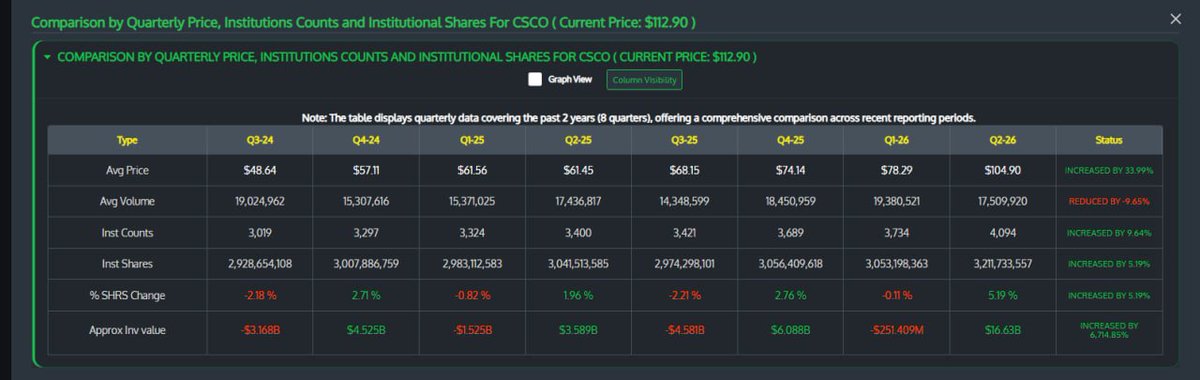
$CSCO institutional interest is also increasing.
Institutional Holders: 3,019 → 4,094 (+35.61%)
Institutional Shares: 2.93B → 3.21B (+9.91%)
Major holders include Vanguard, BlackRock, State Street, Morgan Stanley, Fidelity (FMR), Geode Capital and Invesco.
Notable increases include Invesco +66.69%, D.E. Shaw +604%, Two Sigma +498% and Citadel +106%.
This alone isn’t a bullish signal, but rising institutional positioning alongside the AI networking + enterprise refresh story is another important point to watch.
🧠 𝐂𝐢𝐬𝐜𝐨’𝐬 𝐌𝐨𝐚𝐭
The biggest advantage isn’t just hardware.
Massive Installed Base + Switching Costs + 40K–50K Partners + Certifications + Enterprise Relationships + Broad Product Portfolio
Cisco is now layering Silicon One + Acacia Optics + Splunk + AI/Security software on top of that installed base.
That creates the potential for a platform story, not just a hardware refresh story.
🔍 𝐖𝐡𝐚𝐭 𝐈’𝐦 𝐖𝐚𝐭𝐜𝐡𝐢𝐧𝐠
AI Revenue → Can $CSCO reach ~$7.5B?
AI Orders → Will hyperscaler demand continue?
Margins → Can AI growth happen without major margin pressure?
Campus Refresh → Will enterprise demand remain strong?
Security → Can Splunk + Hypershield accelerate growth?
Silicon One → Can Cisco take share from Arista, Broadcom, NVIDIA & custom silicon?
🎯 𝐓𝐡𝐞 𝐓𝐡𝐞𝐬𝐢𝐬
AI Infrastructure → Silicon One + Optics → Data Centers → Campus Refresh → Security → Recurring Software
The installed base isn’t the question.
The bigger question:
Can Cisco capture meaningful share of the AI networking cycle while maintaining its margins?
If yes, $CSCO could be entering a new growth phase after several years of relatively modest growth.
📌 Credits: I used data and research referenced from @ThinkSabio, including company fundamentals, institutional ownership, SEC filings, customers & partners, contracts, backlog, catalysts, and industry developments.
NFA. DD.
𝐇𝐢 𝐅𝐚𝐦 👋
😂 𝐇𝐮𝐡𝐡𝐡… 𝐀𝐟𝐭𝐞𝐫 $NOK & $BB 𝐈’𝐦 𝐖𝐚𝐭𝐜𝐡𝐢𝐧𝐠 $CSCO 𝐂𝐥𝐨𝐬𝐞𝐥𝐲 👀
$CSCO is no longer just the old networking hardware story.
Cisco is shifting toward AI networking, high-speed switching, optics, security & software, while its massive installed base + channel ecosystem remain major advantages.
🚀 𝐀𝐈 𝐍𝐞𝐭𝐰𝐨𝐫𝐤𝐢𝐧𝐠 𝐈𝐬 𝐓𝐡𝐞 𝐊𝐞𝐲 𝐆𝐫𝐨𝐰𝐭𝐡 𝐃𝐫𝐢𝐯𝐞𝐫
FY2026 Revenue: $63.33B (+12%)
Networking Revenue: $34.67B (+22%)
The bigger story is AI infrastructure.
Cisco generated ~$4B in AI infrastructure revenue in FY2026 and is guiding for ~$7.5B in FY2027.
Key technologies: Silicon One + Acacia Optics
Cisco is positioning across scale-out and scale-across AI architectures.
🏢 𝐂𝐚𝐦𝐩𝐮𝐬 + 𝐄𝐧𝐭𝐞𝐫𝐩𝐫𝐢𝐬𝐞 𝐑𝐞𝐟𝐫𝐞𝐬𝐡
The AI story isn’t limited to hyperscalers.
In Q4:
Campus orders: ~+20%
Enterprise orders: +21%
Data-center networking orders: +35%+
That gives Cisco two major growth engines:
AI Infrastructure + Enterprise/Campus Refresh
🤝 𝐂𝐮𝐬𝐭𝐨𝐦𝐞𝐫𝐬 & 𝐄𝐜𝐨𝐬𝐲𝐬𝐭𝐞𝐦
Cisco has 40K–50K+ channel partners, with roughly 80–90% of product revenue flowing through the channel.
Key relationships include:
$NVDA | Bell Canada | $TSM | Splunk
Cisco has also highlighted multiple hyperscaler Silicon One design wins, while Meta has publicly discussed Cisco Silicon One systems.
🛡️ 𝐒𝐞𝐜𝐮𝐫𝐢𝐭𝐲 𝐈𝐬 𝐑𝐞-𝐀𝐜𝐜𝐞𝐥𝐞𝐫𝐚𝐭𝐢𝐧𝐠
FY2026 Security Revenue: $8.23B (+2%)
Q4 Security Growth: +14%
Firewall Orders: +30%+
New products including Hypershield, AI Defense, Secure Access & XDR are expanding the opportunity.
The Splunk acquisition could become increasingly important for future growth.
📊 𝐅𝐢𝐧𝐚𝐧𝐜𝐢𝐚𝐥 𝐌𝐨𝐦𝐞𝐧𝐭𝐮𝐦
FY2026:
Revenue: $63.33B (+12%)
GAAP EPS: $3.33 (+31%)
Non-GAAP EPS: $4.33 (+14%)
FCF: ~$12.8B
Q4 revenue reached $17.25B (+18%), with Networking up 28%.
🎯 𝐅𝐘𝟐𝟎𝟐𝟕 𝐆𝐮𝐢𝐝𝐚𝐧𝐜𝐞
Revenue: $72.2B–$73.4B
Non-GAAP EPS: $5.05–$5.11
AI Infrastructure Revenue: ~$7.5B
That’s a mid-teens growth outlook, very different from Cisco’s low-growth narrative of the past.
🏦 𝐈𝐧𝐬𝐭𝐢𝐭𝐮𝐭𝐢𝐨𝐧𝐚𝐥 𝐈𝐧𝐭𝐞𝐫𝐞𝐬𝐭
$CSCO institutional interest is also increasing.
Institutional Holders: 3,019 → 4,094 (+35.61%)
Institutional Shares: 2.93B → 3.21B (+9.91%)
Major holders include Vanguard, BlackRock, State Street, Morgan Stanley, Fidelity (FMR), Geode Capital and Invesco.
Notable increases include Invesco +66.69%, D.E. Shaw +604%, Two Sigma +498% and Citadel +106%.
This alone isn’t a bullish signal, but rising institutional positioning alongside the AI networking + enterprise refresh story is another important point to watch.
🧠 𝐂𝐢𝐬𝐜𝐨’𝐬 𝐌𝐨𝐚𝐭
The biggest advantage isn’t just hardware.
Massive Installed Base + Switching Costs + 40K–50K Partners + Certifications + Enterprise Relationships + Broad Product Portfolio
Cisco is now layering Silicon One + Acacia Optics + Splunk + AI/Security software on top of that installed base.
That creates the potential for a platform story, not just a hardware refresh story.
🔍 𝐖𝐡𝐚𝐭 𝐈’𝐦 𝐖𝐚𝐭𝐜𝐡𝐢𝐧𝐠
AI Revenue → Can $CSCO reach ~$7.5B?
AI Orders → Will hyperscaler demand continue?
Margins → Can AI growth happen without major margin pressure?
Campus Refresh → Will enterprise demand remain strong?
Security → Can Splunk + Hypershield accelerate growth?
Silicon One → Can Cisco take share from Arista, Broadcom, NVIDIA & custom silicon?
🎯 𝐓𝐡𝐞 𝐓𝐡𝐞𝐬𝐢𝐬
AI Infrastructure → Silicon One + Optics → Data Centers → Campus Refresh → Security → Recurring Software
The installed base isn’t the question.
The bigger question:
Can Cisco capture meaningful share of the AI networking cycle while maintaining its margins?
If yes, $CSCO could be entering a new growth phase after several years of relatively modest growth.
📌 Credits: I used data and research referenced from @ThinkSabio, including company fundamentals, institutional ownership, SEC filings, customers & partners, contracts, backlog, catalysts, and industry developments.
NFA. DD.
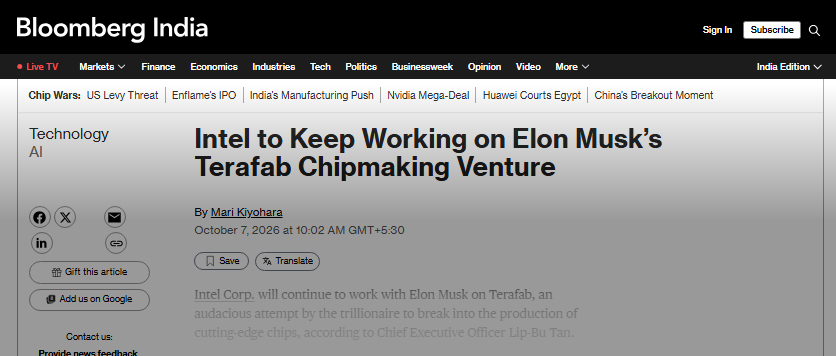
🚨 $INTC Intel to Continue Working on Elon Musk’s Terafab
Intel CEO Lip-Bu Tan said $INTC will continue working with Elon Musk on Terafab, Musk’s ambitious effort to develop advanced chip manufacturing.
Musk is also reportedly in discussions with $TSM on Terafab collaboration, raising questions around Intel’s role after previously signing on as Terafab’s development partner.
Potentially positive for $INTC’s foundry narrative, but uncertainty around TSMC’s involvement could weigh on sentiment.
$INTC $TSM $NVDA #AI #Semiconductors
🚨 $INTC Intel to Continue Working on Elon Musk’s Terafab
Intel CEO Lip-Bu Tan said $INTC will continue working with Elon Musk on Terafab, Musk’s ambitious effort to develop advanced chip manufacturing.
Musk is also reportedly in discussions with $TSM on Terafab collaboration, raising questions around Intel’s role after previously signing on as Terafab’s development partner.
Potentially positive for $INTC’s foundry narrative, but uncertainty around TSMC’s involvement could weigh on sentiment.
$INTC $TSM $NVDA #AI #Semiconductors
$NOK: AI Buildout Faces Supply Limits, Not Demand Limits
Nokia CEO Justin Hotard’s latest comments point to a potentially stronger and longer AI infrastructure cycle than the market may be pricing in.
Customers could build data centers ~2x faster if current memory-chip and power constraints were removed. That suggests the key bottleneck is supply availability—not a lack of AI demand.
More importantly, AI infrastructure growth doesn’t depend solely on continuous new frontier models from 𝗢𝗽𝗲𝗻𝗔𝗜 or 𝗔𝗻𝘁𝗵𝗿𝗼𝗽𝗶𝗰. Even if no major new frontier model were released for the next three years, existing AI technology could still support significant deployment growth.
Why this matters for $NOK:
Nokia provides networking infrastructure that connects AI compute/racks within data centers and data centers across locations. As AI clusters scale, the need for high-performance networking and interconnect infrastructure should scale with them.
CNBC-cited research estimates $10.3T in AI infrastructure investment from 2025–2032.
The AI infrastructure story is increasingly shifting from the next model launch to the multi-year physical buildout of compute, power and networking capacity. If supply constraints gradually ease, the pace of deployment could accelerate—creating a potentially significant long-term runway for infrastructure players such as $NOK
Read and watch this 👇
$NOK : 𝗔𝗜 𝗗𝗮𝘁𝗮 𝗖𝗲𝗻𝘁𝗲𝗿 𝗕𝗼𝗼𝗺 𝗜𝘀 𝗦𝘁𝗶𝗹𝗹 𝗶𝗻 𝗜𝘁𝘀 𝗘𝗮𝗿𝗹𝘆 𝗦𝘁𝗮𝗴𝗲𝘀 — 𝗡𝗲𝘁𝘄𝗼𝗿𝗸𝗶𝗻𝗴 𝗜𝘀 𝗞𝗲𝘆 ⚡💥
Nokia CEO Justin Hotard says AI infrastructure demand is strong enough that customers could build data centers ~2x faster if memory-chip and power constraints were removed.
• 𝗗𝗲𝗺𝗮𝗻𝗱: Current bottlenecks—not weak demand—are limiting construction. Customers would accelerate deployments if supply were available.
• 𝗕𝗲𝘆𝗼𝗻𝗱 𝗳𝗿𝗼𝗻𝘁𝗶𝗲𝗿 𝗺𝗼𝗱𝗲𝗹𝘀: AI infrastructure growth doesn’t depend on constant new releases from 𝗢𝗽𝗲𝗻𝗔𝗜, 𝗔𝗻𝘁𝗵𝗿𝗼𝗽𝗶𝗰 or other frontier labs. Existing models could support years of deployment growth.
• $NOK’s 𝗿𝗼𝗹𝗲: Nokia provides networking technology connecting AI chips within data centers and linking facilities across locations, positioning the company as a key part of the AI infrastructure buildout.
• 𝗖𝗮𝗽𝗶𝘁𝗮𝗹 𝘀𝗰𝗮𝗹𝗲: CNBC-cited research estimates AI-related infrastructure investment could reach $10.3T from 2025–2032.
𝗔𝗜 𝗶𝗻𝗳𝗿𝗮𝘀𝘁𝗿𝘂𝗰𝘁𝘂𝗿𝗲 𝗯𝘂𝗶𝗹𝗱𝗼𝘂𝘁 𝗺𝗮𝘆 𝘀𝘁𝗶𝗹𝗹 𝗯𝗲 𝗶𝗻 𝗶𝘁𝘀 𝗲𝗮𝗿𝗹𝘆 𝗶𝗻𝗻𝗶𝗻𝗴𝘀 — 𝗮𝗻𝗱 𝗻𝗲𝘁𝘄𝗼𝗿𝗸𝗶𝗻𝗴 𝗰𝗼𝘂𝗹𝗱 𝗯𝗲𝗰𝗼𝗺𝗲 𝗶𝗻𝗰𝗿𝗲𝗮𝘀𝗶𝗻𝗴𝗹𝘆 𝗰𝗿𝗶𝘁𝗶𝗰𝗮𝗹 𝗮𝘀 𝘁𝗵𝗲 𝗯𝘂𝗶𝗹𝗱𝗼𝘂𝘁 𝗮𝗰𝗰𝗲𝗹𝗲𝗿𝗮𝘁𝗲𝘀.
🇧🇷 Brazil Election: Stocks to Watch
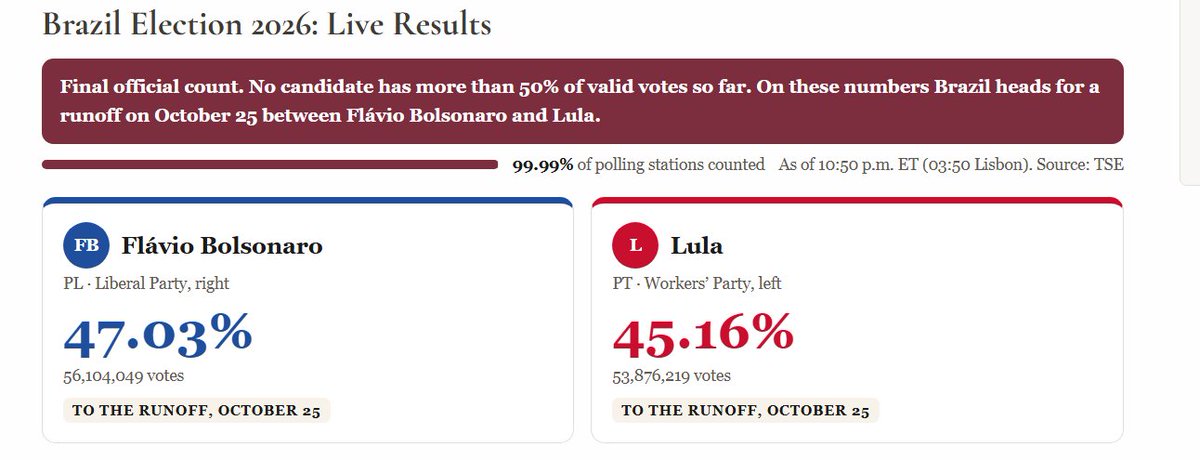
In Brazil’s first-round presidential election, Flávio Bolsonaro finished first with 47.03% of the vote, but since he did not secure more than 50%, he will face Lula in the October 25 runoff.
Lula received 45.16%. More importantly, Bolsonaro performed better than the polls had expected, which is being viewed positively by the market.
The market generally sees Flávio Bolsonaro as a more business-friendly candidate who puts greater emphasis on fiscal discipline. If he wins, expectations for government spending restraint, fiscal consolidation, a lower risk premium and potentially lower interest rates could increase.
That is putting Brazil-exposed names such as $EWZ, $NU, $STNE, $MELI and $DLO on investors’ radar.
• $EWZ — Potential broader rerating in Brazilian equities
• $NU — Could benefit from lower rates and better credit conditions
• $STNE — Could benefit from cheaper business credit
• $MELI — Could benefit from stronger consumer spending and credit growth
• $DLO — Potential benefit from stronger LATAM payment flows
Other Brazilian-listed names such as $XP, $BPAC11, $B3SA3 and $CYRE3 could also benefit from lower rates and stronger domestic activity. For $PBR / $PETR4 and $BBAS3, expectations of reduced political interference could be a positive factor, although oil prices and broader market conditions will also remain important.
Overall, a Bolsonaro victory could be a positive catalyst for Brazilian stocks, particularly if it leads to expectations for greater fiscal discipline, a lower risk premium, lower rates and stronger credit growth. However, Congressional support, the implementation of fiscal reforms and how much optimism is already priced in will be important.
NFA. Do your own DD.
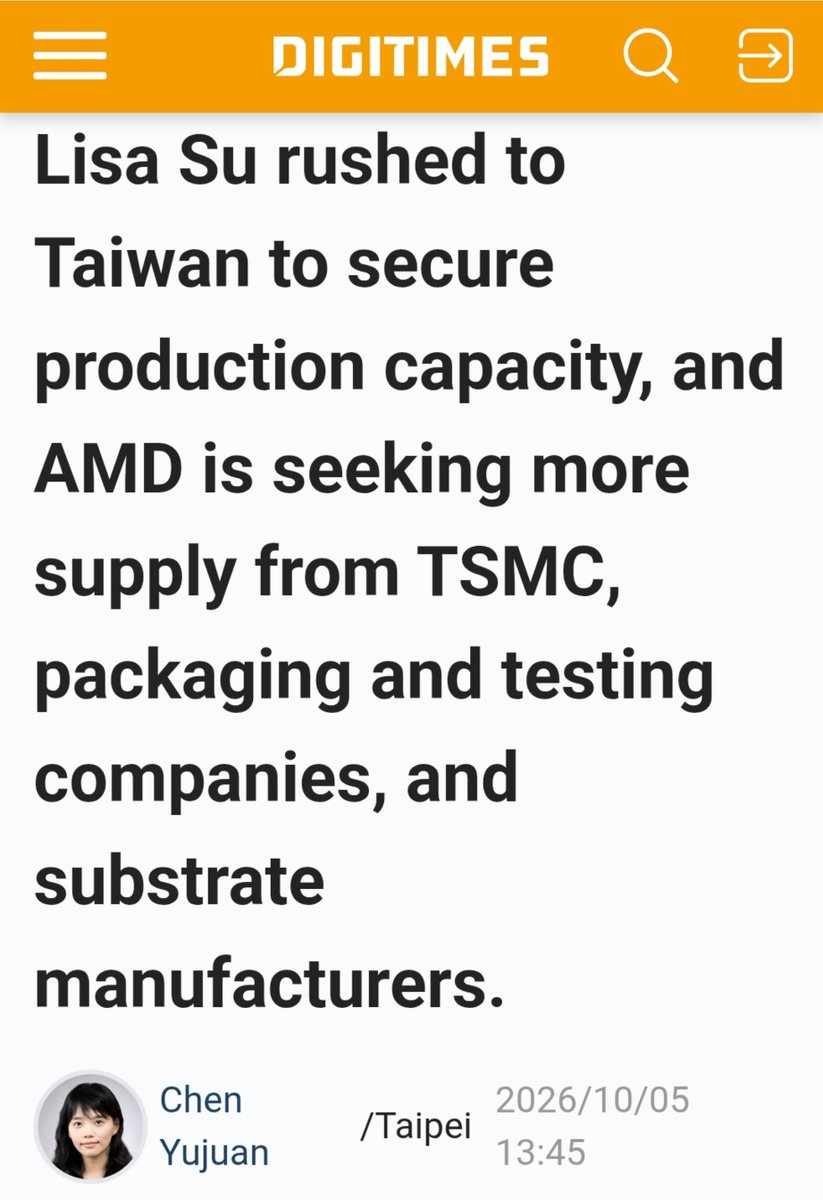
$AMD 𝗔𝗠𝗗: Lisa Su suddenly rushed to Taiwan today to secure more production capacity from $TSM and coordinate with packaging, testing and substrate suppliers. 🇹🇼
Looks like AMD is trying to lock in more supply ahead of strong AI-chip demand, especially with packaging and substrate shortages already pushing prices higher.
📈 Strong AI demand
🏭 More production capacity
📦 More packaging & testing capacity
🔗 Secure substrate supply
🚀 Positive for $AMD
Key suppliers to watch: $TSM $ASX $AMKR $SANM.
$AMD 𝗔𝗠𝗗: Lisa Su suddenly rushed to Taiwan today to secure more production capacity from $TSM and coordinate with packaging, testing and substrate suppliers. 🇹🇼
Looks like AMD is trying to lock in more supply ahead of strong AI-chip demand, especially with packaging and substrate shortages already pushing prices higher.
📈 Strong AI demand
🏭 More production capacity
📦 More packaging & testing capacity
🔗 Secure substrate supply
🚀 Positive for $AMD
Key suppliers to watch: $TSM $ASX $AMKR $SANM.
🇧🇷 Brazil Election: Stocks to Watch
In Brazil’s first-round presidential election, Flávio Bolsonaro finished first with 47.03% of the vote, but since he did not secure more than 50%, he will face Lula in the October 25 runoff.
Lula received 45.16%. More importantly, Bolsonaro performed better than the polls had expected, which is being viewed positively by the market.
The market generally sees Flávio Bolsonaro as a more business-friendly candidate who puts greater emphasis on fiscal discipline. If he wins, expectations for government spending restraint, fiscal consolidation, a lower risk premium and potentially lower interest rates could increase.
That is putting Brazil-exposed names such as $EWZ, $NU, $STNE, $MELI and $DLO on investors’ radar.
• $EWZ — Potential broader rerating in Brazilian equities
• $NU — Could benefit from lower rates and better credit conditions
• $STNE — Could benefit from cheaper business credit
• $MELI — Could benefit from stronger consumer spending and credit growth
• $DLO — Potential benefit from stronger LATAM payment flows
Other Brazilian-listed names such as $XP, $BPAC11, $B3SA3 and $CYRE3 could also benefit from lower rates and stronger domestic activity. For $PBR / $PETR4 and $BBAS3, expectations of reduced political interference could be a positive factor, although oil prices and broader market conditions will also remain important.
Overall, a Bolsonaro victory could be a positive catalyst for Brazilian stocks, particularly if it leads to expectations for greater fiscal discipline, a lower risk premium, lower rates and stronger credit growth. However, Congressional support, the implementation of fiscal reforms and how much optimism is already priced in will be important.
NFA. Do your own DD.
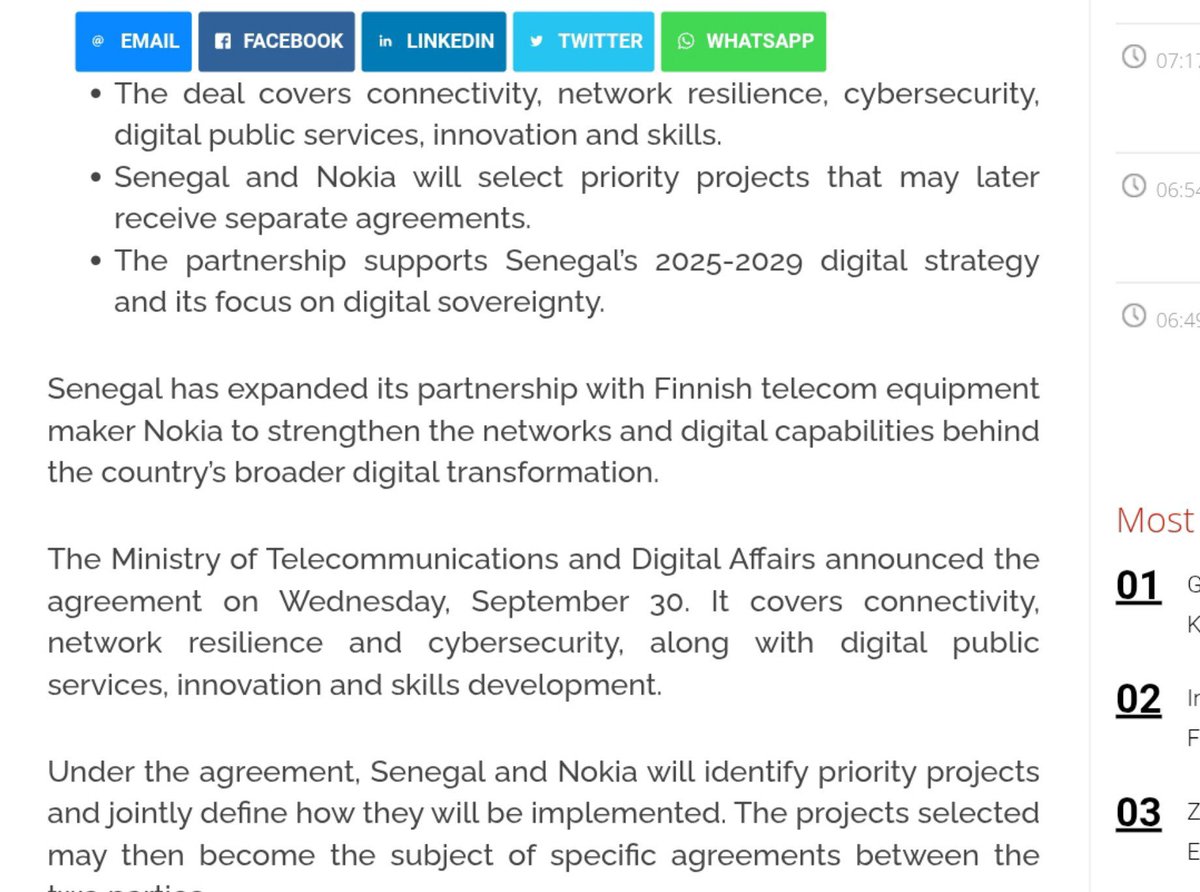
🇸🇳 $NOK — Nokia expands Senegal partnership 💥
Nokia and Senegal’s Ministry of Telecommunications and Digital Affairs have expanded cooperation to strengthen the country’s digital infrastructure and cybersecurity.
The agreement covers connectivity, network resilience, cybersecurity, digital public services, innovation and skills development.
Importantly, Nokia and Senegal will identify priority projects together, with selected initiatives potentially moving into separate agreements.
The partnership also supports Senegal’s 2025–2029 digital strategy and focus on digital sovereignty.
This is more than a general MoU — the key catalyst is that specific priority projects could follow. 👀
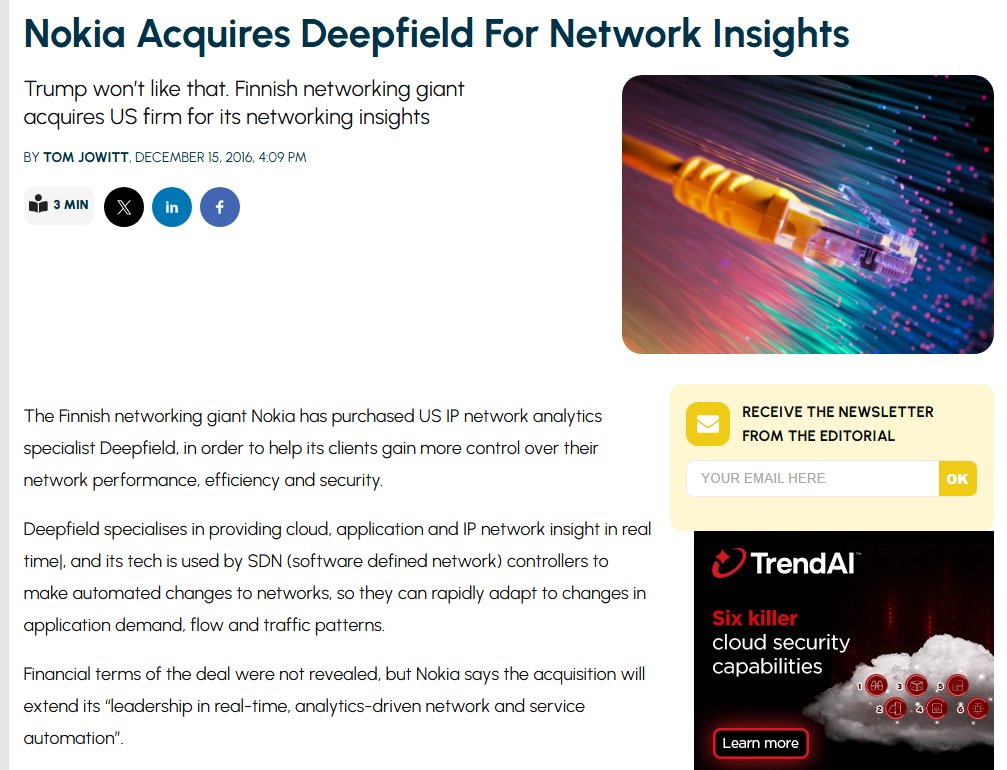
🇺🇸 “Trump might not like that.” 👀
That was the provocative headline surrounding Nokia’s 2016 acquisition of a U.S. networking company.
But Nokia went ahead with the acquisition anyway.
One of Nokia’s most overlooked acquisitions happened in the U.S. in 2016 — and it was far more important than it initially looked.
$NOK — Why did Finland’s networking giant Nokia acquire an American company whose specialty was understanding what was happening inside the network?
That company was Deepfield.
When I started digging into Nokia’s acquisition history, this one caught my attention.
The big story is obviously Alcatel-Lucent.
But when I looked at what Nokia started acquiring after Alcatel-Lucent, a much bigger strategy started becoming visible.
Nokia wasn’t simply trying to sell more telecom hardware.
It was building the intelligence layer around the network.
That’s where Deepfield caught my attention.
At first, Deepfield looks like a relatively small software acquisition.
But the deeper I looked, the more important the strategic logic became.
Nokia announced the acquisition in December 2016 and completed it in January 2017.
So the real question isn’t simply:
“What did $NOK buy?”
The more interesting question is:
“What capability was Nokia missing that Deepfield could provide?”
And that answer reveals another important piece of Nokia’s transformation from a traditional telecom hardware company into a much more software-driven, intelligent and eventually AI-enabled networking company.
So what exactly was Deepfield? 👀
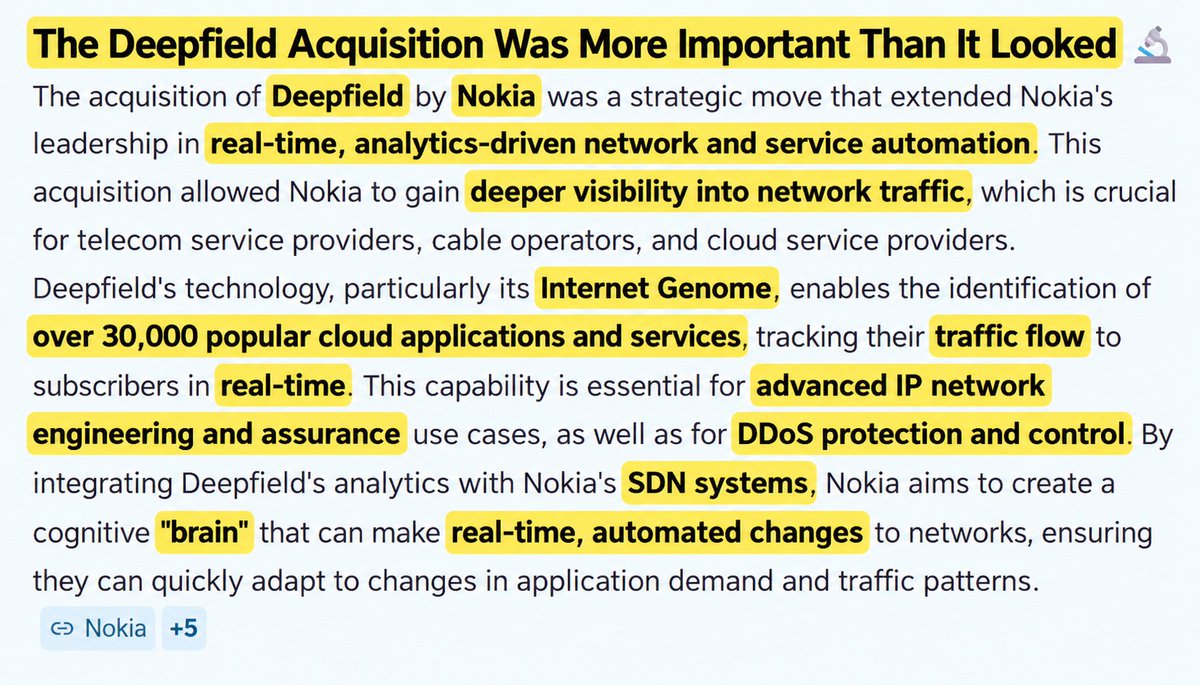
Deepfield specialized in real-time analytics for IP networks, applications, traffic and security.
At the time, networks were becoming dramatically more complex.
Mobile traffic was exploding.
Cloud applications were growing.
Video was consuming massive amounts of bandwidth.
And traffic was increasingly moving across data centers, cloud providers and different parts of the internet infrastructure.
Simply building more network capacity was no longer enough.
Operators needed to understand:
Where is the traffic coming from?
Which applications are consuming the most capacity?
Where are bottlenecks developing?
Is unusual traffic legitimate or malicious?
Which part of the network is affecting customer experience?
And most importantly:
Can the network automatically respond?
That last question is where Deepfield becomes really interesting.
Nokia was moving from Visibility → Intelligence → Automation
Deepfield could process huge amounts of network data in real time and provide context around traffic, applications and network behavior.
But Nokia wasn’t simply buying another analytics dashboard.
The bigger opportunity was to connect that intelligence with network control and automation.
Think about the architecture:
Network Data
⬇️
Real-Time Analytics
⬇️
Network Intelligence
⬇️
Automated Decisions
⬇️
Network Changes
In simple terms:
Sense → Understand → Decide → Act
And when I look at Nokia’s strategy today, this sequence becomes extremely interesting.
Because this is the foundation of a network that can eventually become software-driven, programmable and AI-enabled.
Why did Nokia need this?
Alcatel-Lucent had already given Nokia a much broader infrastructure foundation:
📡 Mobile networks
🌐 IP routing
🔌 Optical networking
🏠 Fixed broadband
🧪 Bell Labs research
💻 Network software
But Nokia also needed something increasingly important:
The ability to understand what was happening across those networks in real time.
Deepfield helped fill that gap.
So I see the acquisition as another step in Nokia’s evolution:
Hardware → Software → Intelligence → Automation
And this is where the bigger story starts to emerge.
Because the network of the future isn’t simply going to carry data.
It needs to understand the data flowing through it.
And eventually:
Use AI to make decisions about how the network should operate.
That is a completely different telecom model.
One important distinction
Deepfield was acquired in 2016, long before today’s AI infrastructure boom.
So I wouldn’t claim Nokia bought Deepfield because it was already planning today’s generative-AI infrastructure strategy.
That would be hindsight bias.
The more accurate way to look at it is:
Nokia was building the software, analytics and automation foundations needed for increasingly complex networks.
As networks later became more cloud-native, programmable and AI-driven, those capabilities became even more valuable.
That’s why this acquisition caught my attention.
It wasn’t necessarily about AI at the time.
It was about building the intelligence layer that could eventually make AI-driven networking possible.
And when I map Nokia’s transformation, the progression becomes much clearer:
📱 Phones
↓
📡 Network Infrastructure
↓
🌐 IP + Optical + Cloud Networks
↓
🧠 Network Intelligence
↓
⚙️ Automation & Programmability
↓
🤖 AI-Native Networks
And Deepfield sits right in the middle of that evolution.
But Nokia didn’t stop there.
It continued acquiring companies that strengthened network software, orchestration, analytics, optical technology and programmability.
And that leads to another acquisition that I think is extremely important.
Next topic: 💻 Comptel — Why did Nokia acquire a company specializing in network software, orchestration and automation?
Because when I connected Deepfield + Comptel + Nokia’s later Network as Code strategy, the bigger picture became much clearer. 👀🔥
🇸🇳 $NOK — Nokia expands Senegal partnership 💥
Nokia and Senegal’s Ministry of Telecommunications and Digital Affairs have expanded cooperation to strengthen the country’s digital infrastructure and cybersecurity.
The agreement covers connectivity, network resilience, cybersecurity, digital public services, innovation and skills development.
Importantly, Nokia and Senegal will identify priority projects together, with selected initiatives potentially moving into separate agreements.
The partnership also supports Senegal’s 2025–2029 digital strategy and focus on digital sovereignty.
This is more than a general MoU — the key catalyst is that specific priority projects could follow. 👀
🇸🇳 $NOK — Nokia expands Senegal partnership 💥
Nokia and Senegal’s Ministry of Telecommunications and Digital Affairs have expanded cooperation to strengthen the country’s digital infrastructure and cybersecurity.
The agreement covers connectivity, network resilience, cybersecurity, digital public services, innovation and skills development.
Importantly, Nokia and Senegal will identify priority projects together, with selected initiatives potentially moving into separate agreements.
The partnership also supports Senegal’s 2025–2029 digital strategy and focus on digital sovereignty.
This is more than a general MoU — the key catalyst is that specific priority projects could follow. 👀
Excellent deep dive. 🔥👏
The Deepfield → Comptel → Network as Code connection really shows how $NOK has been building toward intelligent, programmable and AI-native networks for years.
Great perspective. 👀💥
🇺🇸 “Trump might not like that.” 👀
That was the provocative headline surrounding Nokia’s 2016 acquisition of a U.S. networking company.
But Nokia went ahead with the acquisition anyway.
One of Nokia’s most overlooked acquisitions happened in the U.S. in 2016 — and it was far more important than it initially looked.
$NOK — Why did Finland’s networking giant Nokia acquire an American company whose specialty was understanding what was happening inside the network?
That company was Deepfield.
When I started digging into Nokia’s acquisition history, this one caught my attention.
The big story is obviously Alcatel-Lucent.
But when I looked at what Nokia started acquiring after Alcatel-Lucent, a much bigger strategy started becoming visible.
Nokia wasn’t simply trying to sell more telecom hardware.
It was building the intelligence layer around the network.
That’s where Deepfield caught my attention.
At first, Deepfield looks like a relatively small software acquisition.
But the deeper I looked, the more important the strategic logic became.
Nokia announced the acquisition in December 2016 and completed it in January 2017.
So the real question isn’t simply:
“What did $NOK buy?”
The more interesting question is:
“What capability was Nokia missing that Deepfield could provide?”
And that answer reveals another important piece of Nokia’s transformation from a traditional telecom hardware company into a much more software-driven, intelligent and eventually AI-enabled networking company.
So what exactly was Deepfield? 👀
Deepfield specialized in real-time analytics for IP networks, applications, traffic and security.
At the time, networks were becoming dramatically more complex.
Mobile traffic was exploding.
Cloud applications were growing.
Video was consuming massive amounts of bandwidth.
And traffic was increasingly moving across data centers, cloud providers and different parts of the internet infrastructure.
Simply building more network capacity was no longer enough.
Operators needed to understand:
Where is the traffic coming from?
Which applications are consuming the most capacity?
Where are bottlenecks developing?
Is unusual traffic legitimate or malicious?
Which part of the network is affecting customer experience?
And most importantly:
Can the network automatically respond?
That last question is where Deepfield becomes really interesting.
Nokia was moving from Visibility → Intelligence → Automation
Deepfield could process huge amounts of network data in real time and provide context around traffic, applications and network behavior.
But Nokia wasn’t simply buying another analytics dashboard.
The bigger opportunity was to connect that intelligence with network control and automation.
Think about the architecture:
Network Data
⬇️
Real-Time Analytics
⬇️
Network Intelligence
⬇️
Automated Decisions
⬇️
Network Changes
In simple terms:
Sense → Understand → Decide → Act
And when I look at Nokia’s strategy today, this sequence becomes extremely interesting.
Because this is the foundation of a network that can eventually become software-driven, programmable and AI-enabled.
Why did Nokia need this?
Alcatel-Lucent had already given Nokia a much broader infrastructure foundation:
📡 Mobile networks
🌐 IP routing
🔌 Optical networking
🏠 Fixed broadband
🧪 Bell Labs research
💻 Network software
But Nokia also needed something increasingly important:
The ability to understand what was happening across those networks in real time.
Deepfield helped fill that gap.
So I see the acquisition as another step in Nokia’s evolution:
Hardware → Software → Intelligence → Automation
And this is where the bigger story starts to emerge.
Because the network of the future isn’t simply going to carry data.
It needs to understand the data flowing through it.
And eventually:
Use AI to make decisions about how the network should operate.
That is a completely different telecom model.
One important distinction
Deepfield was acquired in 2016, long before today’s AI infrastructure boom.
So I wouldn’t claim Nokia bought Deepfield because it was already planning today’s generative-AI infrastructure strategy.
That would be hindsight bias.
The more accurate way to look at it is:
Nokia was building the software, analytics and automation foundations needed for increasingly complex networks.
As networks later became more cloud-native, programmable and AI-driven, those capabilities became even more valuable.
That’s why this acquisition caught my attention.
It wasn’t necessarily about AI at the time.
It was about building the intelligence layer that could eventually make AI-driven networking possible.
And when I map Nokia’s transformation, the progression becomes much clearer:
📱 Phones
↓
📡 Network Infrastructure
↓
🌐 IP + Optical + Cloud Networks
↓
🧠 Network Intelligence
↓
⚙️ Automation & Programmability
↓
🤖 AI-Native Networks
And Deepfield sits right in the middle of that evolution.
But Nokia didn’t stop there.
It continued acquiring companies that strengthened network software, orchestration, analytics, optical technology and programmability.
And that leads to another acquisition that I think is extremely important.
Next topic: 💻 Comptel — Why did Nokia acquire a company specializing in network software, orchestration and automation?
Because when I connected Deepfield + Comptel + Nokia’s later Network as Code strategy, the bigger picture became much clearer. 👀🔥