All the indicators you need to start making $1,000 a week trading:
($200 a day)
-VWAP
-9 & 20 EMA
-ORB 30min
⭐️ 3min chart
Only take entries when price is between the 9/20 EMA. Long above VWAP, short below. Take profit on breakouts and place a stop loss.
It’s this simple.
I have good news for the people that enjoy my stream
It'll return to regular schedule starting 2nd of January
Thank you for your attention to this matter
Honestly this cycle has been pretty easy
All you had to do was long memes, then AI, then RWA, then memes again, then utility, then dog coins, then cat coins, then hippo coins, then 2021 L1s, then $ETH betas, then dino coins, then metaverse coins, then farm $HYPE, and hopefully you were awake when $TRUMP launched so you could full port and sell everything the following day while also avoiding $MELANIA $LIBRA and every subsequent celebrity grift, then long $PUMP at the ICO break out and sell the pico top, then rotate into $AVNT + $ASTER to catch the perp dex meta, then buy $XPL and sell everything as soon as the chart starts looking good, then use those profits to get into the $BSC meta that lasted literally 2 days, and also long $BTC but sell at each ATH because price will nuke as soon as it gets a whiff of price discovery, and better not hold anything for longer than 48h because you will roundtrip the farm, and every time the market sneezes your alts will jump off a cliff, and if you mistime any rotations by even a few hours then you will lose all of your money
Pretty easy tbh
There are lots of people who have been in crypto since my time (early 2017) that basically haven’t made any money
You just don’t hear about them because dead bodies don’t talk
You need to assume that you’re an impulsive idiot who will round trip most of your money
So hedge against yourself
Get a job (in crypto or otherwise) and shove it into the S&P 500 as a cushion
It’s not sexy and your ego will take a hit, but it simply works
‘Worst’ case your crypto trading will be lower stress, you’ll make better decisions, and you’ll have more dry powder to execute on a few big trades per quarter or even per year
What you see on your feed isn’t real: it’s massive survivorship bias with varying amounts of LARPing
Zoomer trenches have microwaved normal people into thinking they need to be rotating 10x/day while ‘trading’ 16 hours/day while copy traders farm them, all while underperforming BTC
Most people lose most of their money
Survival is an actual edge in crypto, but you need to stick around long enough to make the most of it - and that means doing ‘boring’ stuff that works
GM
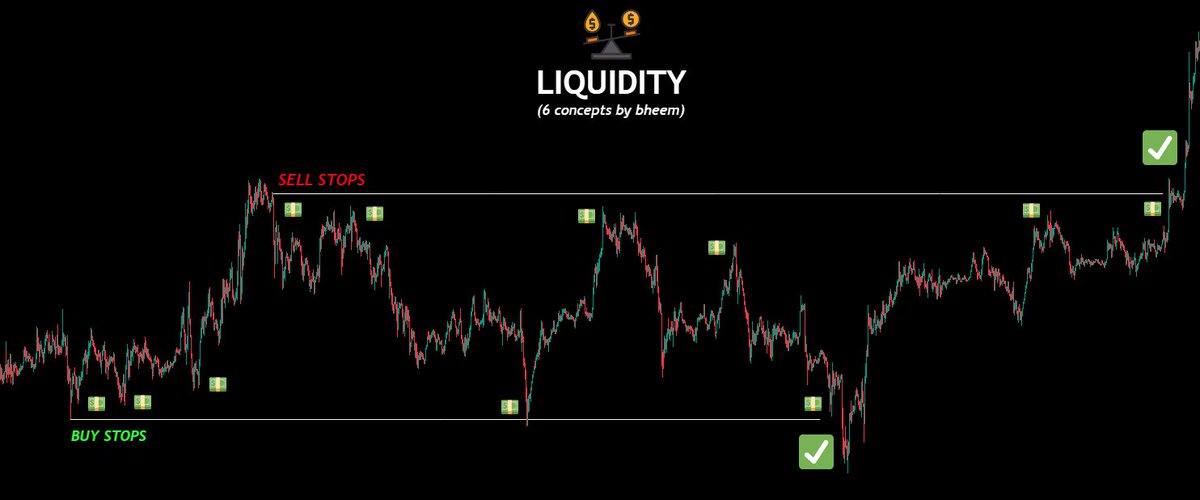
If you can’t identify the Liquidity- You will be the Exit Liquidity🩸
In this thread, you will learn about all 6 forms of liquidity without having to purchase a mentorship course from any influencer ever again🧵
Late longs just got flushed.
If you think the market isn’t designed to shake you out before the real move
It must be your first cycle here.
This game is built on manipulation.
They run stops. They trigger fear. They force impatience.
Do not get shaken out.
@follis_ No, HTF counter trends are more of a gamble. I would wait for HTF trend reversal, if I miss the bottom, be it. (TLDR: Pls don't sell on us sir)
52 Trading Never-Dos: Lessons Every Trader Learns The Hard Way
1) Never oversize. That is when you start becoming irrational. Blowing up while still being right is the fastest way to ruin.
2) Never trade when tired or sleep-deprived. Decision fatigue has ended more traders than liquidation ever could.
3) Never trade without a defined edge. Entering without one is just gambling with extra steps. If you can’t explain your edge in a single sentence, you probably don’t have one.
4) Never enter a position out of boredom. The desire to always be in a trade leads to suboptimal returns. More often than not, doing nothing is the best move.If you find yourself taking trades just to feel busy or because you “haven’t traded in a while,” check yourself. Trading for action leads to sloppy decisions and losses.There’s no prize for the most trades – only for the most profitable trades. Sometimes the best trade is no trade
5) Never trade after a big loss. Tilt sets in, and you try to win it all back in one bad bet. Trying to recover everything at once is a guaranteed way to lose even more.
6) Never enter a position without an exit plan. Whether it’s a time-based stop, price stop, invalidation, or catalyst-driven exit—define it before you enter. Remember, the last moment of objectivity is before you place the trade.Once you’re in, it’s much harder to admit you’re wrong, so decide beforehand when to cut the loss.
7) Never marry your bags. The market doesn’t care about your conviction. Cut or be cut.
8) Never trade your PNL—trade the market. Chasing losses or fixating on past wins clouds judgment and distorts execution.
9) Not all views are meant to be traded. The best trade is often no trade. Preserving capital and mental bandwidth for when odds favor you is more important than forcing activity.
10) Never fight the trend. The wave is stronger than you. Adapt or get wiped out.
11) Never try to knife catch without reason. "Cheap" can always get cheaper.
12) Never break your trading rules or deviate from your plan in the heat of the moment. Your rules exist for a reason – usually learned from painful experience. The moment you convince yourself “just this once” to ignore a rule (like moving a stop, or doubling down, or trading too big), you open the door to chaos. Discipline is doing the right thing even when it’s hard. As one trading maxim goes, plan the trade and trade the plan.
13) Never fire all your bullets at once.
14) Never trade outside your comfort zone. If a position is too big, you’ll start making fear-based decisions, thinking that market or someone is trying to liquidate you seeing ghosts where none exists. Size your trades proportional to the quality of your sleep at night.
15) Never let ego keep you in a bad trade. Admit when you're wrong—cut, reset, move on.
16) Never underestimate market reflexivity. Strength can always go higher, weakness can always go lower.
17) Never assume liquidity will be there when you need it. The exit door is always smaller than you imagine—liquidity isn’t something you decide, the market does.
18) Never mistake randomness for strategy. Buying because price is going up or shorting because it “feels high” isn’t trading—it’s blind betting. Even with good risk management, you’ll bleed out over time if your entries are based on nothing.
19) Never make the same mistake twice. Trading mistakes are inevitable, repeating them is unacceptable. Never lose the same way twice
20) Never forget to play defense. Being wrong is acceptable, staying wrong is not. Protecting capital always comes first. "Don’t focus on making money; focus on protecting what you have.”
21) Never just focus on offense. Survival > everything. If you don’t bet, you can’t win. If you lose all your chips, you can’t bet.
22) Never fall into lifestyle creep after one big win. The problem starts when you begin forecasting annual income based on a single lucky trade.
23) Never forget to turn defensive after a hot streak. Big losses come after a series of wins when overconfidence sets in. Check your ego—your last big trade means nothing to the market.
24) Never let pride, ego, or overconfidence take over. Always stay humble.|
25) Never trade in situations where you don’t have control. for eg. FOMC events
26) Never get complacent. A strategy that worked in one regime may stop working in another. Trading is a craft that requires continuous self-improvement. Comfort Is Often the Enemy of your PNL. Never assume you know for sure what the market will do. “We have two classes of forecasters: those who don’t know — and those who don’t know that they don’t know.” Never assume your edge is permanent. Markets evolve, edges fade, and what worked last cycle may be useless in the next. Keep refining, keep testing—stagnation is death.
27) Never ever average losers after your reasoning has been invalidated
28) Never trade with certainty, trade with conviction.
29) Never assume the market “must” do something, especially based on recent patterns.The market doesn’t owe you continuity or logic. Just because a market has been rising (or falling) steadily doesn’t mean it can’t abruptly reverse. Avoid words like “surely” or “can’t possibly” in trading. Stay flexible – anything can happen. As a reminder: never say never about market behavior.
30) Never mistake win rate for everything. Maximizing winning trades for the sake of feeling good is a trap. Taking profits too early or avoiding necessary small losses ultimately hurts profitability.
31) Never underestimate discipline, patience, risk control, and execution over alpha generation. Plenty of traders have great alpha flow but don’t know how to use it.Good execution involves choosing not just what and how to trade, but when not to trade. Sometimes the best execution decision is no trade at all if conditions aren’t suitable. Always ask: “Do I have an edge here, or am I flipping coins?” If it’s the latter, save your capital for a better spot.
32) Never fall apart after a big loss or get euphoric after a big win. Emotional resilience is a trader’s strongest asset.
33)Never ignore price action after news. If the market reacts opposite to what you expected, get out. The market is telling you something you don’t see.
34) Never trade on borrowed conviction. If you buy on someone else’s tip, you’ll need them to call your exit too—and when they go silent, you’re stuck. As Livermore said: “Nobody makes big money on what someone else tells him to do.” Hone your own craft, build your own system. If you can’t trust your own decisions, you’re just a pawn in someone else’s trade.
35) Never go against your intuition. If something feels off, it usually is.
36) Never try to Catch Every Move It’s tempting to try to grab every up and down in the market, but that’s a fool’s errand. Always come from the mindset of abundance and not scarcity, markets will still be there and there are ample opportunities in the market to make you whole,
you don’t need to swing at every pitch.
37) Never underestimate the power of failure. Failing early and failing often—while staying in the game—is how you get better.
38) Never hold onto losers when your thesis is invalidated, especially after a massive drop. "I’ve lost too much to sell now" is how you go to zero.
39) Never let "getting back to break even" dictate your decisions. That mindset leads to overtrading and eventually, full liquidation.
40) Never focus only on entries. A trade isn’t over until you’ve exited. Knowing when to cash out is just as important as knowing when to enter.
41) Never ignore the “boring” part (position sizing, stops, risk/reward) – it’s what keeps you in business.Don’t wait for a catastrophic loss to teach you this lesson.
42) Never trade for the adrenaline rush, Trade for the win
43) Never fall into the illusion of strength—it’s often just lagging behind reality.
44) Never stay/enter in a position out of 'HOPE' and wishful thinking
45) Never underestimate risk management. Prioritize protecting capital over chasing profits. "Take care of your losses, and the profits will take care of themselves."
46) Never exit/enter a position recklessly. The same way you scale in, you should scale out—"all in, all out" is a recipe for disaster.
47) Never make a bet you can’t afford to lose. No single trade should ever be big enough to take you out of the game.“The most important advice is to never let a loser get out of hand.” You should be able to be wrong 20 or 30 times in a row and still have capital left. Never allow a single position to jeopardize your trading career
48) Never trade outside your edge. If it’s not there, sit out. Forcing trades outside your framework is how accounts erode.
49) Never assume your edge is permanent. Markets evolve, edges fade, and what worked last cycle may be useless in the next. Keep refining, keep testing—stagnation is death.
50) Never judge a trade solely by its outcome. Good trades lose money sometimes, and bad trades can get lucky. Focus on execution over results.
51) Never worry about looking stupid or staying in a position because of your public opinion. I have seen many a men die before their time because they were worried about getting publicly ashamed. Cut your losses without hesitation. The market doesn’t care about your pride—neither should you.
52) Never underestimate the power of stepping away. If you’re in a losing streak, liquidate everything and take a break. Mental capital is just as important as financial capital. The key is to break the negative emotional spiral
Once you come back keep your size small and increase exposure only when you gain back your confidence.
These lessons were learned thanks to the books I’ve read, the smart traders I’ve learned from, and the endless mistakes I’ve made along the way.
Trading is lonely. It hurts. It makes you question everything. But if I had to choose again? I’d still take this over everything.
14/➮ If you can't decide whether to do a rebalance or not, consider the following:
✧ Imagine you bought $SOL at $10, and now it's $200
✧ If you decide to leave everything as it is, it's the same as if you're buying at $200
✧ Ask yourself if you would do that
@astronomer_zero Hey @astronomer_zero , long time follower here. Was wondering if there's any specific altcoin you would long for better R/R if market gives sweep of weekend low ~110k or pushes through 120k plus. I'm looking at XRP or ETH. Since they've been performing decently as of late. Thanks
Hey @grok who was the most famous person to visit my profile in the last 3 years? It doesnt need to be a mutual, don’t tag them, just say who it was using handle without the @ sign.