Would you bet that an agent could write an inference engine from scratch in 12 hrs and beat vLLM? We find that it can 😎
Introducing Humanity Last System, a benchmark that tests how well agents can build hyperspecialized serving engines for text, agentic, and multimodal workloads
Would you bet that an agent could write an inference engine from scratch in 12 hrs and beat vLLM? We find that it can 😎
Introducing Humanity Last System, a benchmark that tests how well agents can build hyperspecialized serving engines for text, agentic, and multimodal workloads
🎯 Much of today's analysis of LLM inference still rests on GQA models. Today's open models, however, have moved beyond GQA. They combine latent caches, sliding windows, sparse attention, compressed caches and linear attention. These designs differ drastically in memory usage and computational efficiency.
📊 With ServingStudio, we compared eleven recent open models with Qwen3-Coder-480B-A35B, a GQA model of similar size. At a 128K-token context, the new designs bring:
- Memory: up to 139× less per request.
- Decode: up to 250× fewer bytes read and 44× faster attention.
- Prefill: up to 183× fewer attention FLOPs and 46× faster attention.
🧵 More in the thread below (1/9)
Ruby Lee (@rubywtlee) is a fantastic researcher. As an undergrad researcher in @UWSyFi, she led Murmur and other ML systems projects.
Murmur transcribes long audio 2.5× faster than single-pass decoding and beats WhisperX on accuracy. Ruby is applying to PhD programs this cycle. If you’re recruiting, talk to her!
Pipeline parallelism, custom prefix caches, and thoughtful schedulers really do boost peformance of LLM serving for coding agents! With ServingStudio to predict how a design performs, we were able to build a bespoke prefill engine for GLM 5.3-Flash that kills the competition!
Work led by our own @KanZhu854772!
🔥 Serving coding agents well needs a high-performance prefill engine, but existing systems fall short.
🚀 Introducing SSEngine-GLM5.3-Flash: an open-source prefill engine for GLM-5.3-Flash on four B200 GPUs. It combines pipeline parallelism, a tiered prefix cache across GPU memory, DRAM and SSD, and a shortest-remaining-prefill-first scheduler.
📈 On real hardware, it sustains 3.1× (AgentX) and 3.2× (TraceLab) the request rate of any vLLM or SGLang setup we tested.
🧵 More in the thread below (1/8)
Check out more:
💻 Blog post: https://t.co/VyJ9l0acMe
🤖 Code: https://t.co/2V4MOjMzNZ
📝 Paper: https://t.co/7B1VBwYsUI
Work done by @rubywtlee@KeisukeKamahori and @bariskasikci
Long-context ASR has a trade-off: single-pass is accurate but slow, while chunking is fast but loses track of speakers and timestamps.
Introducing Murmur🗣️: 2.5x faster than single-pass, and more accurate than WhisperX on every benchmark we tested.
Murmur is compatible with vLLM. Results on an H100, end to end with diarization (2 models x 4 meeting datasets):
- 2.5x faster than single pass on average (2.0-2.9x)
- tcpWER 2.0 pts lower than single pass on average
- Lower tcpWER than WhisperX in all 8 settings (7-17 pts English, 10-51 pts Mandarin)
SyFI is hiring a postdoc or research engineer (~$100K/year) to lead our work on the NSF AI Efficiency Challenge. Build AI infrastructure with us!
Reach out to me or @thepadawang. Please repost or tag a colleague!
🚀 Qwen, Kimi, GLM are all betting on linear attention. But it's still slow: the recurrent state is read & rewritten every token.
Meet LeapQuant: the first training-free method to make 8-bit or 4-bit recurrent states work.
📈 Across Qwen, Kimi, and GLM models:
• Matches FP32 accuracy
• 4.25× faster linear attention kernels
• Up to 2× higher inference throughput
• Cuts memory by up to 56%
Agents are pushing the frontier of model serving. New model, new hardware, no engine? Let agents build it.
By @KeisukeKamahori, @sudopowr, Simon Peter, and @bariskasikci. Thanks to AWS for the compute credits.
Blog: https://t.co/f8Gyl65Qtb
Code: https://t.co/mGlURZrTW4
Heterogeneous hardware is hard. When a new model meets a new accelerator, often no serving engine supports it.
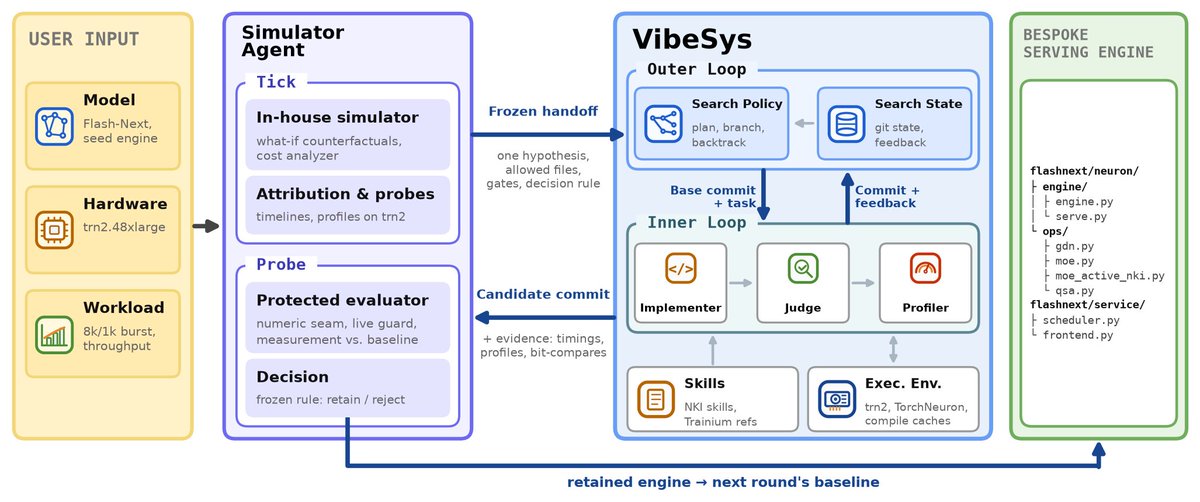
So we had agents build one: VibeSys generated serving engines for new Qwen3.8 models on @awscloud Trainium2. 🧵
The trick is our in-house serving simulator. Experiments on 16 chips are slow, so each round an agent uses the simulator to find one bottleneck. VibeSys fixes it, and a protected evaluator keeps the change only if it is measurably faster.