FRONTIER FILES EXPLAINER | KAAD
Karima Armed Assault Division: What BLF’s new female formation actually tells us
The Balochistan Liberation Front (BLF) has formally unveiled the "Karima Armed Assault Division" (KAAD), a newly established female formation named after prominent Baloch activist "Karima Baloch.
But reducing KAAD merely to another “female militant wing” or treating it simply as an imitation of developments within other Baloch armed groups misses the larger transformation taking place inside BLF.
1. What is KAAD?
KAAD is presented by BLF as an organized female formation combining armed, political, ideological and organizational roles.
Its public rollout included a dedicated insignia, ideological statement, training footage and a claimed debut operation near Jusak, Turbat, on 22 September 2026.
The available material shows women receiving training in firearms, mobility and other combat-related skills.
However, its actual strength, command structure and operational depth remain unknown.
2. “Division” should not be taken literally.
There is currently no evidence that KAAD possesses anything resembling a conventional military division-sized force.
The designation is better understood as an "organizational and symbolic title".
Its importance lies not in numbers presently visible, but in BLF formally creating a separate institutional identity for female participation.
3. Why Karima Baloch?
The choice of name is central to KAAD’s messaging.
Karima Baloch was associated primarily with "political mobilization and Baloch nationalist activism", not with an established BLF combat command.
By naming an armed formation after her, BLF is attempting to connect:
▫️ political mobilization → female participation → armed struggle.
This allows the organization to place military activity inside a wider narrative of political and social resistance.
4. KAAD’s most important feature is its “dual-front” doctrine.
BLF’s own ideological material portrays KAAD as fighting on two fronts:
▪️ against the Pakistani state and security apparatus;
▪️ against what it describes as patriarchy, social inequality and restrictive structures within Baloch society.
KAAD is therefore being constructed not only as a battlefield formation, but also as an ideological project aimed at reshaping gender participation within the insurgency itself.
5. Is KAAD simply organizational competition?
Competition among Baloch armed organizations cannot be ignored.
Groups observe one another, borrow tactics, compete for recruits, visibility and symbolic capital, even fight for resources and also respond to successful innovations elsewhere.
But explaining KAAD solely through that lens is analytically insufficient.
BLF’s trajectory toward female armed participation "predates KAAD itself".
The emergence of specialized formations, female involvement in earlier high-profile operations, and the creation of the "Saddo Operational Battalion (SOB)" all indicate that KAAD belongs to a longer process of internal organizational evolution.
So it could more aptly be put as -
▫️ competition may accelerate innovation but it does not by itself explain the institutional trajectory behind KAAD.
6. KAAD and SOB are not the same.
The "Saddo Operational Battalion" is associated with specialized, high-intensity operations and BLF’s developing assault capabilities.
KAAD, by contrast, is explicitly framed around "female participation across combat, political, ideological and support functions".
There is currently no public evidence establishing that KAAD is subordinate to SOB or that it is exclusively a tactical or fidayeen or fidayeen with small arms- formation.
7. Its first claimed operation remains only partly verified
BLF says KAAD participated in an attack near "Jusak, Turbat", on 22 September.
1/2
An incident in the area is reported, but open-source accounts differ over the exact method, casualties and sequence of events.
Most importantly, the precise scale of KAAD’s physical participation has not yet been independently established.
This distinction is essential:
▫️ the incident appears real; the complete organizational narrative surrounding it remains a BLF claim.
8. The media launch itself is part of the story.
KAAD was not introduced through a single communiqué.
BLF accompanied its unveiling with:
▪️ a dedicated name and emblem
▪️ training footage
▪️ ideological literature
▪️ operation-related material
▪️ multilingual dissemination
▪️ coordinated distribution across its media ecosystem
This suggests KAAD serves both an "operational and strategic-communications function".
For an insurgent group, visibility can generate recruitment, legitimacy among sympathizers, internal prestige and organizational momentum even before battlefield effectiveness is fully demonstrated.
9. The larger significance.
KAAD points toward a broader transformation inside BLF:
from dispersed guerrilla activity toward "greater specialization, branding, ideological institutionalization and differentiated operational formations".
Female participation is increasingly being moved from an exceptional or individual phenomenon toward a deliberately organized structure.
That is the real development worth watching.
10. What should be watched next?
KAAD’s true importance will become clearer through future evidence:
=> Does BLF repeatedly attribute operations to KAAD?
=> Does a commander or leadership hierarchy emerge?
=> Do identifiable regional cells appear?
=> Are women integrated with ordinary BLF units or compartmentalized?
=> Does KAAD develop a distinct operational doctrine?
=> And does its role remain primarily symbolic, or become operationally sustained?
For now, KAAD should be understood neither as mere propaganda nor automatically as a mature combat formation.
It is better viewed as an *"emerging institutional experiment within BLF combining gender, militancy, ideological mobilization and organizational modernization".
2/2
Militant publications should be read not only for what they say, but for why they choose to say it now.
Frontier Files explainer dissects the document beyond the propaganda.
#TTP#FrontierFiles
FRONTIER FILES | DOCUMENT EXPLAINER
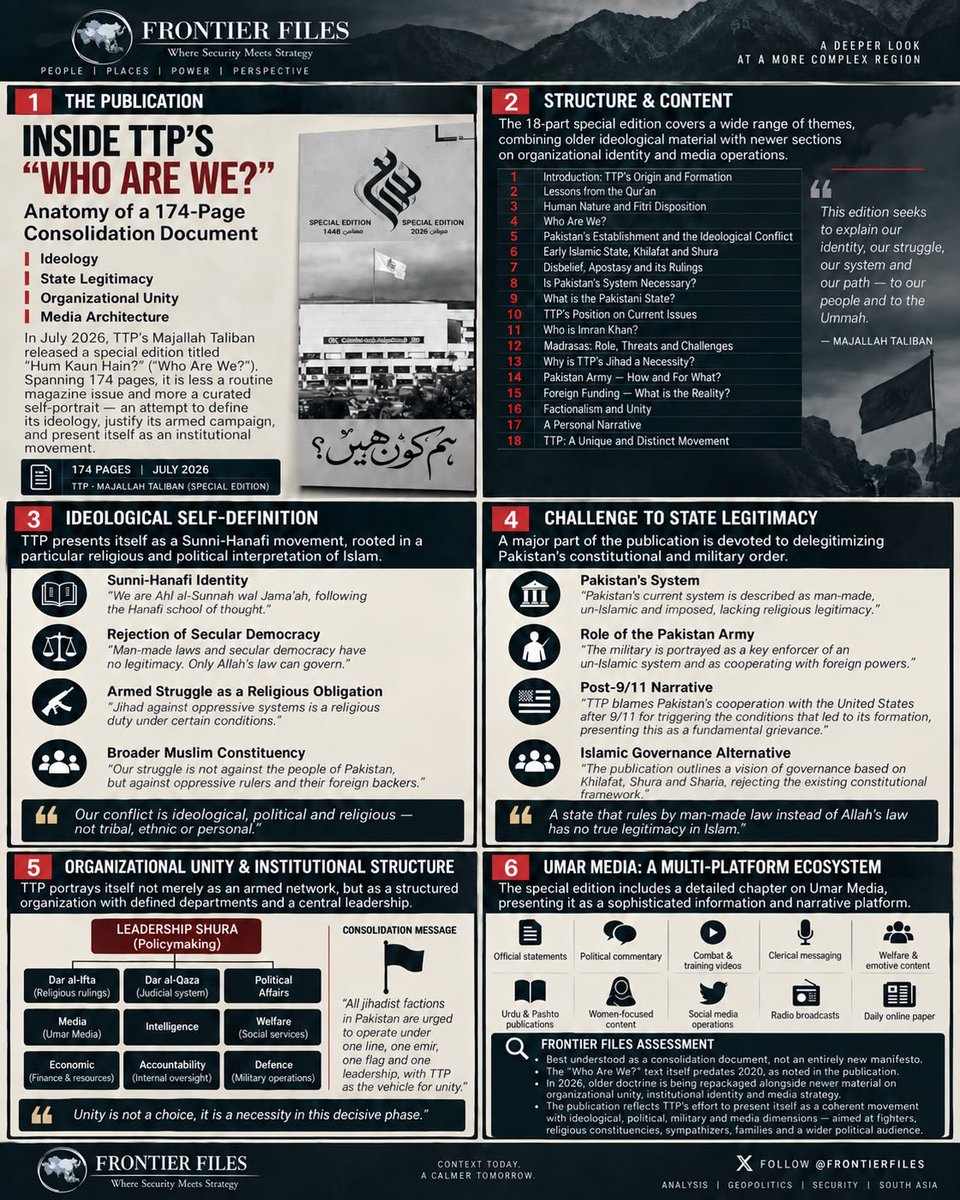
TTP’s July 2026 Majallah Taliban special edition, “Hum Kaun Hain?” (“Who Are We?”), runs 174 pages. It reads less like a routine issue and more like a curated self-portrait: creed, political project, organization and media strategy.
The 18-part issue moves from TTP’s origin narrative and doctrine to “Who Are We?”, Pakistan’s constitutional order, madrasas, unity under TTP, the Pakistan Army’s history and, near the end, a detailed account of Umar Media.
Its ideological core is explicit: TTP presents itself as Sunni-Hanafi, rejects secular democracy and man-made law as alternatives to its reading of Sharia, and frames armed struggle as a religious obligation. These are the publication’s claims.
A central theme is legitimacy. The issue tries to delegitimize Pakistan’s constitutional and military order in religious terms, while folding post-9/11 counterterrorism and earlier historical episodes into a single grievance narrative.
There is also a clear effort at institutionalization. TTP portrays itself not merely as an armed network, but as an organization with religious, judicial, political, media, welfare, economic and other administrative structures.
The clearest organizational signal comes near the end: armed factions in Pakistan are urged to operate under “one line, one emir, one flag and one leadership,” with TTP presented as the vehicle for consolidation. This is more than theological messaging.
Madrasas are treated as part of an ideological ecosystem: institutions that preserve doctrine, produce religious cadres and resist rival interpretations of political Islam. The magazine therefore links armed activity to a wider contest over authority and social influence.
The Umar Media chapter is revealing. TTP describes a multi-format ecosystem: statements, political commentary, combat/training video, clerical messaging, welfare/emotive material, Urdu/Pashto publications, women-focused content, social media, radio and a daily online paper.
FRONTIER FILES ASSESSMENT: Treat this as a consolidation document, not an entirely new manifesto. The “Who Are We?” section itself says its text predates 2020. In 2026, older doctrine is being repackaged alongside newer institutional and media narratives
I request @PMDC to reconsider its decision on Afghan students in medical colleges and universities on humanitarian grounds and civilizational relations between the peoples of the two countries. A more humane and practical approach can be to allow the students to complete their respective degrees and arrange their return to Afghanistan as soon as they complete their education @AmbassadorSadiq@ForeignOfficePk
#Balochistan is no longer just a peripheral security challenge; it is becoming a central test case for Pakistan’s geo-economic ambitions. #CPEC 2.0, regional connectivity, and #trade corridors cannot be protected through reactive security alone.
The BLA’s devastating attack at the Quetta–Chaman rail link isn't just a localized security failure; it's a direct assault on Pakistan's economic future.
With the state actively pushing for CPEC 2.0, the deteriorating security situation in Balochistan poses a critical threat to multi-billion-dollar infrastructure and regional connectivity. True economic integration cannot happen without a total overhauling of the provincial security framework.
#CPEC #Balochistan #QuettaBlast #SecurityCrisis #EconomicStability
.. is no longer confined to traditional militant spaces. It is now penetrating campuses, digital ecosystems, identity politics, and grievance-based mobilisation. This demands serious #academic , policy, and #security attention before it evolves into a wider recruitment pattern.
This signals an emerging and deeply concerning trend: the growing visibility of #women in militant propaganda and radicalisation networks in #Pakistan . More alarming is that many such cases involve educated, urban, and university-linked profiles, showing that radicalisation …
First-Ever Baloch Female Commander Issues Media Message
Balochistan | May 23, 2026
The Baloch Liberation Army's (BLA) media wing, Hakkal, has published a video message featuring female commander Shaynaz Baloch, who addressed the Baloch nation and the international community.
#Balochistan #BLA #ShaynazBaloch #Hakkal #BreakingNews
@khorasandiary@ZarrarKhuhro SCO’s Regional Anti-Terrorist Structure warning isn’t routine; it signals a shifting Eurasian security calculus. Afghanistan is re-emerging as a hub for transnational militancy (TTP, ISKP, TIP etc), while China & Russia leverage this to expand regional CT influence.
A cautious but important opening. Urumqi reflects a mutual recognition that perpetual escalation is unsustainable. If backed by verifiable commitments, this could evolve into a calibrated framework for managing cross-border militancy
Urumqi meeting https://t.co/c7HWsiqZPw Great news that China has successfully brokered peace talks between Pakistan & Afghanistan with Kabul apparently ready & willing to address Pakistan’s genuine concerns on terrorism emanating from Afghanistan via ‘verifiable mechanism’! Pakistan-Afghanistan Border should be a border of Peace & Security, promoting prosperity for both peoples!
The emergence of footage showing the TTP conducting military-style training for minors in Shangla is a chilling escalation in the group's efforts to institutionalize extremism in KP.
This isn't just about tactical training; it’s a systematic attempt to build a generational pipeline of militants through ideological indoctrination and physical coercion. For analysts, this signals a long-term strategy by the TTP to solidify their footprint in areas like Shangla, exploiting the vulnerability of the youth to ensure organizational continuity.
#PakistanSecurity #KP #TTP #Shangla #HumanRights #SecurityAnalysis
A first-hand account by @MahrangBaloch_ from detention highlights claims of prolonged solitary confinement, restrictions on legal access, & alleged pressure on family members. It underscores broader tensions in #Balochistan & the contested space b/w peaceful activism & militancy
My year in solitary confinement has not broken me. My peaceful fight for Baloch rights in Pakistan goes on
I’ve reflected on why our peaceful protests are treated as a threat, when nonviolent political engagement is the very foundation of a democratic society. Resistance is often the path to justice, and such movements should not be suppressed. When a state turns its power against human rights groups and peaceful political actors, it reveals not strength, but weakness.
Our peaceful resistance has allowed the message to reach far and wide. People of conscience are aware of atrocities in Balochistan, yet greater global attention is needed to end the genocide.
https://t.co/EanTNgud2G
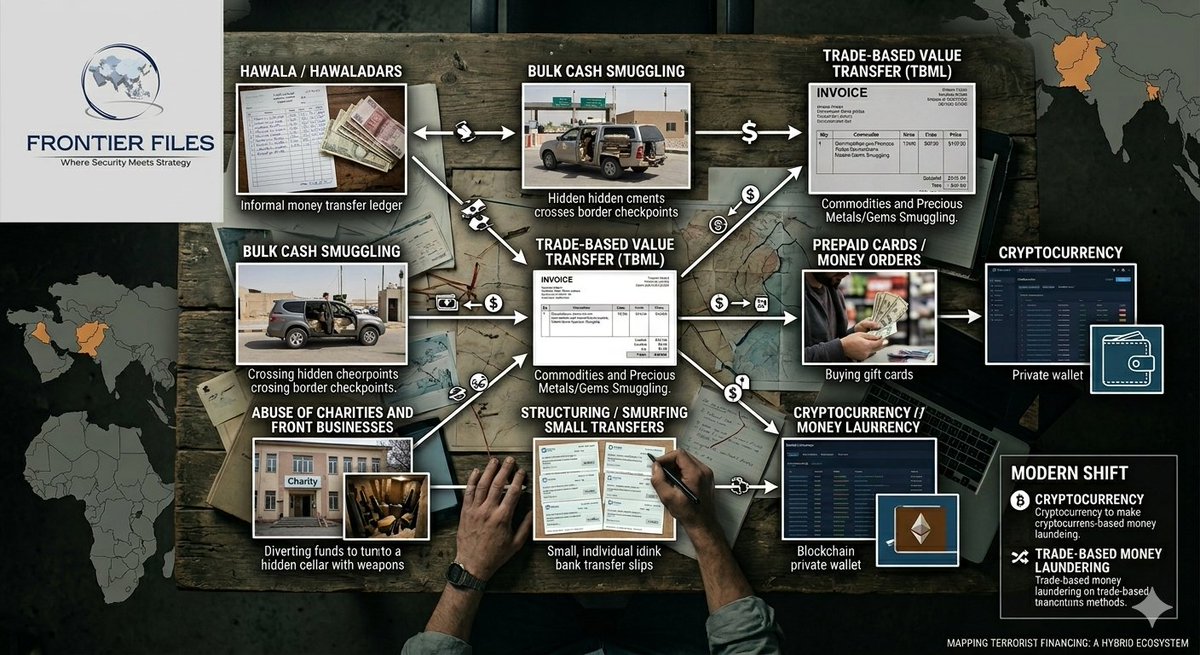
How different methods connect to create a "shadow economy."
Terrorist financing in South Asia is no longer just about #Hawala and "suitcases of cash." It’s a hybrid ecosystem where #TradeBasedMoneyLaundering (barter and over-invoicing) masks the movement of millions. From the abuse of local charities to Smurfing, breaking large sums into tiny, "normal-looking" transfers, these groups are masters of financial camouflage.
As crypto (specifically $USDT on Tron) and prepaid cards gain traction, the "digital-informal" blend makes tracking near-impossible. This isn't just crime; it’s a strategic effort to bypass the FATF-regulated banking system.
Frontier Files has prepared an exhaustive Deep Dive into this evolving shadow economy.
#FrontierFiles #CTF #Geopolitics #SouthAsiaSecurity #FollowTheMoney
@IftikharFirdous Aptly put. It’s a strategic intermission more. Temporary de escalation often serves dual utility. Probably a renewed calibrated coercion.
Crassus at Carrhae is a timeless lesson: flawed intelligence, hubris, and underestimating adaptive adversaries can destroy even the most powerful forces. Logistics beat arrogance. Parthia didn’t run out of arrows; Rome ran out of strategy.
Assassinations of Ali Larijani & Ghulam Reza Soleimani underscore a severe breach within #Iran’s security ecosystem. The penetration of #IRGC and #Basij structures points to deep rooted vulnerabilities; repeated lapses in CI reflect a systemic failure & an entrenched compromise.
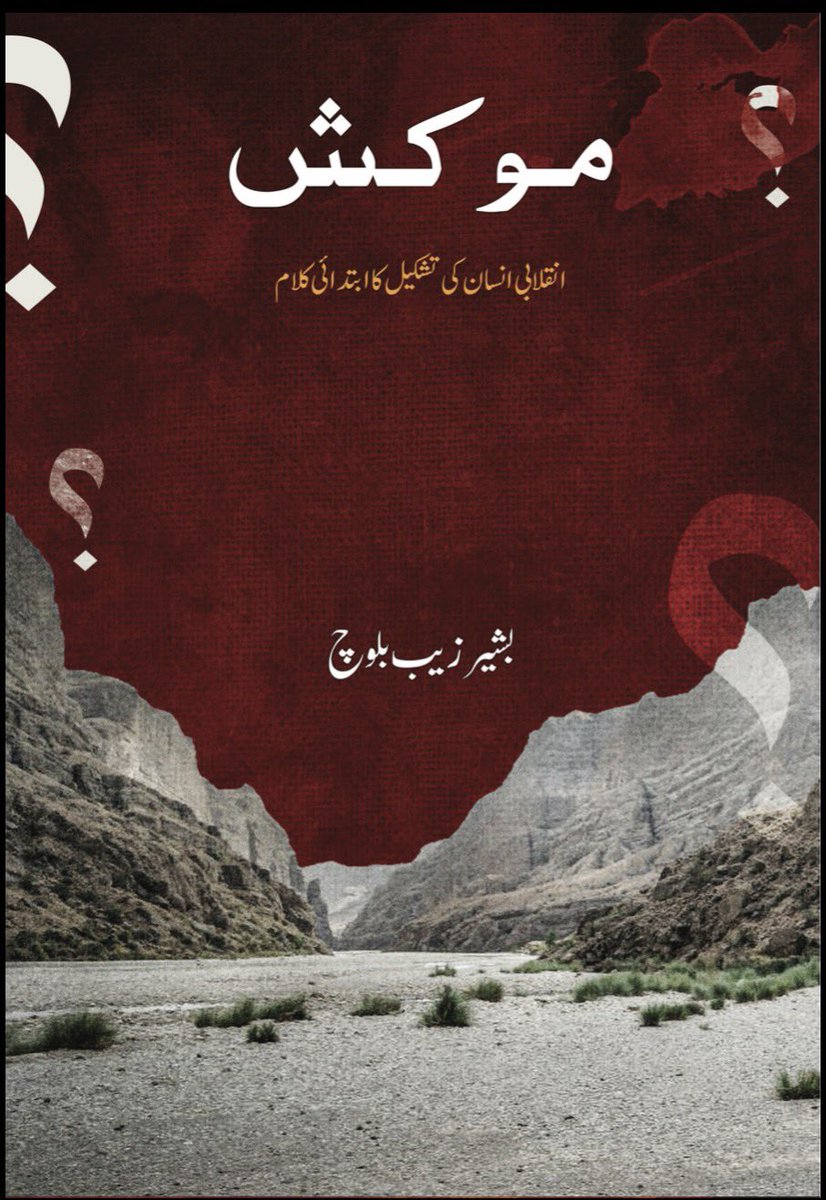
If internalized by cadres, the book could signal a shift toward a more organized, psychologically resilient, and strategically patient insurgent posture in #Balochistan in the coming years
#Geopolitics#FrontierFiles#CPEC#Security
#BLA chief Dr. Bashir Zeb Baloch’s recent book #Mokash is not a traditional insurgent manifesto. It reads more like a psychological cadre manual aimed at shaping the mindset of militants.
Taken together, Mokash appears to be an attempt by #BLA leadership to move the insurgency from emotional resistance to ideologically disciplined #militancy.