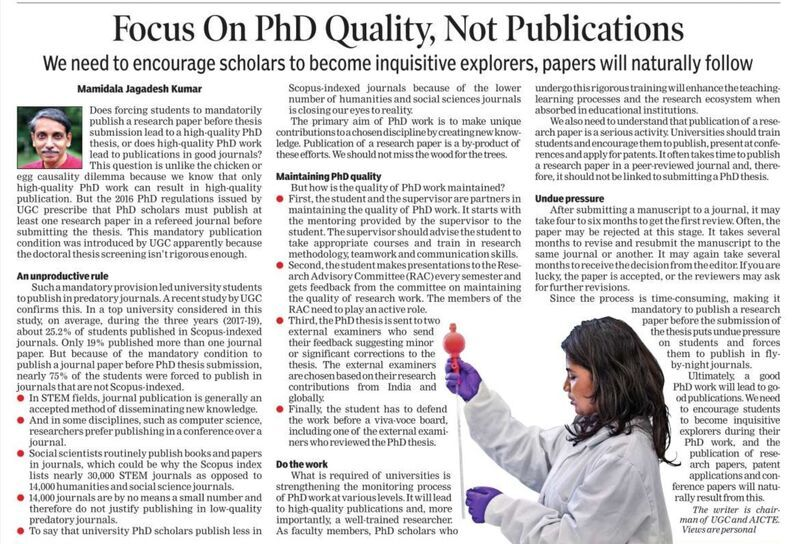
"I watched my advisor publish 21 papers in 1 year. Meanwhile, I spent 8 months on a single study that might never see daylight. I felt like I was failing at academia."
A PhD friend told me yesterday ⤴️
Then she shared what changed her perspective completely.
Those 21 papers were strategic collaborations solving critical problems across multiple fields.
Her single study? That was preventing outbreaks in rural communities!
She realized she was comparing apples to oranges.
This and other conversations with my PhD friends taught me something important about research careers:
𝗧𝗵𝗲𝗿𝗲 𝗮𝗿𝗲 𝗺𝘂𝗹𝘁𝗶𝗽𝗹𝗲 𝗽𝗮𝘁𝗵𝘀 𝘁𝗼 𝗶𝗺𝗽𝗮𝗰𝘁:
→ The deep-dive specialist (months/years on one breakthrough)
→ The strategic collaborator (connecting dots across projects)
→ The methodology expert (enabling others' discoveries)
→ The translator (making research accessible and actionable)
Quality research isn't about doing less work.
It's about doing purposeful work
⤴️ whether that's deep solo research or strategic collaboration.
---------------------
𝗥𝗲𝗹𝗮𝘁𝗮𝗯𝗹𝗲?
🔄 Retweet (& like)
Get FREE exclusive tips on using AI in research:
🔗 link in bio
While FIFA has captured everyone’s attention, something consequential happened in academia this week, especially for international students in PhD programs.
DHS issued a final rule changing how long F-1 students may remain in the United States.
A thread on what it means and what students and universities can do. 🧵
This Amazing Biopic video of His Excellency @PeterObi was made by Mr Brown King as an attempt to recreate a legendary, inspirational, Charismatic, astute public Servant, an excellent administrator, prudent and an accountable leader. Peter Obi continues to inspire all of us. Happy Birthday Sir. We shall continue to walk with you until that day when a New Nigeria will Come. It is POssible, we shall be Ok 👌
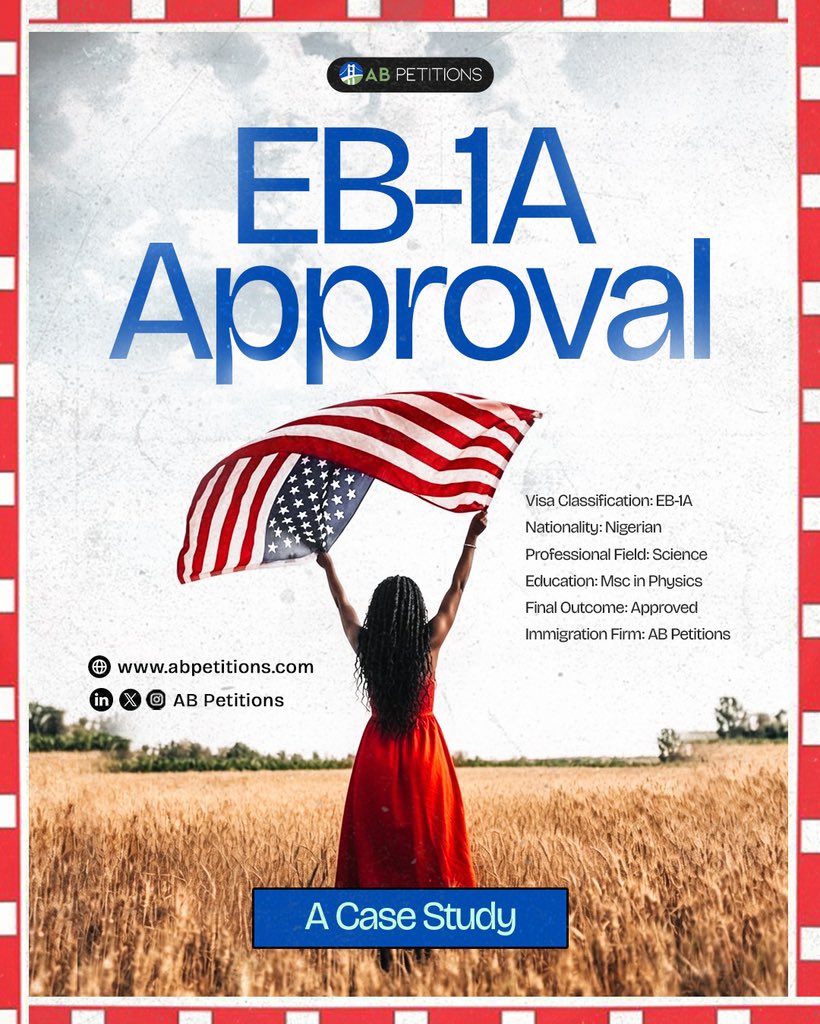
The most expensive myth in the visa world is that the EB-1A green card, the one for extraordinary ability, is only for Nobel winners and Olympians. It is not.
The law lists ten criteria, things like awards, judging other people's work, original contributions, published articles, a leading role, media coverage, and you only need to satisfy three of them. The big one-time prize is a shortcut, not the entry fee.
Most people who actually win it are ordinary high performers who simply documented their work properly and early.
If someone has told you that you are not extraordinary enough for it, there is a very good chance they were just measuring you against the wrong bar.
The Department of Homeland Security has finalized a rule that ends Duration of Status (D/S) for international students and exchange visitors.
Duration of Status (D/S) is a special period of stay designation that allows F and J visa holders to remain in the U.S. for the duration of their academic or vocational programs.
What does this new rule change?
1. Admission now matches program duration: F and J visa holders, along with their dependents, can remain in the country until the date listed on their Form I-20 or DS-2019.
2. Four years is the ceiling: With admission periods being capped at four years, any international student who needs more time to complete their program could lose their status. The 60-day grace period students had to leave after finishing a program or practical training has also been cut in half.
3. Staying longer means filing with USCIS: Students who need more time, whether to finish a degree, start Optional Practical Training (OPT), or complete academic training, must file Form I-539 before their current stay runs out. A timely filing lets a student continue a full course of study while USCIS decides the application.
4. Every extension gets vetted: An extension request is not a rubber stamp. DHS reviews each application fresh, may require biometrics, and holds the discretion to deny requests that fall short of the criteria.
5. Transfers and program changes face new guardrails: An F-1 student must finish the first academic year at the school that issued the initial Form I-20 before transferring or changing educational objectives, unless SEVP authorizes an exception.
- At the graduate level, this policy is stricter. F-1 holders cannot change their educational objections, and may only transfer if SEVP grants an exception for extenuating circumstances, such as a school closure. After completing a program, students can also only move up to a higher educational level, not to the same or a lower one.
6. Language training has its own clock: English language training students are capped at 24 months of total stay, and the clock keeps running through breaks and annual vacations.
Note: This is for general educational purposes only, not legal advice, and doesn't create an attorney-client relationship. For guidance on your specific case, consult an immigration attorney directly.
Huge shift for international students in the US.🇺🇸 From Sept 15, 2026, DHS is ending "duration of status." F-1 and J-1 students will get a fixed stay, capped at 4 years. No more staying as long as your program takes.
Here’s what you need to know.
👇
It took longer than expected but it’s finally here. And yes, it’s brutal:
The core change
Duration of status (D/S) ends for F-1 students.
- You now get a fixed admission end date instead of an open-ended stay.
- New admissions are for your program length, capped at 4 years.
- If your program runs longer than 4 years, you must file an Extension of Stay (EOS) with USCIS.
- To stay past your fixed date, you either file an EOS or leave and re-enter.
Current students (transition protection)
- If you are already here on D/S, you may generally stay until your I-20 program end date.
- But no longer than 4 years after the rule's effective date, whichever comes first.
- Years you have already spent in F-1 do not count against that 4-year window.
- DHS can delay parts of the new restrictions for up to 2 years after the effective date.
Extensions of Stay (EOS)
- The DSO issuing a new I-20 no longer extends your status by itself.
- You must file an EOS with USCIS to stay past your fixed admission date.
- EOS filings may require biometrics (fingerprints, etc.).
- If you timely file an EOS, you may keep studying full-time while it is pending.
- Poor academic progress is generally not an acceptable reason for an extension.
- Academic probation, suspension, or repeated inability or unwillingness to finish your program does not justify an extension.
Extension denials
- If USCIS denies your EOS after your fixed date has passed, you may have to leave immediately.
- You may start accruing unlawful presence at that point.
- Form I-539 denials have no ordinary appeal (a motion can be filed but does not automatically protect you).
For Graduate students
- You generally cannot change your educational objective at any point during a graduate program.
- You generally cannot transfer to another school during your program.
- The only transfer exception is narrow: SEVP-approved extenuating circumstances (school closure, loss of SEVP certification, program elimination, major disasters).
- Advisor conflict, loss of funding, or changing research interests are not clearly protected.
Undergraduate students
- Cannot transfer or change educational objective during the first academic year.
- After completing one academic year, lateral changes and transfers become possible again.
Degree-level rules
- After finishing a program (post-effective date), you may generally only start a program at a higher educational level.
- You cannot move to the same or a lower educational level as an F-1 student.
OPT and work authorization
- After the transition window, post-completion OPT and STEM OPT generally require two forms: I-765 (work permit) and I-539 (F-1 extension).
- They can be filed together but are adjudicated separately.
- A pending extension lets you keep studying, but new OPT employment generally cannot start until both the extension and work authorization are approved.
- If your EOS is still pending after your admission period expires, you may get an auto-extension of existing employment authorization, up to 240 days, but only under severe economic hardship / emergent-circumstance rules.
Transition OPT exception (helpful for you)
- Current D/S students filing post-completion OPT or STEM OPT within the first 6 months after the rule takes effect only need the I-765, not a separate I-539.
Grace period
- The post-completion grace period drops from 60 days to 30 days.
- Some current D/S students keep 60 days during the transition.
- If you end study or training early, you and your dependents must depart or take action to maintain status within 30 days.
Travel
- If you leave and re-enter after the effective date, CBP will generally issue a fixed-date I-94, moving you into the new system early.
- Travel can also affect a pending EOS application.
Dependents (F-2)
- Your spouse and minor children still each need their own I-20.
- Their authorized stay cannot exceed yours as the principal F-1.
Language training student's
Test Driven Development with Python book for FREE!
This is the best book to become GOAT in TDD with Python.
To get the FREE copy:
1. Like and Retweet the post
2. Comment TDD with Python
3. Follow me so that I can DM you