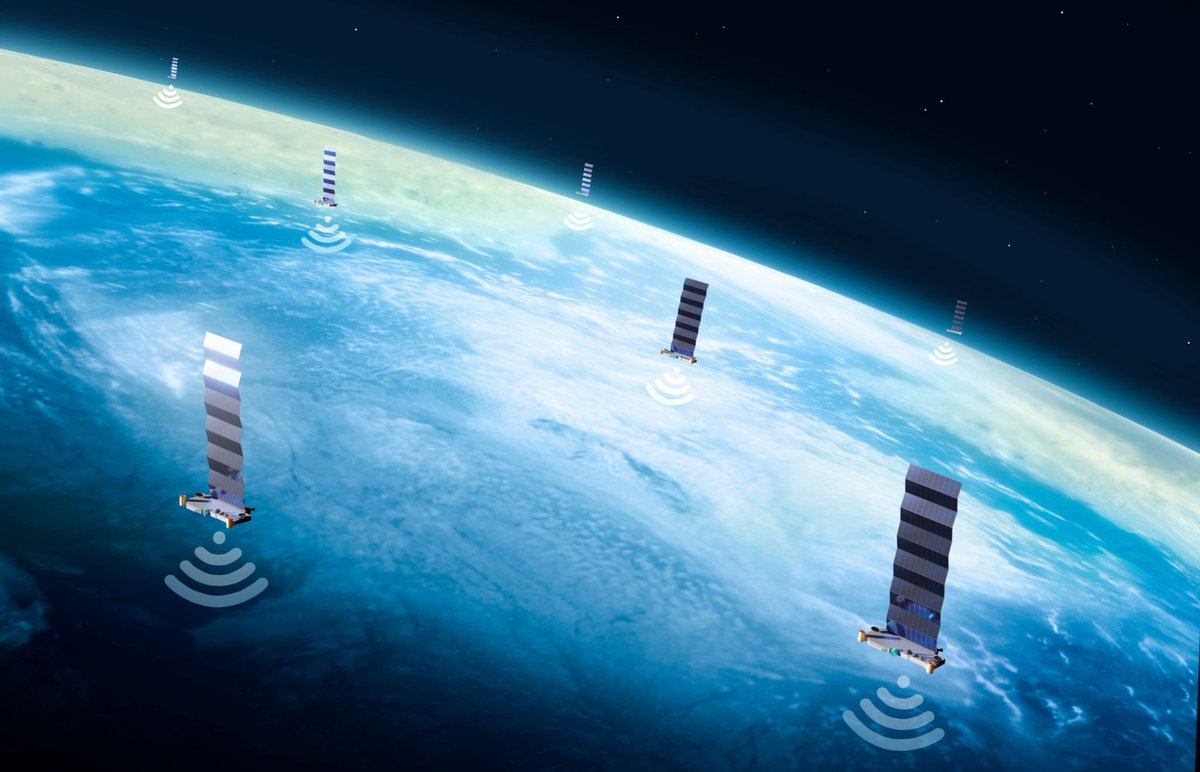
$ASTS just put three more BlueBird satellites into orbit on a single Falcon 9. The direct-to-smartphone space race just got meaningfully faster.
These Block 2 satellites carry the largest commercial phased-array antennas ever launched, 2,400 square feet each, and are built to deliver nearly 200 Mbps straight to ordinary 4G and 5G phones. No special hardware needed.
After losing BlueBird 7 on a Blue Origin failure, management executed a rapid pivot to SpaceX and kept the cadence going. Satellites 11, 12, and 13 are already in preparation as they push toward the 45-satellite threshold.
The deeper story is the widening moat: heavy patent protection on the core antenna technology and a clear first-mover position in a market that could eventually bypass traditional cell towers across large parts of the planet.
Traders who still see this as speculative sci-fi are watching real infrastructure being deployed in real time. Every successful launch narrows the distance between vision and revenue. $ASTS remains one of the highest-asymmetry ways to own the next layer of global connectivity.
#ASTS #SpaceTech #DirectToCell #SatelliteBroadband #Telecom
Rackspace $RXT stock surged sixfold in early 2026 after signing a massive 30-megawatt AI infrastructure deal with AMD. This is not another commodity cloud story. RXT is carving out the sovereign enterprise AI niche that governments and highly regulated industries desperately need.
These players refuse to hand sensitive AI workloads to foreign hyperscalers. They want localized control, ironclad security, and single-operator accountability. RXT is delivering exactly that with unified AMD Instinct GPU and EPYC CPU environments built for both heavy training and fast inference inside strictly regulated settings.
Leadership made the hard decisions. A 15% global workforce reduction and a pivot away from low-margin legacy work unlocked 75 to 85 million dollars in annualized savings. Those savings are now funding the AMD buildout. The 14 to 19 million dollars in short-term restructuring charges look tiny next to the strategic upside.
The result is a genuine moat: customized secure deployments that create sticky, premium-priced clients and defensible IP around governed AI infrastructure.
The 600% stock surge is the market recognizing a real paradigm shift. RXT now sits at the precise intersection of geopolitics, explosive AI demand, and cybersecurity.
Is this the company quietly positioning to dominate the next chapter of enterprise AI? The setup looks compelling. What do you think?
#SovereignEnterpriseAI #RackspaceTechnology #AIInfrastructure $AMD #AI
$ALAB joins the Nasdaq-100 on June 22.
Passive buying from the $300B+ $QQQ and index funds hits immediately. Q1 revenue surged 93% to $308.4M with 76.4% non-GAAP gross margins.
Amazon ( $AMZN ) warrant anchors up to a $6.5B pipeline through 2033. AIXscale Photonics acquisition locks in the optical transition for AI inference scaling. 25x forward P/S.
The indispensable connectivity layer for the $1T data center cycle meets extreme valuation tension.
Core AI infra holding or crowded trade?
$ALAB #Nasdaq100 #AI #Semiconductors #DataCenter
Institutions are loading $CRWD above $680.
The AI era cannot scale without elite digital defense. CrowdStrike combines real-time AI threat detection, a deep patent moat in behavioral analytics, and a SaaS model that turns security spend into resilient recurring revenue.
Geopolitical digital threats and hyperscale data center expansion are not cyclical stories. They are structural tailwinds.
For active and funded traders: This is the infrastructure layer protecting the boom. The 2024 outage remains a clear reminder that even strong theses carry execution risk. Size with conviction and discipline.
The edge is real. Cybersecurity is no longer optional in the AI era. It is the foundation
Is $CRWD on your watchlist? #CRWD #Trading
SpaceX ($SPCX) is set to raise $75 billion in its IPO this Friday at a $1.77 trillion valuation. The offering was oversubscribed by more than four times, with over $300 billion in orders placed.
This leaves roughly $225 billion in sidelined institutional capital that cannot get into the primary deal. Portfolio managers with aerospace mandates will need to deploy that money quickly into public space stocks instead.
The real near-term opportunity may sit in secondary space equities as this capital rotates. $RKLB
#SpaceX #IPO #SpaceStocks #RKLB #Aerospace
Alphabet’s 2015 SpaceX bet is becoming a $100B+ AI war chest.
At SpaceX’s $1.75T IPO valuation, Google’s 5-7% stake delivers massive off-balance-sheet capital. The company is already paying SpaceX ~$920M per month for orbital compute and is reportedly planning space-based data centers.
This isn’t just an investment; it’s a geopolitical and technological moat that could redefine AI infrastructure dominance.
$GOOGL investors should pay attention.
#Google #SpaceX #AI #Alphabet
Most people still picture Nokia as the company that made their old flip phone.
The real story is far more fascinating.
$NOK under CEO Justin Hotard is quietly becoming the architect of the AI-6G era, fusing AI with the foundational infrastructure the world will run on.
After Q1 2026 results, the stock surged 11.87%. AI & Cloud jumped +49%, Optical Networks +20%, and Mission-Critical Defense sales +19%. Management raised 2026 growth guidance sharply while holding over 20,000 patent families and partnering with Nvidia on AI-RAN.
Speculation is also growing around deeper SpaceX integration for a satellite-terrestrial AI network.
Nokia may control more of tomorrow’s connectivity than most realize.
Is this the overlooked infrastructure story of the AI buildout?
#NOK #AI #6G
What if the real challenger to SpaceX dominance didn’t come from another billionaire’s rocket but from a company that began in a New Zealand workshop?
Rocket Lab ($RKLB ) just posted record $200M+ quarterly revenue and sits on a $2.2 billion contractual backlog. Five dedicated Neutron launches are already signed before the rocket has flown. The Motiv Space Systems acquisition brings Mars-proven robotics into the stack. And U.S. defense contracts through the HASTE program are converting geopolitics into a structural moat.
This is no longer just a launch story. It’s about who will actually build and control the orbital infrastructure of the 2030s.
Neutron’s Q4 2026 debut is the moment everything gets validated or repriced.
Is $RKLB the next great aerospace compounder… or the next expensive lesson in space valuations?
$QBTS just unveiled a bold path to fault-tolerant quantum.
While Wall Street stared at IBM's $10B quantum bet, a smaller player quietly pulled off the most credible roadmap of 2026.
On June 1, D-Wave's CEO Alan Baratz unveiled a path that few thought possible: 100 logical qubits by 2032, capable of over 1 MILLION operations.
The twist? Their dual-rail architecture catches 90% of errors at the hardware level. Their error correction runs 100 to 1,000x FASTER than ion-trap or neutral-atom rivals. Their 99.9% two-qubit gate fidelity already matches systems that cost billions.
Meanwhile in Q1: revenue crashed 81% to $2.9M. The market panicked.
What it missed: bookings exploded 1,994% to $33.4M. Backlog +563%. Cash pile $588M. Zero debt.
And here's the killer fact: while Google chases contrived benchmarks, D-Wave demonstrated REAL quantum supremacy on actual magnetic materials simulation.
$QBTS $IBM $IONQ $RGTI
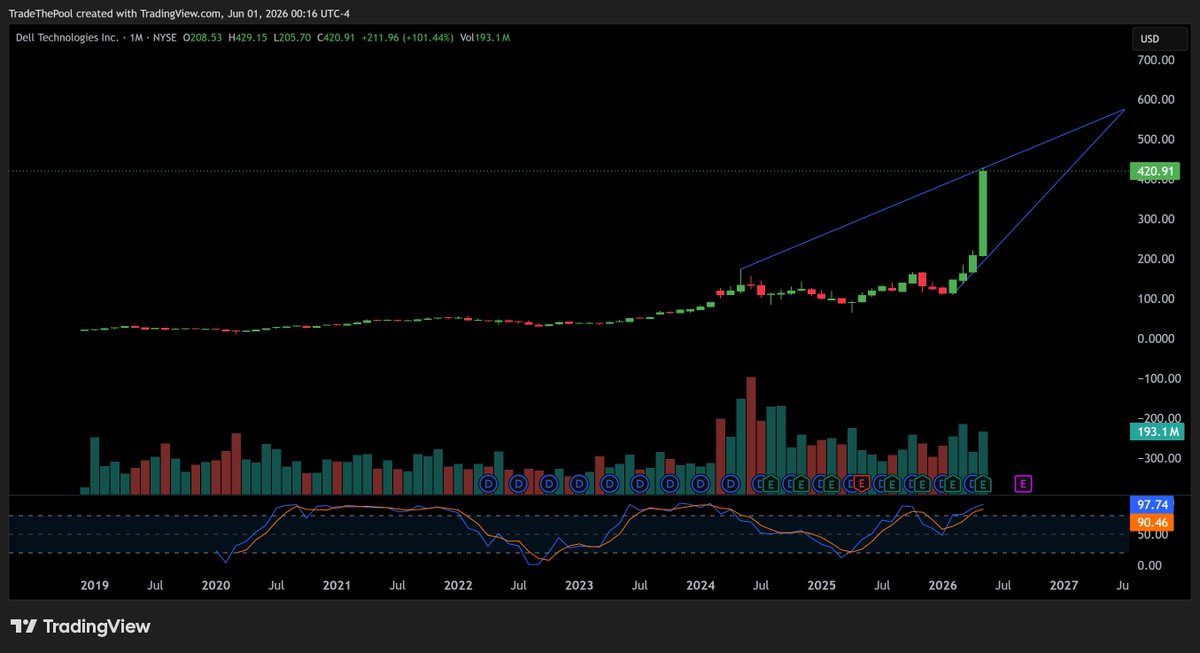
Is $DELL building a structural monopoly in the AI era? 🧵
The Q1 FY27 financial numbers are absolutely staggering:
* Total Revenue: $43.8B, up 88% YoY AI Server
* Revenue: $16.1B, skyrocketing 757% AI Infrastructure
* Backlog: A record $51.3B
But the real moat isn’t just assembly; it’s the underlying engineering. Dell actively shields its infrastructure with 51,713 global patents.
As microprocessors reach heat densities hotter than gas torches, Dell's proprietary liquid cooling plates and Smart Flow fluid dynamics allow racks to handle up to 480 kW of power, a massive 20x capacity increase over legacy tech.
Add in a historic $9.7B Pentagon data contract and a highly efficient proprietary PowerScale storage architecture that uses 72% less power than flash-only rivals like VAST, and it's clear Dell is playing an entirely different game.
$DELL #AI #Tech #Earnings #Hardware
The smartphone ghost is officially gone. 👻
BlackBerry $BB just locked in a massive turnaround with $53.2M in full-year net income and a soaring $950M QNX royalty backlog.
From powering 275M+ vehicles to partnering with @nvidia on Physical AI and robotics, they are quietly anchoring the future of autonomous tech.
Is Wall Street finally waking up? 📈
#BlackBerry #NVIDIA #ArtificialIntelligence #Robotics #TechNews
$RGTI just signed a major CHIPS Act deal with the US Department of Commerce.
The LOI (May 20, 2026):
🔹 Up to $100M over 3 years
🔹 Commerce takes equity stake (15% discount to lowest closing)
🔹 Subject to definitive agreement negotiation
Why it matters:
🔹 Q1 2026 revenue: $4.4M (+193% YoY)
🔹 $569M cash, zero debt
🔹 108-qubit Cepheus-1-108Q now generally available
🔹 99.1% two-qubit fidelity (targeting 99.5%)
🔹 $100M UK investment toward >1,000-qubit system
🔹 Analyst targets: $30 (Cantor, Craig-Hallum)
Watch the dilution mechanics.
$IBM $IONQ $QBTS $RGTI
🧬 Will Amylyx survive its radical rare disease pivot? Moving past the Relyvrio setback, $AMLX is betting big on its high-tech pipeline, Phase 3 avexitide readouts, and Wolfram syndrome breakthroughs.
#Biotech#AMLX#Investing#RareDisease#Macroeconomics
Can ASML monopolize the future of global power? 🧵👇
1) UBS just named $ASML its top European chip pick, bumping the price target to €1,900. While the stock underperformed earlier, its strategic dominance remains absolute. Here is why.
2) The Ultimate Chokepoint: ASML holds a total monopoly on EUV lithography systems. Western governments use it as a geostrategic tool to restrict advanced chip capabilities abroad, turning a commercial entity into a sovereign power player.
3) The AI Surge: The AI boom requires massive processing power. With up to 35% of its revenue coming from memory infrastructure, ASML is directly fueling the shift to advanced DRAM and HBM nodes.
4) Economic Moat: A single High-NA EUV machine costs over $350M. Because chipmakers have zero alternatives, ASML possesses ultimate pricing power and highly predictable long-term cash flows.
5) With its premium vs. US peers compressing to just 6%, UBS calls this a generational buying opportunity.