From Chicago to Delhi: Living Nations Do Not Wait
by Bismay Ray
https://t.co/yw1VRlyvJy
This article reflects on the recent student protests in Delhi through the lens of "The Trial of the Chicago 7", drawing parallels between state responses to dissent across different eras and countries. It examines allegations of police violence, surveillance, intimidation, and the targeting of protesters, while highlighting the restraint shown by demonstrators. The essay argues that democratic participation extends beyond elections and situates the movement within a broader history of resistance. Concluding with Ram Manohar Lohia’s assertion that “living nations do not wait for five years,” it explores the continuing significance of youth-led democratic mobilisation in India.
My article examines the recent Gen Z-led protest movement in India through the lens of The Trial of the Chicago 7, drawing parallels between contemporary youth activism and the anti-war protest movement in the United States during the late 1960s.
https://t.co/F9v87eMjCX
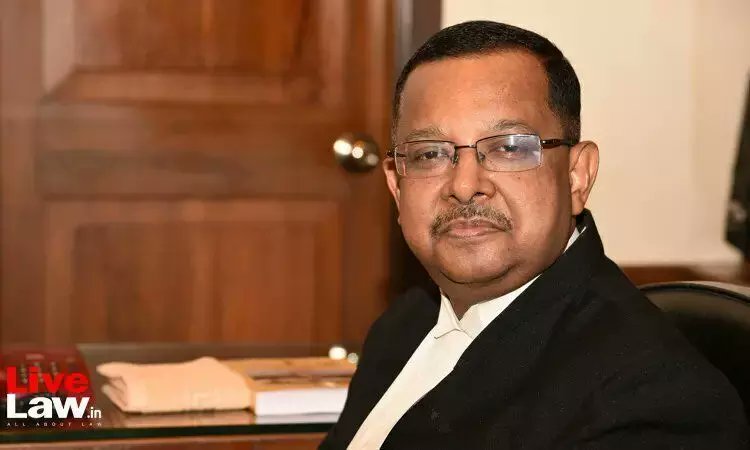
Justice Ujjal Bhuyan of #SupremeCourt criticises the Bombay HC judgment refusing permission to hold march in support of Gaza,Palestine.
"I found it very amusing that when in Bombay, Shivaji Park, when a group of people wanted to demonstrate in solidarity with the people of Gaza, the permission was not granted by the government. So, they moved a writ in the Bombay High Court; the learned judge said 'don't you have any issues in India, why do you have to go that far to agitate?.
India has recognised Palestine; we have a Palestinian Embassy in India. Traditionally, India has always recognised Palestine. The recent incidents in Gaza, it is South Africa that moved the International Court of Justice against what is happening there, saying that make a declaration that it is Genocide. Justice Muralidhar, former judge of the Orissa High Court, UN appointed him to go into the violence in Gaza. He has published a report, which is accepted by the UN and is now in the public domain, about the violence meted out by the State on such children, women and elderly.
I am not saying that only these issues should be debated. These are the issues which should agitate the mind of a young mind of a student, of a research scholar. You must read, you must question. That is the place of a university.
Evil websites like Libgen, Z-library, and Sci-Hub had pirated millions of academic books and papers.
They've been shut down, and rightly so.
We shouldn't use them anyway. We should make billion-dollar academic publishers richer.
Anyway, here's how to access these libraries:
🚨DO NOT DO THIS!
His name was Nitish Katara.
He was 25 years old. MBA from IMT Ghaziabad. Job at Reliance General Insurance. A regular young man building his life in Delhi.
At college, he fell in love with Bharti Yadav. Her father was D.P. Yadav. Sitting Member of Parliament. One of the most powerful politicians in UP.
They were together for four years. Her family knew. Her brother Vikas knew. Her cousin Vishal knew.
Nitish received threats. He did not leave.
On the night of February 16, 2002, he attended a friend's wedding in Ghaziabad. Bharti was there. Vikas was there. Vishal was there.
They danced. They took photographs.
At midnight, security guards saw Nitish get into a Tata Safari with Vikas, Vishal, and one more man.
He never came back.
The next morning, a burnt body was found 80 km away near Khurja. Beaten with a hammer. Diesel poured on him. Set on fire.
His mother Nilam identified the body by his hand. Nitish had unusually small hands just like hers.
Then the system turned against her.
Witnesses changed their statements one by one. Three out of four turned hostile. Even Bharti went to court and said there was no relationship. Just friendship.
One witness refused to budge. His name was Ajay Katara. No relation. Just a man who had seen Nitish get into that car that night and could not lie about it.
Vikas Yadav banged his fist on the courtroom table and told him he would be buried 100 feet underground.
Ajay did not change his statement.
For the next 20 years, he lived under 24-hour armed guard. 37 cases filed against him. Bullet attempts. Poison attempts. His life never recovered.
Nilam Katara had no political connections. No money like the Yadavs. Just one question that she refused to stop asking.
In 2008, the court convicted Vikas, Vishal, and Sukhdev. The Supreme Court confirmed 25 years without remission.
Vikas has now served 23 years. He recently got married from jail. He applied for furlough to spend time with his wife. The Supreme Court granted it for Holi this year.
Nilam Katara is still fighting.
Her son got justice. The men who killed him are counting their last months in prison. But the witness who made that possible lost everything for telling the truth.
In India, power does not just delay justice. It destroys everyone who stands in its way.
But a mother refused to let it disappear.
|| Know your heroes ||
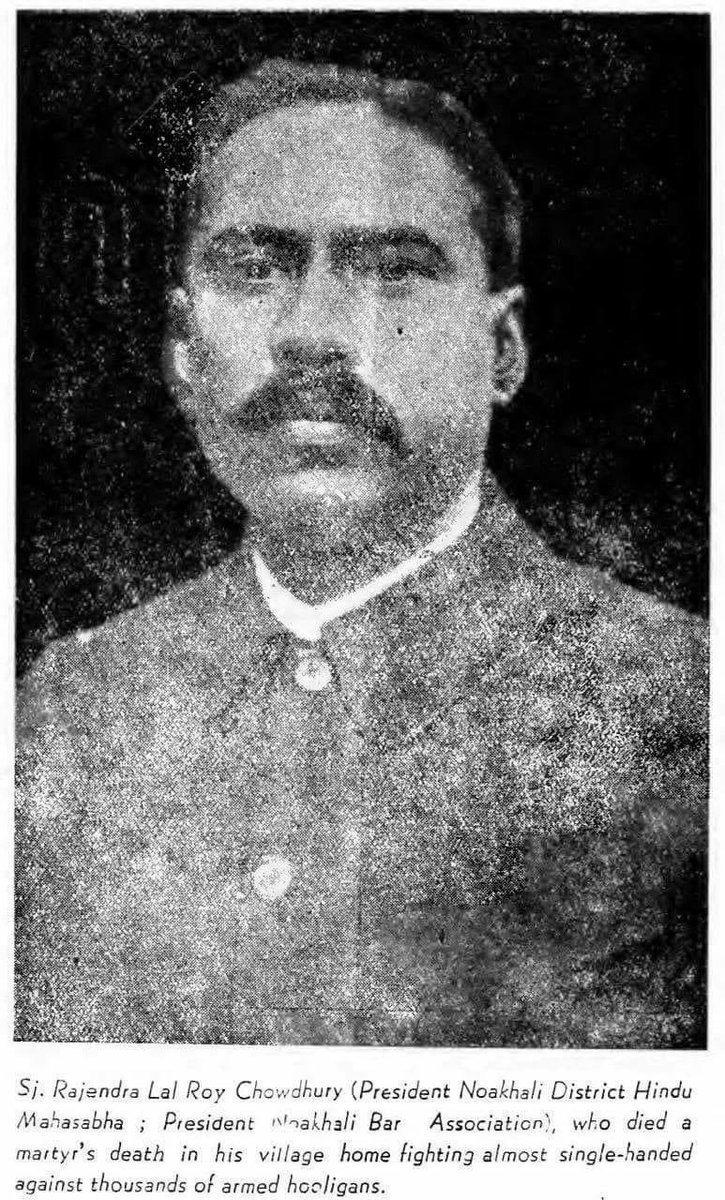
Story of immense bravery and Hindu resistance during the N0akhal! Ri0ts - Rajendra Lal RoyChowdhury.
“The severed head of Rajendra Lal RoyChowdhury was gifted to Gulam Sarowar on a plate. At Gulam’s order his two trusted lieutenants took the two beautiful daughters of Mr. RoyChowdhury as the booty.”
(Binoy Bhusan Ghosh, in his book “ দ্বিজাতিতত্ত্ব ওবাঙালী” / Two Nation Theory and Bengalis).
On 11th October, 1946, the private army of Gholam Sarwar, known as the Miyar Fauj, attacked the residence of Rajendralal Roychowdhury. At that time Swami Tryambakananda of Bharat Sevashram Sangha was in the house as a guest. While Roychowdhury fought the My$lim mob from his terrace with his rifle, Swami Ji stood at the main door with a sword and fended off the Mu$lims. At night when the mob went back, Roychowdhury sent Swamiji and his family members to safety.
However, Roychowdhury remained behind, as he as a leader of the local Hindus and didn’t want to leave them behind stranded alone. So he stayed back to fight. The next day Gholam Sarwar sent a larger mob. Rajendralal Roychowdhury fought bravely until his ammunitions ended, after which he was k!ll€d, and his s€vered head was presented to Golam Sarwar on a platter.
Roychowdhury’s two unmarried daughters, Basanti and Reba, were taken away and given to two of Sarwar's trusted generals to be r-AP€d and kept as s€x slaves. The house was set on fire, and the b0dies of the Roychowdhury family members were thrown into a swamp to rot and be eaten by animals.
On 11th January 1947, the remains of the Roychowdhurys were taken out from the swamp , and cremated as per Hindu rites.
Later Hindus built a hospital in N0akhal! district in memory of Roy Chowdhary.
According to Sucheta Kriplani, Rajendralal Roychowdhury had pledged to follow the footsteps of Guru Gobind Singh and Shivaji to defend Hinduism and family honour with his last breath.
My friends bought 34 acres of Ohio wilderness.
While hiking one day, they stumbled upon a dark, dripping cavern—and decided to pour their life savings into it.
Today, it's one of the world's most profitable airbnbs. The waitlist is years long.
Here's the story...🧵
9 reasons why aristocracy beats democracy
1. The Pyramid Problem. Will Durant said there are grand tasks “requiring generations” of coordination and democracy is utterly incapable of them. A democratically elected leader can never build a Pyramid.
2. The Freedom Paradox. Durant writes that while aristocracies do limit “political freedom,” democracies are no freer as they crush individuality with the “fanatic pressure of dull majorities.” Better a rule by minorities trained from the “outset” in the rigors of an aristocratic upbringing.
3. Pedigree v/s Pocketbooks: Durant writes that “rule by pedigree is the only alternative to rule by pocketbooks.” Rich oligarchs always subject nations to the “ideals of the stock exchange, the marketplace, and the factory” unless aristocrats stop them.
4. Elections are Lotteries: Aristocracies free leaders from the “lottery of elections.” French philosopher Renan predicted that elections will be the triumph of “mediocrity” as they’ll put “knaves and quacks upon the throne.”
5. The Case of England: “England’s leaders were trained for public place from their boyhood; first at home, then at Eton or Harrow, then at Oxford or Cambridge, and then by appointment to arduous minor offices. It was these men who lifted little England to the top of the world.”
6. Slow Is Fast: Will Durant writes that societies cannot change too quickly because “large bodies must move slowly.” But what about science progressing rapidly? The analogy breaks down when you understand that “society is not a laboratory, and men do not submit to vivisection.” Science thrives on trial and error; doing trial and error in political affairs racks up the body count in millions. Ask Chairman Mao.
7. Traditions as Memory. Will Durant: “The sanity of the individual lies in the continuity of his memory; the sanity of a group lies in the continuity of its traditions.” Progressives are strangely proud of their amnesia.
8. Aristocracy of the soul. Durant defines the “aristocracy of soul”: “A vigor and yet ease of carriage, a sureness of touch in judgment and taste, a readiness of wit, an unassuming dignity and an unfailing generosity.”
9. The Aristocratic Peace. Durant writes that equality is the breeding ground of violence: “Peace is between unequals; the pretense of equality brings a perennial tug of war.” Only by accepting the “natural inequality of men in intellect and will” can we realize the “hypocrisy of egalitarian institutions.” Aristocratic peace demands that we do not lie.
The arc of history is long, but it bends towards the return of aristocracy...
Share this to Durant-Pill your timeline.
Every day, on his way to his office, he crossed the temple. He would get down from his horse, remove his hat and boots, offer his salutations to Sri Meenakshi and carry the boots in his hands till he crossed the temple.
This noble trait earned him the popular nickname ‘Peter Pandian'. The title ‘Pandya’ is associated with the dynasty of the great kings who ruled in South India, with Madurai as their capital.
2/5
How big is the Electoral Bonds Scam?
Electoral Bonds have enabled corruption, crony capitalism and fraud at multiple levels. It has spread like cancer.
This thread will show you how far this cancer has spread 🧵
A writ petition under Article 226 of the Constitution can be entertained in spite of availability of an alternative remedy:
▶where the statutory authority has not acted in accordance with the provisions of the enactment in question;
▶It has acted in defiance of the fundamental principles of judicial procedure;
▶It has resorted to invoke the provisions which are repealed; and ▶when an order has been passed in total violation of the principles of natural justice
But High Court cannot entertain a petition under Article 226 of the Constitution if an effective alternative remedy is available to the aggrieved person or the statute under which the action complained of has been taken itself contains a mechanism for redressal of grievance.
#SupremeCourt in PHR Invent Educational Society vs UCO Bank 2024 INSC 297
Read more @ https://t.co/PUE3lwFqs9
#SupremeCourt explains Triple Test For Injunction Orders
1⃣Prima facie case
2⃣Balance of convenience
3⃣Irreparable injury
The Court also said that the standard of scrutiny in applying this test for ‘prohibitory’ and ‘mandatory’ injunctions is different.
This is because the latter require the defendant to take a positive action instead of merely being restrained from performing an act, they carry a graver risk of prejudice for the defendant if the final outcome subsequently turns out to be in its favour.
The Courts are, therefore, relatively more cautious in granting mandatory injunction as compared to prohibitory injunction and thus, require the plaintiff to establish a stronger case, the court said in State Of Kerala vs Union Of India 2024 INSC 253
Read more @ https://t.co/huNoDQW3cA