AI lowered the barrier to building.
It didn’t lower the barrier to getting people to care.
If anyone can generate the product, the advantage moves to distribution, positioning, and actually selling it.
Code used to be the hard part.
Attention is the hard part now.
Most people use Google Maps to find places.
A few use it with ChatGPT to find opportunities.
The map already shows who’s active, who’s local, and who might need work.
The AI just helps you turn that into outreach or ideas faster.The data was always public.
The leverage is in how you use it.
People call it a waste until they need the battery, the trackpad, and the apps that just work without fighting the OS.
The price is high.
The time saved on compatibility, performance, and not troubleshooting is higher.
Tools that remove friction pay for themselves.
Everything else is preference.
The best textures don’t come from texture packs.
They come from old doors, peeling paint, and metal that’s been touched for decades.
Designers who only look at screens start repeating the same clean surfaces.
The ones who walk outside keep finding details no stock library has.
Real world still beats the library.
Without AI, the bugs are yours.
With AI, the bugs are still yours, just harder to trace.
The model can write the code faster.
It can’t own the result.
Review every suggestion like it came from a junior who moves too fast.
The receipt hits different when it’s your own money.
“Thank you for your payment” is just the system confirming you successfully transferred pain to your bank account.
Necessary expense or not, the feeling is the same.
Coding requires thinking through the solution.
Clauding requires thinking through the prompt and the review.
One is slower.
The other is riskier if you skip the second part.
The shortcut only works if you still understand what came out.
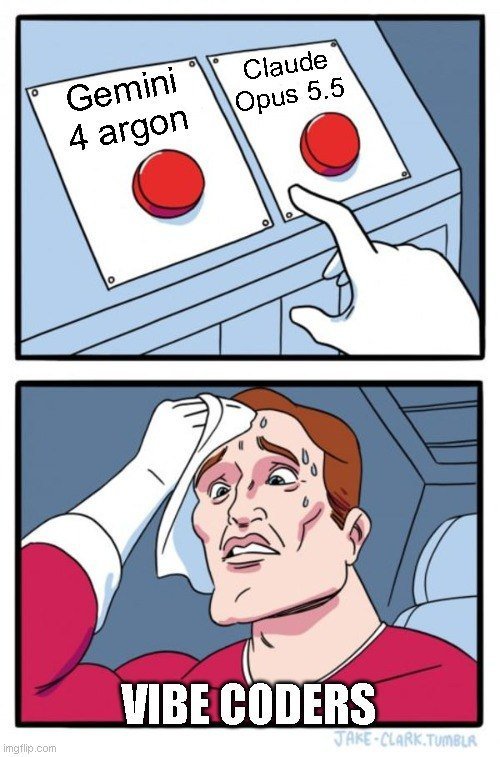
The models keep getting better.
The decision of which one to trust doesn’t.
Vibe coding only works if you know which model is stronger for the task in front of you.
Otherwise you’re just guessing at high speed.
Pick the tool. Then actually review the output.
No single model wins every category.
ChatGPT for conversation.
Claude for code.
Grok for research and real-time context.
Gemini for the rest.
The people getting the best results aren’t loyal to one.
They route the task to the model that’s actually strongest at it.
You gathered the right tools.
The result still looks like a science experiment.
ChatGPT, Stack Overflow, docs, and courses don’t automatically produce clean code.
They produce whatever you feed them plus whatever you forget to check.
The output is only as coherent as the person reviewing it.
The only human on the call is still asking people to turn their cameras on.
AI can fill the seats.
It can’t replace the awkward silence when no one wants to be seen.
The meeting still needs a human who owns the outcome.
Most people pick a browser once and never think about it again.
Chrome for speed and extensions.
Safari for battery and integration.
Brave or Firefox if privacy matters.
Arc if you care about the interface.
The best browser is the one that stays out of your way.
Everything else is preference.
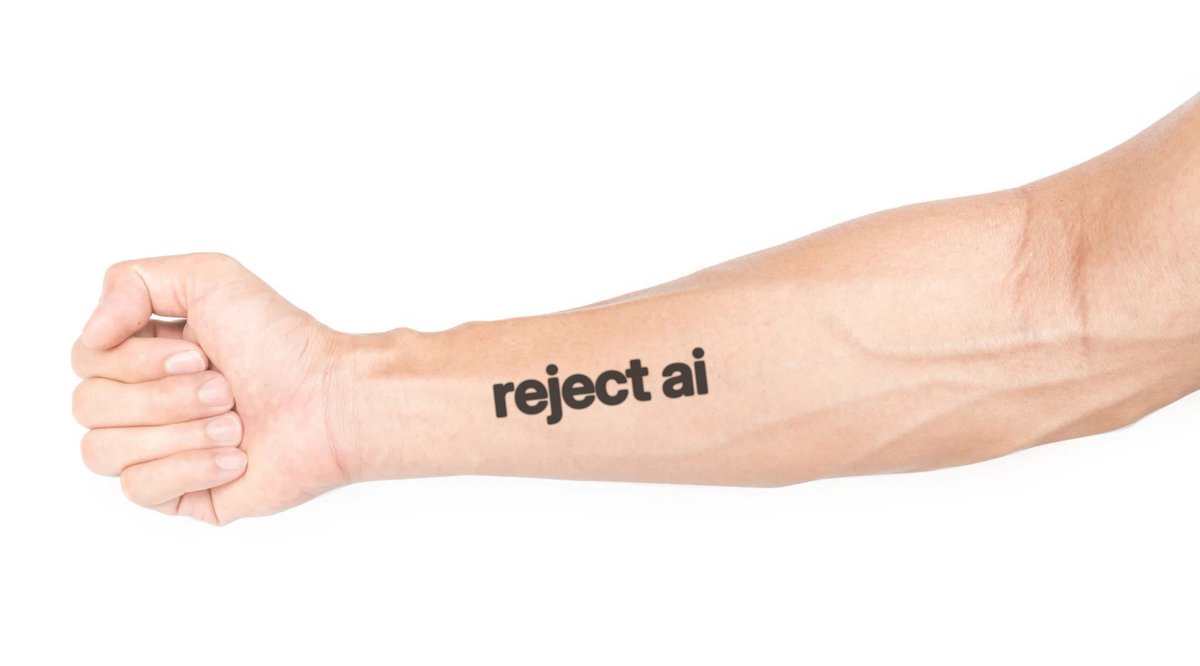
Rejecting the tool doesn’t protect the skill.
It just leaves you slower than the people who learned to use it well.
The real advantage isn’t avoiding AI.
It’s knowing when it helps and when it gets in the way.
Adapt or get outpaced.
The hardware is ready.
The connection is ready.
The skill set is still catching up.
New tools amplify whatever you already know.
They don’t replace the foundation.
Upgrade the skills or the car stays parked.
The list isn’t the problem.
The constant consumption is.
Most “10 resources to instantly improve” posts exist to keep you scrolling, not to make you better.
You don’t need another list.
You need to finish the thing in front of you.
Inter is replaceable.
Bento grids will fade.
Dark mode is a preference.
Auto layout is the one that actually changes how fast you work.
Give up the aesthetic first.
Keep the system that removes the busywork.
via @adhamdannaway
The setup is expensive.
The actual ask is still “make this screen look clean.”
Companies love giving designers powerful tools.
They just rarely give them problems that require the full power.
Most of the work is still clarity, hierarchy, and not overcomplicating it.