In 1932–1933, Soviet authorities deliberately confiscated Ukrainians’ grain and food supplies, brutally repressed resistance, and blocked peasants from leaving in search of food – all while the Kremlin concealed the famine, denied its existence, and rejected international aid.
The Holodomor was intended to destroy Ukrainians as a people and crush their resistance to Soviet rule, and claimed millions of Ukrainian lives and left generations with lasting trauma. We remember every victim of this horrible genocide.
It will be thanks to the Churchillian heroism, the improvisation, the enterprise, the genius of Ukrainians that one day soon your country will be free.
Slava Ukraini!
honoured to be able to unveil the Gareth Jones monument in Kyiv along with ambassador Sir Neil Crompton, @AlunTredegar@DarrenMillarMS joined by WayneThomas NUM and @Uk4Ua
🇬🇧💡 While Russia continues to attack Ukraine's energy infrastructure, the UK is investing £9.5m in a new 200MW wind farm, which, once operational, will power around 300,000 households.
Together, we're building a stronger, more resilient energy system for Ukraine's future.
We welcome today’s EU sanctions against 15 Russian entities linked to Russia’s military-industrial complex.
Targeting Russia’s weapons production capacity is exactly the kind of action needed to weaken the aggressor. We appreciate the EU’s determination in this regard.
We encourage all our partners to follow this example and expand restrictions on Russia’s access to foreign technologies and critical components.
Russia’s cruelty and abuse target Ukrainian women and girls in air strikes on cities, in combat, in captivity, and under occupation. Russian war criminals unlawfully detain, beat, torture, and kill. They subject detainees to psychological pressure, deny them medical care, and hold them in horrific conditions without adequate food and water. The documented crimes include sexual violence ranging from threats to gang rape.
Surviving even one day in these conditions is unimaginable, yet Ukrainian women endure them for months and years.
Russians must be banned from international travel. Economic sanctions must make it impossible for individual perpetrators and Russia’s entire system of abuse to continue committing these crimes. Effective international justice mechanisms must ensure that every crime is met with a punishment proportionate to its severity. Only the inevitability of punishment will compel Russia to stop committing these crimes.
Pleased to welcome Edward Llewellyn @EdLlewellynFCDO, Political Director at @FCDOGovUK, to the Office of the President of Ukraine today. In fact the intensity of our contacts with the UK has been outstanding.
We discussed ongoing diplomatic efforts to achieve a just and lasting peace, security guarantees for Ukraine, further defence and energy assistance, and stepping up sanction pressure on Russia.
Exchanged views on advancing our 🇺🇦🇬🇧 Strategic Dialogue; we are looking forward to the upcoming UK G20 Presidency.
Grateful to the UK for its steadfast support and leadership.
Special appreciation of the tireless work of Sir Neil Crompton, British Ambassador to Ukraine and his team at @UKinUkraine
I had the honour, on behalf of the Ministry of Defence of Ukraine, of awarding the “Star of Military Brotherhood” medal to British citizens who fought as part of the 2nd International Legion for the Defence of Ukraine of the Armed Forces of Ukraine.
Junior Sergeant and scout Leon Cribb, Private and rifleman Gary Bowen, junior commander Idris Voller, and Junior Sergeant and reconnaissance patrol commander Johnathan Petrice defended Ukraine’s freedom as volunteers and were wounded.
Each of them made their own choice and stood up to defend our country, sharing the hardships and pain of war with Ukrainian soldiers. This is a demonstration of true military brotherhood and the courage to fight for one’s principles.
I am grateful to all British soldiers who have fought and continue to fight as part of the Armed Forces of Ukraine.
Eternal memory to the fallen.
I had the pleasure of meeting @BorisJohnson again at the Churchill War Rooms, where Prime Minister Winston Churchill worked during the Second World War. This is precisely the place from which it is very clear today why history does not forgive indecision in the face of aggression.
In 2022, Boris Johnson had the determination to give weapons to those who needed them to survive. A rare case in today’s world, for which Ukraine and I personally will always be grateful to him.
Here, in Churchill’s offices, we talked about lessons for the future. Thanks to Ukrainians, millions of people are not yet being killed in Europe. But thousands of kilometres away from here, as in Munich in 1938, someone is already trying to decide the fate of Ukraine and Europe in the interests of “friend Vladimir”, who for 12 years has been unable to defeat Ukrainians on his own.
Business deals will not end the war that has been going on for more than 12 years in the heart of Europe. A war is ended not by satisfying the enemy’s appetites, but only by depriving the enemy of the ability to fight. This requires unity, because without it a global decision is impossible. As Churchill did in his time, we must talk not about how to avoid responsibility, but about how to protect the future by making difficult decisions today.
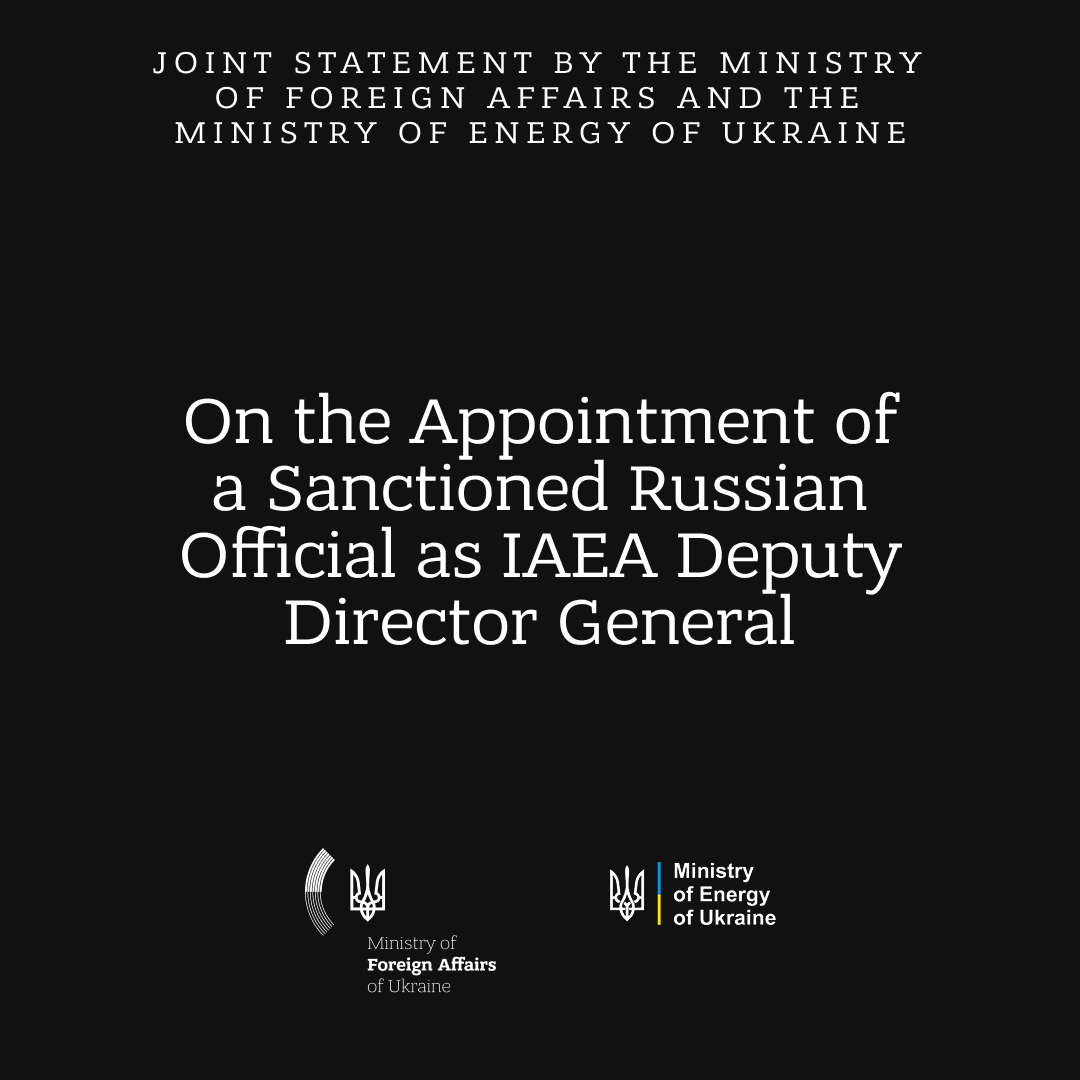
The Ministry of Foreign Affairs and the Ministry of Energy of Ukraine express deep outrage at the decision of the IAEA Director General to appoint as his deputy Oleksii Ferapontov, a sanctioned Russian official and Deputy Head of the Federal Service for Environmental, Technological and Nuclear Supervision of the Russian Federation (Rostekhnadzor).
This Russian official is involved in actions by Russian state bodies aimed at legitimising the illegal seizure of the Zaporizhzhia Nuclear Power Plant and extending Russian regulatory control over it. Ukraine imposed personal sanctions on him by Presidential Decree No. 75/2023 of 12 February 2023.
As a result of the Russian seizure, Europe's largest nuclear power plant has become a constant threat to nuclear and radiation safety.
Appointing a representative of a state body directly involved in undermining nuclear safety principles to one of the IAEA's highest leadership positions fundamentally contradicts the Agency's very mandate.
Ukraine has repeatedly made clear to the IAEA leadership that such an appointment is categorically unacceptable. It did so through diplomatic channels and in public statements by the leadership of the Ministries of Foreign Affairs and Energy.
This personnel decision runs counter to the principles and standards set out in Article VII of the IAEA Statute. The Article makes the highest standards of professional competence and integrity the paramount consideration in recruiting staff. It also guarantees the independence of the Director General and the Agency's staff from outside influence.
The appointment also contradicts the spirit and objectives of the resolutions of the IAEA General Conference and Board of Governors on nuclear safety, nuclear security and safeguards in Ukraine.
An international organisation tasked with protecting the world from nuclear threats cannot entrust leadership powers to representatives of state bodies involved in creating those threats.
The Director General's decision shows institutional weakness at a time that demands leadership, independence and accountability. It undermines the IAEA's authority and trust in its impartiality. It also sets a dangerous precedent for the entire international nuclear safety system. What is needed now is integrity, not spinelessness.
The Ministries of Foreign Affairs and Energy of Ukraine strongly protest this unacceptable personnel decision and demand that it be reversed immediately.
We call on IAEA Member States, above all the members of the Board of Governors, to publicly give a principled assessment of this appointment. We also call on them to use the mechanisms provided for in the Agency's Statute to have the decision reviewed.
Respect for the fundamental principles of nuclear safety, international law and integrity cannot be subject to political compromise.
Russia's war is no longer confined to Ukraine's borders. Across Europe, Russian sabotage, arson, disinformation and other hostile activities are becoming increasingly brazen. The Kremlin is bringing its aggression onto European soil, deliberately undermining the security of the countries whose freedoms it seeks to exploit.
Against this backdrop, allowing Russians involved in the aggression against Ukraine to enter Europe on tourist visas is a direct threat to European security. Russian combatants who kill Ukrainians have no business enjoying holidays in European countries. The EU-wide entry ban agreed in principle must be put into effect without further delay. This should have happened yesterday.
Estonia has already taken the lead by imposing entry bans on Russian combatants. We welcome this decisive step and urge other European countries to follow suit.
The same determination is needed when it comes to Russian athletes. A so-called neutral status cannot whitewash support for Putin's war or grant its supporters the privilege of entering Europe. These people will always serve as instruments of Kremlin propaganda.
We thank Estonia, Norway and the Czech Republic for taking steps to close their doors to such athletes. Finland has set an important example by closing its borders to non-essential travel by Russian citizens, including tourism and transit to other Schengen countries. We welcome these firm measures and urge other European countries to follow their example. Europe has every right to protect itself from those who help legitimise Russia's aggression.
Europe's visa policy should reflect the scale of the Russian threat. Granting entry privileges to those involved in or supporting Russia's aggression creates unacceptable security risks. The time for loopholes and exceptions that undermine Europe's security is over.
Russia attacks civilian areas across Ukraine, killing and injuring people in their homes, shops, and other everyday places.
Yesterday in Dymer, Kyiv region, a Russian drone destroyed part of a five-storey apartment building. At least 11 people were killed. Rescuers worked through the day and night, pulling survivors from the rubble, including 7-year-old Davyd, who had been trapped for almost 14 hours, and an elderly woman, Valentyna, rescued after 22 hours.
In another part of the Kyiv region, a Russian strike on a supermarket killed three people and injured 13. In Kharkiv, Russian drones struck an educational facility and a hotel, injuring eight people. In Sumy region, an FPV drone targeted a vehicle delivering bread and other food supplies to residents.
These attacks show why Ukraine urgently needs stronger air defence, including more anti-ballistic interceptors, to protect civilian lives.
Manchester is a special place in the history of the Ukrainian community in Britain. I am very impressed by the warm meeting with Ukrainians who preserve our language and culture here and pass them on to future generations.
Ukrainians have lived in Manchester since the late 19th century. After the two World Wars, several thousand former servicemen, veterans of the Ukrainian national movement and other people from Ukraine settled in this region, unable to return because of Soviet repression.
After 2022, the community was joined by a new wave of our people who were forced to leave their homes because of Russian aggression. Today, according to various estimates, 300,000-350,000 Ukrainians are living in the United Kingdom. This is a country that has not only become a refuge for our children, but also a pillar of support for Ukraine in this difficult struggle. And it is Ukrainians here, in the United Kingdom, who must be the force that will not only maintain this support but also strengthen it.
I am grateful to the Ukrainian community in Manchester for continuing to support Ukraine and each other.
"The blood of every civilian killed by Russia is on Putin’s hands, and so is the responsibility for every crime committed under his command," Ukraine’s Foreign Minister Andrii Sybiha commented.
"Europe cannot afford to respond to each incident in isolation. The response must address the source of this growing danger: Putin’s Russia," he added.
Since this morning, a search and rescue operation has been underway in Dymer, Kyiv region. Part of a five-story apartment building has collapsed following a Russian drone attack. I thank our first responders for acting quickly: nine people have already been evacuated, and the fire has been contained. But unfortunately, people may still be trapped under the rubble – 14 people remain unaccounted for. All necessary services are working at the scene. A child was also injured in a Russian strike with guided aerial bombs on residential buildings in Zaporizhzhia.
Overall, 20 regions of Ukraine have come under Russian attack this week. Russia launched around 2,700 drones, nearly 1,460 aerial bombs, and 165 missiles of various types at them. A significant number were ballistic missiles, including North Korean ones, which the Russians are constantly helping Pyongyang modernize to improve their accuracy. Against this backdrop, it is particularly difficult to understand the delays in supplying anti-ballistic interceptors to Ukraine. We need to strengthen our defense. It is very important that America authorize the transfer of missiles for Patriot systems that our partners have already paid for under PURL. It is also important to continue contributions to the PURL program, which is our main source of anti-ballistic interceptors. Thank you to everyone who is helping with this.
The courage and resilience of the Ukrainian people has not wavered. Neither will our support 🇬🇧🇺🇦
Defence Secretary @wesstreeting met President @ZelenskyyUa in Kyiv today as the UK deepened its military and industrial support, including new agreements to produce Ukrainian-designed strike drones in Britain.
The UK will continue to stand with Ukraine – helping put it in the strongest possible position to secure a just and lasting peace.