Join us in this adventure, and be a witness of the formation of a new ecosystem, when life conquers the spaces left by the ice. "The Last Venezuelan Glacier: life after the ice". Produced by @ymagoproductions (IG)
A team of Venezuelan scientists from Universidad de Los Andes, with support from @insidenatgeo, go into the remotest summits of the Sierra Nevada in Mérida, Venezuela, to find out what can be learned from #TheLastVenezuelanGlacier.
https://t.co/IBqZXVjiDm
#DespedirALosGlaciares
Venezuela será pronto el primer país de los Andes en quedarse sin glaciares. Miren este corto documental al respecto.
"El Último Glaciar de Venezuela: vida después del hielo". Ya puedes verlo en https://t.co/SEUVETEmBE .
Producción: @ymagoproductions.
Te invitamos a conocer de cerca esta aventura y ser testigo de cómo la vida se establece donde antes estaba el hielo, dando paso a la formación de nuevos ecosistemas.
Documental “El #UltimoGlaciar de Venezuela, la vida después del hielo”.
Producción: @ymagoproductions (IG)
El Último Glaciar de Venezuela está a punto de desaparecer. ¿Cómo será la vida después del hielo? Échale un vistazo al adelanto del documental "El Último Glaciar de Venezuela" mientras esperas su lanzamiento el 11 de diciembre, Día de las Montañas. #mountainsmatter#UltimoGlaciar
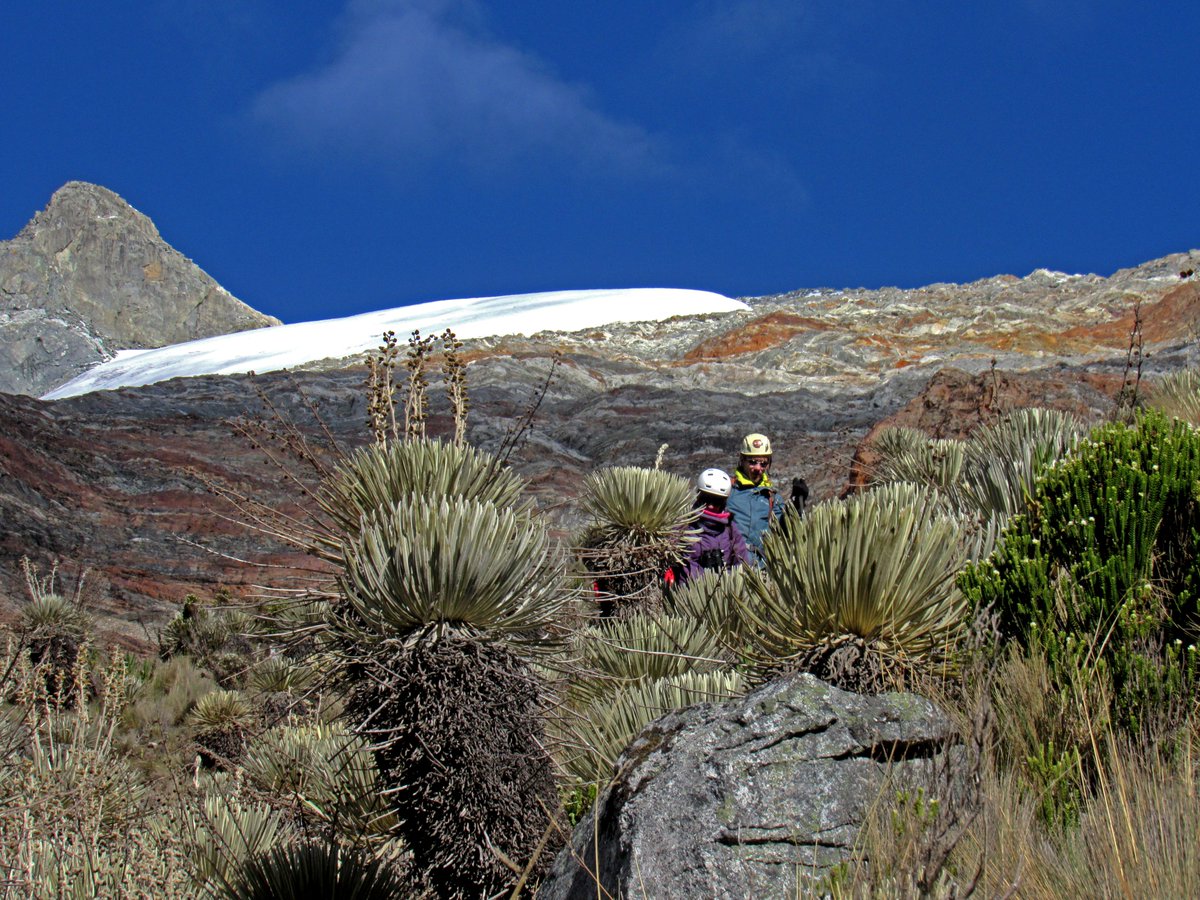
From base camp, there is a climb trail of 2 Km to the periglacial area from where you can see up close the glacier and the top of Humboldt’s Peak.
📷: L. D. Llambí
Most common routes to climb the Humboldt´s Peak are: starting in la Mucuy, with an approximated trail of 10 km inside cloud forest and ascending to paramo from 2000 m a.s.l. to base camp at Laguna Verde at 4000 m a.s.l.
Another route is starting at Pico Espejo (currently not habilitated) using the cable car system of Merida city, ascending from Barinitas station (at 1577 m a.s.l) to Pico Espejo station (at 4765 m a.s.l.) and then a trail of 6.5 Km to Laguna Verde.
Desde el campamento base son cerca de 2 Km en ascenso hasta el área periglaciar, desde donde se puede observar de cerca el glaciar y la cima del pico Humboldt.
📷: L. D. Llambí
Las rutas más usadas para llegar al glaciar del Humboldt son vía La Mucuy, con un recorrido de aproximadamente 10 Km entre selva nublada y páramo, ascendiendo desde los 2000 m s.n.m. hasta el campamento base en la Laguna Verde a 4000 m s.n.m.
Mapa: @alejalucero
La segunda es vía Pico Espejo (no habilitada actualmente), usando el sistema Teleférico de Mérida, ascendiendo desde la estación Barinitas (1577 m s.n.m.) hasta la estación Pico Espejo (4765 m s.n.m.) y un posterior recorrido de 6.5 Km hasta el campamento base en la Laguna Verde.
But after hours of walk, that sometimes feel like days, your mind says that it is possible to continue. You will arrive to that place where Venezuela’s #LastGlacier rests. Climb up there isn’t easy but to see the glacier so close puts aside all the tiredness.
📷: L. D. Llambí
Humboldt Peak’s glacier is at 4950 m a. s. l. Ascending to this wonderful place isn’t easy. Your body feels how the air becomes rarer while you ascend, your heart beats quickly and each step is harder than the last one.
While you put on more and more layers of cloth, your fingers feel like it isn’t enough, but with more layers of cloth on your mobility is limited. The weight on your shoulders pushes you down when you’re trying to climb up.
Pero tras horas de caminata en la alta montaña, que parecen días, la mente supera al cuerpo: es posible, llegarás a este sitio único donde se encuentra el #UltimoGlaciar de tu país. Llegar es difícil pero ver el glaciar tan cerca elimina cualquier malestar.
📷: L. D. Llambí
A 4950m s.n.m. se encuentra el glaciar del pico Humboldt. Al ascender, tu cuerpo siente el aire enrarecido, el corazón late muy rápido, cada paso es más pesado que el anterior.
Mientras te pones más y más abrigos para combatir el frío de la montaña, tus dedos te recuerdan que no son suficientes, pero tantos abrigos también limitan tu movilidad. Los kilos sobre tus hombros te empujan más hacia abajo que al frente.
We also take all necessary measures to minimize the negative effects on the ecosystem both during our field work and on the camp sites that are our home during the expeditions.
📷: Eloy Torres
In our #LastGlacier project, we have a ‘minimal intervention’ policy of our study area. We focus our scientific work on the periglacial area where we work with the least possible impact on fauna and flora of the area.
📷: Eloy Torres