A months-long Sky News investigation into the US double-tap strike on a Minab girls' school found the Pentagon had tracked the site by satellite since 1987 and could still count children's shadows in the courtyard before firing anyway.
What the evidence shows:
Three Tomahawk missiles fired from the USS Spruance, 716 kilometers away in the Arabian Sea, hit the Shajareh Tayyebeh Elementary School in Minab on Feb 28, the opening day of the US-Israeli war on Iran. Witnesses described a second strike hitting the exact spot where a teacher had moved surviving students for shelter, killing nearly everyone who had taken cover there. A third strike followed on the same site. Death tolls range from 156 to over 170, most of them girls aged seven to twelve. The school had been walled off from the adjacent IRGC naval base since at least 2015, had its own website, and was geolocatable through open-source materials any analyst could have pulled in minutes.
Built to fail:
The Pentagon's own machinery for preventing exactly this outcome had already been dismantled. Defense Secretary Pete Hegseth slashed the Civilian Protection Center of Excellence workforce by roughly 90 percent and cut CENTCOM's civilian casualty assessment team from ten people to one, months before the war started. A May Pentagon Inspector General report found the office had become a shell on paper with no budget, no mandate, no real mission. A functioning warning system was defunded on purpose, then blamed for not warning anyone.
Accountability buried:
Four months on, CENTCOM's commander told reporters the investigation was near complete, yet nothing has been released. Asked in June whether anyone would face consequences, Trump called it a strange question, adding that mistakes are made and war is nasty. The mistake was choosing not to fund the office that exists to catch mistakes like this one.
My take: A military that surveilled a schoolyard for four decades didn't fail to see the children, it decided in advance that seeing them wouldn't change the targeting. Nobody in this chain lacked information.
"If the plans that are currently being elaborated for Gaza go forward, genocide may come to be seen by some nations as the legitimate and lucrative extension of politics by other means." https://t.co/l8o0202i1Y
Ursula von der Leyen has confirmed that everyone in the EU will need to use the EU's app for identity authentication before being able to access or post on social media websites.
🇪🇺 As an expert in online child safety, I am here to expose the misinformation and misdirection in von der Leyen's statements.
Today von der Leyen said:
"This is not about whether children can access social media, it is about whether social media can access our children".
💡The first part is true. This isn't about children. It's about surveillance and combating political dissent. A state that can't control its own citizens is more dangerous than a state rife with criminals. The second part is a PR soundbite that politicians are using like a campaign slogan straight out of 1984.
🇪🇺"The question is no longer if children face risks online, but what can we do to give children a safer start online".
💡No. You can't give children a "safer start" online any more than you can offline. In the offline world, the government doesn't enforce curfews or ban children from entering liquor stores, bars or restaurants. That's a parent's responsibility. The digital world should be no different.
🇪🇺"The age verification app is one of the tools to get it done".
💡This is a contradiction because she also said "It won't be foolproof".
🇪🇺"It's easy to use, it is privacy preserving and it is open source".
💡The app was compromised as soon as it was released. "Privacy-preserving" age verification is an oxymoron. You can't verify a person's age without verifying their identity. Where or how that age is shared afterwards is irrelevant.
🇪🇺"This is basically about putting back the power into the hands of parents".
💡More from 1984. The EU is doing the opposite. Parents are having their authority stripped by politicians who think they know better. Many parents are capable and unaffected by peer pressure, and they know how to use parental controls to block any app classified as 13+. Some teens are safe, their parents trust them, and the state has no business overruling that trust.
🇪🇺"We don't give our children keys to the car before they have their licence"
💡Comparing an app to a car is a false equivalence used to justify mass surveillance. Governments don't decide when a young person is ready for car keys, guardians do.
💡Forcing every adult and child into a biometric checkpoint just to use an app or website is not licensing drivers. It's the state seizing everyone's keys, locking the garage, and forcing every driver to ask a private company for permission to take a drive.
💡 This is a gross, unethical overreach that strips authority from parents while imposing state sanctioned identity verification on every adult who doesn't even have a child.
💡Additionally, people who pass a test, obtain a licence and drive a car aren't forced to use an app to constantly authenticate their suitability to drive.
🇪🇺"We do not let them buy alcohol until they are legally allowed"
💡False equivalence. We don't force every person to show ID at a shopping mall entrance just because a few people might buy alcohol with a meal at a restaurant. Some parents are okay with their 12 year-old going to the mall with friends while others aren't. Either way, it's their choice. Whatever irresponsible decisions some parents might make, every adult in the country shouldn't be forced to pay the price.
🇪🇺"It won't be foolproof"
💡This is all the proof we need to show that the EU and every government know that banning social media for teens won't protect them. When pressed by journalists about VPNs being used to circumvent a ban, politicians always state the ban isn't a silver bullet and will take time. The Mayor of London, Sadiq Khan went as far as to say "we know it's not the solution".
💡Either age verification works, or it doesn't. As a technical expert in this space, I can tell you there are no additional steps to take and no progress to be made. Either the approach does what it is supposed to do, or it's not fit for purpose. If they claim a bulletproof solution is coming, it can only mean one thing. They intend to ban or restrict VPNs to people who verify their identity.
🇪🇺"It will take time to invite the cultural change that is already taking shape in our society, just as it took time to outlaw drink driving, just as it took time to use seatbelts in the cars. Great change never happens overnight, but when it comes to our safety it is always worth it".
💡Comparing a social media ban and age verification to seatbelts is a completely broken analogy. Seatbelts are a safety feature that protects children while allowing them to travel in a car. A ban doesn't give kids a seatbelt. It kicks them out of the car entirely.
💡Instead of supporting parents who want to guide their own children through the digital world, this heavy-handed law strips away parental authority by banning the apps and websites that many parents are perfectly fine with and actively monitor.
💡Furthermore, enforcing these bans requires biometric age verification, which means forcing millions of adult citizens to scan their IDs, faces or credit cards just to browse the internet. That isn't a common-sense traffic law.
💡It's a digital checkpoint on every street. True safety means teaching kids how to navigate the digital world safely with real guardrails and parental guidance, not burning down digital spaces for everyone under the guise of protection.
🇪🇺☠️ The EU wants to ban teens from social media so every person is forced to verify their identity before they can read, share or post anything online. In their words, this is to protect children from dangerous content.
🇪🇺☠️ The EU wants to enforce "Chat Control" so every app has to monitor everything people say privately inside it, including apps with end-to-end encryption. In their words, this is to protect children from dangerous criminals.
💡Where this ends
🇪🇺 "If you want a picture of the future, imagine a boot stamping on a human face - forever".
George Orwell, 1984.
I don’t know who needs to hear this but if the government has the power to freeze your personal financial accounts simply because you express a political opinion that they do not like, then you are neither free nor living in a democracy.
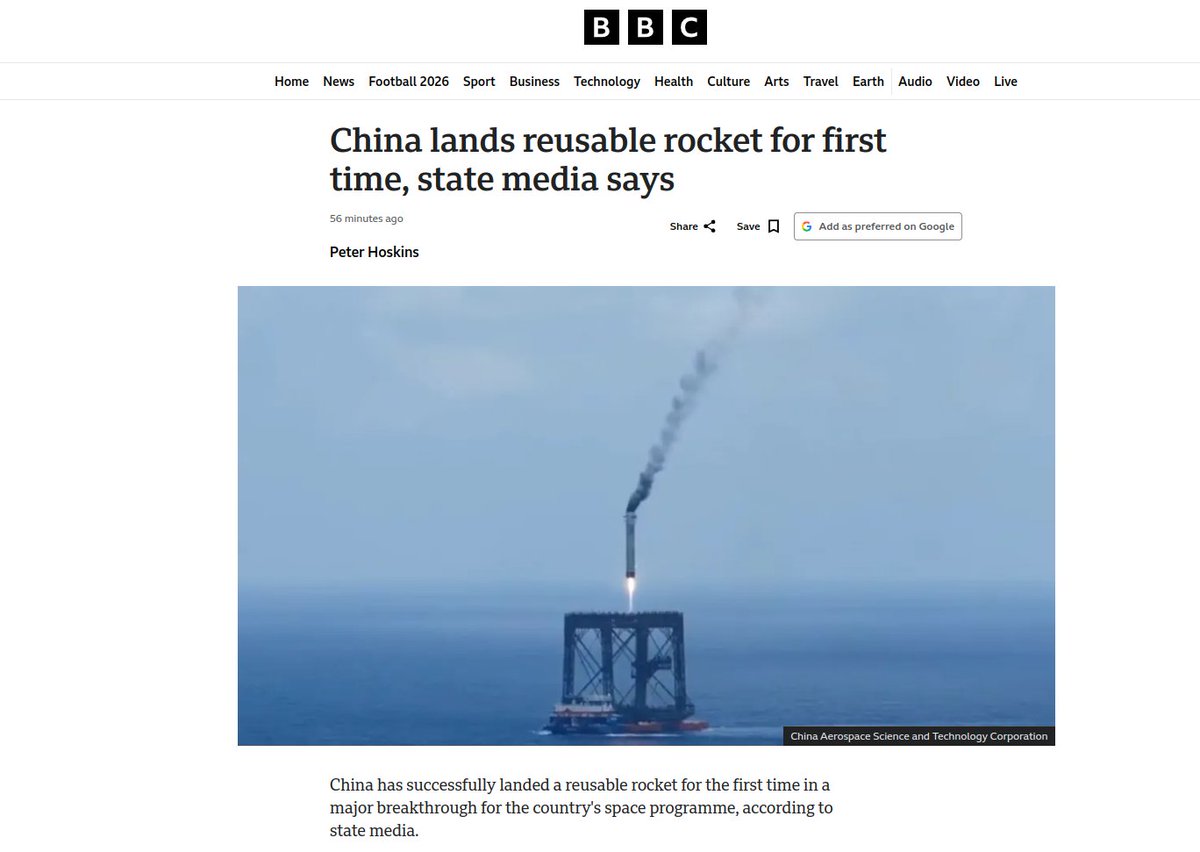
🇨🇳China Lands First Stage Rocket For First Time - Only the 2nd Country to Do So After the US
▪️China's state enterprise, China Academy of Launch Vehicle Technology (CALT) has successfully launched and recovered the first stage of its Long March 10B carrier rocket;
▪️The first stage successfully helped launch a functional satellite payload into orbit before guiding itself to a recovery ship at sea where it landed under its own power;
▪️Note how nasty the BBC is - "state media says," as if it might not actually be true - despite literal video footage of it doing so;
▪️China has surpassed the US by virtually every conceivable metric with few exceptions including space launch capabilities, AI, and several others - however today's success poises China to inevitably surpass the US in this realm as well- with all other gaps closing also;
▪️Imagine if US leadership (corporations/policymakers/politicians) weren't so obsessed with power and profit and infected with a false sense of superiority - what the US and China could achieve together?
▪️Unfortunately - while the world should cheer on these successes as collective achievements for humanity - the US will only see this success as impetus for increased aggression, confrontation, propaganda, and chaos...
Some thoughts on the current situation around the war
📌Putin appears to believe that Russia is winning and will ultimately win the war. In his view, taking Donbas is only a matter of time. He seems ready to pay almost any price to achieve that goal because he sees it as an existential issue for Russia. Those who expect that increasing pressure on Putin will create more room for negotiations are likely to be disappointed. More pressure is more likely to lead to further radicalisation in Moscow and a stronger military response.
📌Economic difficulties, which are becoming more serious, together with battlefield losses and the fuel crisis, are unlikely to make Putin reconsider his approach to the war. Instead, they are more likely to harden his position, encourage further escalation, and increase the risk of scenarios that many have previously dismissed as bluff.
📌There is a growing gap between the political leadership and the rest of the country, particularly the business community, which increasingly wants the war to end. At present, there is little room for internal debate or for questioning Putin’s course. Instead, the leadership appears committed to further escalation, with no clear limits. This is likely to make these internal contradictions more acute over time.
📌Ukrainian strikes inside Russia are strengthening anti-Ukrainian and anti-Western sentiment, making it easier for the Kremlin to justify further escalation. At the same time, Russian public opinion is divided. Some argue that the war should end roughly along the current front line, while others call for far more extreme measures, including the destruction of Kyiv, the use of nuclear weapons, and mass violence against Ukrainians. A prolonged war of attrition will further strengthen both camps.
📌The year 2026 appears to be a particularly important stage in the war. For the first time, the cumulative effects of the conflict are having a visible impact on Russia’s domestic situation, raising questions about the state’s ability to continue functioning in the same way. This weakens Putin politically, but it also appears to make him more radical, contributing to a growing sense among parts of the Moscow elite that a catastrophe may be approaching.
📌There is a strong and growing expectation that significant changes lie ahead. There is little understanding on what form they will take, who will drive them, or how fast they may begin. However, there is an increasingly widespread belief that, if the current war of attrition continues, Russia’s resources will come under growing strain, while the economy remains constrained and growing numbers of businesses become unviable.
The overall conclusion is that two processes are unfolding at the same time: increasing external escalation and deepening internal contradictions. The West should be prepared for unexpected developments.
Europe’s red heat maps show the Urban Heat Island effect, not cLiMaTe ChAnGe.
Copernicus satellites recorded a land-surface temperature gap of about 23C between urban areas and nearby forests. In Belgium, the city of Brussels reached 47.4C (117.3F) while the adjacent Sonian Forest sat near 24.5C (76.1F).
Full breakdown (and more) in today's Substack: https://t.co/6Wkf3MSp5B
If you were to write this headline or article in a variety of US, UK, German or French media outlets, your career might be on the line and you’d probably be accused of antisemitism.
And yet the author of this piece is a former prime minister for Israel.
https://t.co/xUqPAHxsab
This is a really fascinating paper that everyone interested in China's industrial policy should read.
It destroys so many myths (see below), and is written by deeply credible people who conducted over three years of fieldwork in China and interviewed 60+ Chinese officials, entrepreneurs, and engineers. When it comes to China studies, it literally doesn't get more rigorous than this.
First myth it destroys: contrary to popular belief, Beijing's industrial policy didn't build the companies that became China's EV champions. They rose largely **despite** it, through its cracks.
For sure, Beijing did favor EVs as an industry and pushed hard for it but their big bet was SOEs (State Owned Enterprises): research grants, pilot programs, licenses, cheap credit - virtually all of it flowed to state firms.
The result? China's actual EV champions - BYD, Geely, NIO, XPeng, Li Auto, etc. - are overwhelmingly private firms that succeeded despite Beijing favoring their SOE competitors.
How so? Because, when favoring SOEs, the central government didn't just pick winning companies, it picked winning cities, each SOE being anchored in a specific city: Shanghai (SAIC), Changchun (FAW), Wuhan-Shiyan (Dongfeng), etc.
Which means that every city not on the list, that wanted a piece of the auto boom, had only one option left: team up with private entrepreneurs who were equally excluded from central government favor.
That's what truly fueled China's EV miracle: an alliance of the excluded, between local private entrepreneurs and local mayors.
This is the biggest misconception this paper destroys: the reality is that the "Chinese state capitalism" that many in the West think powered the EV boom actually tried to block many of these companies from existing. In effect, it was closer to an obstacle course that local actors (mayors and provinces) learned to game.
Geely - now the third largest automaker in China - is a fantastic example of this.
First of all, it started off illegal since, to build passenger cars, you had to have a central government license and they couldn't get one. Zhejiang Province told them to go ahead regardless because the province had hundreds of auto parts suppliers but no carmaker of its own.
It's only a couple of years later, recognizing the fait-accompli that Geely was producing cars and was competitive, that the central government admitted them to the National Sedan Catalog - effectively legalizing them retroactively because there were facts on the ground.
Then there was the Volvo acquisition in 2010, which is fair to say - looking back - proved to be the most strategically valuable acquisition in Chinese automotive history. Despite it being presented at the time (and still described this way today) as "China buying Volvo", all 3 major state-backed banks in China (Export-Import Bank, China Development Bank, Bank of China) refused to finance the deal. The only state-bank money Geely managed to get was a $200 million loan from a provincial branch of China Construction Bank - a tiny fraction of what the deal required.
Geely actually did the deal with Goldman Sachs money via Hong Kong plus loans and equity from four local governments (Chengdu, Zhangjiakou, Daqing, Shanghai's Jiading district), each of which bought in by securing a Volvo plant or headquarters for itself.
In effect, the doors that Beijing controlled were largely closed to Geely, but it made it because the doors subnational actors controlled were opened.
Which all means this paper destroys another very common myth: the big merit of the central government in all this was to be relatively chill about it, to NOT be dictatorial.
I just imagine if that had happened in France and you had - say - the mayor of Lyon or Marseilles open, fund and promote an unlicensed carmaker against Renault: the préfet would shut it down within weeks, and the mayor would be lucky to escape prosecution.
That's the irony: on industrial policy, the supposedly "totalitarian" Chinese state proved more tolerant of local defiance than most Western liberal democracies would be. Beijing's greatest contribution to the EV miracle wasn't the plan - it was looking the other way while the plan was being violated.
To be sure, the paper doesn't hide the costs of this system: ferocious local competition also produced what's known today in China as "involution" (内卷-Neijuan, basically a hypercompetitive price war), as well as some spectacular failures. For instance one county lost 6.6 billion yuan on a carmaker that never really made cars.
But that's precisely the point: this is a high-risk, high-reward model of decentralized experimentation, the very opposite of the careful central planning Westerners imagine.
I've repeated this countless times but it bears repeating again: the single greatest misconception people have about China is - probably because we wrongly associate communism with centralized control - that it is a monolith run from Beijing. Some even say it's run by "one man."
The reality is the exact opposite: China is, in practice, one of the most decentralized countries on earth. Roughly 85% of government spending in China happens at the subnational level - against about 30% in the average OECD country (and even less in France, which is actually one of the most centrally controlled countries on earth). A Chinese mayor commands fiscal resources, land, investment funds and policy latitude that virtually no Western mayor could dream of.
Last but not least, I'd be remiss not to mention what the paper has to say on the positive legacy of Mao and its role in the rise of EVs (given I myself wrote an article titled "Mao's economic record wasn't bad, actually": https://t.co/1NZgHqBHwg).
When it comes to China myths, none is more entrenched than the idea that Mao left behind nothing but ruins.
This paper confirms a key argument of my article: Mao's deliberate dispersal of industry across China (during the Great Leap Forward and Cultural Revolution decentralizations) left dozens of cities with their own small auto works. Inefficient, yes - but these scattered factories survived into the 1990s and became the seed stock of everything that followed: the industrial base, the engineers, and the production licenses that EV startups would use to enter the market.
The paper even says it outright: the fragmentation that industrial policy "sought to eradicate" is "precisely" what "ironically enabled" the EV sector's rapid rise.
This is exactly the mechanism I described in my Mao article: structures built in the Mao era - communes becoming township governments, commune enterprises becoming TVEs, Third Front factories seeding interior industrialization - became load-bearing foundations of the reform miracle.
Fittingly, the spark for China's first municipal carmaker adventure was literally a TVE (Township and Village Enterprise), the institutional descendants of Mao's commune enterprises: Tongbao, a kit-car maker in Wuhu whose success stunned local officials into building what became Chery (one of China's biggest carmakers today). You can't tell the story of China's EV miracle without crediting the legacy of Mao.
What's the biggest lesson in all this for Western policymakers?
The obvious one is that the part of industrial policy that most people assume China does and that they sometimes want to copy - i.e. the state picking winners - is actually the part that failed.
The part that did succeed is the China nobody in the West believes exists: a radically decentralized system with a high degree of tolerance for disobedience and experimentation.
We imagine China as a country where nothing happens without Beijing's approval when the reality is closer to the opposite: China's EV miracle happened precisely because localities asked for forgiveness rather than permission.
All in all, and this is the lesson I often come back to, this is yet another illustration of the importance of understanding China for what it is as opposed to the caricature we've built of it. This matters whichever "camp" you're in. If you see China as a rival, you can't compete with someone you don't understand. If you see them as a source of lessons, you can't emulate what you've misunderstood. Whatever you want from China - to compete with it or learn from it - the entry fee is the same: genuinely understanding it.
Ukrainian drone strike destroys Franz Roubaud’s giant 1904 painting at the Battle of Sevastopol Panorama, Crimean city’s main landmark, the Russian-imposed authorities say. One of the world’s best known piece of battlefield art and Ukraine’s own cultural heritage.
Gaza: “Nearly eight months have passed since the announcement of a ceasefire, and there is no end in sight for the killings, the turmoil and the misery.”
@UNHumanRights says Gaza’s public servants are being systematically targeted in Israeli strikes.
https://t.co/b8ZcCC3o5o
In 2013, two former US national security officials – Flynt Leverett and Hillary Mann Leverett – published a book called Going to Tehran (which @s_m_marandi has been telling us to read for a long time!)
In it they argued, on the basis of insider experience, that the United States was making a strategic mistake of historic proportions in its policy towards Iran; that the Islamic Republic was a stable, legitimate, rational political entity; that decades of US sanctions, isolation and threats would fail; that Iran would emerge from any direct confrontation stronger, not weaker; and that the only rational US course was the kind of grand rapprochement Nixon achieved with China in 1972.
The US foreign policy establishment declined to read it. Months into a war on Iran that the US is manifestly losing, every one of the Leveretts’ predictions has come to pass – and the establishment is implicitly conceding it. Robert Kagan in the Atlantic. Gideon Rachman in the Financial Times. Dan Shapiro in the Washington Post.
In this video I review Going to Tehran, explain its central arguments, and make the case that it is one of the most important unread books of the twenty-first century.
https://t.co/QiIxvUnGWs
Iran has included three important tests within the terms the MOU it is negotiating with the United States. These tests are intended to give Iran's leaders confidence that Trump, a counterparty they see as highly unreliable, is ready to make credible commitments, opening a pathway for further diplomacy.
First, the Iranians are testing the credibility of American security commitments by insisting that the MOU encompasses a Lebanon ceasefire. They are not doing this for the sake of Hezbollah or Lebanese Shias. Rather, they want to see if Trump can restrain Israel in its own backyard. If Trump is able to do that, then he might be able to defend his own deal with Iran from further Israeli sabotage.
Second, Iran is insisting on a nominal fee for vessels passing the Strait of Hormuz. This is not because they want more revenue, which would be negligible. They are insisting on this arrangement because they want to test whether Trump will endorse a deal that includes a clear instantiation of Iranian sovereignty and authority, especially one that did not exist before the war. Iran believes in the logic of a win-win agreement. Trump does not. Forcing him to accept a fee forces him to give Iran a "win" and to defend it as such from the Iran hawks in his circle. This is politically meaningful.
Finally, Iran is insisting on a the release of frozen assets. The sums in question are a tiny fraction of the economic cost of the war and the release of assets is not as valuable as sanctions relief that Iran will also be targeting. But by insisting on the release of funds at an early stage of the negotiations, Iran can test whether broader economic commitments, such as sanctions relief, will be credible. Iran will only consider the promise of sanctions relief to be credible if Trump's sanctions bureaucracy allows Iran to move and spend its own money. The Iranian side will insist on transactions that push the Trump administration to set new precedents for how sanctions relief can be operationalized, especially through guidance to banks.
For many in Washington, these demands seem unreasonable. But that is entirely the point. Iran's leadership won't tolerate a kind of narrow deal that allows U.S. policymakers to avoid putting political capital at stake. Iran wants a deal that reflects the unprecedented nature of the war and ensuing crisis. To meet the moment, the diplomacy has to be transformative.
Iran's leaders don't trust Trump, so they are testing him. So far, he is failing these tests.
The coming military and psychological unravelling - Tet v2?
Late 1960’s, America at the zenith of its power, its economy dominated, military unstoppable, confidence unshakable. The Vietnam war was going swimmingly, MacNamara’s body counts were the proof of it. Then came Tet.
January 30th, 1968, Tet, the Vietnamese lunar new year. On that day and the next North Vietnamese and Viet Cong forces launched coordinated attacks on over 100 cities, and hundreds more rural sites, across South Vietnam. It was not merely a surprise attack, but a fundamental inflection point. The Viet Cong struck everywhere at once, proving they were not a ragtag insurgency, peasants in sandals, but a coordinated, disciplined force with sophisticated low-tech commincation and coordination networks. They eventually lost the battles, yes, but they shattered the myth of American invincibility. The psychological blow was irreversible. Public trust collapsed. The war wasn't lost on the battlefield that week; it was lost first on the 6 o’oclock news, and then in the American mind.
That is the lesson we miss when we reduce Tet to just a "surprise." It was the moment the trajectory of American power bent. Not because the U.S. stopped winning battles, but because the world, and Americans themselves, realized victory was not just a question of firepower, and was not inevitable.
Today, we seem to be approaching a similar inflection point in the Gulf. Not a repeat of 1968, but a parallel unraveling. American power projection, naval dominance, air superiority, deterrence credibility, is being tested in real time. The contemplated land operations, Kharg Island, Hormuz, wherever, carry the same hubris that marked early Vietnam: assumptions in the Trump administration of quick success, underestimation of adversary resolve, and overreliance on technology against an enemy that thrives in ambiguity and asymetric warfare.
The difference now is the psychological context. In 1968, many Americans doubted the war's morality, but no one doubted their nation's raw power. Today, social media and fragmented news mean more people see the cracks: stalled initiatives, diplomatic friction, asymmetric losses. Yet for many leaders, and for the archetype of the "average American" still shaped by post-Cold War triumphalism, the idea of a swift, visible military debacle remains unthinkable. Despite Vietnam. Despite Iraq and Afghanistan. Despite the American helicoptors in Iran in 1979 or “Black Hawk Down”. The new Tet moment has not yet arrived. In the American mind, all of the above failures were somehow due to individual failures, lack of resolve or coordination, the hippies, Carter or Biden’s weakness, … It hasn’t arrived yet, but all indications are that the next Tet is approaching very fast. A military disaster is already unfolding but it is gradual, there are no headlines (yet?) saying “TODAY WE LOST”. A large military operation in the Gulf involving thousands of troops could well be that moment. Geography, logistics, fighting spirit, and for once possibly even technology, all favor the Iranians. Drones, missiles, mines. Lack of air defense. Shore versus ship. Improvisation and lack of detailed planning. An American command structure without real experience in modern warfare. It all adds up. Hegseth’s 10,000 targets as the modern version of MacNamara’s body counts. The coming days or weeks could deliver this new Tet moment. A failed operation. A strategic miscalculation that exposes limits. An outcome that cannot be spun. In a hyper-connected age, the perception shift would be instantaneous. The already threadbare myth of omnipotence would fracture not over months of coverage, but in hours of viral footage.
If January 30, 1968 marked the peak before the long decline of American unquestioned authority, then the Gulf today may be where that curve bends again. Not because America is now weak, but it is unquestionably weaker. And the world has changed, adversaries have learned and adapted. The question isn't whether the U.S. can win a battle, the coming operations might even initially be successful, it's whether the American psyche can absorb a strategic setback without overreacting.
We may be days or weeks from that pivot. Not a surprise, but a culmination. Tet didn't create the American crisis in Vietnam; it revealed it. The Gulf's Tet will fully reveal the limits of the old America-centric world order. And when that moment comes, it remains to be seen whether America can face the new reality without losing its bearings.
Substack 👇👇👇
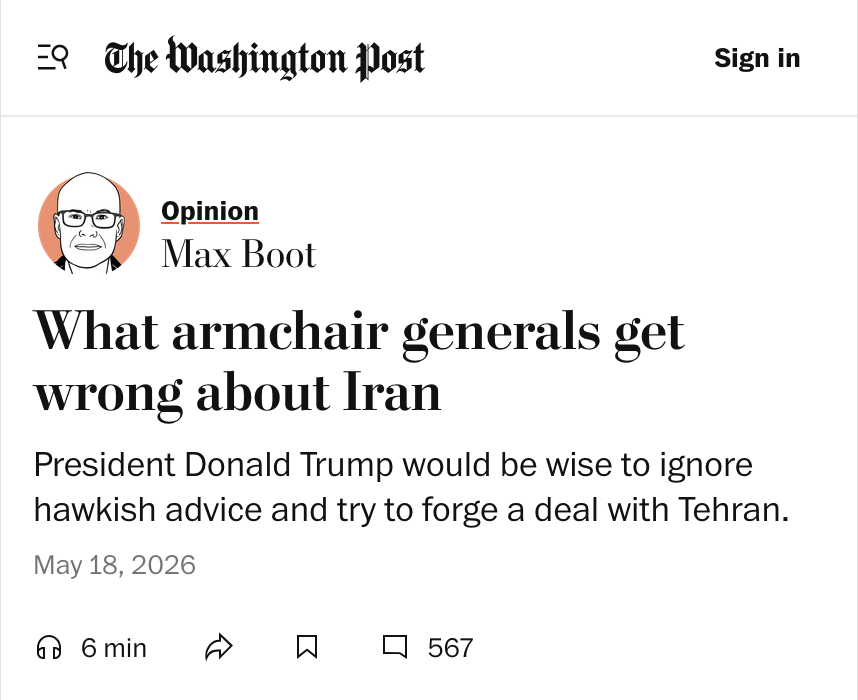
👇One of the most important points in this @MaxBoot piece is retired Adm. James Stavridis's assessment of what reopening Hormuz by force would actually require.
Stavridis isn't an armchair pundit. He is a former NATO Supreme Allied Commander Europe.
His estimate: a carrier strike group, dozens of warships and aircraft, minesweepers, and 5,000-10,000 troops.
And even then, as this war has shown, Iran doesn't need to defeat the U.S. military. It only needs to create enough risk and uncertainty to disrupt shipping and energy markets.
In this scenario, Iran would be able to more easily hit these U.S. targets in the Persian Gulf, and could still threaten traffic in Hormuz from deeper inside its territory.
That's the reality many hawks ignore: there is no feasible military solution to Hormuz.
"All governments suffer a recurring problem: Power attracts pathological personalities. It is not that power corrupts but that it is magnetic to the corruptible."
— Frank Herbert, Dune
In 2016, the Netherlands Meteorological Institute adjusted temperatures at De Bilt, the country's main climate station. Daily maximums from 1901 to 1950 were lowered by up to 1.9C, which removed 16 of 23 heatwaves from the record.
The altered data were then used to claim modern heatwaves were unprecedented.
Four researchers challenged the changes, but the institute dismissed the criticism, so the analysis went to peer review. In 2021, it was published, conclusively demonstrating the method systematically erased historical heat extremes.
Today, the Meteorological Institute has quietly changed its approach, and as a result, seven erased heatwaves have been restored, including the extreme summer of 1947.
Here again, we have a government agency caught rewriting climate history. The Netherlands Meteorological Institute erased heatwaves of the past, ignored critics, and reinstated the truth only when the evidence became impossible to ignore.
Policies were built on that manipulated record.
Dutch farmers lost livelihoods.
Industry and the wider economy paid the price.
But accountability is coming.
If you wonder why Zelensky bothered with the reburial and glorification of Andrii Melnyk, the leader of the more Nazi‑collaborationist wing of the OUN, to the right of Bandera's wing – a seemingly unnecessary symbolic move, predictably harmful for Ukraine’s fading international sympathies and already provoking scandal with Poland and Israel – here's the answer. When the majority does not want to fight, you have to sustain the mobilized minority, who must be constantly reassured that they are fighting not just for this corrupt government.
Delivering something substantial on integration into EU and other Western transnational structures is much harder, often impossible, and cuts against powerful vested interests in Ukraine, as the permanent conflicts around IMF and EU requirements show. Delivering to ethnonationalists and the far right is much easier: glorify collaborationists, eradicate everything Russian and Soviet from public space, rewrite history, rename streets, dismantle the remaining monuments. This does not necessarily respond to direct pressure or concrete demands. In a situation where the majority will not fight even for higher pay (this is not Russia), there is a need to reassure – and to keep raising the stakes for – those who are ready to fight that their sacrifices are not in vain, but for “the Ukraine of their dreams.”