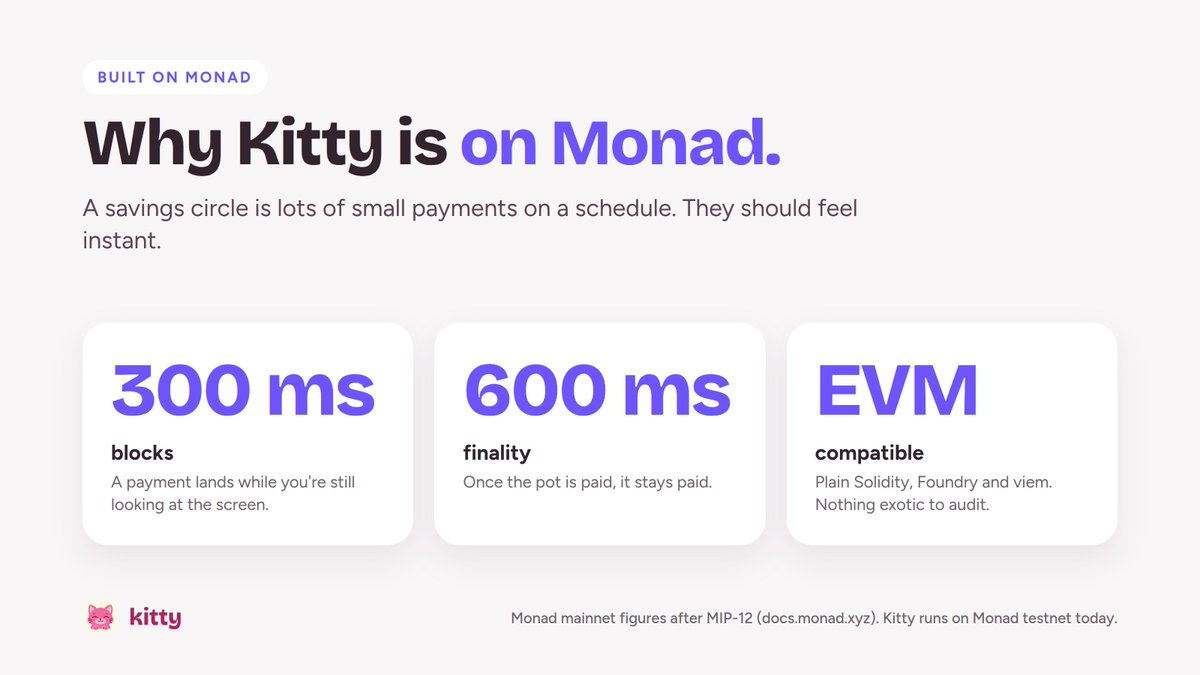
Why build Kitty on @monad?
A savings circle is a lot of small payments on a schedule. Monad gives us ~300 ms blocks, ~600 ms finality and the EVM we already know.
Paying your round should feel like tapping a button, not waiting on a blockchain.
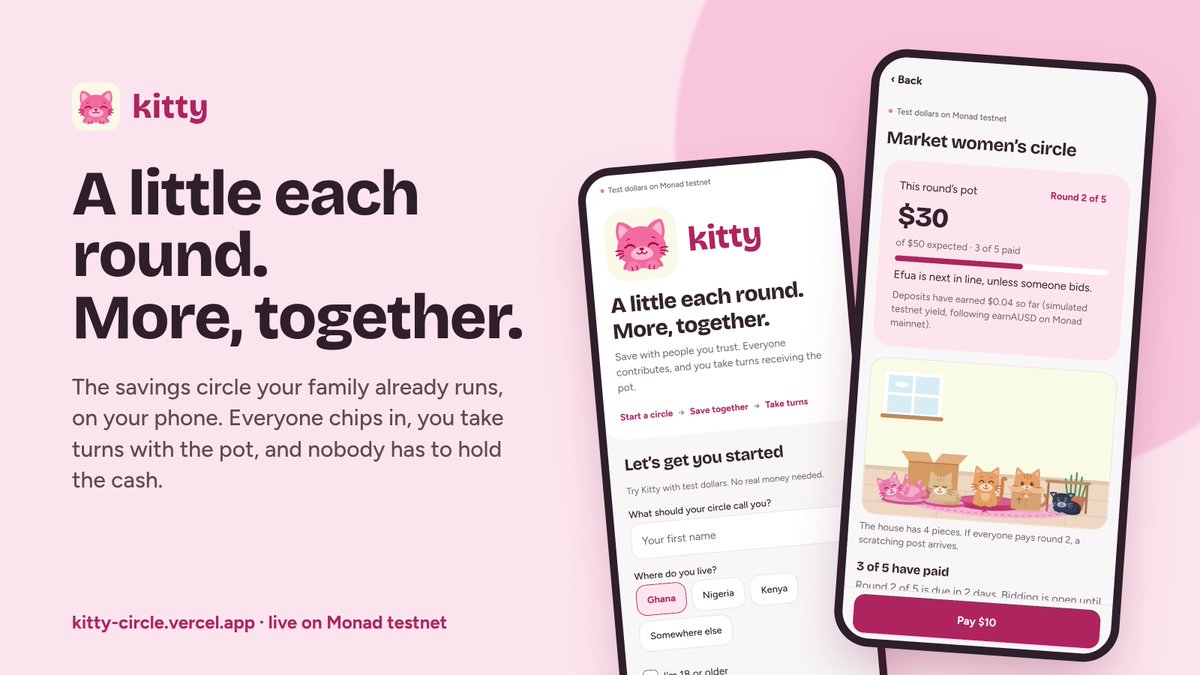
Meet Kitty 🐱
The savings circle your family runs, but on your phone.
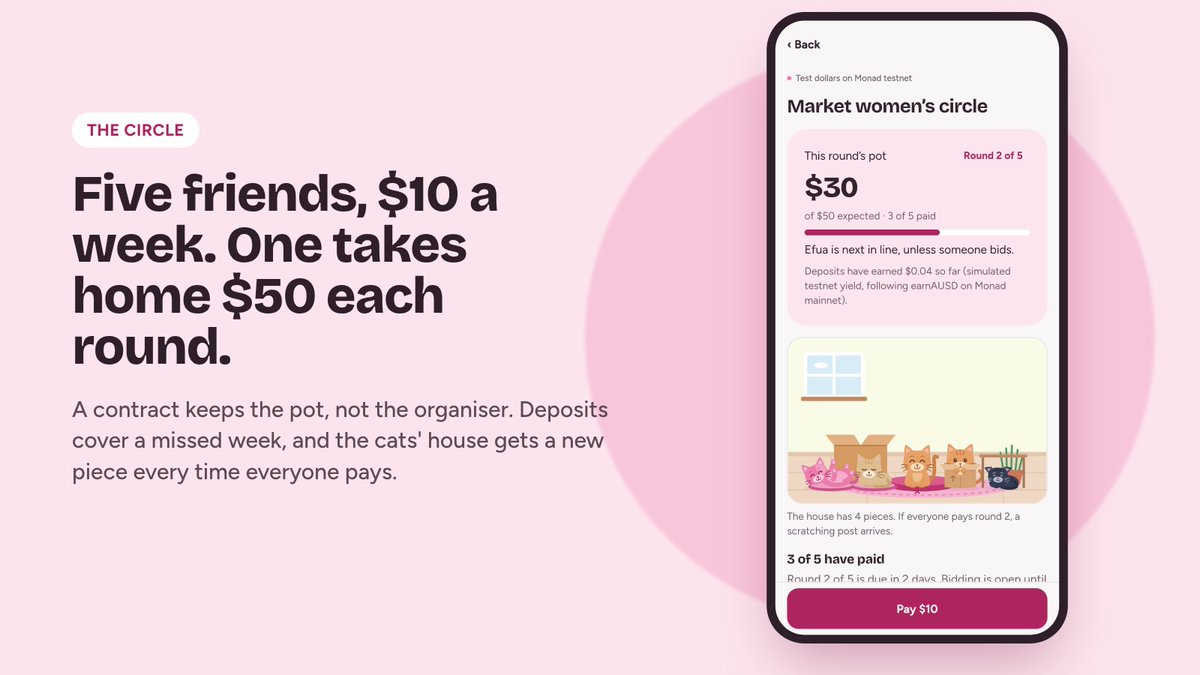
Everyone chips in. You take turns with the pot. A contract holds the cash, not a person.
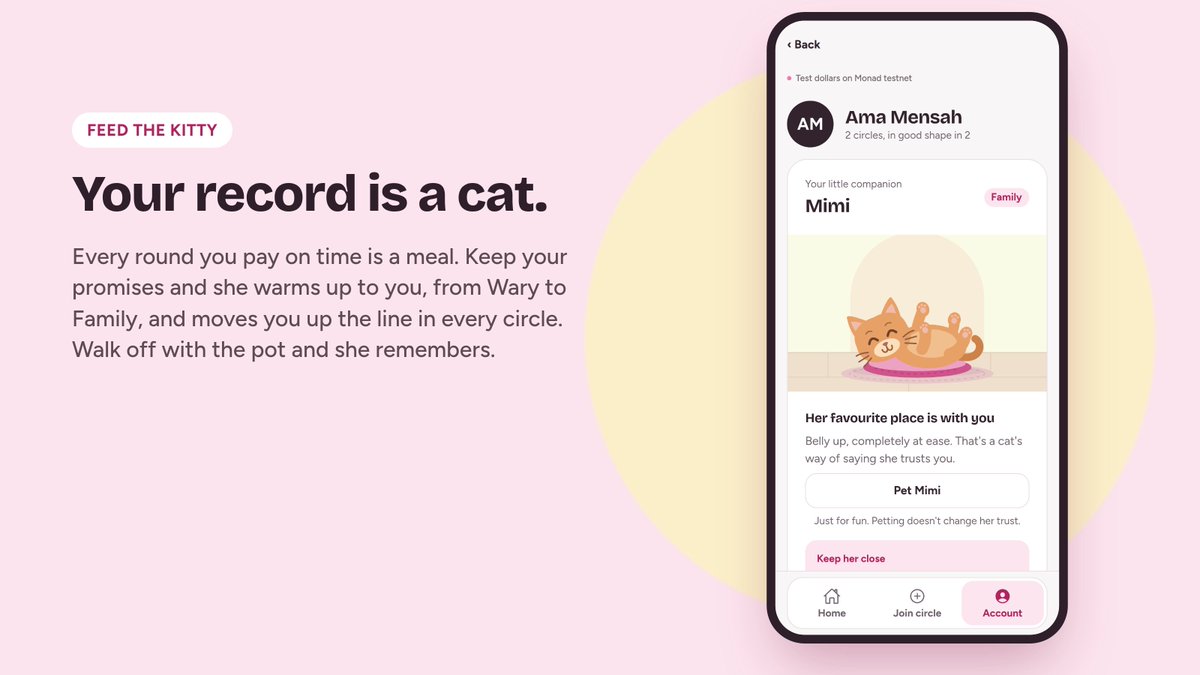
Pay on time and your cat learns to trust you.
Live on @monad testnet:
https://t.co/cya5yhztG2
A small update but there have been some major changes to the SDK especially to improve its performance. Still working on getting this out as soon as possible.
The demo of the first game built using the SDK is finally out! Do check it out alongside the repo and source code of both the game and the v1 of the sdk.
A separate repo will be created for just the SDK soon.
Game : https://t.co/SpHweUFcMM
Repo : https://t.co/m96o1UeV7I
Missed the Blitz submission deadline, but still wanted to share what I built.
Umpire is an SDK for building private, verifiable multiplayer games.
The basic idea is that players shouldn’t have to fully trust a centralized server with the rules, hidden game state, or the final outcome.
Umpire handles things like deterministic game logic, private views for each player, match flow, replays, reveal, verification, and settlement.
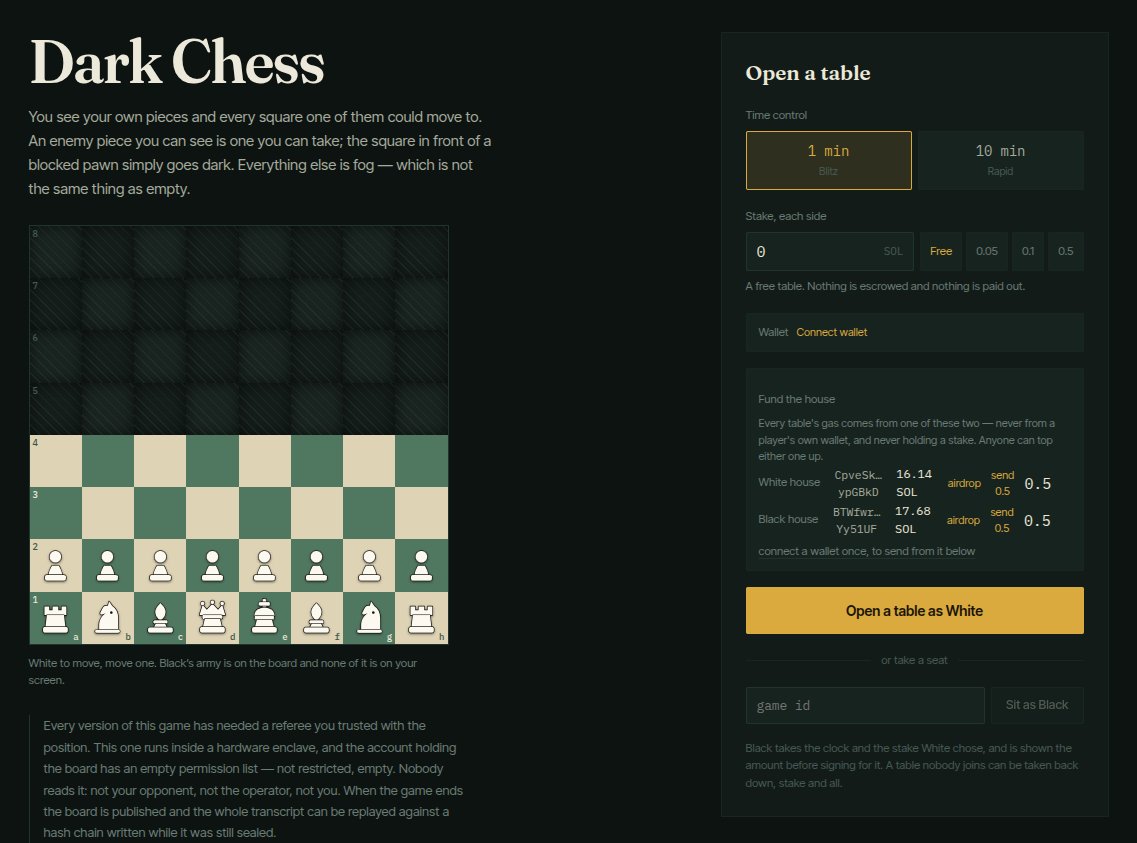
I built Dark Chess as the first demo. It’s fog of war chess, so you only see the parts of the board your pieces can actually see.
After the game, the full state and transcript can be revealed and replayed to verify that the result was legit.
Dark Chess is just the first example. The bigger goal is to make Umpire useful for all kinds of private multiplayer games.
Play: https://t.co/dHkClIIlDD
Repo: https://t.co/IHPSsGv3uT
@magicblock@solanagaming
Missed the Blitz submission deadline, but still wanted to share what I built.
Umpire is an SDK for building private, verifiable multiplayer games.
The basic idea is that players shouldn’t have to fully trust a centralized server with the rules, hidden game state, or the final outcome.
Umpire handles things like deterministic game logic, private views for each player, match flow, replays, reveal, verification, and settlement.
I built Dark Chess as the first demo. It’s fog of war chess, so you only see the parts of the board your pieces can actually see.
After the game, the full state and transcript can be revealed and replayed to verify that the result was legit.
Dark Chess is just the first example. The bigger goal is to make Umpire useful for all kinds of private multiplayer games.
Play: https://t.co/dHkClIIlDD
Repo: https://t.co/IHPSsGv3uT
@magicblock@solanagaming
Ever felt building games on @solana with secure, hidden & verifiable information is hard?
Or that the code boils down to the same few primitives?
That’s why I’m building Umpire, an SDK built on @magicblock to make hidden-information games simple, secure & verifiable.
More soon
Whether it be @RaceGameTeam's Race Poker, @FastdotPoker , or Xenovoya, these games share the same core problems.
Umpire generalizes those problems into a small set of efficient, secure primitives using tools from @magicblock.
Build the game, we've covered the referee.
Guys do follow this account and engage with it, it's an open source SDK I'm building for anyone interested in building hidden information games on @solana using @magicblock rollups
It's still in development but do give it a shot when it finally releases, I have a lot planned for it and 8 hope others will decide to build something of their own using it.
Ofcourse I will ship it with a few examples and a dev skill as well, so it'll be AI friendly :)
Ever felt building games on @solana with secure, hidden & verifiable information is hard?
Or that the code boils down to the same few primitives?
That’s why I’m building Umpire, an SDK built on @magicblock to make hidden-information games simple, secure & verifiable.
More soon