Catholic Father of 4 | Combat Vet, Ranger School, WP Grad | Faith seeking understanding
Strength, sacrifice, and the interior battle
For the broken & searching
Pope Leo XIV has become one of the most debated figures in public life right now — immigration, the War in Iran, the death penalty. And with that debate comes the predictable responses:
"He's a Communist."
"He's a Leftist."
"He's in with George Soros."
I would not defend Pope Leo XIV if any of those were true. Some of the observations behind those reactions are at least understandable — but none of them hold up to real scrutiny.
Here is why: every member of the Catholic clergy — from parish priest to pope — is formed differently. You cannot sort them into Left vs. Right buckets and call it analysis. To truly understand any pope, you need a more rigorous tool.
That search led to a framework. It does not begin with politics — it begins with Providence.
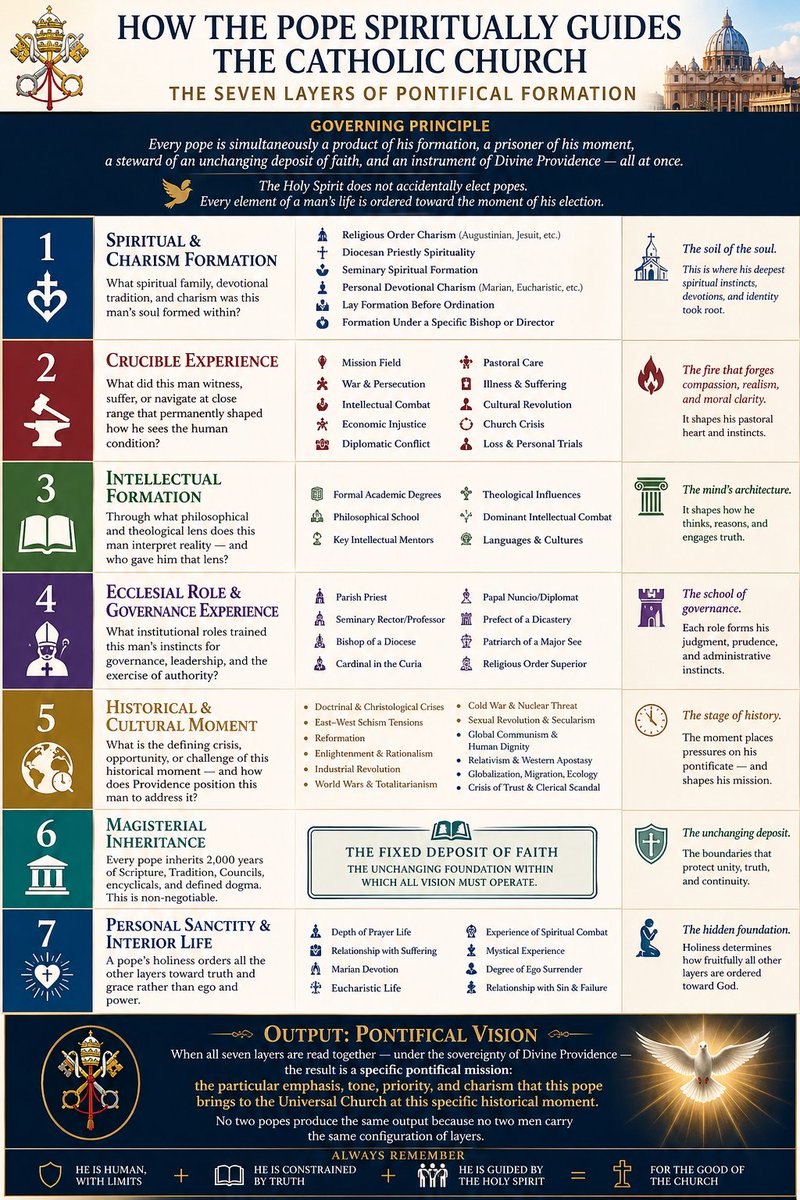
The Guiding Principle: every pope is simultaneously a product of his formation, a prisoner of his moment, a steward of an unchanging deposit of faith, and an instrument of Divine Providence — all at once.
Seven layers follow from that principle. They apply to Leo XIV. They apply to every pope before him.
The graphic below describes each layer in detail. Apply it before drawing conclusions — and see what you actually find.
Let's run it properly — layer by layer — with full pressure applied at each stage.
Catholic content creator Zach Gonring, who has thousands of followers across social media, has announced that he will enter seminary formation for the Diocese of Grand Rapids to become a Catholic priest.
The Croatia national football team, including captain Luka Modrić, attend Mass in their homeland ahead of the 2026 FIFA World Cup
Image: Riječka nadbiskupija
The horror film “Obsession” is a surprise hit at the box office this summer. Made for around one million dollars, it has already grossed over a hundred and fifty million. But it's not only a financial success; it's also a spiritually quite interesting film. What drives the plot is a young man's ardent desire to be loved by the woman whom he loves. Seeking a gift for Nikki in an occult store, Bear finds a device that advertises itself as “One Wish Willow.” If you break the stick and make a wish, it will come true. In his desperation, he follows the instructions, and it works like a charm. The previously diffident Nikki becomes totally devoted to the delighted Bear. All his dreams, it seems, have come true. Then things go, shall we say, south. I won't spoil any more of the plot. Suffice it to say that Nikki proceeds to devour the young man and push him toward despair.
Throughout this film, I kept thinking of Oscar Wilde's famous line: “the only thing worse than not getting what you want is getting what you want.” The spiritual issue here is one that the masters have recognized for centuries and one that stands at the very heart of Biblical revelation: if you tie your deepest desire to anything or anyone other than God, you will find, not satisfaction, but destruction. This is the moral teaching behind the great Shema prayer: “Hear, O Israel, the Lord your God is Lord alone.” Jesus reiterates this when he says, “You shall love the Lord your God with all your heart, with all your soul, and all your strength.” The psalmist affirms it when he sings, “Only in God will my soul be at rest.”
During the rite of Confirmation, I ask the young people a series of questions, the first of which is “do you renounce Satan and all his works and empty promises?” Up and down the ages, Satan has made the same empty promise: I will give you something less than God and it will make you happy. In point of fact, it will ruin you, and the more you seek to acquire it, the unhappier you will become. What becomes clear in the course of “Obsession” is that the owners of the occult shop where Bear bought the fateful wish-willow are in fact involved with very dark spiritual powers. In my conversations with exorcists, I hear over and over again that those who get ensnared by the devil commence by dabbling in the occult.
“Obsession” is a good horror movie. If you like the genre, and you're not too squeamish, go see it. For it won't just scare you; it will offer some important spiritual truths.
Artificial intelligences do not undergo experiences, do not possess a body, do not feel joy or pain, do not mature through relationships, and do not know from within what love, work, friendship or responsibility mean. Nor do they have a moral conscience, since they do not judge good and evil, grasp the ultimate meaning of situations, or bear responsibility for consequences. They may imitate or even simulate, but they do not understand what they produce, for they lack the affective, relational, and spiritual perspective through which human beings grow in wisdom. #MagnificaHumanitas
Brazil is going viral with ‘running raves’
Sao Paulo’s PACETRONIK events mix group runs with electronic music and club energy
The running rave concept is already backed by ASICS Brasil
Footage: PACETRONIK