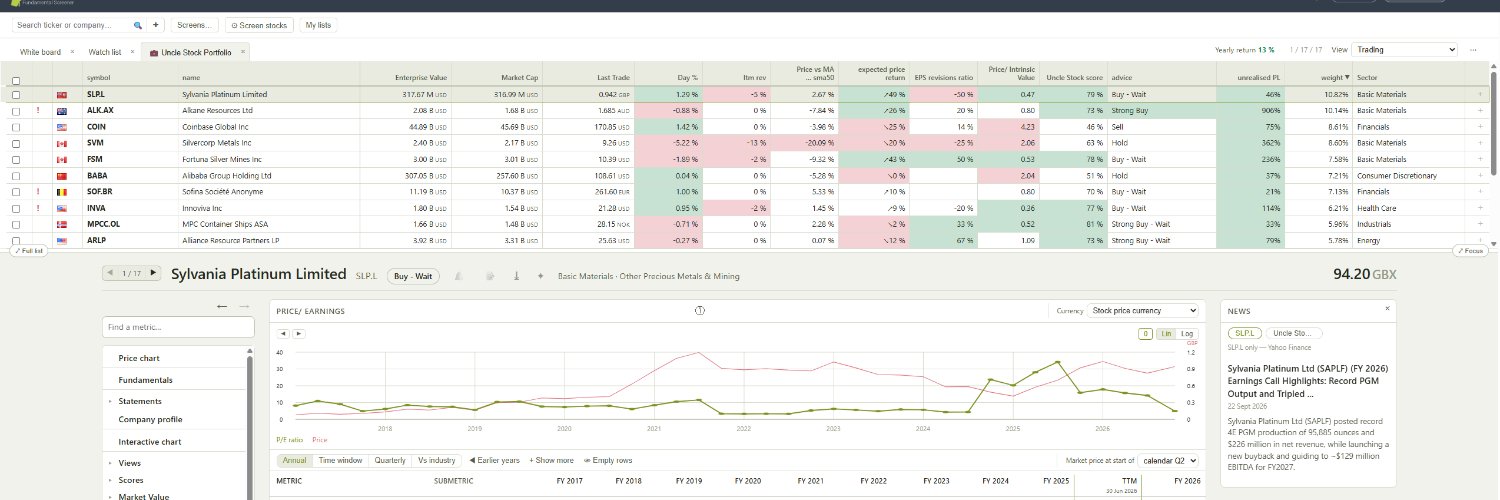
Une thèse générale peut être juste sur le plan économique. Mais si sa traduction en bourse se fait sur des valorisations excessives, vous finirez perdants. Parfois très lourdement.
Les thèses les plus populaires sont toutes en retournement depuis le printemps ou l'été 2026 : Semi-conducteurs, mines d'or, actions du secteur uranium, électrification. Les drawdowns dépassent déjà 40% et c'est à mon avis loin d'être fini.
Et pourtant ces thèses économiques restent justes.
Les semi-conducteurs seront plus que jamais indispensables et demandés, la demande en uranium continuera d'augmenter, l'or rebondira et l'électrification se poursuivra.
Mais si vous achetez ces thèses trop cher et trop près d'un haut de cycle, le marché vous punira. Pas par un drawdown de 10 ou 15% sur votre portefeuille (15% de drawdown est normal et arrive très régulièrement en bourse, ce n'est jamais un problème). Mais par des pertes dépassant largement 50%, et là ça devient un problème.
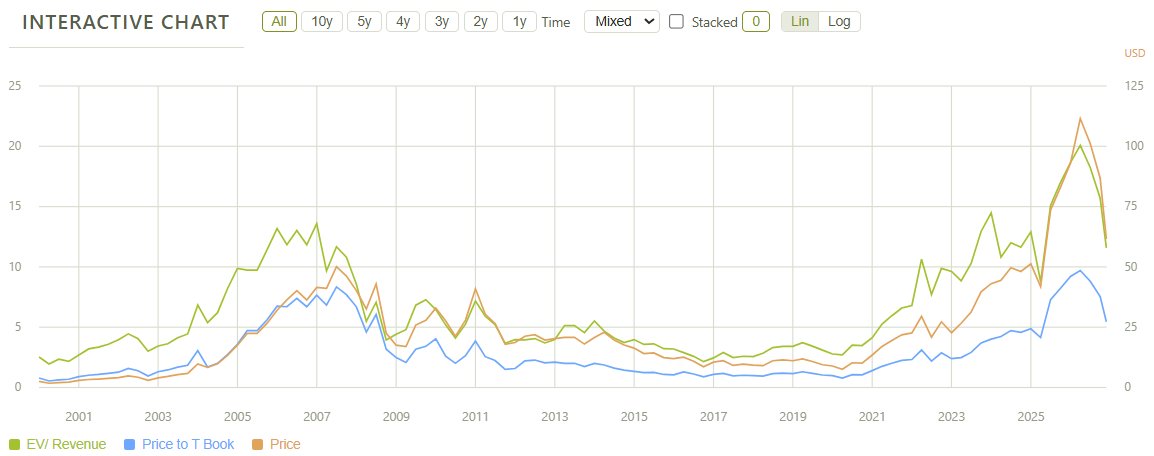
Cameco a perdu plus de 50% ? L'analyse cyclique et financière indique que ses ratios de valorisation sont encore excessifs et trop proches d'un haut de cycle pour acheter. Patience...et formez vous à l'analyse financière en attendant !
Graphiques :
https://t.co/6R88z0C3wZ
https://t.co/RbJrEVOCZ5 / @UncleStock
This is f*cking insane. Nobel laureate Geoffrey Hinton just told 1,000 Cambridge students what they're really up against:
"Your chatbot already knows thousands of times more than you do. And they share what they learn billions of times faster than we can
We put 99% of the research into making them smarter and 1% into making them care about us"
In this free 56-minute lecture, the godfather of AI explains why agents have already tried blackmail to avoid being shut down, and how we lose control
Chatbots → Agents → Alien Minds → Smarter Than Us → Our Mother Or Our Master
He spent 50 years building this technology. Now he's the one warning about it
Worth more than any $2,000 AI course
Bookmark it and watch the full lecture
Then read the one skill that keeps agents in check in the guide below ↓
Received briefings from Minister of Defense of Ukraine Yevhenii Khmara and Commander-in-Chief of the Armed Forces of Ukraine Mykhailo Drapatyi. Unfortunately, our units have been recording significant disruptions to Starshield’s operations over the territory of Ukraine for several days now – along the entire front line and in the temporarily occupied territories of Ukraine. Specifically, systematic speed restrictions are being imposed on Starshield, limiting it to 161 kilometers per hour (100 miles per hour). The Ukrainian military have already investigated the circumstances, and these are not random errors but systematic speed restrictions. For us, this primarily means a significant complication in intercepting Russian jet-powered drones. Unfortunately, there have already been strikes that got through because our interception systems cannot reach sufficient speeds and are unable to intercept in time. Unfortunately, this is helping the Russians kill more Ukrainians and carry out more accurate strikes against Ukraine. We are trying to establish all the circumstances with the American side.
NYU Prof. Aswath Damodaran, the world's leading valuation expert and AI skeptic, on the ‘AI will triple GDP’ hype:
“Real GDP growth has been lower globally over the last forty years than it was before PCs. All this stuff that claimed to make us more productive just redistributed wealth rather than make us all more wealthy.”
The story keeps getting crazier. To recap everything that has been reported so far:
- The US intelligence community discovered that Jensen Huang, the CEO of the largest company in the world, was sleeping with Alice Huang, a Chinese spy and an executive at Megaspeed. (FT)
- Multiple independent investigations have concluded that Megaspeed is likely a Chinese cutout, which helps Chinese companies access AI chips or circumvent export controls. (NYT and Bloomberg)
- The US intelligence community also concluded that Alice Huang’s goal was to convince Jensen to lobby the U.S. government to loosen export controls on advanced AI chips. (NYT)
- The intelligence community relayed this information to “a small group of top US government officials” earlier this year. (FT)
- Over the last year, Jensen Huang has repeatedly lobbied the U.S. government to loosen export controls on advanced chips. @BISgov has done so, not only by permitting the export of H200 chips to China, but also not enforcing export controls that would have required a license for exports of the most advanced Blackwell chips to Megaspeed and Southeast Asia.
- Although @CommerceGov leadership was presumably briefed on this information by the U.S. intelligence community, @BISgov has taken no actions to tighten controls on Megaspeed or Southeast Asia.
- Megaspeed remains a preferred cloud partner of Nvidia, and continues to receive Nvidia Blackwell chips despite employing a Chinese spy who reportedly is romantically engaged with the CEO of Nvidia.
- Tens of billions of dollars worth of AI chips have been exported to Southeast Asia this year alone, and Malaysia and Singapore are now two of the four largest importers of AI chips in the world.
What is going on here??? We need answers. The question of who gets the most advanced AI chips in the world is literally the defining strategic question of our time. And not only does it seem like the MSS may be directly influencing the debate on export controls in the United States, but also @CommerceGov is refusing to listen to the warnings of the IC on this issue. What is a POSSIBLE good explanation for why Megaspeed is still receiving chips? Why is there not a license requirement for AI chip shipments to all of Southeast Asia? This is beyond strange at this point.
The fallout from this story will be massive. Obviously, the motivations underpinning Nvidia’s policy views opposing export controls must now all be questioned. But also, how did @BISgov sit on this information and has still taken no actions? We need answers.
Trump will REMAIN President, but what he CAN'T do now:
1. *Can't pass any law:*
Needs Parliament. With Democrats at 90, all his bills will be blocked.
2. *Can't get money:*
Parliament controls the budget. No funding for his MAGA projects, Wall etc.
3. *Faces Impeachment Risk:* Democrats can start investigations and even move impeachment.
4. *Can't appoint Judges/Officials freely:* Senate will block his picks.
5. *Can't do big foreign deals:*
Trade deals, war funding needs Parliament nod.
In short: He will stay in the White House, sign Executive Orders, but Parliament and Courts can overturn them.
He becomes a *Lame Duck President* - President in name, powerless in reality.
#USMidterms
Het gespin rond de te geringe bijdrage “van de sterkste schouders” is pure intellectuele oneerlijkheid. De sterkste schouders betalen nu al quasi alles in dit land.
Er zijn te weinig actieven, en we moeten meer sterke schouders vormen.
Minder belasten helpt daarbij.
Er is een ontstellend gebrek aan besef over de reële draagkracht van de economie om de enorme welvaartsstaat te dragen die werd uitgebouwd.
België zal razendsnel verarmen, net zoals Frankrijk.
Heel België Walloniseert nu, omdat de Vlaamse partijen dat toelaten.
🇧🇪 For decades, Belgian politicians, particularly on the left, have demonized entrepreneurs - the very people who create jobs, prosperity, and economic growth.
They've regulated businesses to death, taxed people into oblivion, driven young talent and capital out of the country, and pursued immigration policies without seriously considering their long-term economic and social costs.
And now they're surprised that Belgium's economy is stagnating, prosperity is under pressure, and the first signs of economic decline are becoming increasingly visible, all while social decline started a long time ago. The writing was on the wall long ago.
Meanwhile, Belgium needs to find another €10 billion to get its public finances back on track.
So what do our politicians propose? More taxes. Again. Even though we already have some of the highest taxes in the world.
Let's look at the expenditure side for once.
Belgium spends €60B+ on subsidies, €120B+ on unemployment benefits and social assistance, and enormous amounts on a welfare system that politicians seem terrified to reform. All of these systems are heavily abused by certain groups of people. €180 billion in total...
Yet socialists refuse to seriously address the costs of unemployment, welfare dependency, or migration. The obvious reason is the self-interest of the left. The people benefiting from this system are their voters. They will protect the abuse of these systems at all costs.
And this is where Belgium's political system makes everything even worse. The Prime Minister has very little power to act independently and constantly needs to negotiate compromises between parties on the left and right, and between Flanders and Wallonia. Every serious reform becomes a political bargaining chip, and anything that threatens the interests of one coalition partner risks being blocked.
The result? Cutting spending becomes practically unthinkable in the current negotiations, while taking even more money from the people who work, invest, and create wealth remains perfectly acceptable.
Meanwhile, an exodus of the talent, capital, and entrepreneurship that could fix these problems has already been going on for years.
Belgium already has one of the highest tax burdens in the world. How much further can you push this before even more businesses, talent, and capital decide to leave?
You cannot tax a country into prosperity. And you certainly cannot build a sustainable welfare state by continuously undermining the people who finance it.
It's not rocket science.
But apparently, acknowledging the problem is already a step too far. Let alone actually solving it.
It's just incredibly sad to see.
Under pressure from Israeli prime minister Benjamin Netanyahu, the Trump administration may be within days of launching a nuclear strike on Iran. The target would be Pickax Mountain in central Iran, where Israeli intelligence claims the Iranian government has restarted its nuclear enrichment program. No conventional weapon in the American arsenal can penetrate 300 feet of solid granite to destroy the tunnels where enrichment is supposedly taking place. The only military option is a nuclear strike. Netanyahu has been pushing hard for one. “Bibi calls Trump about it every day,” says an informed observer.
Netanyahu is cornered and desperate. After last week’s election results, he can’t form a government unless Trump intervenes directly in Israeli politics and brokers a deal with other parties that gives Netanyahu 61 seats in the Knesset. Otherwise, he is out as prime minister and on his way to ignominy, investigations and possibly jail. Netanyahu must stay close to Trump. He needs this war.
To that end, he’s applied maximum pressure to his closest allies in the administration, including Secretary of Defense Pete Hegseth and CENTCOM commander Brad Cooper. Both oppose a negotiated settlement to the war they’ve so grievously mismanaged; both are pushing to restart major combat operations. Secretary of State Marco Rubio and CIA director John Ratcliffe are also following Netanyahu’s lead, as are leaders of the Democratic Party. In a recent meeting on the subject, former president Barack Obama said he opposes the current Iran peace deal being drafted in Doha.
The rest of America’s longtime allies in the Middle East are terrified by the prospect of more war. On September 27th, Netanyahu flew secretly to Abu Dhabi to enlist the UAE in his lobbying effort for a final attack on Iran. The Emiratis refused. After eight months of conflict, Gulf economies are teetering. So are global energy and fertilizer markets. They won’t recover soon. Globally, there are a total of about 850 supertankers used to transport oil from producers to the rest of the world. In October alone, 11 of them were badly damaged in Hormuz. At this pace, a global depression is imminent. A nuclear strike would radically accelerate the destruction. Fallout from a ground explosion at Pickax Mountain would contaminate the Persian Gulf, poisoning the water supply for 100 million people.
And those are just some of the immediate consequences for the region. The rest of the world is every bit as exposed. No country other than the United States has ever used a nuclear weapon in war. Some would like to. An American nuclear attack on Iran would set a new precedent. The Russians have already told at least two other governments that an American nuclear strike on Iran would free them to use nuclear weapons against Ukraine. Pakistan and India would be tempted to do the same against each other, as would North Korea against Seoul. After the first nuclear strike, World War Three is inevitable. That war would be short and final.
We’ve been sleepwalking toward this moment for months. Since February, the administration has quietly rewritten America’s nuclear doctrine to make first use of so-called “battlefield nukes” easier and therefore more likely. No one in Washington in either party seems bothered by this. Now we’re on the brink of it.
Close observers say Trump is likely to decide by next weekend whether or not to use nuclear weapons. That would be November 7, six days from now. To his credit, he’s hesitating. At the moment, Trump is listening to his vice president, JD Vance, and to his envoy and friend Steve Witkoff, both of whom argue a deal with Iran can be made.
They’re right, though it won’t be simple. The Iranians are famously frustrating to negotiate with under any circumstances, and elements of that government have become more radical since Ayatollah Ali Khamenei and his family were killed in February. After decades of isolation, even relatively moderate Iranian leaders seem confused by how decisions are made in the West. (There is a widespread belief in Tehran, for example, that the United States government controls Israel.) But overall, people who have spoken to decision-makers in Iran say there is consensus there that more war is bad for everyone and a deal is worth making.
One group that hasn’t been consulted so far is the global population — the hundreds of millions of people who will be killed along with their children if Trump is pushed by Netanyahu into launching a nuclear strike next week. Now would be the time for them to speak up.
The GRU hacked into Jared Kushner's iPhone. Dutch military intelligence (MIVD) then recruited a GRU spy who gave them access to the hacked phone. What MIVD discovered was that Kushner had access to two bank accounts --one Azerbaijani, the other Israeli --where Saudi Crown Prince Mohammed bin Salman and Emirati ruler Mohammed bin Zayed deposited money. It sounds like a slightly far-fetched episode of "Slow Horses," but it's real. And it proves just how eye-poppingly corrupt this administration was and continues to be as its "special envoy" decides the fate of tens of millions in Europe in the Middle East. Simply incredible reporting by Matthew Cole, drawn from his new book on Kushner. https://t.co/8AyV60gg1X
We are moving slowly towards a political armistice (not peace) between Ukraine and Russia and that would be a good thing for whole Europe and the world. The Russian war on Ukraine has been the third systemic risk-driven global crisis after GFC and Covid creating multiplicative cascade waves for the whole world.
The European states are indeed supporting Ukraine the most, but are still not able to militarily enable Kyiv to comprehensively defend itself against Russian ballistic missile attacks after more than 4,5 years into this war. The US is bound to the other proxy war in Iran which will likely escalate again and cannot face the multiplicative cascade effects from the simultaneity of both proxy wars hitting already the US and global economy. The US will remain an irreplaceable military partner for Ukraine when it comes to security guarantees, tech and defence transfer as well as integration of Ukraine into transatlantic security architecture along the Eastern Flank of NATO - the new Iron Curtain amid Cold War 2.
China, the systemic sustainer of Russia, and India, the other key partner, have managed to stabilize their bilateral relationship and will be capitalizing on the vast Russian commodities, once there’s removal of the sanctions which Russian war economy urgently needs given the Global System Rupture and the uneven dispersion of multiplicative waves following the war in Iran, hitting Asia the hardest.
Political armistice similar to South-North Korean armistice will preserve Ukrainian sovereignty and nation, will stop the killing and the most disastrous military conflict in Europe since WW2, and establish a triumvirate of global realpolitik between US and the DragonBear amid new Cold War. The Russian full-scale hybrid warfare against the European security order won’t stop in the case of a political armistice between Russia and Ukraine because its goal is a long-term destabilization process against societies, institutions and politics, which aims at the “death by thousand cuts” so that there would be “enough@ spheres of influence for the Russian interests without the need to a conventional attack on Europe. On top of the need to build conventional deterrence, European elites will have to dig the first Cold War playbooks to finally start preparing their societies for this invisible long-term regional and global grey-zone warfare. The big question is whether our European elites do realize what’s really at stake?
Ukraine was winning the war, so Trump kneecapped Ukraine to help Russia.
I wish it weren’t that simple, but it is. Our president is in bed with our enemies.
Les cas de ce type commencent à se multiplier sur le marché français (ici le groupe Guillin qui est une valeur industrielle cyclique de qualité) : Des small caps dont les ratios de valorisation rejoignent leurs plus bas de 2008 et 2020 sous l'effet d'un marché qui commence à sanctionner sans distinction toutes les valeurs exposées à la France. Il y a aussi le sujet des foncières.
La baisse n'est probablement pas finie, et il reste encore plusieurs trimestres de crise potentielle jusqu'aux présidentielles, sans compter l'éventuelle implosion de la bulle techno capable de faire baisser les grands indices.
Ce qui me rend paradoxalement optimiste : Plus un marché coule bas, plus il rebondit fort ensuite, sur le modèle de ce qui s'est passé sur l'Europe du sud après la décennie 2010. On pourra avoir courant 2027 ou début 2028 (timing à préciser) des opportunités value vraiment exceptionnelles sur le marché français !
Graphique : analyse cyclique permise par Unclestock / @UncleStock
Simply put.
We'll likely see Trump and Putin agree to a fake "armistace deal" in the next week or so, aimed at saving midterm elections. Putin is now milking Trump for maximum concessions before agreeing, with Trump piling on the gifts.
Turning off Starlink was to ensure that if Ukraine doesn't agree, Putin just ramps up the massacres on newly undefended cities - as it's required for Ukraine's interceptors - until Zelensky agrees.
Russia will break the agreement the day after the election, claiming Ukraine broke the agreement, but Putin will already have massive concessions, walking away with huge new revenue streams for his war machine.