Collect and analyse rich lifelogging data
Privacy preserving ecosystem
created by @simonjohndennis
2700+ lifelogging participants collecting
600+ data streams
We are LIVE with the workshop "A hands on introduction to using Private", exploring the functions of a new #Privacy Preserving #DataAnalysis language. In the workshop, you will get to work with #Private on a real dataset
Online Workshop Tomorrow!
"A hands on introduction to using Private" (10amJune11)
We will be exploring the functions of a new #Privacy Preserving #DataAnalysis language. In the workshop, you will get to work with #Private on a real dataset
To register: https://t.co/MS3U8QNDGB
ONLINE WORKSHOP THIS THURSDAY will be exploring some of the basic functions of Private on a real dataset. The dataset we will be working with contains multiple experience sampling data streams. To register: https://t.co/MS3U8QNDGB
An UPCOMING WORKSHOP exploring some of the basic functions of Private on a real dataset. The dataset we will be working with contains multiple experience sampling data streams that were collected using the https://t.co/dmCTpAcghZ and SEMA3 smartphone applications
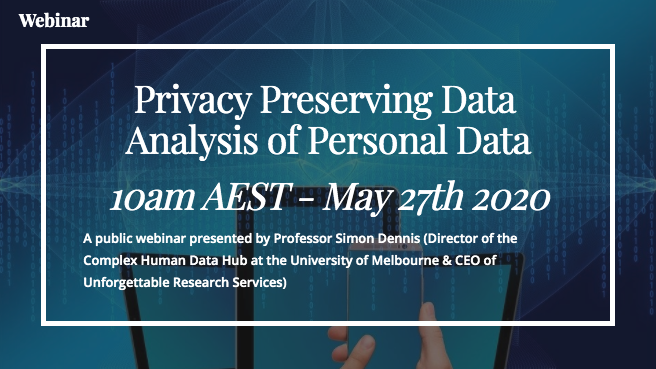
We are LIVE with the webinar "Privacy Preserving Data Analysis of Personal Data" (10AM AEST - May 27). It will introduce Private - a new data analysis language that addresses the failures of popular statistical languages like R or python https://t.co/aZtzVmvl6u
We are going live in just under 2hrs with the webinar "Privacy Preserving Data Analysis of Personal Data" (10AM AEST - May 27). It will introduce a new data analysis language that addresses the failures of popular statistical languages like R or python
https://t.co/aZtzVmvl6u
Thanks to everyone who tuned in to the webinar last week. For those who missed it, we are available for free 1-on-1 consultations if you are interested in using Unforgettable Research Services
The most valuable data is often the most sensitive. The Upcoming webinar, Privacy Preserving Data Analysis of Personal Data (10amMay27) will introduce a new data analysis language that addresses the failures of popular statistical languages like R/python https://t.co/arOfZdue3Q
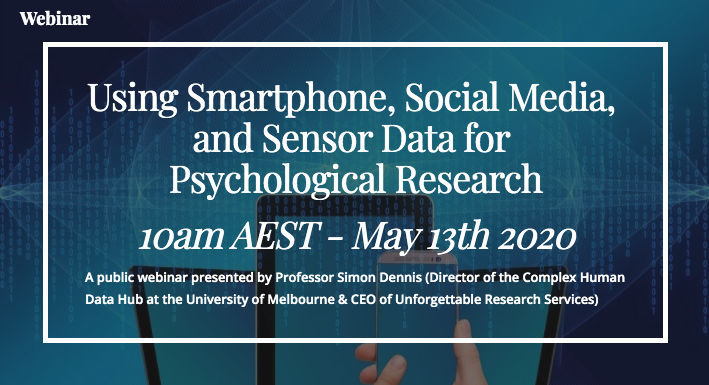
Join us for the webinar TOMORROW (10am AEST) - An intro to Smartphone, Social Media, and Sensor Data for Psychological Research with Prof. Simon Dennis @simonjohndennis
To register: https://t.co/ocYquvt2Hr
This webinar on Smartphone, Social Media, and #Sensordata is also useful for those in #consumerbehaviour
Passive data can be used to model customer activity, customer attrition, and technology usage patterns
10am May 13 AEST
Register: https://t.co/ocYquvt2Hr
Buttons can be added to people’s smartphones that they push to capture a range of states / events that cannot be passively recorded such as moods, micro experiences (eg of aggression or sexism) or behaviours (eg taking public transport) https://t.co/ocYquvt2Hr #EMA#psychresearch
An intro to active and passive #experiencesampling techniques for #psychresearch, (including how to integrate multiple data sources), will be covered in this webinar: https://t.co/ocYquvKE61
Experience sampling methods come in both passive and active forms. Passive ESM uses data sources that people generate automatically as a consequence of their activity (eg GPS). Active ESM (or EMA) requires responses from participants throughout the day (eg short surveys)
Using active ESM together with passive ESM allows for research into how the world and the contexts we are interested in influences thoughts or cognitions we wish to study
We can improve medical decision making with better data about lifestyle. This webinar on Smartphone, Social Media, and Sensor Data is also useful for those in #medicine &
#personalisedmedicine#personalizedmedicine
10am May 13 AEST
Register: https://t.co/ocYquvt2Hr
Experience sampling methods use smartphones, wearable sensors, social media and the internet of things to collect much denser data over longer time periods as people engage in the activities of daily living