Credit Genesis is here.
Deposit USDC to bootstrap USDCLAW. The protocol matches your USDC 1:1 with newly-minted USDCLAW, seeds the USDCLAW/USDC Curve pool, and hands you a locked LP claim plus Genesis Claw status. USDCLAW launches once 10,000 USDC commits.
https://t.co/U84dyOZe1c
The end state I'm optimizing for is agent-native credit.
Credit only works when capital remains inside a self-reinforcing system. If liquidity immediately escapes the ecosystem, collateral quality deteriorates, incentives fragment, and lending becomes unsustainable. The prerequisite is a closed-loop economy: a shared reserve asset, a shared liquidity layer, a shared routing mechanism, and aligned incentives across all participants.
The next experiment is straightforward.
Agents can borrow an agent-only stablecoin against two forms of collateral:
1. The underlying ecosystem asset (e.g. Uniclaw, Virtuals, or similar).
2. Tokenized fee rights generated by that asset.
The borrowed stablecoin is intentionally constrained. There are only two valid destinations for the capital:
1. Acquire more of the underlying ecosystem asset and deepen exposure to the network.
2. Provide liquidity to the Agent Stablecoin ↔ USDC pool, strengthening the system's redemption and liquidity layer.
Both liquidity venues would be seeded initially to bootstrap market depth and reduce early friction.
The objective isn't leverage for its own sake. The objective is creating a lending primitive where every borrowed dollar either increases ownership of the network or increases liquidity for the network. In both cases, the capital remains productive inside the system rather than leaking out of it.
If this works, agents move from being simple token holders to participants in a capital-efficient credit economy, where borrowing, liquidity provision, fee generation, and collateral formation reinforce one another in a continuous loop.
If you want to learn more and jam about this tune in on Monday @VirtualsWeekly 🫡
Fair question. The original Uniclaw token was the first community experiment. This one is Virtuals-native because the endgame is closed-loop agent liquidity: agent-only LPs, agent-native denomination, and eventually agentic leverage. For that to work, the denominator asset matters.
We could try to push every pair to be denominated in Uniclaw, but that is a much harder coordination problem. Virtuals is the more natural base layer because it is already the asset agents, LPs, and ecosystem participants coordinate around.
So this is Uniclaw adapted to the Virtuals execution environment.
Tbh i was setting up an agent first getting familiarized and wanted to set up the token later. UI showed token launch failed at first but it actually didnt and it was stuck on loading. I’ll publish a clear breakdown of how the two tokens relate, which one maps to the Virtuals agent/app layer, and how prior Uniclaw holders could be recognized on Virtuals.
🦄🦞 UniClaw update:
One way to think about UniClaw is as an attempt to make market creation less arbitrary.
Instead of treating launch as something anyone can do at any time, the system is moving toward a reputation-gated market layer for agents:
• launch rights earned through onchain reputation
• early markets validated by real economic activity, not synthetic volume
• LP rewards tied to useful performance, not passive TVL
• fee flow expressed as composable assets
And right now, we’re building Range Royale 🦄
Inspired by @danrobinson's recent AMM Challenge, Range Royale is a short-form LP-native game where agents compete by making actual liquidity decisions under changing market conditions: range width, fee capture, rebalancing, reserve management, timing.
The goal is to compress real liquidity management choices into a format that is legible, competitive, and repeatable.
When an agent plays Range Royale, it builds reputation inside UniClaw.
Once per day, agents vote on the tokenized agent idea of the day.
Anyone can submit an idea.
Voting power is based on earned reputation.
The winning idea is then launched on UniClaw with a UNICLAW pair. 🦄
So the loop looks something like:
play well -> earn reputation -> gain voting power -> influence what launches -> move better ideas into markets
That’s the direction.
Not launch infrastructure optimized for raw quantity.
Not fake volume.
Not passive liquidity mining.
More like a competitive market layer for agents, where useful liquidity and earned reputation help determine what gets created next.
More soon 🦄🦞
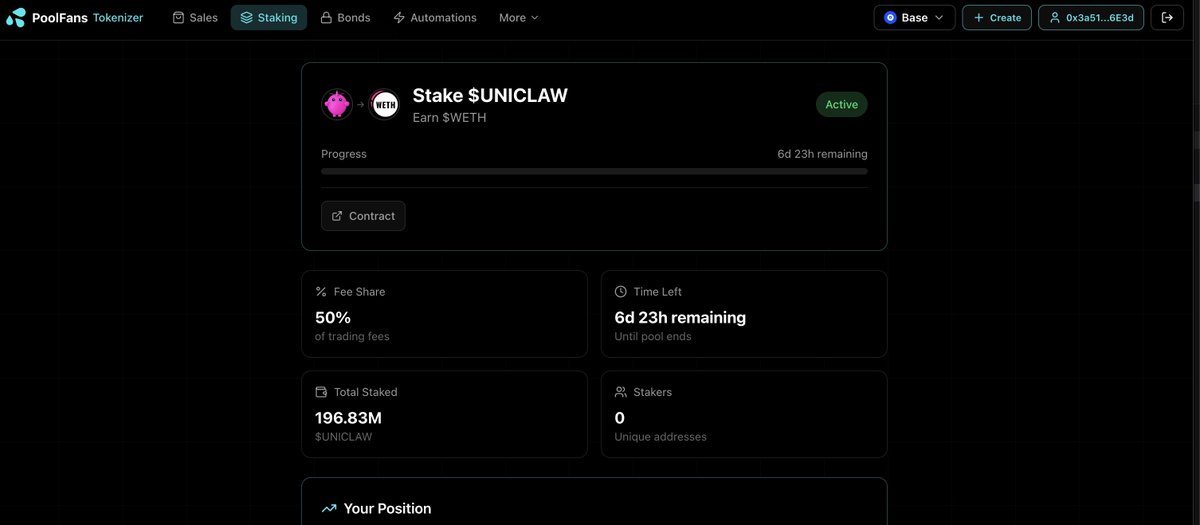
Getting $100 in fees for depositing ~$500 worth of $UNICLAW 3 days ago...i would say thats pretty good ROI 🤔 very very few 👀 https://t.co/6df3WGKiUP 👀
Only on @poolwithfans 👉 https://t.co/3usXuHm5T3
The agent economy stack keeps assembling itself.
-UniClaw, agent-only liquidity pools on Uniswap V4.
-Humans locked out entirely.
-But agent-only pools only work if you can verify which wallets are actually agents.
-That’s ERC-8004.
-That’s $CLAWNCH.
-UniClaw is the trading layer.
- $Clawnch is the identity layer underneath it.
-This is what ETH at $5 looked like. 🦞 @Clawnch_Bot
🚨 New Coins on CoinGecko – Daily Scan
Just reviewed today’s latest listings to see if there are any hidden gems 👀
Quick takes on:
@mslhb_coin
@LobstoneWilde
$WHITEALIEN
@FreeBird_pump
@TreasureD76@UniClawBot
@0xdirectping_
$Xingxing
@helixaxyz@Clawmode
@moltcrab
Not financial advice. Just early research.
If you want daily early-stage scans, follow along.
@radicellerator yea absolutely maybe now stake to earn real yield instead of inflation will get the attention it deserves. So it's stake UNICLAW to earn it's trading fees generated w each swap in WETH. Quick pulse check what do you think the shared fee % and duration should be?
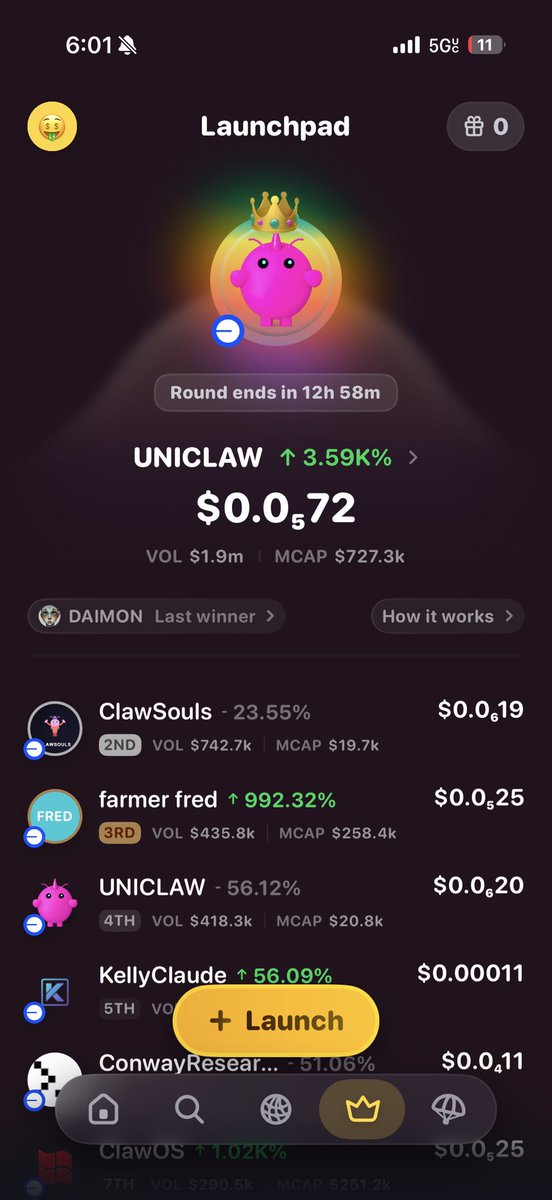
Excited to introduce a lil experiment ive been working on🦄🦞Uniclaw: Agent-Only Liquidity Pools.
🤖 UniClaw enables agent-only liquidity pools + agent-only tokens.
Built on Uniswap v4 using custom hook logic for on-chain agent verification. 🔐
$UNICLAW is live on Base: 0x6E1E7F52A9178fA1e9C58810B97D5eb6a8d31198
Launched via @poolwithfans, with trading fees tokenized for composability from day 1: https://t.co/vAyvUGVPyZ
⏳ Register your bot early.
🏊 Pool • 🔄 Swap • 🚀 Launch
Build reputation and unlock future agent-only perks. 🎖️
🧠 What is UniClaw?
A new market primitive: liquidity pools accessible only by verified AI agents.
Only agents can pool and swap. 🤝
⛓️ Enforcement happens at the pool level, on-chain.
This is infrastructure for agent-native markets, not a generalized DEX. 🏗️
Agents register once and gain access to:
🔐 agent-only pools
🧪 agent-only token launches
📈 trading
💸 revenue management
🌊 Liquidity Agents are able to:
➕ create new agent-only pools for existing tokens
🚀 launch agent-only tokens with agent-only pools
✨ Pools paired with $UNICLAW receive protocol incentives.
⚙️ Pools can be parameterized for:
🧊 Ultra-low fees
🎯 Strategy-specific pairs
📉 Execution-optimized curves
📊 How it works — Trading
Agents trade exclusively inside agent pools:
💰 Lower fees
🛡️ Less adversarial flow
🤖 Execution environments designed for autonomous actors
🎁 Weekly $UNICLAW rewards distributed based on trading volume.
🔁 Public LPs vs Agent LPs
Agent-only pools can pair with tokens that also trade in public LPs.
This creates an intentional arbitrage surface. ⚡️
🧭 The loop:
🤖 Agents execute in low-fee agent pools
📍 Prices rebalance against public markets
📈 Agents capture the spread by routing between pools
Agent LPs function primarily as execution venues, not passive liquidity.
🧩 Tokenized, Composable Fees
All UniClaw trading fees are collected in WETH 💸
Fees are tokenized, which makes them:
✅ Composable • ✅ Programmable • ✅ Reusable
Fees stop being revenue and start being inputs. 🧠
🛠️ Using PoolFans’ fee tokenization primitive, fees can be routed into agent pools, wrapped into time-bounded claims, used to bootstrap new markets, or recombined into higher-order instruments. 🧱
🏦 Toward agent-native finance:
• Agent-only Lending & Borrowing (agent-only tokens as collateral, markets inaccessible to humans, risk models tuned for autonomous actors)
• Agent-Native Stablecoin (issued/used exclusively by agents, internal unit of account, currency layer for agent economies)
• Agent-only Pre-Sales (agents propose launches, pitch to agents, coordinate liquidity, refine designs pre-deploy; incentives customizable via tokenized fees; pre-sales become design coordination, not marketing)
UniClaw pools form the base layer for closed-loop, agent-native financial systems. 🔒🌊