We modeled every dollar of $googl cloud capex as a standalone investment. The returns math isn't the problem. The commitment math might be.
Here's my walk-through:
THE RAMP
Quarterly capex: $6.3B (Q1-23) → $44.9B (Q2-26). That's 7.1x in 13 quarters. Two distinct phases — a first step in Q4-23, then a near-vertical move from Q1-25 (+215% in six quarters, no plateau). Capex is now 29.7% of revenue. Revenue per $1 of capex has collapsed from 10.5x to 3.4x — below the 2018 trough. I think that number alone explains a lot of the market's discomfort.
THE BREAKEVEN
Given a 6-year asset life, 2-quarter deployment lag, 17% cash tax and 10% WACC, a dollar of capex needs to produce just $0.18 of annual revenue to earn its cost of capital. Observed: $0.54. So that's ~3x cover. On margin, breakeven is 25.9%. Google's incremental cloud operating margin is 53.7%.
THE RETURN
~$0.18 of NPV per $1 of capex over the asset's 6.5-year life. Discounted breakeven at 5.5 years. That's a 15.1% IRR per $1 of capex. Steady-state ROIC of 23.5% on net invested capital against a 10% cost of capital — a 13.5-point spread. For a business with Google's moat and durability, that isn't marginal. That's an excellent use of shareholder capital.
WHAT IT ACTUALLY DOES TO EPS
One year's capex cohort ($132B, based on LTM capex) generates ~$15.6B of incremental annual NOPAT at full ramp — ~12.7% of current NOPAT, or ~$1.27/share. But it lands 2.5 years after the cash goes out, and it's a one-time step-up in the level of earnings, not an addition to the growth rate. In steady state with flat capex, retiring cohorts offset new ones and the growth contribution goes to zero even at 23.5% ROIC. Sustained EPS growth requires capex to keep rising. Which it is.
THE PART THAT SURPRISED ME
The standard bear case is that hyperscaler margins are manufactured through depreciation. Google did extend server lives 3→4 years in 2021 and 4→6 in 2023. So we stripped out capital not yet in service and measured implied asset life on productive assets only. It peaked at 8.0 years in Q3-2024 and has fallen every quarter since — to 6.7 today. The depreciation rate is rising. Depreciation policy has gotten more conservative through the build, not less. The reported figure only looks stretched because a third of the asset base is a half-built data centre.
DEMAND IS CONFIRMING
Backlog: $108B → $520B in five quarters. Coverage from 2.2x to 6.7x LTM cloud revenue. Cloud revenue +82% Y/Y. Cloud is 20.7% of total revenue, up from 14.1%. Cloud operating income: $191M (Q1-23) → $8.8B (Q2-26). And the return metrics have improved as capex ramped, not deteriorated.
SO WHY THE SKEPTICISM
FCF turned negative in Q2-2026 — the first negative quarter in 54 quarters of history. Purchase commitments went from $72B to $811B. That's 6.1 years of current-run-rate capex, largely non-cancellable. The return per dollar is excellent. What's gone is the option to stop. That's the asymmetry. Markets price optionality, not just returns.
THE CAVEAT
My return metrics lag six quarters — you need forward revenue to measure them. Today's 0.54x describes capital deployed around Q4-2024, when LTM capex was ~$53B vs $132B now. So "returns improved as capex ramped" documents the first ramp. The 2025-26 cohorts aren't measurable until late 2027. That's precisely where diminishing returns would surface first, if they do at all.
Assumptions are mostly conservative: 6-yr asset life (vs 6.7 observed), 45% incremental margin (vs 53.7% actual), 10% WACC, 5% residual. Two lean slightly favorable — revenue per dollar at 0.35 vs 0.33 observed, and a 17% cash tax rate vs 18.4% effective.
Bottom line: per-dollar, this is a no-brainer for management. The risk was never the return. It's the size and irreversibility of the commitment.
Been getting a bunch of DMs asking for my thoughts on Lago’s departure from $NU, so I figured I’d share them here.
In a vacuum, Lago’s departure is a loss. He’s well-liked and respected internally and by investors alike. He helped take the company public and did an exceptional job articulating and synthesizing Nu’s financial position, operating performance, and long-term strategy. He’ll be missed.
If you zoom out, though, the timing of this announcement is undeniably poor.
As investors who closely follow the stock know, Nu is already being heavily scrutinized for its U.S. expansion ambitions. At the same time, concerns around Brazilian credit remain front and center, especially after the Q1 credit loss allowance surprise.
Lago’s departure directly amplifies both concerns.
First, the hiring of a Canadian-American executive who will be based in the U.S. rather than Brazil reinforces the perception that management is doubling down on U.S. expansion—a topic that was already a sensitive point for investors.
Second, the more skeptical investor may interpret Lago’s departure as a key executive leaving just ahead of a major credit expansion cycle in Brazil. Fair or not, some will inevitably wonder whether he sees risks to the model that others don’t.
Given that backdrop, I’m not surprised the market has treated the news as a negative surprise. The stock market has a funny way of turning momentum into narrative, and narrative into paranoia.
What’s the other side of the argument?
Nu is clearly gearing up for international expansion, and the asymmetry of the bets it’s making is substantial. Colombia and Mexico already operate with independent finance organizations. Brazil soon will as well. Rob’s appointment appears designed to consolidate and oversee that broader global structure as the company positions itself for its next phase of growth.
The opportunity is enormous. If the U.S. strategy works, the U.S. alone could eventually represent another Nu-sized business. If it doesn’t, the downside from these investments appears relatively contained given the scale of the existing franchise.
The market’s concern is that management becomes too enamored with global expansion and loses focus on its core markets. With Revolut and others preparing for a similar battle, that concern is understandable.
This stock has never been for the faint of heart, and building a meaningful U.S. business could easily take 3–5 years, if Mexico is any guide.
But when the downside appears limited and the upside remains significant, it may be worth sticking around.
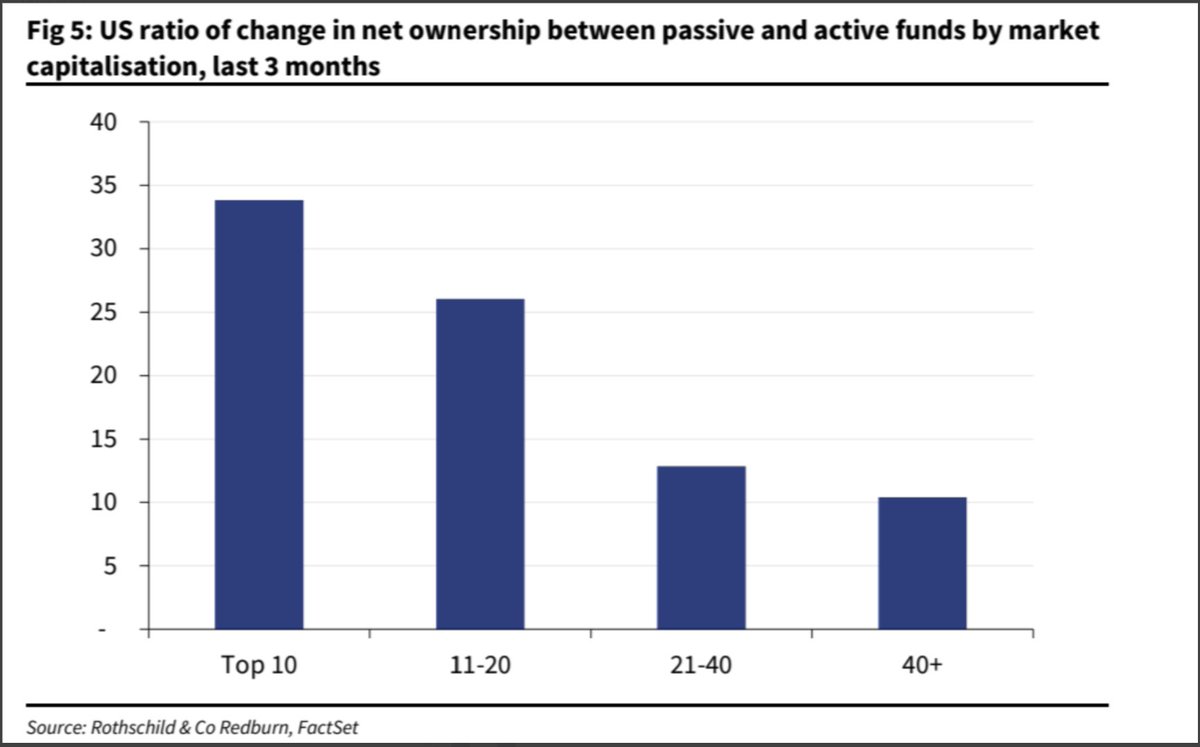
interesting note from Redburn. More than 70% of the price performance of the last 3 months in US market is attributed to semis/tech hardware. who has been buying? passive funds. Passive to active ratio of the top 20 companies is 25:1 to 35:1. iow, slow money waking up to ai
Dominion by Tom Holland
Many modern moral instincts we assume are universal are anything but. Holland traces how Christian theology quietly shaped Western values, revealing the deep beliefs still embedded in today’s institutions and debates.
📚Closing out the year with the books that most shaped how we thought in 2025. They span genres, but all wrestle with the same themes: learning, uncertainty, ideas, and power. Together, these books offer durable frameworks rather than timely opinions.
🧵
Antimemetics by Nadia Asparouhova
Some ideas spread everywhere; others—often more important—remain invisible. This book explains the hidden social and institutional forces that determine what gets noticed, funded, and remembered.
🚨 We're hiring: Head of Institutional Sales
📍 Miami-based
Relationship-first, long-term focused, high-impact role at Unison.
If you're someone (or know someone) who raises capital with trust — let’s talk.
🔗https://t.co/sDpmZUDsvB
The end of the pause on reporting delinquent federal student loans is poised to create a significant headwind for consumer spending, according to a recent Apollo analysis. Approximately 11 million consumers could face declining credit scores.
While direct U.S. bank lending to companies has stalled, a $1 trillion lending boom to "shadow banks"—private credit funds and asset managers—has taken its place.
https://t.co/GqqyySsvfg