@PASQAL and @QubitPharma implemented a groundbreaking hybrid quantum/classical algorithm on a commercial quantum device. Accelerating drug-protein binding studies, this marks a significant leap in healthcare innovation!
https://t.co/ZhbPNmcVgT
🛰️ The SKA Observatory will operate 2 massive telescopes across 3 continents! Get ready to witness a new era of cosmic discovery. Check a look at our new article and learn more about this exciting project 🌌📻 #SKAO#RadioQuietZone#CosmicChallenges
https://t.co/nGDU9Jl7hH
@esa's Euclid spacecraft successfully lifted off weeks ago. It is the first space telescope designed to investigate the nature of dark energy. But, what is it about? Our collaborator @Brownianaweb wrote about this mission. Check it out!
https://t.co/cWSSz53tg8
Jumping from academia to industry can be tough but worth trying. Here you have some new advice about how to navigate this process📌
https://t.co/3a807nfbQT
#academia#jobhunt#industry
Anti-Müllerian hormone: the gold standard for assessing ovarian reserves? A study challenges it as a marker for oocyte quality, exploring the potential of multiple oocyte retrieval events for successful fertilization for women at an advanced age.https://t.co/akEevnftei
Finding a new job outside of academia can be a trial-and-error process. Check out our recent article, to explore pathways beyond the traditional academic route. Tools for #networking, connecting with #recruiters, and finding #jobopportunities.
https://t.co/wt0OxRTwYY
Medicaid expansion has had a significant impact on #cholecystectomy trends and outcomes in New Jersey, according to a recent study. The incidence of emergency cholecystectomies has decreased, while ambulatory procedures have increased after the expansion. https://t.co/HsrQmRtfv3
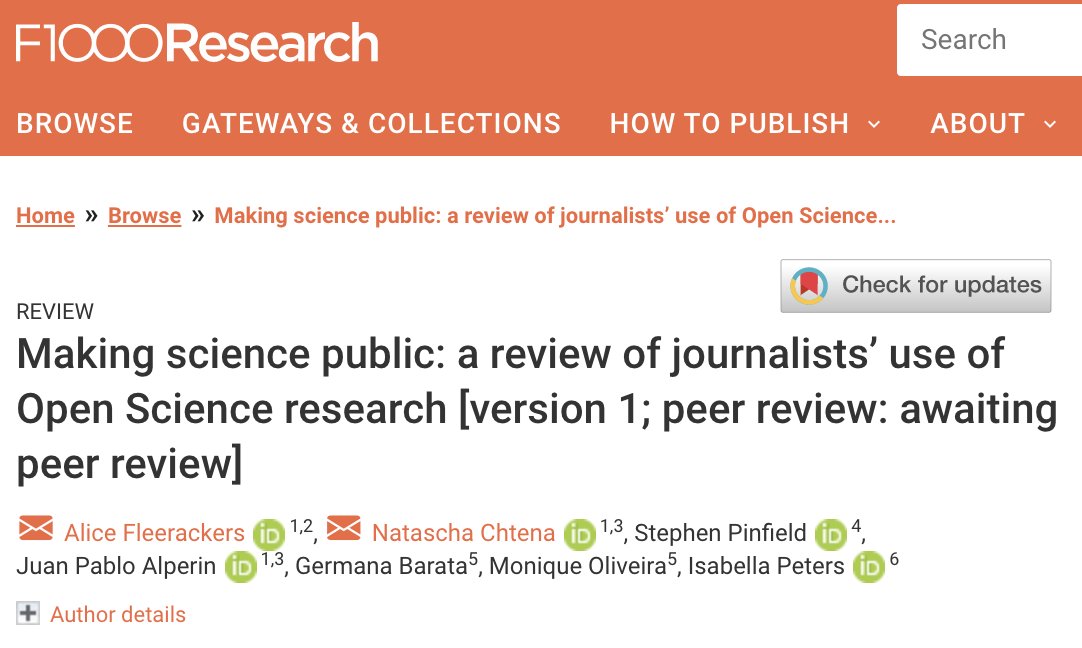
I'm so excited to see our review of journalists' use of #openscience research finally out in the world
We read a huge pile of #scicomm & #scholcomm research to try to understand how journos use preprints and #openaccess papers
Here's what we found... 🧵
https://t.co/XwgKKVcksO
#CitizenScience: According to a Cornell University research, participate in data collection is the most impactful way to improve participant-level outcomes in citizen science project.
Check out the study here https://t.co/KXsl6Aj39k .
Transitioning from #academia to #industry can be tough. Whether you're seeking new challenges or struggling to secure a permanent academic position, some #Tips and insights can guide you towards a #Successful transition.
https://t.co/3afcvbcByS
Having opioids in the home can increase the risk of opioid overdose not only for the person prescribed the medication but also for other household members Check out the latest study on JAMA Network Open: [link] #opioids#Overdose
https://t.co/KY7sYNtXjj
Tomorrow is ESA’s Jupiter Icy Moons Explorer mission, #JUICE launch!! Our collaborator
@Brownianaweb wrote about it and here we re-share some insight about this exciting mission #DestinationJupiter
https://t.co/M6qVe0uIF2
According to a new study, Impressionist artists were actually documenting changes in air pollution through their paintings during the Industrial Revolution. How they did it? Read the full article
https://t.co/oJbIeUKcQ4
A study published in Plos One found that stress is significantly elevated in parents who either have sleep disorders or have children with sleep problems.
https://t.co/GuoIrAujfr
Most women do not link the risk of breast cancer with breast density, a major factor to develop the pathology.
Read the full article⬇️
https://t.co/BVrpC37TKA
The industrial revolution is arguably the single most important event in economic history, but why did the industrial revolution start in Britain in the eighteenth century? Maybe the availability of coal made a difference.
Read the article
https://t.co/xs8tw7jZ4V
Researchers from the US observed a significant reduction in melanoma death rates in that country after the introduction of newer treatments in 2011. Patients under 75 years were also living longer with melanoma.
Article by Gairika Bhattacharya
https://t.co/5iQ1xzcK7p
Vitamin D can improve your brain’s efficiency, according to Tufts University's study. Researchers found that older adults with higher amounts of vitamin D in the brain might have up to 33% lower chance of developing dementia-related cognitive decline.
https://t.co/bOCZQwZMue
Scientists at PASQAL have successfully applied their quantum algorithm named QEK on their quantum processor to identify substances that may cause cancer in mice. #QuantumComputing
https://t.co/srl1Mb0Pn3