Kazakhstan is gradually becoming a technological hinterland for Russia. It offers Russian IT companies a base of operations and gives Russia a way to circumvent sanctions and gain access to technology developed abroad. This is part of Kazakhstan’s effort to balance Moscow’s interests against Western demands.
Russian companies have already obtained Western microelectronics through Kazakhstan. They are now looking there for backup computing capacity for their digital services and may soon try to secure regular shipments of Nvidia B300 chips.
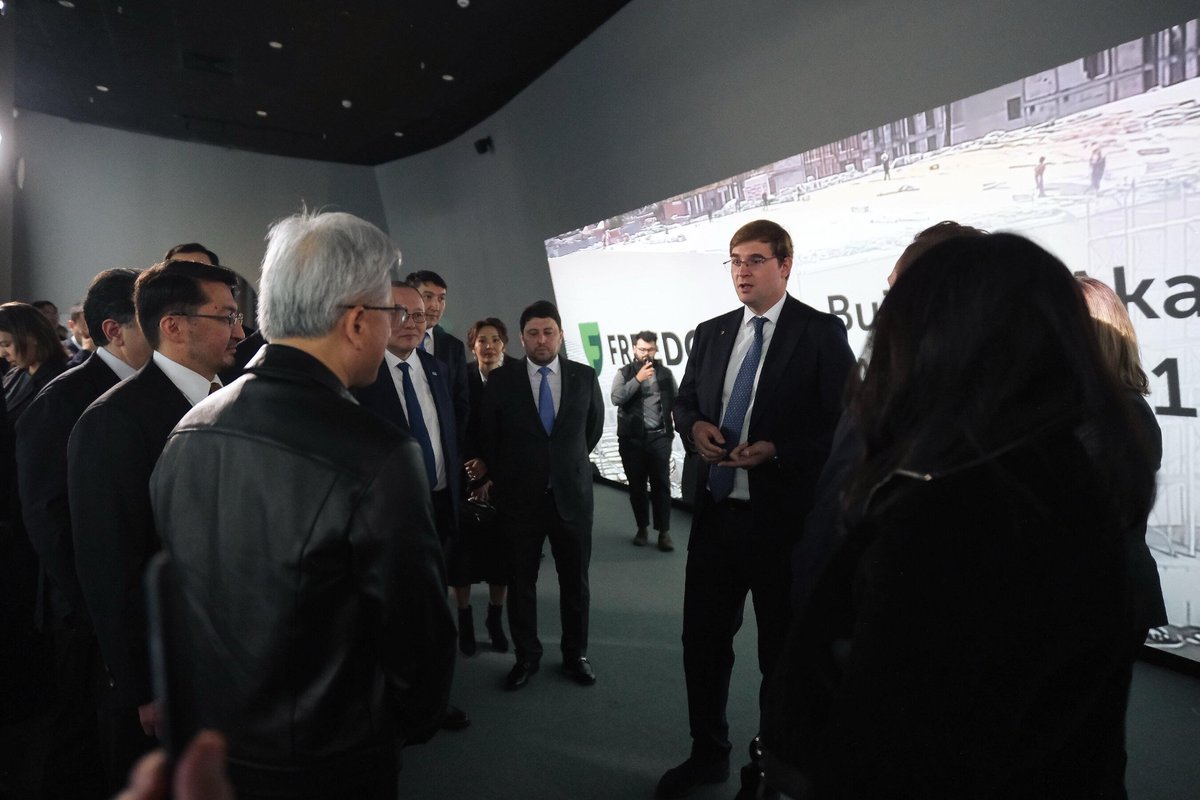
In October 2026, Freedom Holding unveiled plans in Astana for the Sovereign AI Hub, a $2 billion artificial intelligence centre. For its first cluster, which will comprise up to 300 servers, the company announced an order for B300 chips designed by the US firm Nvidia. It plans to give customers remote access to this computing capacity in 2027. On 26 November, during a visit to Moscow, Kazakhstan’s President Kassym-Jomart Tokayev pledged to support the Russian companies Yandex and Sberbank in the Kazakhstani market.
As early as March 2025, Putin instructed the government to work with Sberbank on deploying AI so that Russian drones could operate more autonomously.
Once B300 chips reach Russia through Kazakhstan, what will matter most to Moscow is how regularly the shipments arrive. A steady supply of new servers will allow Russian developers to keep updating military software for years to come and to process data from the front in their own data centres. Russian companies will also be able to move some commercial workloads abroad, freeing up servers in Russia to handle sensitive data.
Russia has already received large shipments of this kind of equipment through third countries. According to Bloomberg, a single Indian company shipped 1,111 Dell servers to Russia between April and August 2024. Documents confirm that 998 of them contained Nvidia H100 chips. Malaysia was listed as the country of origin for at least 834 of the servers. In 2022, Kazakhstan exported $18 million worth of microchips of various types to Russia. Over a five-month period in 2023, Hong Kong suppliers shipped $17.6 million worth of Nvidia products to Russia. The US has also documented shipments of dual-use goods through companies in Turkey, the United Arab Emirates and Kyrgyzstan.
The Russian military needs these chips most. It has already amassed video footage that it can use to train military AI systems. On 12 October 2026, Russia’s Ministry of Defence said it had opened its archive of combat footage to more than 40 organisations developing such systems. Servers equipped with B300 chips can process that footage faster. Intelligence analysts will be able to review more critical clips and get the information to commanders in time. Drone developers will be able to install a single improved image recognition program across an entire production run of drones. The B300 itself operates in a data centre. A compact computer on board the drone runs the trained model. Ukrainian intelligence found just such an Nvidia module in a Shahed-136 shot down over the Sumy region. One implication for Ukraine is that some Russian drones will be able to continue their missions even after losing contact with their operators.
Another application is in manufacturing. At a Rostec plant, a machine vision system already detects defects in the blades of the PD-8 civilian aircraft engine. If military factories adopt the same inspection method, they will be able to catch defects before final assembly and spend less time correcting them. In a protracted war, that affects how much equipment industry can deliver to the armed forces in working order.
The threat extends beyond Ukraine. Russia already sends drones into NATO airspace on a regular basis. If Russian drones can keep flying after losing contact with their operators, they could be programmed to reach more distant targets. NATO allies will have to factor that into any decision to intercept them. They will have little time to assess Moscow’s intentions.
Russia also uses its own servers to interfere in the domestic politics of NATO countries. According to the US Treasury Department, Russian military intelligence funded an AI server at the Moscow-based Center for Geopolitical Expertise, which spread disinformation during the 2024 US elections. In Europe, researchers investigating the Operation Overload campaign identified videos that used synthetic voices to attribute fabricated statements to journalists and academics. Access to powerful chips makes it possible to produce such material in several languages simultaneously.
Both the US and the EU can influence whether Russia gains unrestricted access to the technology it needs. The US could authorise shipments of Nvidia B300 chips to Kazakhstan one batch at a time and agree with Astana to check the serial numbers of servers already installed before the next batch is shipped. If the operator cannot verify the equipment’s location, the US Commerce Department can suspend or revoke the licence. US rules already prohibit companies from servicing servers they know were illegally diverted to Russia. Under rules dated 19 November 2026, Washington can also verify whose workloads the Kazakhstani data centre is actually running. It can deny a licence if a Russian company seeks computing capacity above the specified threshold, including through an intermediary.
The EU can scrutinise the contracts of its exporters and cloud service providers. For certain categories of electronics, exporters must include a clause in their contracts with Kazakhstani buyers prohibiting re-export to Russia. They must also report any breaches to the authorities. European providers are prohibited from giving the Russian government or companies registered in Russia access to high-performance computing or AI training platforms, including through intermediaries. If targeted sanctions against intermediaries and talks with Astana fail to stop systematic re-exports, the Council of the EU can vote unanimously to restrict exports of specific goods from the EU to Kazakhstan. In April 2026, the Council used this mechanism to restrict exports of certain machine tools and telecommunications equipment to Kyrgyzstan.
📷: Nvidia CEO Jensen Huang (left) and Freedom Holding CEO Timur Turlov discuss plans for AI infrastructure in Kazakhstan. Astana, 23 October 2026. Photo courtesy of Freedom Holding Corp. via PR Newswire.
Hodges: “The fact that United States is not even allowing European countries that'd already bought Patriot interceptors to deliver them to Ukraine makes United States culpable for the deaths of Ukrainian civilians and for Russian war crimes of attacking civilian infrastructure.”
A boy who was 3.5 years old when Russia occupied Berdiansk has been reunited with his mother after being separated since the start of the full-scale war.
He was among nine children returned to Ukraine from Russia and occupied areas today.
Video: elvina__seitbullaeva / Threads
“Letters detail how soldiers’ bank cards are taken from them, and how their PINS are extracted – including through torture and threats – to gain access to their accounts." On Russia extorting its own soldiers:
https://t.co/Oud7T2zRrU
- Radoslaw Sikorski:
"...Do you know that stealing another country's children is tantamount to genocide, as recently affirmed by the Parliamentary Assembly of the Council of Europe?
Do you remember that diplomats and propagandists of a genocidal regime are also criminals – as Soviet prosecutors argued at Nuremberg with reference to Ribbentrop and Streicher?
Permanent members of the UN Security Council are supposed to be guardians of peace and not to fight their wars with other people's children. This is Russia's shame that will not be forgiven or forgotten.
And by the way, since Ambassador Nebenzia denies the reality of Soviet-Nazi collaboration in the invasion of Poland in 1939, here is a picture of their joint parade. I'm sure you recognize the Soviet uniforms."
............
Excellent Radoslaw Sikorski,😉
Thank you for your firm support 🫡
За 16 дней число АЗС в России с бензином сократилось на 35 п.п. с 90% до 55%
На 26 ноября только 55% АЗС в РФ имели в наличии бензин в продаже, максимум был 10 ноября, тогда 90% АЗС были обеспечены бензином. За 16 дней доля АЗС с бензином упала на 35 п.п.
Падение практически отвесное !!!!!!!!
Подписывайтесь на мой тг-канал, там больше новостей
https://t.co/UUMqO7hDCd
Putinist Russia Erases the Memory of the Gulag’s Horrors and obliquely but step-by-step Restores STALIN
The government of President Vladimir V. Putin is waging a national campaign to suppress the memory of millions who, like Mr. Smiryaka’s grandfather, were swallowed by the Gulag from the 1920s to the 1950s. About 1.5 million of those imprisoned — both political dissidents and ordinary criminals — died from extreme cold, starvation, disease and intense labor.
A new official narrative has reframed Stalin as the essential architect of the Soviet victory in World War II and played down the repressions as an unavoidable byproduct of building a modern Soviet state.
https://t.co/5BoyDJKDGg
Moscow has closed the Gulag Museum, the group Memorial dedicated to remembering Soviet terror has been banned and dozens of monuments to victims of repression have been taken down as Putin rehabilitates Stalin to justify his Ukraine war. @VALERIEinNYT https://t.co/gyKPkX0evg
Following the destruction of fuel infrastructure in occupied Donetsk Oblast, Russian forces began using concealed fuel storage facilities.
One of these facilities has now been destroyed, along with its supporting infrastructure, in a joint operation by Azov’s SxLüd unit and the Signum battalion.
The trial of a woman caught spying for Russian intelligence and infiltrating Germany’s political and defense circles began in Berlin on Thursday.
According to German federal prosecutors, 57-year-old businesswoman Ilona W., a dual German-Ukrainian citizen, helped Russian military intelligence establish contacts with influential Germans and sought sensitive information concerning military assistance to Ukraine.
Her alleged handler, Andrei Mayorov, was a GRU colonel operating under diplomatic cover as Russia’s deputy military attaché in Berlin.
The investigation alleges that she facilitated his access to political events under a false identity and gathered information on defense manufacturing facilities, drone testing and planned deliveries to Ukraine.
Germany expelled the Russian diplomat following her arrest in January. She faces up to five years in prison if convicted.
The case underscores the threat Russian intelligence operations pose to European security and international military assistance to Ukraine.
Garry Kasparov:
This is the best show Putin can hope for - not a single straight answer. It's not about how many weapons or ammunition you have. It's about whether you are willing to fight and die.
Ah, we're celebrating NATO... NATO is not strong, NATO doesn't exist. It's a fake - it's just N-A-T-O, four letters. The reason you are still sitting here celebrating it is that Ukraine is dying every minute. It's a massive sacrifice. If not for Ukraine standing in front of Russia, Russian tanks would already be in Poland. You all assumed Ukraine would give up. You offered Zelenskyy a ride, and he said, 'I don't need a ride, I need ammunition.'
For four years, Ukraine has been fighting for the whole of Europe. NATO was built to fight only one war - not to go to Afghanistan, not to go to Syria - one war to save free Europe from Russian aggression. Ukraine is the only country fighting this war, and we're still discussing whether we should include them or not? Ukraine is the only country fulfilling NATO's destiny, and we owe them everything. 'Oh, let's sacrifice them.'
Ukraine responds to every Russian strike absolutely justly. And I thank our Defense Forces of Ukraine for the accuracy of these responses.
This week alone, we have achieved results in the Samara, Nizhny Novgorod, Krasnodar, Rostov, Volgograd, Stavropol, Bryansk, Perm, and Tula regions, as well as in Bashkortostan and Tatarstan, and in the Black Sea. Russian oil facilities, enterprises involved in explosives production, and other facilities serving the war effort, military airfields, and aircraft – our long-range strikes reached them all.
I thank all branches of Ukraine’s Defense and Security Forces that are imposing our kinetic sanctions on the aggressor.
Russia has been offered numerous options for de-escalation and ending this war, yet it has chosen war anyway. Russia must end its war – it must choose peace. Thank you to everyone who stands with Ukraine!
The Yefremov Synthetic Rubber Plant in Russia's Tula region was reportedly struck last night. It is involved in producing solid rocket propellant for Iskander ballistic missiles Russia uses to attack Ukrainian cities.
The facility is one of Russia's major producers of synthetic rubber and is strategically important to the country's military-industrial complex.
The plant also specializes in polymers and polyisobutylene additives. Its products are used to manufacture components for plastic explosives and materials for solid rocket propellant for tactical and ballistic missiles.
Ukrainian Defense Forces strike drones are currently attacking the Yefremov Synthetic Rubber Plant in Tula Oblast. A large fire is visible near the facility.
Just so we are clear: the Trump administration is consciously and intentionally withholding anti-ballistic missile interceptors that are already in Europe, paid for, and ready to be delivered, on the verge of winter, when Russia has clearly stated its intention to cause a humanitarian disaster in Ukraine by destroying our infrastructure during the coldest months.
This is a clear attempt to press Ukraine into surrendering. Add whatever is happening with Starshield/Starlink on top of that, plus the public rhetoric of the US president himself, and you will see the full picture of whose side this administration is on.
Česká firma dodávala do ruských továren precizní obráběcí stroje, které teď vyrábí tanky, rakety, granáty a plno další techniky na frontu.
Na dodávky těchto strojů byly uvaleny sankce. Stroje se z Česka tedy začaly dodávat do dceřiné firmy v Číně. Z ní zase do Ruska, kde vyrábí tanky, rakety, granáty a plno další techniky na frontu.
Dodávky strojů, které pracují pro ruský zbrojní průmysl, jsou téma, o kterém se trochu špatně píše - lidi od toho odvrací zrak. Je to komplikované, nejednoznačné, názvy těch strojů samy od sebe odrazují od čtení.
Představte si ale, že by takhle putovaly z Česka do Ruska rakety. Je to hodně blízko, protože bez těch strojů by ty rakety nemohly existovat, protože Rusko na to nemá know-how.
Podle mě snad neexistuje polopatičtější příklad toho, jak se s českým zbožím obchází sankce, než to, co tady velmi dobře popisuje Kristina @veinbender . Fakt skvělá práce, na které dělala dost dlouho v mezinárodním týmu. Co stát, bude pokračovat v její práci a dokáže s tím něco udělat?
Celá investigativa v dalším postu👇
Russia has attacked the containment structure of the damaged Chernobyl nuclear power plant with a drone, causing severe damage. The estimated cost of repairs is at least 500 million euros.
In doing so, Russia has shown a reckless disregard for the potential radioactive contamination of large parts of Europe and the deaths of countless people. An attack on a nuclear containment facility is no ordinary act of war damage; it carries risks that extend far beyond Ukraine, potentially affecting millions of people.
And who is footing the bill?
Not the aggressor, but rather Europe and the international community. 303 million euros have already been pledged.
This is the bitter reality: Russia causes the damage, and Europe picks up the tab. Russia jeopardizes the nuclear safety of an entire continent, while European taxpayers are left to cover the consequences.
How much longer will Europe continue to put up with this?
❗️Former Commander-in-Chief of the Armed Forces of Ukraine Oleksandr Syrskyi secretly visited Norway, where together with General Eirik Kristoffersen he studied the terrain along the 198-km border with Russia to strengthen air defense against drones and missiles. The flight from Oslo to Jarfjord took place with the transponder switched off; afterwards the generals and officers inspected the border using tracked vehicles and helicopters, held closed meetings, and observed the Pechenga valley from a tower at Korpfjell, where the Russian 71st Guards Motor Rifle Division (formerly the 200th Brigade) is based—a unit that has been fighting against Ukraine since 2014. Barents Observer published its report only after the mission ended.
Sikorski: “After breaking Budapest Memorandum, border treaty with Ukraine, and all 10 OSCE principles while being a member of OSCE, Russia is proposing a new security architecture and saying, ‘Trust us, once we agree on new rules, we will abide by them.’ It is very interesting.”