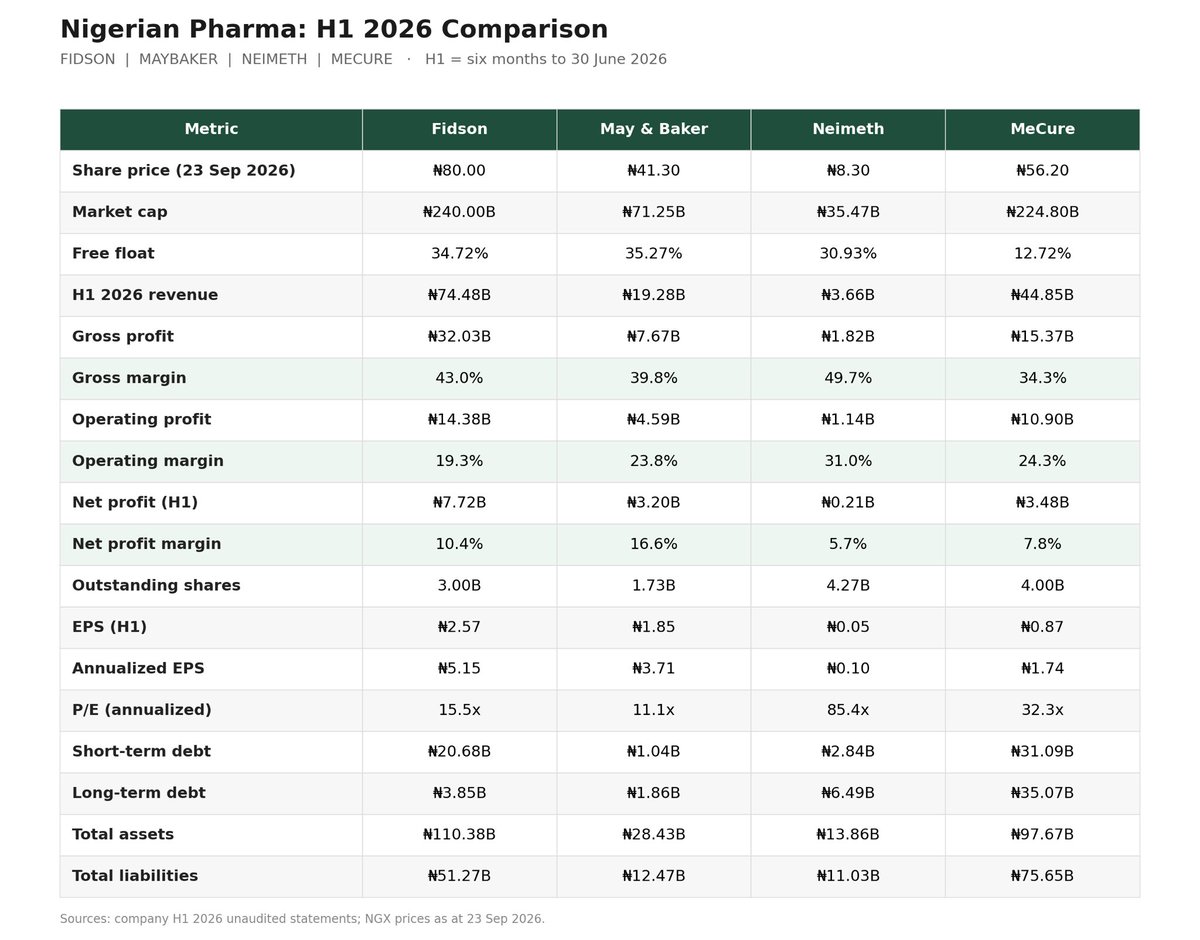
Fidson: 80
May & Baker: 41.30
Neimeth: 8.30
Mecure: 56.20
Like I said the other day, May and Baker is the GTCO of pharmaceutical industry. People sleep on them a lot.
Your investment made 15%? Before you celebrate, subtract inflation.
Nominal return is the raw number your investment pays. Real return is that yield minus inflation.
With inflation at 15.4% as of July, a 15% nominal return is already close to flat once you account for eroding purchasing power.
This is why high growth equity funds matter for long term wealth. A yield that barely beats inflation isn't really growing your money, it's just keeping pace.
For context, Nigeria's top performing equity mutual funds as of July 2026, by YTD return:
Zedcrest Equity Fund, 88.58%
Futureview Equity Fund, 77.44%
Halo Equity Fund, 74.00%
Zrosk Magna Equity Fund, 66.09%
CardinalStone Equity Fund, 58.99%
Cowry Equity Fund, 56.70%
Paramount Equity Fund, 55.86%
Meristem Equity Market Fund, 50.11%
FCMBAM Equity Fund, 47.27%
AXA Mansard Equity Income Fund, 47.21%
Returns like these are what actually outrun inflation with room to spare, not just match it.
Warning: equity funds are high risk. These are past returns, not guarantees, and a fund that returned 88% this year can just as easily post a loss next year. Only invest money you won't need in the short term, and never your emergency fund.
Always calculate your real return, yield minus inflation minus tax, before deciding an investment actually worked for you.
Not financial advice
A money market fund pools money from thousands of investors
Puts it into very safe, short term instruments, mainly Treasury Bills, government securities, and short term bank deposits.
Here's why it matters for beginners specifically.
It's low risk. Your capital doesn't swing up and down the way a stock or equity fund does.
It's liquid. You can typically withdraw within 24 to 48 hours if you need the money back.
It currently pays around 17% to 21% annually, well ahead of what a regular savings account offers, which is usually 2% to 4%.
Minimum to start is as low as ₦1,000 with most licensed fund managers, Stanbic IBTC, ARM, Meristem, United Capital, Zedcrest, investnaija or through an app like Cowrywise.
Think of it as the safest first step into investing. Not for growth. For protecting money you might need soon, while still earning something meaningful instead of letting it sit idle.
If you're brand new to investing, this is usually where to start before moving into anything higher risk.
Not financial advice.
Nigeria's best equity mutual fund returned 88.58% year to date, as of July 31, 2026.
The worst in the top 10 still returned 47.21%.
Here's the full top 10 ranking.
Zedcrest Equity Fund — 88.58%. ₦5m invested from January would be worth ₦9,429,240 today.
Futureview Equity Fund — 77.44%. ₦5m becomes ₦8,872,000.
Halo Equity Fund — 74.00%. ₦5m becomes ₦8,700,000.
Zrosk Magna Equity Fund — 66.09%. ₦5m becomes ₦8,304,500.
CardinalStone Equity Fund — 58.99%. ₦5m becomes ₦7,949,500.
Cowry Equity Fund — 56.70%. ₦5m becomes ₦7,835,000.
Paramount Equity Fund — 55.86%. Nigeria's oldest equity fund on this list, running since 1991. ₦5m becomes ₦7,793,000.
Meristem Equity Market Fund — 50.11%. ₦5m becomes ₦7,505,500.
FCMBAM Equity Fund — 47.27%. ₦5m becomes ₦7,363,500.
AXA Mansard Equity Income Fund — 47.21%. ₦5m becomes ₦7,360,463.
Context worth knowing.
The equity mutual fund segment sits at ₦241.38 billion in total assets, up 2.78% from June, recovering part of what was lost in June's market correction. Now serving 121,316 unitholders, up nearly 8% in a single month.
Zedcrest has now held the top spot for three consecutive months, though its return actually eased from 91.11% in June to 88.58% in July, a reminder that even leading funds fluctuate month to month.
One more thing worth noticing. Several names on this list, Zrosk, Halo, Cowry, are newer, smaller funds outperforming some of the older, more recognizable managers. Fund size and brand recognition don't automatically mean better returns.
Not financial advice. Figures from SEC data via Nairametrics, July 2026. Past performance does not guarantee future returns.
Which of these funds are you currently holding, if any?
If you invested ₦1,000,000 in the Zedcrest Equity Fund back in January, your money has now officially doubled.
As of today, the fund's Year To Date return sits at +102.26%.
That means ₦1,000,000 invested at the start of the year is now worth ~₦2,022,600.
Here's what the journey actually looked like month by month to get here:
January: ₦1,109,600 (+10.96%)
February: ₦1,445,700 (+30.28%)
March: ₦1,501,200 (+3.85%)
April: ₦2,025,100 (+34.90%)
May: ₦2,083,800 (+2.90%)
June: ₦1,830,600 (-12.15%)
July: ₦1,885,900 (+3.02%)
August: ₦1,857,400 (-1.54%)
Today: ₦2,022,600 (+102.26% YTD)
THE MILESTONE BREAKDOWN
Current YTD Return: +102.26% more than 2x capital
Benchmark NGX ASI YTD: +56.93%
Fund Outperformance (Alpha): +45.33% above the market
THE VOLATILITY REALITY
Notice June. The fund dropped from ₦2.08 million to ₦1.83 million in 30 days, a brutal -12.15% drawdown in a single month.
It's easy to imagine investors who bought near the May peak panicking and pulling out in June, missing the push that carried the fund past +100% YTD.
High returns in equity funds never come in a straight line. That -12.15% dip in June wasn't a defect, it was the volatility cost required to capture +102% total performance.
If you cannot stomach watching your balance drop 10-15% in a bad month without panic selling, high risk equity funds are not the right place for your capital.
Figures reflect official reported app and factsheet data. Past performance does not guarantee future returns. Educational content, not financial advice.
The kind of long-term compounding in the post is best achieved through Equity Mutual Funds (also called Aggressive Equity Funds).
These funds professionally manage a diversified basket of Nigerian stocks. You don’t need to pick individual companies or read balance sheets.
Some reputable ones worth considering:
• @StanbicIBTC IBTC Aggressive Fund
• @armengage Aggressive Growth Fund
• @ZedcrestWealth Equity Fund (one of the strongest recent performers)
Important note: 17% average annual return over 30 years is ambitious. Well-managed equity funds have the potential to deliver strong double-digit returns over very long periods, but markets are volatile and past performance is never a guarantee of future results.
The real key is discipline + consistency. Set up a monthly standing order from your salary and stay invested through the ups and downs for 20–30 years.
That’s how wealth is actually built in this country.
30 Financial Goals to Hit by Age 50
1. Build an emergency fund that can cover 6–12 months of expenses
2. Invest consistently, not occasionally
3. Save at least 4–6 times your annual income for future stability
4. Open a brokerage account for long-term wealth building
5. Diversify your investments (stocks, mutual funds, real estate, fixed income)
6. Set up automatic savings or investment deductions
7. Review and rebalance your portfolio at least once a year
8. Avoid early liquidation of long-term investments
9. Understand the basics of how the stock market and ETFs work
10. Own your home or pay off a significant portion of your mortgage
11. Build solid home equity or rental property income
12. Make home improvements that increase property value
13. Pay off high-interest loans and credit card debts
14. Eliminate unnecessary personal and auto loans
15.Maintain a strong credit history and healthy debt profile
16.Keep your loan-to-income ratio low
17.Regularly review your financial statements and spending patterns
18.Start or maintain an education savings plan for your children
19.Set financial boundaries with family and friends
20. Plan ahead for major life events (weddings, relocation, etc.)
21.Take at least one debt-free, fully-funded vacation
22. Build a lifestyle that fits comfortably below your income level
23.Get proper insurance cover (health, life, home, or business)
24.Create and update your will or estate plan
25.Consult a licensed financial advisor or planner
26.Learn how to grow passive income streams
27.Track your net worth yearly and adjust your goals
28.Know your FIRE number (Financial Independence, Retire Early)
29.Learn tax-efficient ways to grow and preserve your income
30.Define clear financial goals for your 50s and beyond
My life in one view.
INVESTMENTS
Stocks, Nigerian and US: @ZedcrestWealth , @hisanigeria
Mutual funds, equity and money market: @ZedcrestWealth
Treasury bills: @getladda
Real estate: @Risevest and the US market
Crypto
Land banking
Emergency fund, sitting in a money market fund
My own business, the biggest position of all
CLUB
Real Madrid
BASKETBALL
Golden State Warriors @warriors
MUSIC
Rod Wave and Naomi Raine
FOOD
Jollof rice and turkey
JUNK
Parfait and pizza
INVESTORS I STUDY
Dangote, Buffett, Tony Elumelu
HOBBIES
Books and anime
Pick any line and tell me yours.
Compounding doesn't look impressive at the beginning.
That's why most people quit.
₦100k becoming ₦110k doesn't change your life.
But doing the same thing for years while continuously adding more capital?
Now the numbers start behaving differently.
This is how to invest in mutual funds and treasury bills.
Before the market opens, here's what you need to know.
-Money Market Fund.
Risk level: Low. Your capital stays stable.
Timeframe: Short-term. Good for money you may need within a year, or an emergency fund.
Returns currently around 17% to 20% annually.
Minimum to start: as low as ₦5,000 with most fund managers.
-Balanced Fund.
Risk level: Medium. A mix of stocks and bonds, roughly 50-60% equities, the rest fixed income.
Timeframe: Medium term. 2 to 5 years works best, enough time to ride out a dip.
Grows faster than a money market fund, with a cushion underneath it when the market corrects.
-Equity Fund.
Risk level: High. Mostly invested in NGX stocks.
Timeframe: Long term. 5 years minimum, ideally longer. Leave it untouched.
Historical returns can exceed 40% annually in strong years, and can also post real losses in a bad one. Time in the market is what makes this work.
-Treasury Bills.
Risk level: Very low. Backed fully by the Federal Government.
Timeframe: Short term. Choose between 91, 182, or 364 days.
Interest is paid upfront, at the point you invest, not at maturity. You receive your full face value back at the end of the term.
How to actually start any of these.
Download a licensed fund manager's app, Stanbic IBTC, ARM, Meristem, United Capital, or Cowrywise for mutual funds. For treasury bills, use your bank's app or a licensed stockbroker.
Provide your BVN, a valid ID, and fund your account.
That's it. No office visit required.
Match the fund to your timeline, not to whichever one has the highest number attached to it.
Not financial advice. Rates fluctuate and are not guaranteed.
Over the weekend I did some deep analysis across 12 stocks on the NGX. Grouped them by risk level. Here is what I found
SPECULATIVE (High risk, high reward)
1. CHAMS - Digital identity and payments infrastructure. Traded 60.7 million shares in one session, 3rd highest volume on the entire exchange. Institutional money is quietly accumulating.
2. TRANSEXPR - Logistics and courier services. Returned 32.75% in a single week. Lekki Deep Sea Port and e-commerce growth driving structural demand for logistics.
3. VERITAS - Insurance penny stock. Nigeria has less than 1% insurance penetration. If mandatory insurance reforms gain traction, small insurers could re-rate massively. Extremely high risk.
GROWTH (Strong earnings momentum, moderate risk)
1. JAIZBANK - Nigeria's only non-interest bank serving 90 million+ Muslims with zero direct competitors on the NGX. Revenue grew 21%. Profit surged 32%. Already met CBN recap requirements early while others scrambled.
2. NASCON - Dangote Salt and seasonings. ROE of 61.56% which is elite level on the NGX. Revenue grew 49%. Debt to equity of just 0.09. Earnings report expected April 24, potential catalyst.
3. NCR - IT infrastructure and payment solutions for banks. Up 174% YTD. As banks recapitalize and upgrade systems, NCR benefits directly. Best performing tech stock on the exchange this year.
4. MAYBAKER - Pharmaceuticals. Profit tripled year on year. Beta of 0.09 means it barely moves with the broader market which makes it excellent for portfolio diversification.
5. HONYFLOUR - Classic turnaround story. Swung from heavy losses to profit after naira stabilized and FX losses disappeared. Revenue at ₦277 billion. Up 240% over 52 weeks.
6. GUINNESS - Consumer recovery play backed by Diageo, the world's largest spirits company. Gained 34% in 4 weeks as inflation drops and consumer spending power returns. Not yet a blue chip again but heading in that direction.
7. NGXGROUP - The Nigerian Exchange itself. When the market booms, the exchange earns from every single trade. FTSE upgrade means more listings, more volume, more fees. The harbor makes money regardless of which boats win.
BLUE-CHIP (Institutional quality, lower risk)
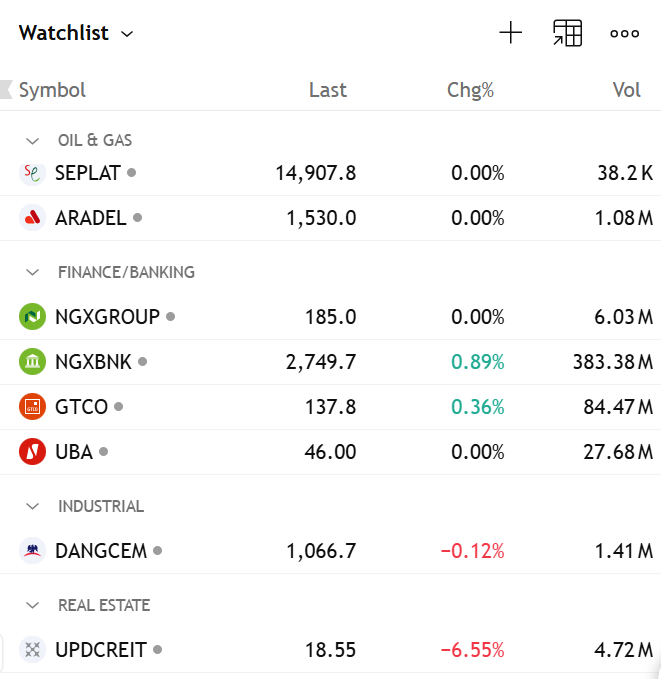
1. GTCO - Gained 10.66% in one week after FTSE news. Profit before tax of ₦1.23 trillion. Dividend of ₦12.76 per share. Will be among the highest weighted Nigerian stocks when global tracker funds start buying in September.
2. SEPLAT - Revenue surged 144% to $2.73 billion. Gross profit up 156%. Pays ₦108 dividend per share. Dual listed in Lagos and London. The dominant energy play on the NGX.
What do you think about these picks. Which ones are you watching. Which ones would you avoid. Drop your thoughts below.
Equity mutual funds are the easiest way to get into the 🇳🇬 stock market. With this, you don't have to pick company stocks. Just buy into the funds and let a professional manage it for you.
Let me explain how it works 👇
You’re 42 and want to retire at 57. That’s 15 years.
Invest ₦200,000 monthly at 15% average returns.
In 15 years, that becomes roughly ₦132m.
You contribute ₦36m. Growth adds nearly ₦96m.
Fifteen years is not too late. It’s a full runway if you start now.
How to Choose a Mutual Fund: Your 7-step checklist
STEP 1: Define your goal
Short-term under 3 years: Money Market Fund
Medium-term 3 to 7 years: Balanced Fund
Long-term 7+ years: Equity Fund
STEP 2: Check track record
Minimum of 5 years.
Do not judge by last year alone. Look at long-term average returns.
STEP 3: Compare to benchmark
Did the fund beat the NGX All Share Index?
If an equity fund returned 10% while the market did 15%, that is underperformance.
STEP 4: Check consistency
Fund A: 50%, -20%, 40%, -15%, 30%
Fund B: 15%, 18%, 14%, 16%, 17%
For most investors, Fund B wins over time.
STEP 5: Verify fees
Money market funds below 1.5%
Equity funds below 2.5%
Fees compound against you.
STEP 6: Check minimum investment
Can you afford the entry amount?
Can you invest consistently?
STEP 7: Verify SEC registration
Confirm the fund is registered on https://t.co/mfgRCywlcY
Do not invest based on ads.
Invest based on data.
Mutual funds pool money from many investors, and a professional manager invests it according to a specific strategy. You do not pick individual stocks; the manager does that for you.
There are four main types:
1. Money market funds: These invest in short-term government securities. They are very safe and offer low returns. They are good for parking cash.
2. Bond funds (fixed-income funds): These invest in government and corporate bonds. They carry moderate risk and provide steady income.
3. Equity funds: These invest mainly in stocks. They have higher risk but offer the highest long-term return potential.
4. Balanced funds: These combine stocks and bonds. The manager adjusts the ratio over time. They are good for people who want both growth and stability.
If you are a complete beginner, a balanced fund or a broad-market equity fund managed by a reputable firm is one of the simplest ways to start building wealth.
If you’re thinking long-term (15–25 years) and want to enjoy the magic of compound interest in Nigeria, here’s where you should be looking:
1. Mutual Funds (via ARM, Stanbic IBTC, FBNQuest, Meristem) — reliable fund managers with long track records. Focus on equity-based or balanced funds for growth.
2. Federal Government Bonds (via the DMO or primary dealers) — one of the safest long-term investments in Nigeria. Pays fixed interest, great for stability.
3. Treasury Bills (for short-medium term rollover) — not exciting returns these days, but very secure.
4. Real Estate Investment Trusts (REITs) — invest in real estate without buying physical property. Available on the NGX.
5. International Dollar Mutual Funds (like ARM Dollar Fund, Stanbic IBTC Dollar Fund) — hedge against naira depreciation while compounding in USD.
Tip: Mix growth-focused funds with stable income assets. Prioritize security, credible institutions, and consistency.