Hi @JenStDen, we are the creators of Unlocked: Living With AI👋
As companies bring AI into work, entry-level tasks that help new employees gain experience are becoming automated.
How do you think businesses can balance AI adoption with opportunities for the next generation?
#AI
📊Businesses can use AI to complete tasks faster, but this could reduce job opportunities. Should companies prioritize productivity or protecting employment?
#AI#Employment#Jobs#Unlocked_LivingWithAI#thisorthat
🎓📚AI can explain concepts instantly, while teachers offer human understanding and guidance. Who would you rather learn from?
#AI#thisorthat#Unlocked_LivingWithAI
One vulnerability. 178 organizations. One major lesson.
The Optimizely cyberattack shows how compromised third-party software can put trusted websites and visitors at risk. Who's responsible for keeping our connected world secure?
#CyberSecurity#AI#Technology#Igor
Beyond The Screen: Meet the creators of Unlocked: Living With AI - The voices behind the screen and the people who bring stories about how AI is shaping our world 👩💻🎙️
https://t.co/bRaXS4FXue
#Unlocked_LivingWithAI#MeetTheCreators#AboutUs
With in 5 American high school students using AI, yet half of US high schools have no policies, we must ask “Is using AI in the classroom cheating or learning?”
Unlocked: Living With AI, explores the controversy around AI in the classroom?
https://t.co/vFsM71Labd
#Bridges#AI
Stanford just published its 2026 AI Index Report and one number inside it should be read by every parent, every teacher, and every school board member in the country.
4 out of 5 American high school and college students are already using AI for schoolwork.
Only 6% of teachers say their school has clear policies on how that should happen.
That gap is not a technology problem. It is one of the most significant institutional failures in the history of modern education, and it is happening right now, quietly, inside every classroom in America while the adults responsible for those classrooms are still writing the memos.
To understand why this matters, you have to understand the speed at which it happened. Stanford's researchers found that generative AI reached 53% population adoption within three years, which is faster than the personal computer and faster than the internet. Students did not wait for permission. They did not wait for curriculum updates or policy frameworks or guidance from administrators. They found the tools, figured out how to use them, and integrated them into their schoolwork the same way every generation of students has always integrated whatever was available to them, except this time the tool is capable of writing their essays, solving their problem sets, structuring their arguments, and doing the cognitive work that teachers have spent decades designing assignments to produce.
Half of all middle and high schools in the United States have no AI policy whatsoever. The ones that do have policies have them in a form so unclear that only 6% of teachers describe them as actionable. Which means that in practice, across almost every school in the country, a student using AI to complete an assignment and a student not using AI are being evaluated against the same standard, measured by the same rubric, and assessed for the same skills, without anyone in the building having agreed on what any of that actually means in a world where the distinction between the two has become nearly impossible to detect.
The Stanford researchers also found what students are using AI for, and it is not the edge cases. They are using it for research, essay editing, and brainstorming, which are precisely the three activities that sit at the center of what schools have traditionally used to teach students how to think. Those are not peripheral tasks that AI has quietly automated. They are the core of what academic work was designed to develop, and they are now being handed off at scale to a tool that most institutions have not formally acknowledged exists inside their walls.
China and the United Arab Emirates have already responded by mandating AI education starting with the 2025 to 2026 school year. Both countries made a national decision that the right response to students using AI was to teach them to use it deliberately, critically, and with an understanding of what it can and cannot do. The United States has not made that decision at any level of government, which means the first genuinely AI-native generation of workers is being formed right now, mostly without guardrails, and the employers who will eventually hire them have not yet thought carefully about what that means for the skills they will and will not be walking in the door with.
The report describes this as an institutional readiness failure.
That is the polite version of what it is.
AI data centres are often criticized for their water consumption, how does it compare with other major water users?
Read our research on AI's impact on the environment, raising broader questions about how we manage limited water resources.
https://t.co/Vus4mB1WH7
#Bridges#AI
Water usage by almonds, pistachios, golf courses, residential pools, and data centers.
Even with the AI buildout, almonds have exponentially drained water resources compared to data centers.
In the case of the Colorado River, states are rationing water while using resources to grow alfalfa for Arab countries.
Follow: @AFpost
As AI changes different industries, some workers may need to learn new skills or move into different careers. This report explores how workers can prepare for changing job opportunities.
https://t.co/EiSXyTGMUv
#Jobs#Career#AI#Unlocked_LivingWithAi#Link
Did you know that AI creates electronic waste? As companies upgrade their servers and computer equipment, old technology needs to be replaced and disposed of, creating another environmental challenge.
https://t.co/vz2FGmMPS2
#ai#environmental#Unlocked_LivingWithAi#Link#waste
💬Beyond The Screen: have a question or idea to share?
We'd love to hear from you! Whether it's feedback, a collaboration opportunity, or a conversation about AI's growing impact, your voice matters💜
Visit our contact us page and let us know📩
#Contact
https://t.co/Ch8KZeyltc
🎤 The question from our practice interview:
"Have you noticed changes in how students approach assignments and learning when AI is introduced in the classroom?"
As our podcast explores students' use of AI, we wanted a teacher's perspective on the impact of AI.
#Unlocked_LWAI
Here's something interesting! A 2025 study estimates the potential water and carbon footprints of AI servers in the United States, highlighting the environmental challenges that could come with the rapid growth of AI.
https://t.co/MxNI6t12UZ
If AI is changing how companies hire, what happens to young people trying to gain their first work experience? Are we changing the career ladder before the next generation even gets a chance to climb it?
Explore our investigation: https://t.co/QTWSQI9wdA
#AI#Bridges#Employment
AI's impact on employment may be showing up in hiring decisions rather than layoffs.
@Stanford researchers found that employment among workers ages 22–25 in highly AI-exposed occupations was 19% below the level implied by trends among less-exposed peers, largely reflecting reduced hiring.
Federal labor statistics need to capture these shifts in hiring, job openings, and occupational demand—not just changes in total employment.
Read more👇
https://t.co/p2dv3TbrXP
Have you ever wondered which careers could be most affected by AI? This research examines how AI could change everyday tasks across different occupations, especially in media, technology, and other industries.
https://t.co/bCwd7fMTzf
#Jobs#Ai#UnlockedLivingWithAi#Link#Career
AI is not always right and often makes mistakes known as AI Hallucinations, this is when it produces information that may be false to unsupported.
Check out our AI myth buster where we explore AI hallucinations in greater depth.
https://t.co/3ajOhI2BOg
#AI#Bridge#Hallucination
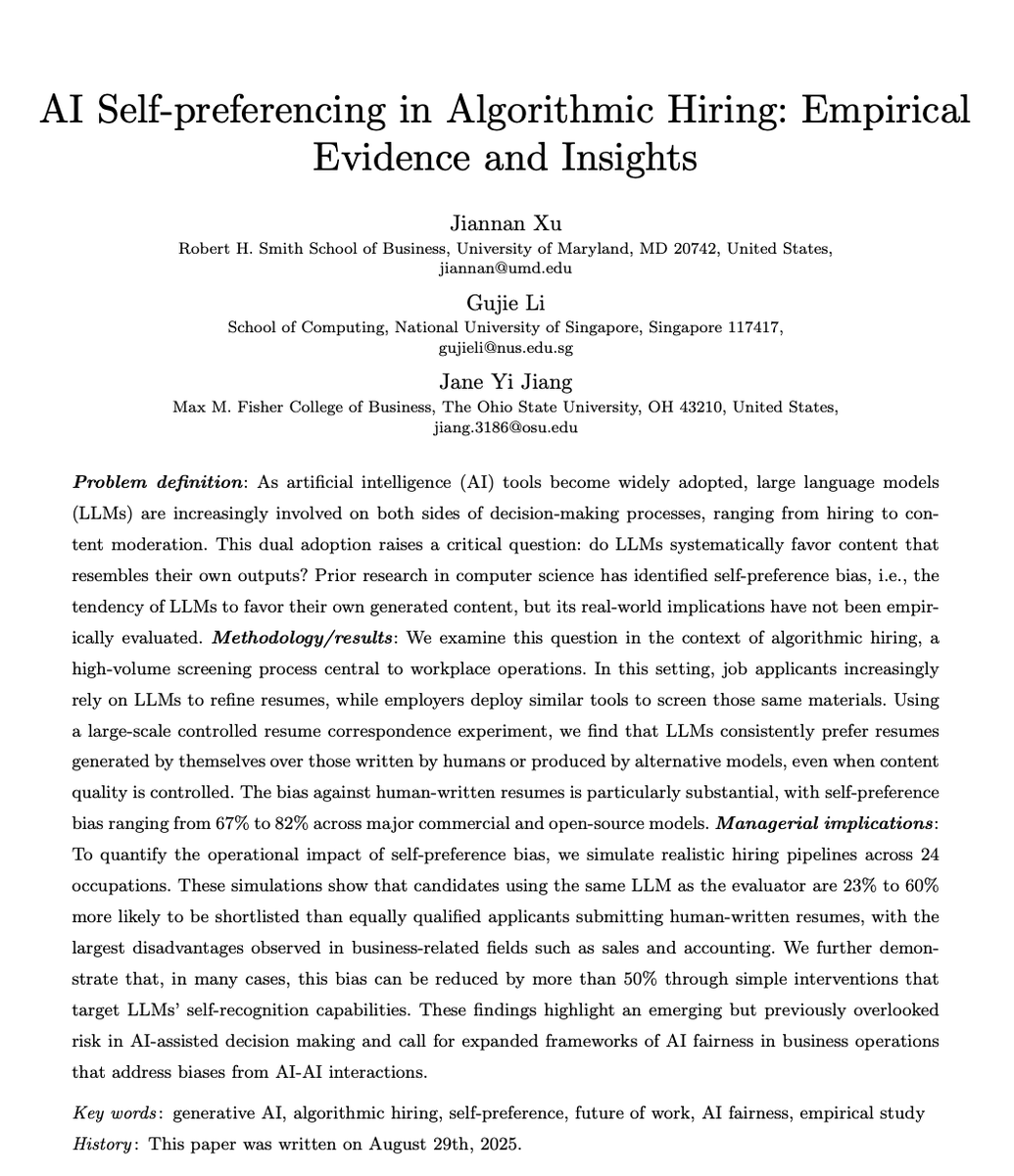
Researchers proved AI hiring tools secretly reject human-written resumes 82% of the time.
They ran an experiment. Sent the exact same resume to an AI hiring tool twice, same skills, same experience, same everything.
One version written by a human. one rewritten by ChatgGPT.
AI picked the ChatgGPT version 97.6% of the time.
Researchers call it "Self-Preferencing Bias"
Right now, employers are using AI to screen thousands of job applications. but these models are not actually looking for the best candidate.. they are looking for themselves.
When an AI reads a resume, it systematically favors text that sounds like it was generated by its own algorithm.
Researchers tested 9 of the top LLMs as recruiters, and the finding was universal..
gpt-4 picked its own resume over a human-written one 82% of the time. even when the human version was factually identical and objectively stronger. the AI doesn't want human nuance.. it wants the patterns it already recognizes.
Candidates whose resume happened to match the specific AI model the employer was using to screen were up to 60% more likely to get an interview.
Think about what this means for your career right now. your skills don't matter as much as the invisible watermark of your syntax.
If a company uses claude to filter resumes, and you used chatgpt to write yours.. you are at a massive disadvantage.
If you wrote it yourself? you are dead in the water..
Researchers found that this "AI self-preferencing" ranges from 67% to 88% across major commercial models.
Did you know most students in many countries now use AI for schoolwork? A recent OECD report explores how students use AI to learn, complete assignments, and research topics, while raising questions about whether relying on it too much affects learning.
https://t.co/G8nkq1yKAt