At the same time, 20+ states have created new “skip residency” licensure pathways, along with pathways toward board certification, all in less than 3 years.
If this was only about physician shortages, why were board certification pathways added so quick?
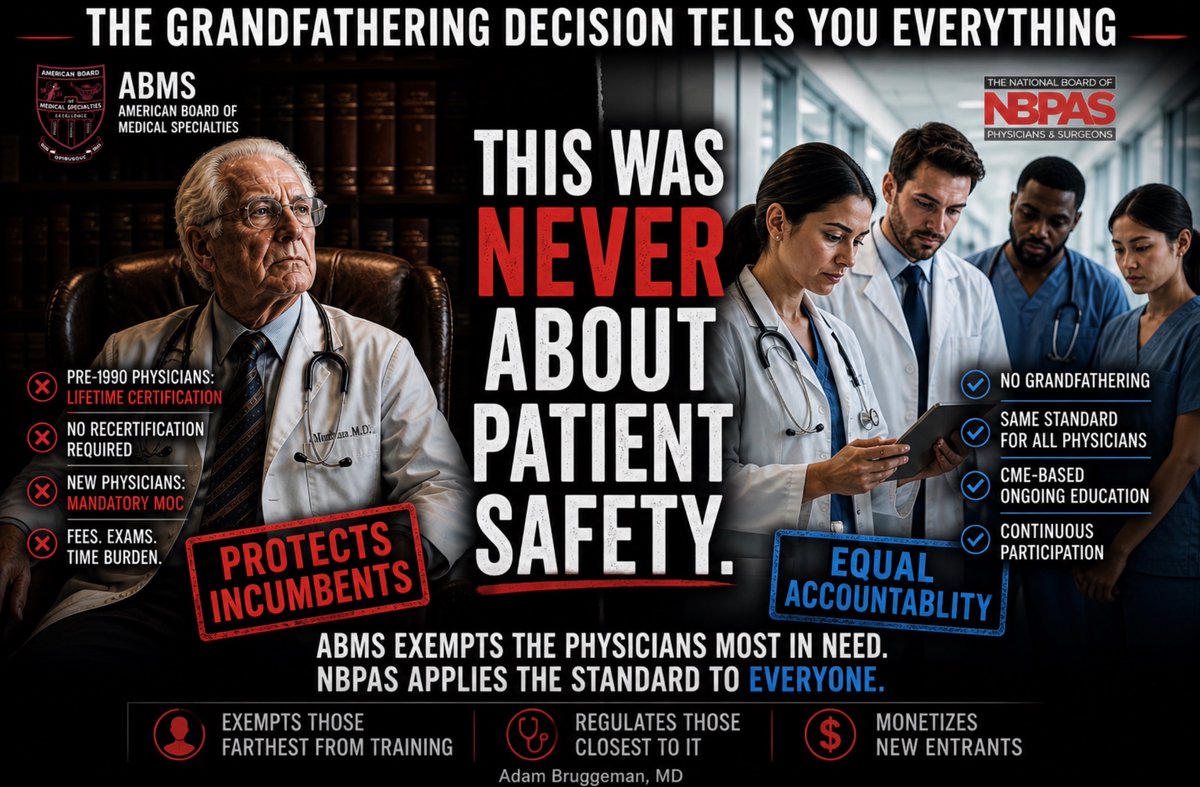
Maintenance of Certification Controversy - The Impact of the Grandfather Clause
When the American Board of Medical Specialties introduced Maintenance of Certification requirements in 2000, it faced an immediate question: which physicians needed ongoing recertification most urgently? The answer, under any honest patient safety rationale, was obvious. The physicians most likely to be practicing outside current clinical standards were those whose training was farthest removed from contemporary evidence-based medicine. These were the senior physicians who had completed residency in the 1960s and 1970s and whose foundational medical education predated three decades of pharmacological, surgical, and diagnostic transformation. If the purpose of ongoing recertification was patient protection, those were the physicians the program should have reached first.
ABMS grandfathered them entirely. Physicians who had obtained initial board certification before 1990 received permanent, non-expiring credentials with no ongoing recertification obligation. The mandatory commercial program was built around the physicians who had trained most recently. These were the physicians whose knowledge base was most current, who had just completed ACGME-accredited residencies and passed rigorous initial certification examinations. The patient protection rationale, applied honestly, demanded the opposite. The grandfathering decision at launch tells you what the program was actually designed to do.
That decision was not corrected as the program matured. It was institutionalized. The American Medical Association, which founded ABMS in 1933 and retains a delegate vote in the ABMS General Assembly today, has codified grandfathering as permanent policy in H-275.924 Principle 23, which explicitly states that physicians with lifetime board certification should not be required to seek recertification. The organization that built ABMS defends it against every reform effort and owns the AMA PRA Category 1 Credit designation that ABMS member boards require physicians to fulfill as their mandatory CME standard. It has officially and permanently protected the cohort of physicians the patient protection argument would most urgently cover. That means this is not about legacy protections but instead an institutional commitment to an arrangement that has never been about patient safety.
The National Board of Physicians and Surgeons, the organization the AMA has disqualified from recognition, explicitly prohibits grandfathering. NBPAS holds every physician who seeks its certification to the same 24-month CME documentation requirement regardless of when they trained, how long they have been in practice, or what year they completed residency. The Practical Neurology summary of NBPAS's Joint Commission recognition states this directly: NBPAS prohibits the discriminatory practice of grandfathering, which gives lifetime elite status without recertification requirements to a significant portion of US physicians. The organization the AMA has disqualified using patient protection language is the only certifying body in the country that applies the patient protection rationale without exception. The organization the AMA protects exempts the physicians the patient protection rationale would most urgently cover.
This is the efficient demolition of the ABMS patient safety argument, and it requires only the structural choices ABMS and the AMA made themselves. It needs no external critique. The grandfathering decision at launch, the AMA's codification of it as permanent policy, and NBPAS's explicit prohibition of it together establish that the mandatory commercial recertification program was designed to extract fees from new entrants while protecting incumbents. It was not designed to ensure that the physicians treating patients today are current in their specialty knowledge.
On April 30, 2026, the Department of Justice and the Federal Trade Commission issued a joint letter to the Tennessee Supreme Court describing the American Bar Association's exclusive accreditation authority over law schools as a monopoly. The letter documented that the ABA's governance is dominated by parties with financial interests in limiting competition, that its standards exceed any defensible baseline, and that its history includes documented antitrust violations. The ABMS has a concerning similarity to that description. Paul Teirstein, MD, the cardiologist who founded NBPAS, described the ABMS precisely in a Wall Street Journal op-ed published October 19, 2025: a private nonprofit entity that operates like a regulator, controlling a credential held by nearly 95 percent of practicing physicians, required by most hospitals and insurers as a condition of employment, with no accountability to the physicians or patients it claims to serve. The combined net balance of all 24 ABMS member boards, which are all 501(c)3 nonprofits, grew from $237 million in 2004 to $642 million in 2014. The American Board of Internal Medicine alone reported $90 million in revenue in fiscal year 2023, with its President and CEO receiving $1,385,563 that year and $7 million over the preceding six years.
The program was embedded into the Affordable Care Act (ACA) through federal lobbying while ABMS was simultaneously lobbying Congress on its own behalf. You might ask how the ACA codified ABMS certification. The ACA wrote a statutory definition of maintenance of certification that matched the ABMS program, then CMS attached a Medicare bonus payment through PQRS quality reporting of ABMS participation on top of that statutory definition. The taxpayer-funded bonus flowed exclusively to ABMS-certified physicians participating in ABMS MOC. The DOJ and FTC just drew the legal and policy map for challenging exactly that kind of structure. This week I am making the case for reform.
@beauhightowerdn@ChiefEngineerCE Saying there’s no pattern assumes the system is transparent and standardized it’s not.
Programs don’t disclose:
- how they screen
- what filters they use
- who gets excluded pre-interview
- who is ranked
- how they rank
So you’re defending a process no one can actually audit.
Every medical graduate must complete a residency and pick a specialty to get licensed.
“Not competitive” based on what? In every other field, it’s positions vs applicants.
But in medicine, PGY-1 positions by specialty aren’t fully known when you apply, and programs don’t have to finalize positions until months into the cycle.
So how are students supposed to accurately assess competitiveness?
@beauhightowerdn@ChiefEngineerCE I'm referring to your comment on all virtually being able to practice here - so US Citizens that do get loans for medical school via FAFSA for medical school are being re-evaluated for gainful employment.
@beauhightowerdn@ChiefEngineerCE If virtually all U.S. graduates can be gainfully employed, why are their loans being re-evaluated under the BBB? That doesn’t align.
IMG stands for International Medical Graduate.
That is any physician who earned their medical degree outside the United States or Canada. It includes both US citizens who studied abroad (often in the Caribbean) and non-US citizens trained in countries like India, Pakistan, the Philippines, Nigeria, and elsewhere.
In practice on X and in policy discussions, when people say IMG they usually mean the foreign-trained non-US citizen pipeline that flows through J-1 visas, Conrad 30 waivers, provisional licensure paths, and the residency match.
These are the doctors who often enter the system with advantages US graduates do not get:
sponsored visas, lower debt loads, fast-track provisional licenses in 17+ states, and targeted recruitment incentives.
It's surprising anyone would want to get their degree in the USA when all the advantages go to IMG the way our current system is set up.
That single acronym hides a lot of the replacement mechanics we have been walking through.
Citations (APA)
Educational Commission for Foreign Medical Graduates. (2025). IMG Applicant Data.
National Resident Matching Program. (2026).
Results and Data: 2026 Main Residency Match.
Rise and shine! Nothing goes better with that first cup of coffee than our hot off the press newsletter. And this one is sparking controversy.
‼️From a historical perspective, what is the purpose of the Trump administration?
‼️The low down on the Match, foreign doctors and doctors who can’t get a job.
‼️Politics, policy and power.
‼️A Wisconsin professor gets it all wrong.
‼️The Dignity Act dismantled line by line.
And more news can use.
(Link in the replies.)
Since Match week, physicians and medical students have begun documenting on social media cohort compositions at individual residency programs and the patterns are not what a neutral, merit-based process would produce.
There are programs where the overwhelming majority of residents — eight, nine, ten out of ten — share the same country of origin. The statistical probability of such clustering emerging from an unbiased selection process approaches zero. Clustering at that level is not coincidence.
The USA is the only developed country that does hot prioritize its citizens. That needs to change.
@MaryBowdenMD Read my article detailing why we don’t produce more U.S. MDs. For every U.S. MD applicant replacing an international one, these orgs (AAMC NRMP FSMB NBME ECFMG) make 30-50% less fee rev. In total, they’d lose $200-250M annual: https://t.co/imkdRGGhag
The math isn’t adding up in our medical schools. We have the residency spots, but we’re blocking U.S. students from filling them while educating a quarter of our workforce from abroad.
Why is the system set up this way?
Our lawsuit against the FSMB and 6 state medical boards is finally in motion! One board is refusing to respond, another one blew off the judge but just came around, and the other four are begrudgingly complying.
The Match algorithm won a Nobel Prize.
It's also the perfect cover for what's actually happening inside American teaching hospitals.
The algorithm only processes what program directors submit.
The real decisions happen before the computer ever runs.
And nobody is auditing those decisions.
(Link to our latest Substack in the replies.)
Building new medical schools gets headlines. But it won't fix the doctor shortage anytime soon.
If we want faster results, we need more residency positions — where doctors actually begin treating patients.
https://t.co/u23LgoUVvX
🚨 IDAHO LAW UPDATE — READ THE FINE PRINT 🚨
Idaho now defines an “International Physician” as someone who:
👉 Was NOT a U.S. or Canadian resident when they attended medical school
This definition isn’t neutral — it directly impacts:
• Eligibility for new licensure pathways
• Access to clinical roles
• Who gets included vs excluded
⚠️ Key implication:
It’s no longer just about where you trained —
it’s about your residency status at the time of medical school.
That distinction matters.
#UnmatchedMD #GME #MedEd #PhysicianWorkforce
🚨 New “Pathways” Just Confirmed What We’ve Been Saying 🚨
The new ACALM guidance isn’t an endorsement — it’s a warning.
https://t.co/u62r6V0Iek
These pathways:
• Bypass traditional U.S. training structures
• Rely on provisional supervision + assessment instead of residency
• Are expanding rapidly across states
Meanwhile… thousands of unmatched U.S. grads already exist.
The system isn’t fixing a shortage.
It’s restructuring the pipeline.
Transparency matters. Accountability matters.
#UnmatchedMD #Match2026 #MedicalEducation #PhysicianWorkforce
🚨 A visa processing slowdown is “wreaking havoc” on foreign doctors’ lives — per Politico reporting.
But zoom out for a second:
📉 Thousands of U.S. graduates go unmatched every year
📉 Residency positions remain capped
📉 Programs delay filling spots waiting on visas
And yet — the system still calls this a “physician shortage.”
This isn’t a pipeline problem.
It’s a distribution + policy failure.
When:
• Positions sit unfilled due to visa delays
• Qualified applicants are ready NOW
• Start dates get pushed → impacting patient care
You have to ask:
👉 Who is the system actually designed to prioritize?
The Match doesn’t reflect workforce reality.
It reflects constraints, bottlenecks, and incentives.
At UnmatchedMD, we’ve been saying this:
💡 The issue isn’t a lack of doctors
💡 It’s how access to training is controlled
#UnmatchedMD #Match2026 #IMG #ResidencyMatch #PhysicianShortage #MedTwitter
@MaryBowdenMD@AFPhq@ckochfoundation These new paths for internationally-trained physicians (ITPs) to bypass residency in the US also include a pathway to obtain board certification.
https://t.co/EmzzGEHIj5